
Deutzia often has a graceful fountain of spring flowers on branches made in an earlier growing season. That display is easy to damage with an indiscriminate winter haircut. University of Georgia Extension lists deutzia among shrubs best pruned after flowering and specifically recommends thinning cuts when shaping is needed. The goal is usually to remove a small number of old, crowded or damaged stems, not to turn a flowering shrub into a flat-topped hedge. This guide separates the normal post-bloom tidy-up from renovation work, shows where to make each cut, and explains how to preserve healthy new shoots that may carry the following spring’s bloom.
Confirm You Have a Spring-Flowering Deutzia
Identify the shrub from its foliage, flowering clusters and plant label before adopting a pruning schedule. Deutzia species and selections differ in height, shape and bloom period. Many common garden deutzias flower in spring or early summer and make next season’s show on older growth. A plant that has not bloomed may still be immature, shaded or pruned at the wrong time. Examine a healthy flowering shoot and an older woody cane side by side. The aim is to understand where flowers actually appeared, not to assume that every white-flowered shrub responds to the same treatment as summer-blooming spirea. For the basics, see our guide: When to Prune Spirea.
Wait Until the Main Floral Display Has Ended
For routine shaping, prune shortly after the flowers fade. University of Georgia and the RHS both place deutzia in the after-flowering group rather than the winter-pruned, current-season flowering group. In a warmer region the bloom may finish earlier than in a cool northern garden, so watch the plant itself instead of relying on a universal month. Pruning too late can remove developing wood that would support next year’s buds; pruning in late winter often sacrifices the upcoming spring bloom. Damaged or hazardous stems can require attention whenever noticed, but distinguish that necessary work from elective reshaping. For a step-by-step method, see how to prune flowering quince after bloom without losing next year’s flowers.

Choose Thinning Over Repeated Hedge Shearing
Hedge shears shorten every exposed shoot in the same plane, stimulating many tips and often creating a dense outside shell above a bare center. Extension guidance advises thinning selected stems instead, following each back to its point of origin. The result preserves deutzia’s naturally layered or arching habit and leaves room for younger growth. The right number of stems to remove depends on the shrub’s actual age and vigor; there is no requirement to remove a fixed percentage every year. Step back before cutting and imagine which single cane would make the biggest improvement in light, airflow or balance.
Locate the Origin of an Old Cane
An older cane may be thick, dark, crossing through other stems or growing awkwardly into a path. Trace it down through the canopy to where it arises from the base or joins a larger stem. Do not cut a random midpoint and leave an obvious upright stub. If removing the whole cane, place the cut at its origin without damaging the neighboring living stem or burying the cut below soil. Work with sharp hand pruners or loppers suited to the diameter. The teaching diagram shows the base, but real plants can contain many closely packed stems, so expose the attachment before cutting.
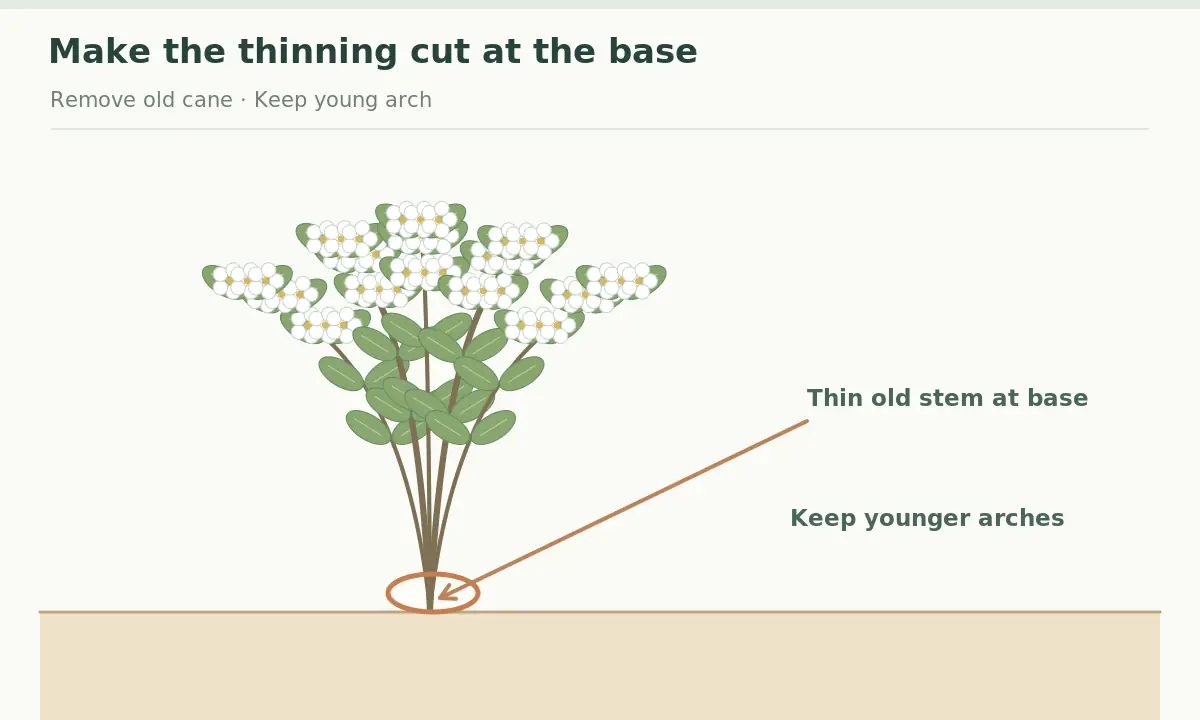
| Garden observation | Practical choice | What not to assume |
|---|---|---|
| Wait Until the Main Floral Display Has Ended | For routine shaping, prune shortly after the flowers fade. | A single schedule applies everywhere |
| Locate the Origin of an Old Cane | An older cane may be thick, dark, crossing through other stems or growing awkwardly into a path. | One diagram fits all specimens |
| Shorten Stray Branches at a Side Shoot | When a branch projects too far into a walkway, follow it back to a healthy outward-facing side shoot that can take over the growing tip. | More aggressive action always works better |
Remove Dead and Crossing Wood First
Dead, diseased or broken branches generally deserve attention before cosmetic shaping. A truly dead twig is brittle and has no live buds or green tissue under a cautious scratch, while a late-leafing live stem may appear bare in early spring. When uncertain, wait for clearer growth. Remove branches rubbing bark from adjacent stems and small dead twigs trapped in the center. Sanitize tools after suspected disease, and dispose of infected material according to local guidance. This selective pass may be enough for a young healthy deutzia. Excessive pruning simply because the shears are available reduces the shrub’s stored energy and flower potential. If you are starting from scratch, read When to Prune Weigela Without Removing Spring Flower Buds.
Shorten Stray Branches at a Side Shoot
When a branch projects too far into a walkway, follow it back to a healthy outward-facing side shoot that can take over the growing tip. Cut just beyond that junction, without leaving a long dead stub or slicing into the retained shoot. This reduction cut differs from topping an entire shrub at one height. Keep the visible line of the canopy irregular and plant-like rather than geometrically flat. If the deutzia was planted too close to a building for its mature dimensions, plan a relocation or appropriate smaller cultivar instead of demanding that constant severe cutting solve a permanent spacing mistake.
Renew a Congested Shrub Gradually
An old clump with many tired canes can sometimes benefit from staged renewal. Remove a few of the oldest weak stems after bloom while keeping substantial healthy young growth. Reassess next season before making another pass. RHS notes that some neglected spring-flowering shrubs, including deutzia, can respond to removing older wood. However, a very weak or drought-stressed plant may recover slowly, and a drastic cut can delay flowering. The safest schedule is shaped by vigor, light, site history and local growing season. A regular modest renewal is easier to manage than an impulsive hard chop. For the basics, see our guide: When to Prune Mock Orange and Which Older Stems to Remove After Bloom.

Protect New Shoots After Pruning
New basal and side shoots are future structure, not automatically suckers to be cut away. Leave well-placed vigorous replacement shoots room to expand. Water deeply when conditions are dry enough to warrant it, check that roots have good drainage, and keep mulch away from direct contact with stems. Avoid applying fertilizer simply to force immediate tall regrowth; soil testing and plant condition should guide feeding. Pruned shrubs exposed abruptly to intense sun or wind may need closer moisture observation. A healthy deutzia recovers by growing foliage through its normal season rather than by immediately replacing every lost flower. For the basics, see our guide: When to Prune Camellias After Bloom Without Removing Next Season’s Buds.
Monitor Buds and Shape the Following Year
Return after leaf-out and note which branches filled gaps, whether the center gets light and where flowers appear the following spring. If new shoots crowd one another, select just the least useful instead of shearing them all. Flowering differences between two seasons may reflect weather, winter damage, shade or prior pruning. Keep a garden photo taken before and after each job; it reveals whether repeated cuts are making the silhouette better or creating a clipped mound. Do not interpret a single weak flowering year as proof that more severe pruning is necessary. Observations are part of good long-term shrub care. For the basics, see our guide: When and How to Prune Glossy Abelia Without Spoiling Its Arching Shape.
Make One Clear Decision Before Cutting
If the shrub has a good shape, prune little beyond dead wood. If a few canes are old or crossing, make low thinning cuts after bloom. If only a branch blocks a path, reduce it neatly to a suitable side shoot. If the entire shrub is far too large, consider staged renovation or a site change. Avoid late-season heavy shearing in hopes of a tidier winter silhouette, as that can cost the next flower display. This choice-based approach makes the pruning goal explicit and matches what Extension sources actually recommend for deutzia. For a step-by-step method, see how to prune common lilacs after flowering and renew old stems.
Related Guides
- When to Prune Rhododendrons After Bloom Without Removing Next Spring’s Buds
- How to Prune Weigela After Flowering Without Losing Next Spring’s Blooms
- When to Prune Azaleas After Bloom Without Losing Next Spring’s Buds
- When to Prune Mock Orange After Bloom Without Losing Next Year’s Flowers
- When to Prune Ninebark Without Losing Next Spring’s Flowers
How We Research and Verify This Guidance
Sources checked on 2026-10-24. We reviewed the following university Extension, governmental or horticultural research guidance for the specific recommendations in this article: extension.uga.edu — Deutzia listed among spring-blooming shrubs to prune after flowering; extension.uga.edu — Deutzia: make thinning cuts after flowering if shaping is necessary; www.rhs.org.uk — RHS spring flowering shrub pruning immediately after bloom; site.extension.uga.edu — Difference between thinning cuts and repeated hedge shearing. The article emphasizes visible plant stages and cultivar or species differences instead of treating hardiness zones as planting calendars. Drawings are intentionally simplified instructional schematics, not scale botanical plates. Adjust actions to local temperature, precipitation, site conditions, plant identity and the instructions provided with seed or plants.
Disclosures, Safety and Regional Differences
This VegWin guide is general gardening education and does not claim a paid endorsement, sponsorship or confirmed affiliate relationship. See the affiliate disclosure. Regional restrictions on plants or pesticides may apply. Check the appropriate local Extension program and current product label when making a high-stakes decision. The article does not recommend unverified pesticide recipes or invented fertilizer rates.
For routine shaping, prune shortly after its spring flowering period finishes in your location.
Necessary deadwood work can be done, but heavy late-winter pruning commonly removes wood carrying the next flower buds.
Usually not. Selective thinning preserves a more natural shape and avoids a thick outer shell with a bare middle.
Follow it to its point of origin and remove it there without injuring surrounding stems or leaving a long stub.
Not necessarily. Recovery and flower production depend on vigor, the amount removed and the time needed to regrow mature flowering wood.