
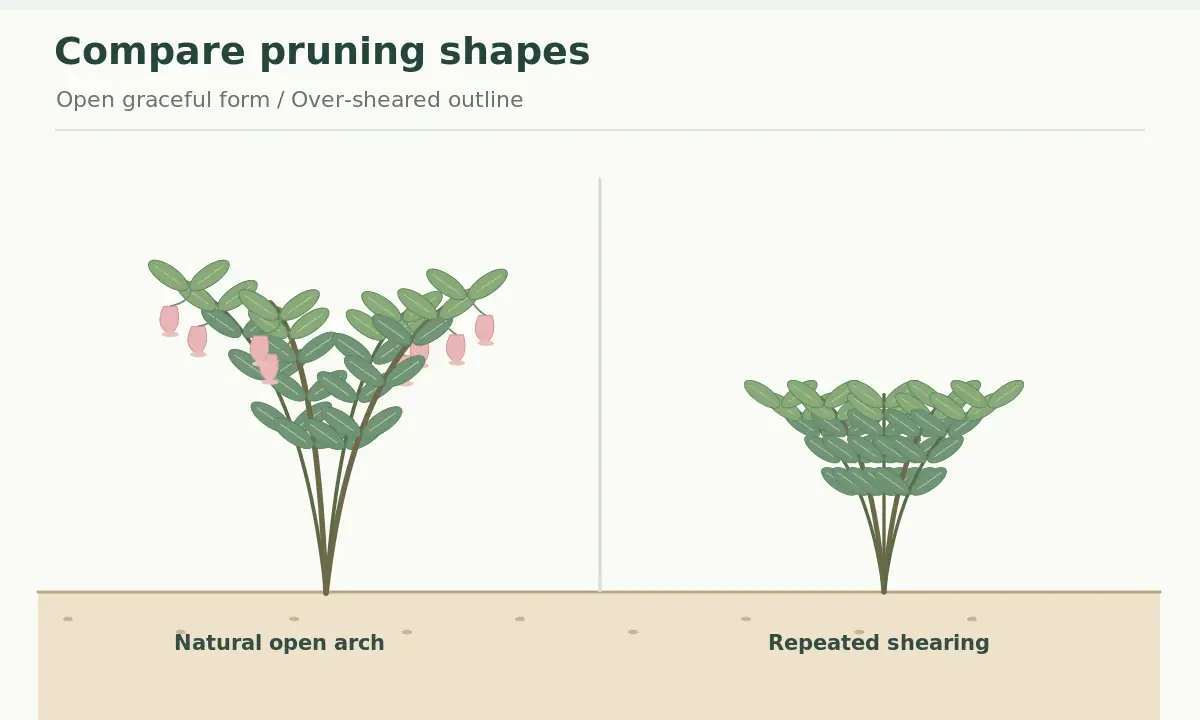
Glossy abelia makes an attractive arching mound when its slender flowering stems are allowed room to grow. The common mistake is treating it like a hedge and clipping every shoot to the same line. That method can leave a dense outer shell and obscure the shrub’s characteristic airy flowers. For established summer-blooming abelias, late winter to early spring before strong new growth is usually the clearest time for structural work. The details depend on your cultivar, climate and the amount of dead wood present. This guide separates thinning at the origin from shortening individual shoots, with diagrams showing where a cut belongs.
Confirm Which Abelia You Have
Many home gardens contain cultivars sold under glossy abelia or older Abelia × grandiflora names; botanic naming may now appear under Linnaea or specific hybrid names. Plant habits vary substantially. A dwarf compact cultivar will not need the same reduction as a wide old shrub arching over a sidewalk. North Carolina State Extension describes hybrid selections including Edward Goucher, which flowers on new growth and forms an arching plant. Look at the label or plant database before choosing a severe pruning plan. Check mature expected width and cold damage first. Do not assume that pruning advice for a spring-blooming relative, such as a bridal-wreath spirea, has the same seasonal logic. If you are starting from scratch, read When to Prune Bridal Wreath Spirea and Keep Its Arching Spring Flowers.
Work Before Strong Spring Shoots Extend
University of Georgia Extension places glossy abelia among summer-flowering shrubs pruned before spring growth. These plants form flowers on new growth rather than overwintered spring-flower buds. In climates with freezing winters, wait until severe cold is largely past so damaged wood is apparent; in frost-free areas, aim for a calm interval before vigorous new shoots. University of Maryland Extension also cautions against unnecessary late-season pruning that stimulates tender growth before winter. Avoid promising one month for every region. The best calendar is the shrub’s growth stage plus local freeze risk, not USDA hardiness zone alone. For the basics, see our guide: When to Prune Smokebush for Purple Foliage or Summer Smoke Flowers.

Inspect the Shrub From Several Angles
Walk around the plant before making a cut. Identify dead stems, broken tips, branches scraping a path, rubbing wood and the oldest thick canes near the base. Mark what creates actual problems; not every branch crossing visually is harmful. Step back to find the natural flowing outline, especially the longer flexible stems that carry flowers outward. If half the plant looks leafless in late winter, remember that some abelias are deciduous or partly evergreen depending on weather. Do not confuse seasonal leaf drop with dead branches. A light scrape test and inspection for flexible live tissue can help if you are unsure. Plan several selective cuts rather than trimming indiscriminately.
Remove Dead or Broken Wood First
Start with unmistakably dead, cracked or diseased branches, working back to sound growth or to their origin. Use sharp clean bypass pruners for small wood and loppers sized for larger canes. Make a clean cut just outside a branch collar where a branch joins a larger stem; do not leave a long stub or cut flush into the trunk. If an abelia suffered freeze dieback, allow enough spring warmth to identify what is truly dead before removing the whole aboveground framework. Discard suspect diseased debris rather than forcing it deep into the crown. This first pass sometimes supplies all the correction an otherwise healthy young abelia needs.

| Observation | Practical next step | Avoid |
|---|---|---|
| Work Before Strong Spring Shoots Extend | University of Georgia Extension places glossy abelia among summer-flowering shrubs pruned before spring growth. | Assuming timing is the same in every climate |
| Remove Dead or Broken Wood First | Start with unmistakably dead, cracked or diseased branches, working back to sound growth or to their origin. | Treating a diagram as a substitute for examining the plant |
| Use Heading Cuts Only for a Clear Reason | A heading cut shortens a shoot to a suitable node or side branch, often promoting branching near the cut. | Repeating an action without monitoring the outcome |
Thin Old Canes at Their Base
To renew an established leggy shrub, selectively remove one or a few of the oldest crowded canes at or near their origin. The illustration shows that thinning opens a path for light through the middle without cutting all outer shoots to one height. Avoid gouging nearby younger stems when getting loppers close to the base. If the plant has many old canes, spread renovation over seasons instead of stripping the structure in a single day. Branch removal stimulates replacement growth, but the speed depends on vigor and sunlight. A modest renewal often preserves flowers and shape better than an abrupt universal haircut. If you are starting from scratch, read When to Prune Shrubby Potentilla and Restore a Natural Mounded Shape.
Use Heading Cuts Only for a Clear Reason
A heading cut shortens a shoot to a suitable node or side branch, often promoting branching near the cut. It may be useful where a branch is blocking steps or sticking awkwardly from the intended form. However, repeated heading all around the plant can generate dense twiggy regrowth at the outside and leave an empty center. If a stem only needs shortening, trace it to an outward-facing live side shoot and cut neatly above that point. Do not leave bare internodal sticks that cannot readily hide behind foliage. The goal is a natural mound of different branch lengths, not a perfectly round green ball unless that is the deliberate hedge design.
Avoid Shearing Away All Flowering Tips
Abelia bears clusters of small tubular blooms on new season growth. Continuous summer shearing can remove developing flowering shoots just when pollinators would benefit from them. A seasonal structural prune before new growth usually creates a clearer balance between fullness and flowering. If you are shaping a formal hedge, accept that flowering display may be reduced by repeated clipping. Remember that some new red-tinged leaf growth is normal for colorful cultivars; do not label every color variation diseased. Watch actual bud and leaf condition. Compared with a loose abelia mound, a clipped hedge needs more frequent management and can develop a dense exterior. If you are starting from scratch, read When to Prune Spirea.
Respond to Cold Damage Conservatively
Some glossy abelias may lose leaves or die back in cold winters. Wait until new basal or branch buds demonstrate where growth is returning. If the tops are brown and brittle but the crown produces fresh shoots, remove only the dead sections to allow replacement stems room. Do not automatically take a healthy cultivar to ground level because it has a few damaged tips. A heavily frozen or neglected plant may require a different rejuvenation plan and sometimes professional assessment. Ask a regional Extension office when you suspect winter injury interacts with drought, drainage or an unfamiliar cultivar. Recovery from freeze injury depends on plant health and microclimate. For the basics, see our guide: When to Prune Boxwood and Why Thinning Beats Constant Shearing.
Keep Tools Clean and Cuts Proportionate
Clean cutting blades before starting and after working with suspected disease. Position hands safely, especially when using saws in thick older wood. Cut only branches you can control without tearing bark below. Stand back after each few cuts and check whether the plant still has a balanced outline. If a pruning session is producing an open bare center with little remaining greenery, stop and reassess. Water normally afterward if soil is dry, but do not apply an invented fertilizer dose simply to force regrowth. A plant’s response to sensible thinning is easiest to evaluate over the next growth season. Record which older canes were removed. If you are starting from scratch, read When to Prune Deutzia After Flowering and Thin Older Canes Correctly.
Check Flowering and Shape Next Summer
As new growth develops, watch whether sunlight reaches inside the shrub, whether replacement shoots fill intended spaces and whether flower clusters appear on current season stems. Keep photographs from the same angle before pruning, just after and in late summer. This simple comparison prevents overreacting to a temporarily sparse winter outline. If a crossing branch returns, choose one well-positioned shoot rather than cutting all of them short. If the abelia remains too large for its location despite careful annual work, transplanting or choosing a smaller cultivar may be a better long-term solution than forcing an unsuitable shrub into a narrow slot. For a step-by-step method, see how to prune weigela after flowering without losing next spring’s blooms.
How We Research and Verify This Guidance
Updated and source-checked on 2026-10-24. We compared the specific horticultural question with the following university or Extension guidance: extension.uga.edu — Abelia blooms on new growth and suggested pruning before spring growth; extension.umd.edu — Summer flowering shrubs including abelia pruned in winter or early spring, and fall pruning cautions; plants.ces.ncsu.edu — Cultivar plant habit and flowering on new wood. This article separates observed plant development from local timing; seed lot, species, soil conditions and growing region can alter results. Diagram labels are simplified to teach the relevant decision, rather than reproduce any particular cultivar as a photographic specimen. Always verify current local pesticide labels and restrictions where relevant.
Disclosures, Sources and Regional Limitations
VegWin provides educational gardening information, not site-specific diagnosis. No sponsorship, product endorsement or confirmed commission-based partnership is claimed in this guide. Read the affiliate disclosure. The source links in the research section support the underlying horticultural claims; any cultivar instructions, soil test results, local freeze date or pesticide registration take precedence over a general illustration. Readers should consult local Cooperative Extension for a plant that appears infected, invasive, regulated or unsafe.
Yes. University of Georgia lists glossy abelia among summer-flowering plants normally pruned before spring growth.
Many glossy abelia cultivars flower on new seasonal growth, unlike typical spring-flowering shrubs.
Not for a natural arch. Selective thinning from the base usually maintains a more graceful silhouette than all-over shearing.
Wait for safe spring conditions and check for living buds or basal shoots before assuming the whole plant is dead.
Avoid major pruning late in a cold-climate season because tender regrowth may be damaged by winter temperatures.