
If you prune weigela at the wrong time, the shrub may remain healthy but produce disappointingly few flowers. That is because most of the dramatic spring display comes from buds carried on growth made during the previous season. Many modern weigelas can produce scattered later flowers on new growth, so neither “never prune in spring” nor “cut it down every year” captures the whole picture. The practical goal is to identify which stems actually need removal, work near the end of the main bloom when shaping is needed, and preserve enough healthy leafy wood to support the next season. A neglected mature shrub calls for a different plan than a compact plant that fits its space.
Start With How Weigela Produces Its Flowers
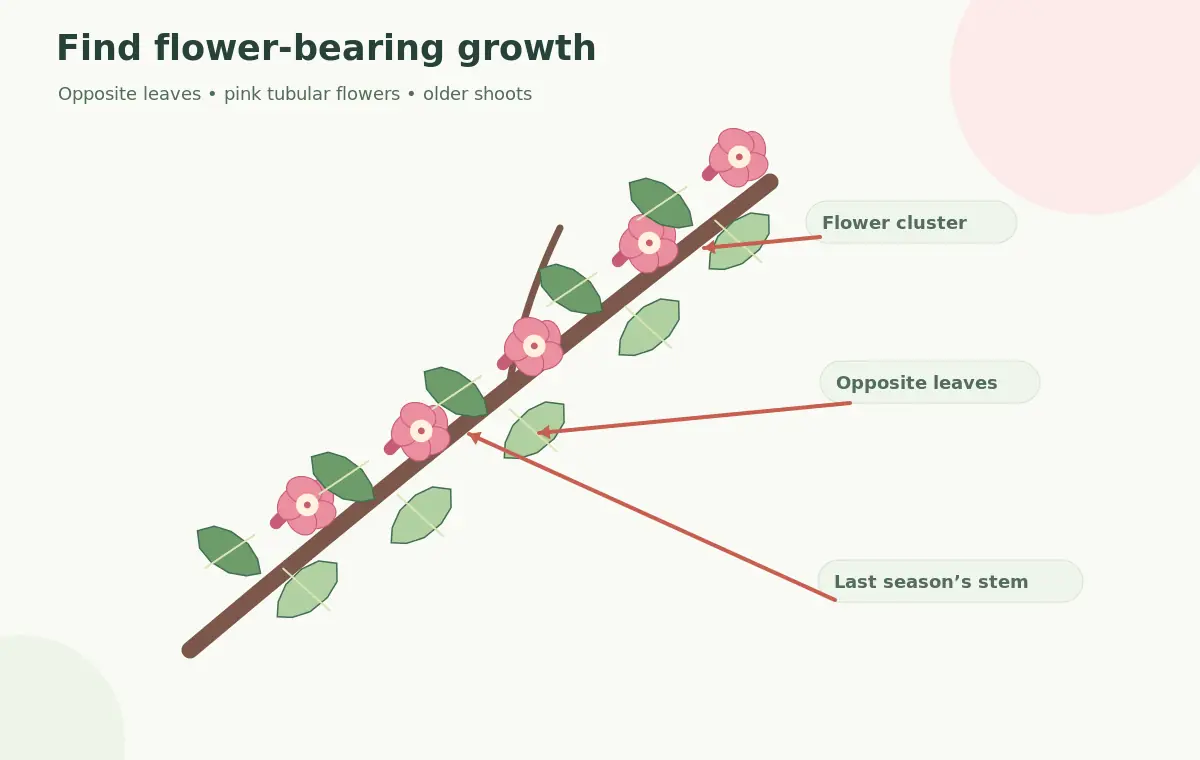
Weigela florida and garden cultivars make their principal late-spring floral show on older, previous-season stems. Some plants also flower intermittently on the current season’s shoots. Iowa State University Extension explicitly notes both behaviors, while North Carolina Extension describes the traditional spring flowering on old wood. That distinction matters: cutting every branch short in late fall removes part of the wood carrying next spring’s buds, even though the shrub can still push fresh leaves. A repeat-blooming label is not permission for indiscriminate shearing. Inspect how your actual cultivar behaves through a season, and aim to keep an arching framework with light reaching its interior. Flowers do not need to be the sole reason to retain crowded, broken stems.
Choose a Pruning Window by the Job
For a normal established weigela, the simplest window for light shape correction is immediately after the main spring flush fades. This preserves much of the opportunity for new stems to mature and form the following year’s display. Dead or obviously broken wood can be removed when seen; winter-injured branches become easier to distinguish when leaf buds start to expand. University guidance also describes selective removal of oldest stems during late winter or early spring, accepting fewer flowers on those particular stems. Avoid routine late-summer or fall shaping in climates with cold winters: it can remove developing buds and may promote late tender growth. Use flowering and growth stage rather than a fixed calendar date across states.
Recognize the Stems Worth Removing First
Stand back before cutting. On a mature, multi-stemmed weigela, mark dead, damaged, rubbing, and inward-growing canes. Older canes may be relatively thick, barky, and sparsely leafy compared with younger vigorous shoots. Choose a few large old stems for removal at or near their point of origin instead of shortening every tip to the same height. If most flowers appear only at the outside edge, this selective opening can admit light and encourage renewal growth. Do not remove live new shoots merely because they are longer than the rest: they can form next year’s blooming structure. A dwarf cultivar may need little or no pruning beyond occasional deadwood removal.
Make Clean Cuts at the Right Junction
Use sharp hand pruners for small stems and appropriate loppers or a pruning saw for larger wood. For a branch being shortened, cut immediately above a living bud or lateral branch that points toward the shape you want; avoid leaving a long dead stub. For complete removal of an older cane, cut close to its natural point of attachment without gouging the adjacent crown or trunk tissue. If a branch is too large to control safely, do not force it with hand pruners. Clean tools between visibly diseased plants and dispose of infected wood as local Extension guidance recommends. Heading dozens of shoots at arbitrary heights produces a dense outer shell rather than the open natural fountain form of many weigelas.
Reduce an Overgrown Shrub Over Several Seasons
Where a weigela is too large or woody, spread renewal across years rather than assuming an aggressive haircut is harmless. Virginia Tech recommends removing about one-third of the oldest wood after flowering; this maintains living stems while admitting fresh replacement growth. Mark and remove a limited number of the oldest canes low, then evaluate the shape. Repeat in a later year if necessary. Complete rejuvenation cutting is sometimes possible for vigorous neglected shrubs but sacrifices flowers temporarily and can fail on severely stressed plants. Check for rotten crown tissue, poor drainage, drought, or winter damage first. If you only need two inches of clearance along a path, selective lateral cuts are usually preferable to wholesale rejuvenation. For a step-by-step method, see how to prune Russian sage in spring without cutting off new growth.
Handle Repeat-Blooming and Dwarf Cultivars Carefully
Named rebloomers can set flowers on both older and newer growth, but the heaviest bloom still may be in spring. After the first flower show, remove individual awkward shoots only where they interfere with the outline; avoid treating the plant like a frequently clipped boxwood hedge. Some compact cultivars naturally stay dense and need no shaping at all. If new shoots carry flower buds in summer, leave them where practical. When a shrub crowds a window every year despite selective pruning, its mature size may be incompatible with the site. Consider relocating it during an appropriate planting season rather than repeated severe shearing, and check the exact cultivar description before assuming a mature height. For the basics, see our guide: When to Prune Boxwood and Why Thinning Beats Constant Shearing.

Separate Deadwood From Dormant Living Stems
A leafless late-winter shoot is not necessarily dead. Look for swelling buds as weather warms and lightly scratch a suspect spot to check for living green tissue beneath the bark; this is an aid, not absolute proof for every stem. Damage can be concentrated at tips while lower sections remain alive. Work back gradually to healthy tissue instead of cutting everything at soil level. Frost injury varies with winter exposure, cultivar, and local conditions. If uncertain, let growth begin and recheck. Do not seal normal small pruning cuts with paint: routine wound dressing is not recommended in general pruning guidance. Prioritize correcting the reason branches died, such as repeated deer damage or poor drainage, over simply cutting away evidence.
Avoid Three Habits That Cost Flowers
First, resist shearing the entire plant after buds have formed for the next year: this cuts across many flowering shoots at once. Second, do not force weigela into a tight geometric ball without considering its natural arching structure; dense peripheral foliage can shade out the interior. Third, do not perform major renovation just before a forecast of severe drought or extreme temperature. Healthy recovery requires roots, foliage, and adequate moisture. If the shrub is mostly healthy and flowering, pruning is optional, not an annual requirement. A measured no-cut season is a reasonable choice when you do not yet know which branches are flowering or when a recent planting is still establishing. For a step-by-step method, see how to prune weigela after flowering without losing next spring’s blooms.
Evaluate the Plant After Pruning
Take a photograph from the same angle before and after you work. You should still see a balanced shrub with living leafy stems and some interior space, not a pile of identical short stubs. Water established plants during extended dry conditions according to soil moisture, and avoid a large untested fertilizer application designed to “force recovery.” Watch where vigorous new shoots originate and note which carry flowers next season. If flowering remains weak, investigate light exposure, winter bud injury, cultivar traits, and pruning history. A shrub in heavy shade may not bloom well even if every cut is expertly made. Record the actual month of your local main bloom so next year’s decisions are based on observations.

Use a Simple Decision Before Each Cut
Ask whether the branch is dead, crossing, too old, or merely tall. Dead or crossing wood usually has a clear purpose for removal. A few large old canes can be selected for renewal when a mature shrub is congested. A long healthy arch can often remain, especially just before flowering. For a busy gardener, the lowest-risk routine is to inspect once in spring, correct damage, and shape lightly after flowers fade only if needed. Always reconcile the plan with the size of the shrub and the climate in which it grows. There is no universal annual “cut back by half” rule for all weigelas. For the basics, see our guide: When to Prune Shrubby Potentilla and Restore a Natural Mounded Shape.
Related Guides
- How to Prune Flowering Quince After Bloom Without Losing Next Year’s Flowers
- When to Prune Deutzia After Flowering and Thin Older Canes Correctly
- When to Prune Japanese Pieris Without Losing Next Spring’s Flowers
- When to Prune Pyracantha Without Losing Spring Flowers or Winter Berries
- When to Prune Mock Orange After Bloom Without Losing Next Year’s Flowers
How We Research and Check Recommendations
Research checked October 23, 2026. This guide combines plant-specific Cooperative Extension advice with institutional guidance on propagation, pruning, crop handling, or integrated pest management as applicable. Where institutions describe different methods or regional calendars, we identify the difference instead of presenting one schedule as universal. Recommendations are educational, not a substitute for plant diagnosis, product labels, or locally applicable rules.
Institutional sources reviewed: Iowa State University Extension (weigela spring bloom on old growth and intermittent bloom on new growth; pruning options); North Carolina Extension Plant Toolbox (flower morphology, natural habit, and postbloom pruning timing); Virginia Tech Extension (established shrub renewal and removal of old stems after flowering). This article is not sponsored; no product endorsement or confirmed affiliate relationship is claimed. See the VegWin affiliate disclosure for site-wide information.
It is usually a poor time for routine shaping because you may remove buds intended for the major spring bloom. Remove hazardous broken wood when necessary.
Some vigorous mature plants can resprout after rejuvenation, but this is stressful and forfeits flowers for a period. Gradual one-third renewal is safer for many established shrubs.
The main spring show is on older wood, while many plants produce some later flowers on new growth. Cultivar performance varies.
Check pruning date, full or partial shade, winter bud damage, and plant maturity before adding fertilizer.
Individual deadheading is not essential for most shrubs. Light pruning after the main bloom can be used when you actually need shape control.