
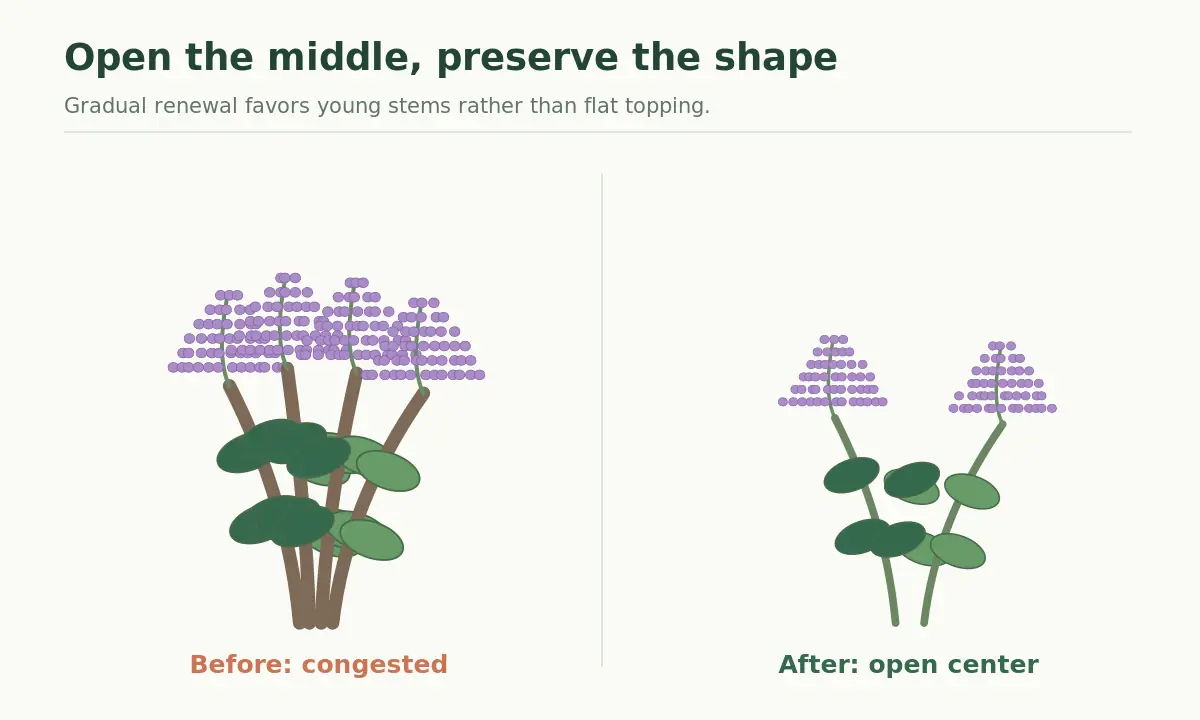
A large common lilac can keep growing leaves while carrying fewer flower clusters on shaded, aging canes. Fixing that problem takes more than cutting the top flat. You need to distinguish optional deadheading from thinning cuts at the base, protect buds for next spring, and retain enough young growth to replace old stems. The diagrams below show which wood to remove and which to preserve.
Prune After Flowers Fade to Protect New Buds
Common lilac (Syringa vulgaris) flowers mostly from buds formed on shoots during the previous growing season. Once spring flowering ends, a relatively short window remains for shaping without removing as much next year’s bloom potential. Minnesota Extension recommends pruning right after bloom. A late-summer or winter haircut can take off already-formed flower buds even when the shrub otherwise looks healthy. Timing varies with weather and cultivar, so use flower fade rather than a fixed calendar date. If the shrub is old and badly overgrown, dormant-season structural renovation is possible, but expect a deliberate tradeoff with the upcoming flower show. If you are starting from scratch, read When to Prune Lilacs Without Cutting Off Next Spring’s Flowers.
Separate Deadheading From True Renovation
Removing spent flower clusters tidies a lilac but does not create an entirely new framework. Cut an exhausted flower head just above a healthy pair of leaves or a suitable lateral shoot, without shortening the entire flowering branch dramatically. Maine Extension notes that deadheading may not significantly increase the following year’s bloom; do it for appearance and modest energy allocation, not as a guaranteed flower-boosting technique. Renovation, in contrast, means removing large declining stems at their origin to make room for younger canes. Use different tools and goals for these two jobs. Label them mentally before beginning so small cosmetic cuts do not become uncontrolled heavy shearing.

Find Old Thick Canes at the Base
Step back from the shrub and locate the thick, barky, crowded stems that cast shade through the center. A mature common lilac often includes several generations of canes rather than a single permanent trunk. Identify dead, rubbing or damaged growth first, then the largest, least productive old stems. Look for young healthy stems that could eventually replace them. The goal is a more open, naturally shaped stand, not a perfect hollow circle. Take a photograph before pruning so you can compare the distribution of remaining canes. Check the base for obstacles, nearby irrigation and nesting wildlife before putting a saw into dense growth.
Make Thinning Cuts Without Leaving Stubs
Use clean bypass pruners on fine twigs, loppers on smaller woody stems, and a suitable pruning saw on heavy canes. For renewal, cut selected old stems near the ground or their point of origin without tearing into adjacent young canes. Do not leave tall stubs that will crowd the center with awkward shoots. A heading cut shortens a branch partway along it; it is not the preferred basic technique for opening a mature lilac. Maine Extension specifically favors thinning cuts where a stem meets another stem or the base. Remove brush as you work so you can see the next safe cut, then reassess the shrub’s balance.
Renew an Overgrown Shrub Across Several Years
Minnesota Extension suggests removing roughly one-third of the thickest oldest stems annually for gradual renewal. This is a ceiling-style planning concept, not an instruction to remove one-third of every healthy branch no matter the plant’s condition. A weak lilac may need lighter work and improved care before additional cutting. A gradual program keeps some flowering wood while allowing light to reach newer stems. Complete hard rejuvenation by cutting a lilac low can cause one or more seasons of few flowers; it should not be disguised as routine deadheading. The most important check is whether well-positioned young stems remain capable of replacing the removed wood.
| What you find | Best cut | Main consequence |
|---|---|---|
| Spent flower head | Snip just above leaves | Tidier outline |
| Old thick shaded cane | Thinning cut at base | Space for newer stems |
| Healthy flowering branch | Usually retain | Preserves bloom potential |
| Hazardous broken wood | Remove promptly | Reduces immediate damage |

Handle Broken Branches and Disease Sensibly
Dead, broken or dangerously rubbing branches deserve attention when noticed, not only during the ideal bloom window. Use sound pruning hygiene, especially if disease symptoms appear. Powdery mildew on lilac leaves is common and does not automatically call for aggressive branch removal; first identify the condition and improve spacing and plant care. If large stems show severe dieback, unusual cankers, or borers, seek local Extension diagnostic advice rather than treating every dark patch as a pest. Avoid cutting foliage when wet if disease spread is a concern. Disinfect tools when moving between clearly diseased plants, following an Extension-approved sanitation procedure appropriate for the pathogen.
Keep the Natural Arch Rather Than Shearing
A healthy common lilac is a multi-stemmed shrub with an irregular outline. Mechanical shearing into a flat-topped box may produce dense outer foliage that shades out older interior stems, and it often removes developing flower buds. If a branch crosses a walkway, trace it to a strong lateral junction or origin and remove it purposefully. Do not keep heading every tall cane at precisely the same height. That produces an artificial hedge shape and can weaken the visual flowering structure. If a mature cultivar is simply too tall for its site, consider whether a smaller lilac cultivar is a better long-term choice rather than annual severe topping.
Distinguish Suckers From Useful Replacement Canes
Common lilacs often send new stems up near the crown. On an own-root shrub, selected vigorous basal growth can become the next generation of flowering wood. On a grafted lilac, shoots originating below the graft may belong to a different rootstock and should be assessed differently. Never remove every young shoot simply because it appears near the soil: you may be cutting away the replacement framework required for renewal. Conversely, allowing every weak twig to stay creates a thicket. Locate the graft union if present, identify strong well-placed shoots and thin spindly extras. When uncertain about a grafted tree-form lilac, obtain species-specific guidance first. For the basics, see our guide: When to Prune Red-twig Dogwood for Brighter Winter Stems.
Follow Up With Light, Water, and Patience
Pruning is only one part of producing flowers. Minnesota Extension notes that established lilacs benefit from substantial direct sun and that too much nitrogen can promote foliage at the expense of blooms. Check surrounding shade before blaming every sparse flower display on pruning. Keep roots mulched but not buried against stems, and water appropriately during unusually dry establishment or stress periods. Do not apply heavy fertilizer without a soil test. After renewal, expect young canes to spend time developing before carrying abundant flowers. Keep annual photographs of new canes and bloom distribution; the progress across seasons is more informative than whether the shrub looks temporarily smaller after its first renovation.
Check Next Year’s Flowering Wood
Before putting tools away, walk around the plant and identify remaining buds and young shoots on the outside and inside. There should be enough well-positioned stems to intercept sunlight, and airflow should be better through previously congested sections. Never conclude that all remaining flower buds are safe if pruning was done late in the season; use the correct timing in future years. If substantial flowering wood has already been lost, resist the temptation to apply high-nitrogen products to compensate. Monitor recovery through the next growing period and prune more selectively next time. A thoughtfully renewed lilac may look less perfect immediately, but will have a healthier structural path forward.
Related Guides
- When to Prune Rhododendrons After Bloom Without Removing Next Spring’s Buds
- When to Prune Bridal Wreath Spirea and Keep Its Arching Spring Flowers
- When to Prune Deutzia After Flowering and Thin Older Canes Correctly
- When to Prune Japanese Pieris Without Losing Next Spring’s Flowers
- When to Prune Pyracantha Without Losing Spring Flowers or Winter Berries
How We Research and Check These Recommendations
This guide was reviewed on 2026-10-24 against horticultural guidance from University of Minnesota Extension; University of Maine Extension; Maine lilac pruning Q&A. We compare the advice with the precise crop, flowering habit, or pest life stage rather than copying a generic garden calendar. Timing and performance depend on region, season, cultivar, and plant condition; consult local Cooperative Extension for unusual disease or weather problems. This article is educational, not a substitute for product labels or local rules.
Sources, Transparency, and Practical Limitations
Source URLs and the claim each supports are recorded in the article metadata and linked above. We did not conduct a controlled trial in your garden, and no specific harvest yield, germination percentage or treatment success is guaranteed. VegWin does not claim a sponsorship or commission for the techniques mentioned here. See our affiliate disclosure for site-wide details.
You can remove dead or hazardous wood, but pruning healthy flowering shoots in winter commonly sacrifices spring buds.
It is optional for appearance; evidence for strongly increasing next year’s flowers is limited.
A common renewal plan removes about one-third of the oldest heavy stems per year, adjusted for plant vigor.
Some lilacs can regrow, but drastic rejuvenation may eliminate flowers for one or more seasons and is not routine pruning.
Shade, young stems, excess nitrogen and pruning at the wrong time can all contribute; investigate rather than guess.