
“Bee balm” is a common name covering several Monarda species, not a promise that every seed packet should be treated identically. Wild bergamot (Monarda fistulosa), scarlet bee balm (M. didyma), lemon bee balm (M. citriodora), and regional native species differ in life cycle and seed handling. A USDA plant-materials guide describes moist chilling for its collected bee balm seed, while commercial propagation instructions for some Monarda types use straightforward shallow sowing. Begin with the botanical name and specific seed lot instructions. This guide explains how to choose between ordinary indoor sowing, outdoor winter exposure and justified cold treatment without burying tiny seed or keeping propagation trays constantly soggy.
Find the Botanical Name on the Packet
Read the small print before soaking, chilling or sowing anything. Monarda fistulosa is often sold as wild bergamot, M. didyma as scarlet bee balm, and M. citriodora as lemon bee balm. Different seed suppliers may describe different dormancy behavior even within a species, owing to seed origin and handling. A named garden hybrid may not grow true from seed. Do not assume that seed from a bright red cultivar will produce an identical clone; division or cuttings are better choices for preserving an exact selected plant. Write the botanical name, source and date on every tray label to keep germination experiments interpretable. Our walkthrough on how to grow catmint from seed without confusing sterile hybrid cultivars sets out each step.
Check Whether Moist Chilling Is Actually Needed
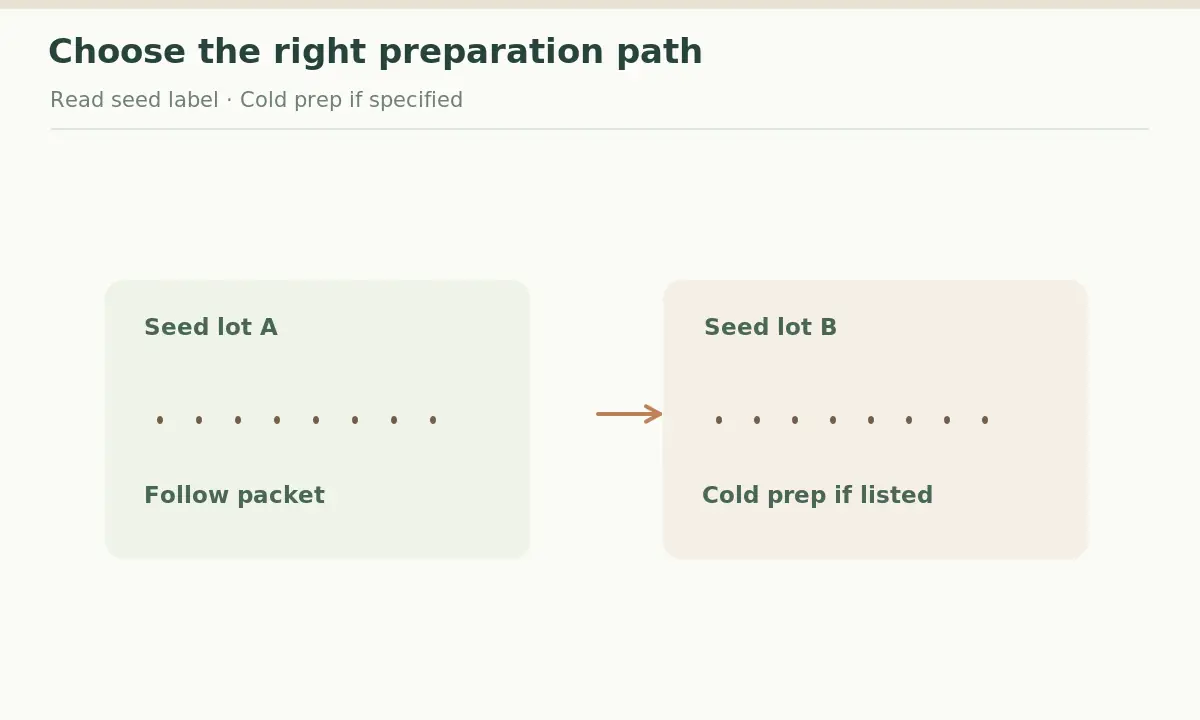
USDA NRCS describes cold-moist stratification for its bee balm material before spring sowing. That is a valid procedure for that seed source, not evidence that every commercial Monarda seed packet needs three months in a refrigerator. Some seed suppliers list no special treatment for their cultivated lots. If your packet explicitly requests stratification, follow its stated duration and method. If it does not, do not automatically create a cold-treatment requirement; consider testing a small sample under ordinary conditions and contacting the supplier. Dry storage in a fridge and moist stratification are different processes, so read directions carefully.

Plan Around Local Frost and Transplant Conditions
Many perennial bee balms can be started inside before outdoor planting weather is reliably suitable, then hardened off. The number of weeks depends on species, growing conditions and seed-company guidance rather than USDA hardiness zone alone. Monarda citriodora may be grown as an annual in many gardens, while other Monarda species persist as perennials where adapted. Choose an outdoor planting window after dangerous frost conditions for vulnerable young transplants, or plan a suitable protected seedbed. Where winters offer reliable cool conditions, outdoor winter sowing may provide natural chilling for lots that need it. Protect seed trays from rodents, pounding rain and drying winds. For a step-by-step method, see how to start lupines from seed without damaging their young taproots.
Prepare Fine Mix and Reliable Drainage
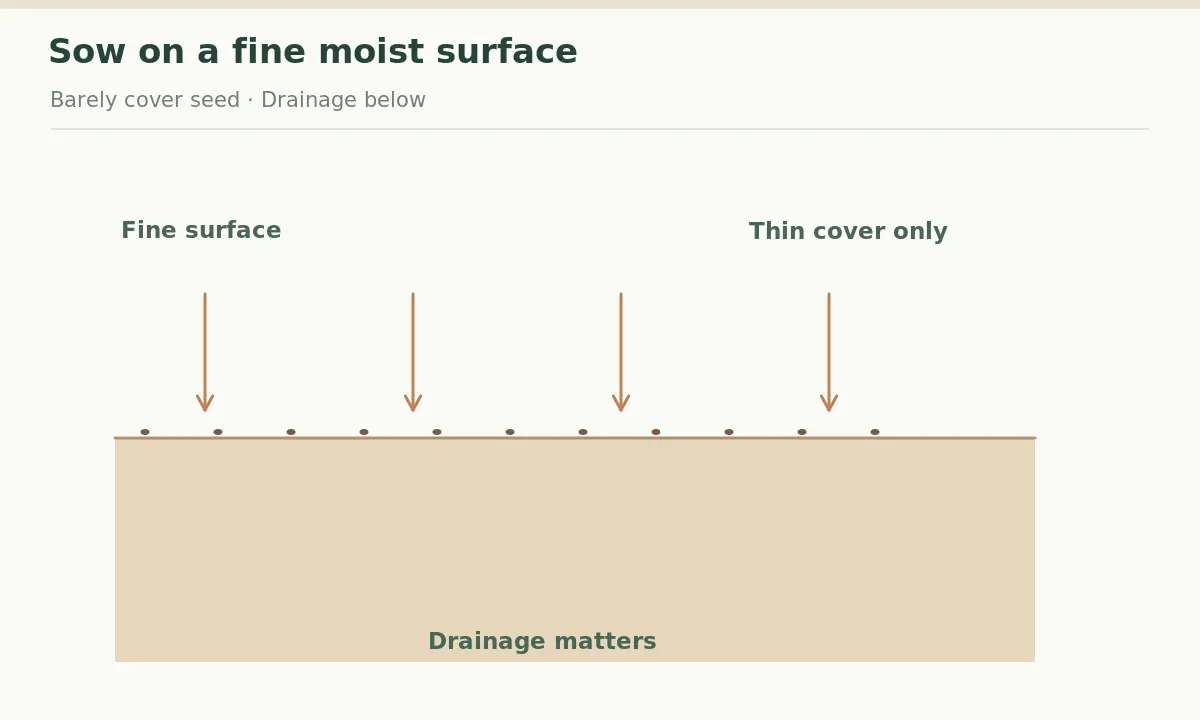
Tiny Monarda seedlings are vulnerable when seed-starting mix stays saturated. Use a clean container with drainage holes and a fine, premoistened seed-starting medium. Break up large lumps at the surface so small seeds do not fall deep into cracks. Set the tray over a catch pan only long enough to water and drain; do not park it in standing water. Reused containers should be cleaned before filling, especially if past seedlings collapsed from damping-off. You do not need a high-nitrogen fertilizer at the sowing stage. The job is to provide modest moisture, air in the root zone and a stable place for a small root to begin. Our guide “Start Echinacea Seeds With Cold Treatment and Avoid Moldy Seed Trays” covers a related question.
| Garden observation | Practical choice | What not to assume |
|---|---|---|
| Check Whether Moist Chilling Is Actually Needed | USDA NRCS describes cold-moist stratification for its bee balm material before spring sowing. | A single schedule applies everywhere |
| Prepare Fine Mix and Reliable Drainage | Tiny Monarda seedlings are vulnerable when seed-starting mix stays saturated. | One diagram fits all specimens |
| Keep Germination Moist but Not Waterlogged | The surface should not crust hard or become bone dry during germination, yet saturated mix can rot seed and promote damping-off. | More aggressive action always works better |
Sow Shallowly and Provide Suitable Light
Sprinkle seeds sparingly over the smooth, moist medium rather than dumping an entire packet into one cell. Commercial Monarda propagation directions recommend barely covering or covering lightly, and Extension advice also identifies adequate light as important for bee balm germination. Do not place tiny seed several inches underground. A very thin layer of fine medium, if the seed instructions recommend it, is different from packing a thick soil cap over the tray. Press gently for seed-to-medium contact, label the cells, and water with a fine spray or from below so the seed remains in place. Bright light after emergence is essential to prevent stretching.
Keep Germination Moist but Not Waterlogged
The surface should not crust hard or become bone dry during germination, yet saturated mix can rot seed and promote damping-off. Check the surface and container weight daily rather than spraying automatically on a timer. If a clear humidity cover is used, vent it as condensation builds and remove it promptly once seedlings emerge. Put trays in a suitably warm, bright area following the temperatures on the seed packet; excessive bottom heat is not a substitute for light. A barely visible green thread can become a sturdy seedling only when its roots receive oxygen. Slow germination is not permission to keep increasing the water.
Thin Seedlings When True Leaves Appear
A first pair of seed leaves is not the same as the later true leaves. Once seedlings make recognizable paired true leaves, gently thin extras or pot on the strongest plants using care around the fragile roots. Hold seedlings by a leaf rather than squeezing a soft stem; lift with a small dibber and a little surrounding mix. Avoid crowding several plants into a tiny cell until they become pale and spindly. The aim is a compact rooted transplant, not the tallest possible top. If a seedling falls over at the soil line and develops a pinched dark stem, remove it and review moisture, sanitation and air circulation.
Harden Off Without Scorching the Foliage
Indoor-grown Monarda leaves are not immediately adapted to unfiltered sun and outdoor wind. Gradually increase protected outdoor exposure as weather permits over several days, adjusting to real temperature and sunlight. Bring trays back to safety during cold snaps, severe gusts or hard rain. Transplant when the root ball holds together but roots are not densely circling, at approximately the same depth the seedling grew in its cell. Firm gently around the roots and water the planting hole without leaving a puddle. These steps matter more than rushing to meet a generalized planting-date chart written for another state. If you want the full process, read how to grow bee balm in containers without crowding the roots.
Give Plants Space for Air Movement
Mature bee balm can develop powdery mildew when foliage is crowded, stressed or humid. Plan spacing by the actual species and mature habit, not by a universal number on an unrelated seed packet. Place plants where they get appropriate sunlight and air movement; support even root-zone moisture and avoid continuous wet foliage where leaf disease is common. Some Monarda species spread by underground shoots, while annual types behave differently. Choose a location appropriate to the species and check regional ecological guidance before introducing spreading species near sensitive habitat. Monitor seedling health instead of expecting any cultivar to be completely free from mildew. Our walkthrough on how to start black-eyed Susan seeds and avoid germination mistakes sets out each step.
Track Results Instead of Declaring Seed Failure Too Soon
Record the seed source, botanical name, sowing date, whether you applied cold treatment, and the first appearance of seedlings. A tray can fail for several reasons: old seed, drying, excessive burial, unsuitable temperature or wet rot. If two treatments are uncertain, split a small packet into labeled tests rather than mixing them into one batch. Note which seedlings look vigorous weeks later as well as which germinated first. This prevents an anecdote from becoming a universal rule for Monarda. For a valued named cultivar, consider established plants or vegetative division rather than relying on unpredictable seed offspring.
Related Guides
- How to Save Bee Balm Seeds From Dry Monarda Heads Without Losing Them
- When to Divide Bee Balm and Replant Rooted Rhizome Sections
- How to Prevent Powdery Mildew on Bee Balm Without Guesswork
How We Research and Verify This Guidance
Sources checked on 2026-10-24. We reviewed the following university Extension, governmental or horticultural research guidance for the specific recommendations in this article: www.nrcs.usda.gov — USDA bee balm seed collection and cold-moist stratification method for the material described; www.johnnyseeds.com — Monarda fistulosa indoor sowing and light cover, transplant handling; www.johnnyseeds.com — Monarda didyma and citriodora germination guidance and species-specific care; ask.extension.org — Extension advice on light and warmth for bee balm seed germination. The article emphasizes visible plant stages and cultivar or species differences instead of treating hardiness zones as planting calendars. Drawings are intentionally simplified instructional schematics, not scale botanical plates. Adjust actions to local temperature, precipitation, site conditions, plant identity and the instructions provided with seed or plants.
Disclosures, Safety and Regional Differences
This VegWin guide is general gardening education and does not claim a paid endorsement, sponsorship or confirmed affiliate relationship. See the affiliate disclosure. Regional restrictions on plants or pesticides may apply. Check the appropriate local Extension program and current product label when making a high-stakes decision. The article does not recommend unverified pesticide recipes or invented fertilizer rates.
No universal rule applies. Some Monarda sources specify cold-moist treatment; others provide ordinary shallow-sowing instructions. Follow the botanical species and seed lot.
No. Tiny Monarda seed is usually sown on or very near the surface with only a light covering, according to packet directions.
Not reliably. Seedlings from selected cultivars may differ from the parent; use vegetative propagation when a named cultivar must remain identical.
Damping-off or other root problems may be involved. Remove affected seedlings and check sanitation, drainage, airflow and watering.
Yes, for suitable species and local conditions. An appropriate outdoor seedbed or winter sowing can expose seed to natural seasonal conditions.