
Small insects under tomato leaves are not all the same, and a curled leaf is not proof that you need to spray. Aphids are sap-feeding insects that can form colonies on growing tips and leaf undersides. Their sticky honeydew and shed white skins may be noticed before the insects themselves. Natural enemies can also be present in the same patch. The purpose of this guide is to help you confirm a live aphid problem, judge what it is doing to the tomato plant and choose observation or integrated pest management (IPM) before reaching for a product. It is narrower than VegWin’s broader tomato hornworm and blight guides.
Confirm You Are Seeing Aphids on Tomatoes
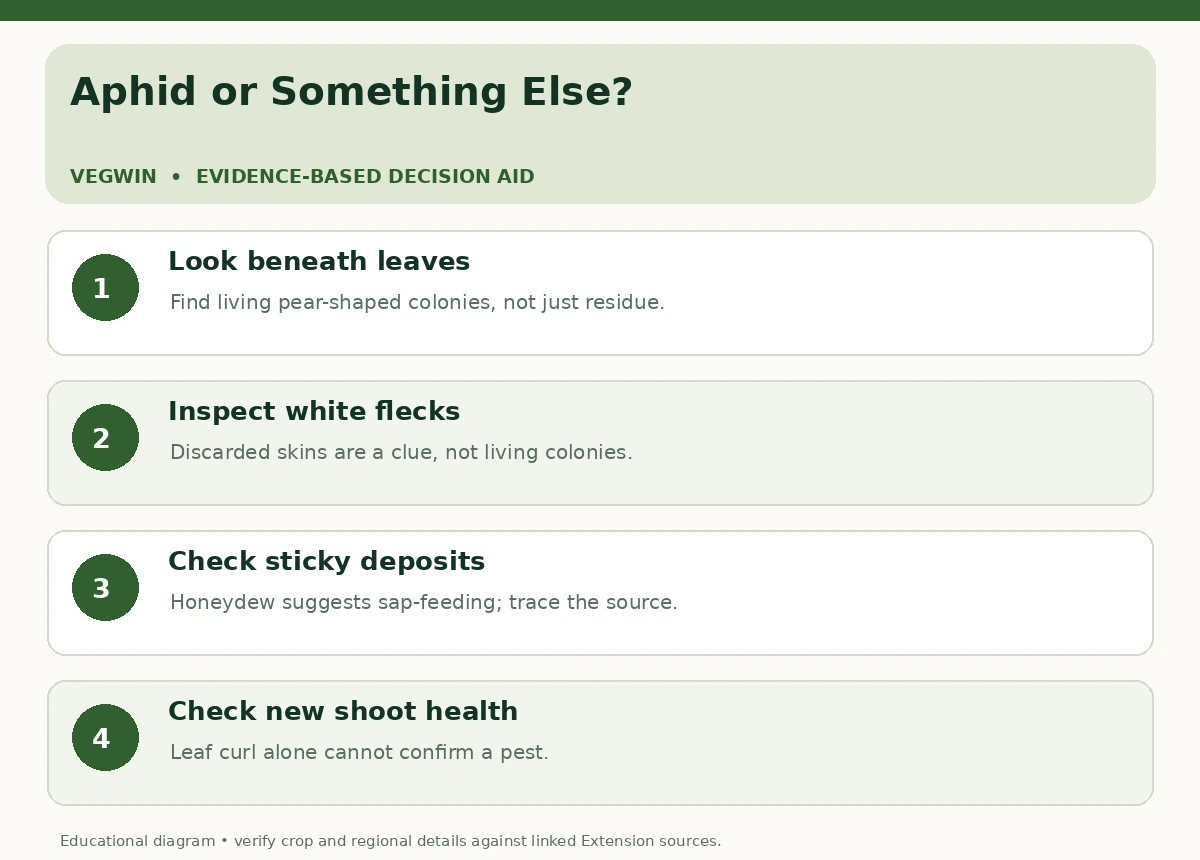
Inspect the youngest growth and leaf undersides with a hand lens. The University of Connecticut’s tomato aphid resource describes small pear-shaped insects that may be green, black, yellowish or mottled, sometimes with two short cornicle structures near the rear. Winged adults may appear when colonies move between hosts. White papery particles can be shed skins, not necessarily dead insects or a fungal disease. Identify living insects before deciding that every residue is evidence of a growing infestation. For the fuller picture, see our guide “Tomato Leaf Curl”.
Record whether you see just a few aphids on one growing tip or multiple dense colonies distributed around the plant. Do not diagnose from the color alone: tomato plants can host more than one aphid species, and other tiny arthropods share some visual features. Compare your observations with close-up photographs from a recognized Extension source. If the plant shows severe or atypical symptoms, submit photos or a sample to local Extension rather than inventing a species identification.
Read Honeydew, Curling, and Leaf Symptoms Carefully
University of Connecticut reports aphid feeding may accompany leaf curling, yellowing, distorted shoots and sticky honeydew. Honeydew can support dark sooty growth, but neither black deposits nor curl alone proves aphids are the sole cause. Tomatoes may also curl leaves because of environmental conditions or other problems. Look for active colonies on the same shoots showing change. Note whether the newest tips are growing normally and whether fruiting continues. Our walkthrough on how to identify cabbage aphids on kale and manage colonies sets out each step.
Ant activity can signal a honeydew source, but ants alone are not a diagnosis. Heavy outbreaks sometimes interfere with new growth, and some aphids can transmit plant viruses; how important that risk is depends on region, aphid species, virus and plant health. Do not promise that every aphid sighting will cause disease or reduce harvest. Photograph the same cluster at successive checks so a declining population is not mistaken for an escalating one because shed skins remain behind.
Count Beneficial Insects Before Controlling Aphids
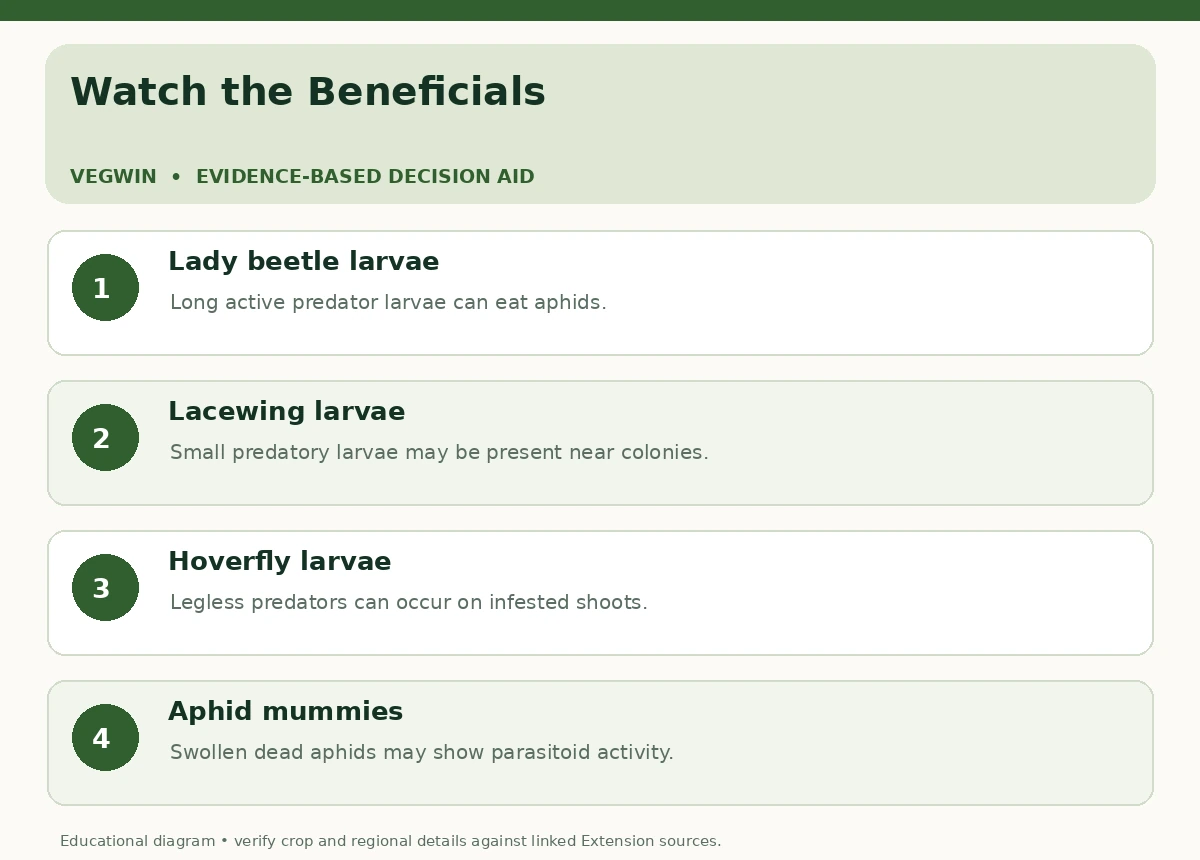
UC IPM documents predators and parasitoids that naturally feed on or develop in aphids, including lady beetles, lacewing larvae, hoverfly larvae, parasitic wasps and naturally infected aphids. A swollen, hardened aphid mummy may indicate parasitoid activity. Look carefully before removing insects, as some helpful larvae look unfamiliar and are mistaken for pests. Beneficial insects are not a guaranteed instant cure, but their activity should influence whether an aggressive intervention is warranted.
The presence of ants, honeydew and predators forms a more useful field picture than aphid count alone. Avoid broad-spectrum insecticides simply because a few aphids appeared; such products may also harm beneficial organisms. Encourage habitat that supports natural enemies where local recommendations permit, while avoiding unproven claims that a neighboring herb reliably repels tomato aphids. Recheck the population over time and consider both visible crop damage and natural-enemy activity.
Start With Nonchemical and Preventive Actions
For a small localized colony on a sturdy garden plant, a careful stream of water may dislodge some aphids without resorting to pesticides, provided it does not break tender tips or saturate disease-prone foliage. Repeat observation afterward rather than declaring the colony eradicated. Remove nearby weed hosts where appropriate, avoid unnecessary high nitrogen feeding and maintain enough plant access to examine new growth. The University of Connecticut emphasizes cultural practices and biological controls in its IPM guidance. Our guide to whiteflies on vegetables adds more detail on this.
A heavily infested tender tip may need crop-specific advice. Hand removal of a small portion of badly affected foliage can be practical in some situations but should not mean stripping the tomato of all young leaves. If an aphid colony continues to increase with significant damage, consult local Extension for locally registered options and thresholds. No universal pesticide mix, homemade soap concentration or treatment interval belongs in an all-region guide. Legally approved labels take precedence over an online suggestion.
Use a Scouting Table Instead of a Spray Rule
Start a simple log with columns for date, affected leaves, density trend, ant activity, honeydew, predators and visible growth damage. The key decision is whether the aphid population is increasing while the plant declines, or whether a small colony is stable and natural enemies are active. Different production environments have different risk profiles, so do not borrow a greenhouse treatment threshold for every backyard tomato. Scouting is especially valuable on growth tips that change rapidly.
If an insect is unidentified, label the observation “unknown sap-feeder” rather than confidently recording aphids. Check both surfaces of a leaf and note any damage to nearby crops. If leaf curling persists after aphids disappear, investigate other tomato disorders instead of spraying repeatedly. Treating symptoms without identifying the cause wastes time and can injure helpful insects. A dated before-and-after photo is a stronger record than simply saying that the plant “looked better.” For a step-by-step method, see how to identify whiteflies on tomatoes and reduce their damage.
| Field observation | Why it matters | Next step |
|---|---|---|
| Few aphids, predators present | Natural control may be active | Mark stems and scout again |
| Many aphids, distorted new leaves | Feeding may be significant | Check trend; consult local IPM advice |
| Sticky honeydew, no live aphids | Residue may persist after decline | Search nearby growth for current colonies |
| Winged insects, yellow leaves | Multiple causes remain possible | Confirm species and inspect whole plant |
Escalate Only With Identification and Label Checks
If action beyond cultural measures is warranted, use the current local Extension recommendation and verify any pesticide is registered for tomatoes, the target pest and your location. Read and follow the entire EPA-regulated product label, including protective equipment, application timing and preharvest interval where relevant. Products are not interchangeable because they share a broad category name. Do not combine treatments, add household ingredients or assume an “organic” label means harmless to bees or predators. If that is your next decision, our guide “Spider Mites on Tomato Plants” explains how to confirm the pest before taking action.
The article gives no rate or branded product recommendation because regional approval, product formulation and crop stage are material. If plants have severe virus-like symptoms, contact a plant diagnostic service; killing visible aphids cannot reverse an established systemic infection. Preserve beneficial insects where possible and avoid applications when bees or other non-target species could be exposed contrary to label precautions. The safest course is identification, observation, prevention and only then a justified intervention.

Inspect Again and Document What Changed
Reinspect the same marked stems after taking a nonchemical step. Count live aphids rather than relying on old skins or sticky residue that remains after the colony shrinks. Note the number of live beneficial insects and whether fresh leaves are growing normally. If populations stay low and foliage recovers, continued monitoring may be enough. If the colony spreads, bring your observations to the local Extension office, which can interpret regional pests, weather and current regulations. Our walkthrough on how to identify aphids on roses and control them without harming Allies sets out each step.
This topic is purposefully separate from tomato blight, a disease-identification article, and tomato hornworm, a chewing-caterpillar article. Aphids puncture and suck plant sap, leave honeydew and can be tended by ants; their field clues and natural enemies differ from the other tomato threats. That distinction makes this page useful without a sweeping “tomato pests” treatment list.
Related Guides
- Growing Tomatoes: A Step-by-Step Plan from Transplant to Harvest
- How to Identify Leaffooted Bugs on Tomatoes and Protect Developing Fruit
- How to Identify Stink Bug Feeding Spots on Tomatoes Without Guessing
- How to Identify Aphids on Pepper Shoots and Protect Beneficial Insects
- Tomato Blight Symptoms: Tell Early Blight From Late Blight First
How We Research and Maintain This Guide
We checked the linked sources on October 19, 2026. Claims below are tied to specific university Extension or National Center for Home Food Preservation guidance, not to invented trials, a product endorsement, or universal regional conditions. These original graphics are simplified decision aids, not diagnostic photographs. The site owner should check local Extension recommendations, crop identity, packaging instructions and WordPress overlap before manually publishing. Tomato IPM and pesticide registration depend on region and product; this Stage 1 article intentionally makes no pesticide rate or universal treatment claim.
Evidence and further reading: [1] University of Connecticut IPM 2026 [2] University of California IPM [3] University of Connecticut IPM
All three buttons lead to independent educational sources and are not paid recommendations. We checked sources including affiliate disclosure.
Look for small pear-shaped sap feeders on tender shoots and leaf undersides, often with paired cornicles. Check Extension images when uncertain.
No. Leaf curling has multiple causes. Confirm an active colony and consider weather, watering and other disorders.
Not automatically. Check colony size, plant injury and predator activity before deciding any control is necessary.
Lady beetle larvae commonly consume aphids and are useful natural enemies. Learn their appearance before removing insects.
First confirm the pest and need for treatment. If escalation is justified, obtain current crop-specific local Extension guidance and follow the exact registered product label.