
Russian sage grows long silver-green stems and airy blue-violet flower spikes from a woody base. In winter, those stems can look completely dead even when the plant is alive. The reliable spring-pruning cue is not the first warm afternoon but the appearance of fresh shoots near the crown or low on the old stems. This article shows how to recognize Salvia yangii, formerly called Perovskia atriplicifolia, where to place your cuts, and why pruning it like an evergreen culinary sage or a spring-blooming shrub can produce poor results.
Confirm That the Plant Really Is Russian Sage
Russian sage is Salvia yangii, a woody-based perennial subshrub previously sold as Perovskia atriplicifolia. It has an open upright habit, finely divided silvery-gray aromatic foliage and many tiny blue-violet flowers held in branched spikes. The stems are more rigid than those of many soft herbaceous perennials, and the base can remain woody through winter. It is not the same plant as culinary garden sage, Salvia officinalis, which retains a different evergreen woody framework, or lavender, with a different pattern of live and old stems. Identifying the plant first prevents copying pruning advice for the wrong salvia. Check its plant label when the dormant clump is hard to recognize.
Leave Winter Stems Until New Growth Is Clear
The old flower stalks provide a useful map of the crown and may add winter texture. RHS recommends leaving the stems of Russian sage through winter and pruning them back to a low framework in spring. Where winters are severe, holding off also prevents an unnecessary early cut before you can see which shoots survived. Wait until fresh little leaves or green buds appear on low stems or around the base; the exact month changes with climate and seasonal weather. It is better to follow visible growth than insist on one national date. Avoid pulling hard on an apparently dead clump, which may dislodge the living crown.

Locate the Live Shoots Before Marking Cuts
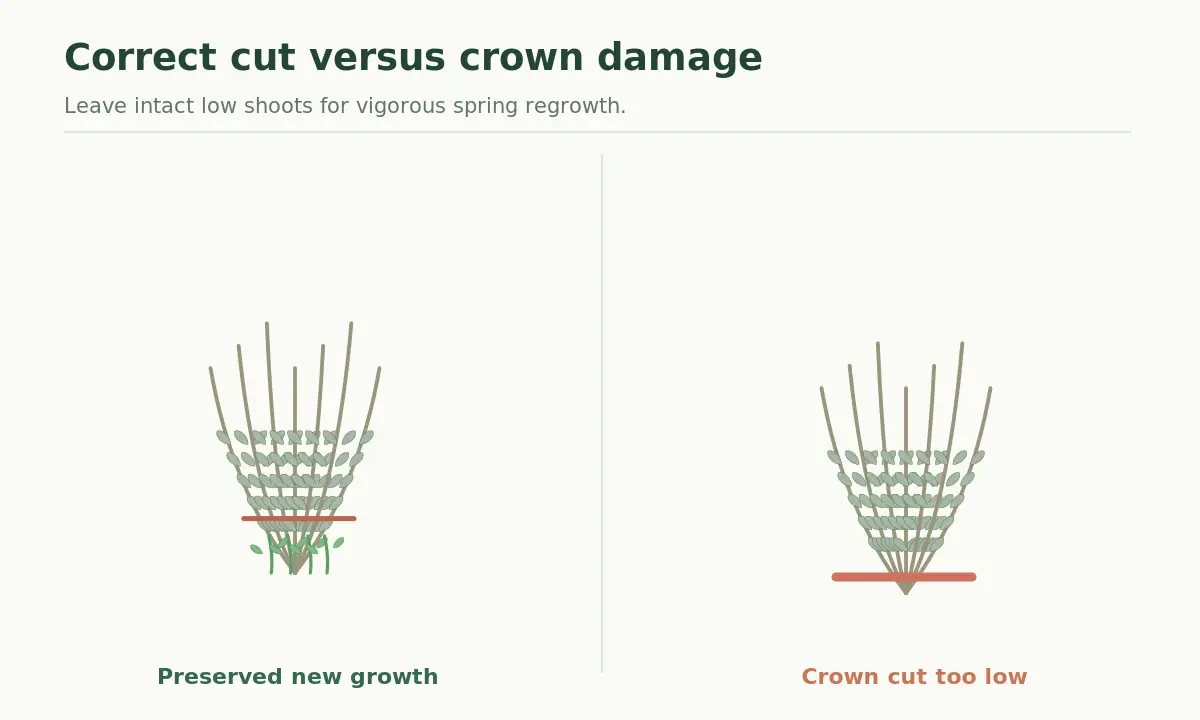
Bend aside the old, tan stems and look for small silvery-green leaf clusters or green shoots just above soil level. They are the positions you want to preserve. The RHS gives a typical low framework of about two to four inches, but the most useful diagram instruction is to cut above the surviving shoots, not through them. On a healthy clump, new growth may appear at slightly different heights along different stems. You need not create a perfectly level hedge if that would remove living buds. If the entire crown still looks dormant, inspect again after a suitable warming period rather than automatically shearing into uncertain tissue.
Cut Each Old Stem Just Above a Low Shoot
Use clean sharp bypass pruners for individual stems or appropriate hand loppers for especially woody ones. Position the blade a short distance above the selected healthy shoot so that the emerging leaf pair is not crushed. Remove the brittle upper portion in manageable pieces. North Carolina State Extension confirms that stems are usually cut to several inches above the ground early in spring to encourage the season’s growth. The important distinction is between lowering last year’s stems and excavating or severing the woody crown itself. Do not drive blades beneath soil level. Branches that are alive only at the base can still produce new growth after their upper portions are removed.
Remove Broken or Dead Sections Without Overcutting
Dry stems that snap cleanly and show no growth above the living lower framework can be shortened during the main spring pruning. If a shoot is damaged but has healthy growth beneath it, trim back to that lower point. Do not decide by color alone that every gray stem is lifeless; weathered bark and silver foliage are ordinary features of the plant. A scratch test on a thicker stem may help but is less useful than clearly visible new shoots. Avoid raking aggressively around the crown. Where pruning reveals rot or a loose, mushy base, check soil drainage and whether the plant has suffered winter wetness before assuming more pruning will solve it.
| Visible condition | What it means | Next step |
|---|---|---|
| Green shoots near base | Active regrowth | Cut above them |
| Old dry stems, no obvious green | Possibly still dormant | Inspect again as spring progresses |
| Soft rotten crown | Possible site stress | Assess drainage before pruning further |

Do Not Treat It Like Lavender or Spring-Flowering Shrubs
Russian sage flowers on the season’s new shoots. That is why a low spring cut can encourage a compact framework without sacrificing preformed spring-flower buds. This does not make severe spring pruning safe for every woody plant. A lilac, for example, develops buds on older wood and is generally pruned after flowering; lavender requires a more cautious approach to old wood. Russian sage is also not a culinary leaf harvest crop. Teach and practice the correct plant-specific cut rather than memorizing a generalized rule such as cut all shrubs nearly to the ground. The low-cut recommendation assumes the plant is healthy and established.
Avoid Crowding, Shade, and Wet Soil After Pruning
NCSU describes Russian sage as a sun-loving plant that prefers sharply drained soil and relatively dry conditions once established. A spring-pruned plant may quickly make fresh stems if light and drainage are suitable. Deep shade often leads to stretched, floppy growth, while constantly wet soil may damage roots or crowns. After pruning, clear away a heavy layer of plant debris pressing against the base, but do not damage emerging shoots. Water a recently established or newly moved plant as needed; avoid automatic daily irrigation for a mature drought-tolerant clump. Fertilizer is not a substitute for adequate sun and drainage, and a specific dose requires a soil or local recommendation.
Know When a Fall Cut Is an Optional Choice
Some gardeners shorten rangy Russian sage in fall to prevent stems from sprawling or blowing around. North Carolina State notes that a fall reduction can be used for oversized plants, while RHS favors leaving stems until spring. These approaches are not identical prescriptions: in cold climates, leaving winter stems can be the more cautious default. A fall trim should not be mistaken for the main precision cut above live spring buds. If you choose a tidying cut, leave enough structure to find the crown and complete the final shaping only when growth resumes. In marginal sites, consult your local Extension guidance about winter protection and survival.
Judge Regrowth Over Weeks Rather Than Days
Spring emergence may be uneven, with new shoots along one side appearing before another. Once correctly cut, Russian sage can produce numerous vigorous shoots from the low framework and flower later in the growing season. Do not immediately remove the whole plant because some old stems remain empty during cool weather. Watch whether fresh growth expands as the soil warms, then prune any obviously dead remnants. If the center is entirely lifeless while the margins sprout, mark those live points for assessment and improve site conditions. Repeated drastic cuts will not compensate for wet roots, insufficient sun or planting too deeply.
Finish With a Safe Low-Framework Checklist
Identify Russian sage, locate several live low shoots, choose a mild workable day, and disinfect tools if you have been cutting diseased plants. Protect your eyes and hands from brittle branches; hold each old stem before severing it just above the selected shoot. Gather the debris without burying the crown. Step back and confirm that the new buds remain visible and that no stem is torn below its attachment. Recheck after active growth begins and remove isolated dead stems. The drawing compares the correct cut just above new leaves with an overly low cut through the crown; the latter is not part of standard Russian sage care.
How We Research and Verify This Guidance
Checked on 2026-10-24, this guide combines botanical and garden-specific recommendations from Royal Horticultural Society; North Carolina State Extension; University of Minnesota Extension Master Gardener response. We compared their supported claims with the named plant or pest and avoided turning region-specific seasons into universal dates. These are simplified teaching illustrations, not photographs or product labels. Consult your county Extension office where climate, cultivar, regulation or site drainage changes the best decision.
Sources, Disclosure, and Local Considerations
Each source and its factual scope are recorded in the article metadata and linked above. We did not run a site-specific cultivation trial, promise a particular outcome, or claim a paid sponsorship. See the site-wide affiliate disclosure. These instructions concern Salvia yangii, not evergreen culinary sages or lavender; adjust timing to observed local spring growth.
It is now classified as Salvia yangii, previously Perovskia atriplicifolia, but is not the same plant as culinary sage.
Often to a low two- to four-inch framework, but always place cuts above surviving spring shoots rather than through them.
Optional tidying is possible, but leaving stems over winter and doing the main shaping in spring is a sound default.
Russian sage generally flowers on new-season growth, so timely spring pruning does not remove stored spring flower buds.
Allow appropriate warming time and check drainage and crown condition before deciding the plant has died.