
A boxwood hedge that looks like a smooth green wall may hide an increasingly bare interior. Repeatedly clipping every visible tip encourages a dense outer shell, while light and air reach fewer inner leaves. That matters not only for appearance but for disease pressure when foliage remains wet. Thinning selected branches back into the plant is a different operation from shearing the outer surface into a sharper rectangle.
University of Maryland Extension favors thinning boxwood over routine aggressive shearing and gives a winter dormant-season window for that work in its regional advice. University of Minnesota Extension describes general healthy-branch pruning principles. Use these sources together, then adjust for local winter severity, species or cultivar and the actual problem. A plant with brown leaves does not always need to be cut back immediately; first find out why those leaves changed.
Identify the purpose before touching the hedge
Decide whether you are correcting a blocked path, thinning a dense interior, repairing broken stems or shaping a formal topiary. Each calls for a different cut. A hedge that is still healthy and within its allotted space may need only minor selective work. Cutting because the calendar says ‘pruning day’ can remove functioning foliage without improving structure. First inspect the plant from both ends and from above, looking for dark, crowded areas and stems rubbing together.
Part the outer foliage gently to see where stems attach. A healthy green exterior over an empty brown center suggests that surface-only shearing has not maintained useful interior leaves. If the shrub is severely declining, record which side is affected and whether the damage coincides with winter exposure, saturated roots or a pest. Treat diagnosis as an important part of pruning rather than as a separate optional job.
Match the timing to the climate and condition
Maryland Extension recommends dormant-season thinning of boxwood, describing winter as suitable for their region. But a calendar month in Maryland is not a safe universal instruction for every northern or high-elevation planting. Local Extension can advise whether extreme cold or late-season new growth changes the preferred timing. Work on a dry day with suitable conditions; avoid severe pruning just before stressful weather when the plant has little chance to recover.
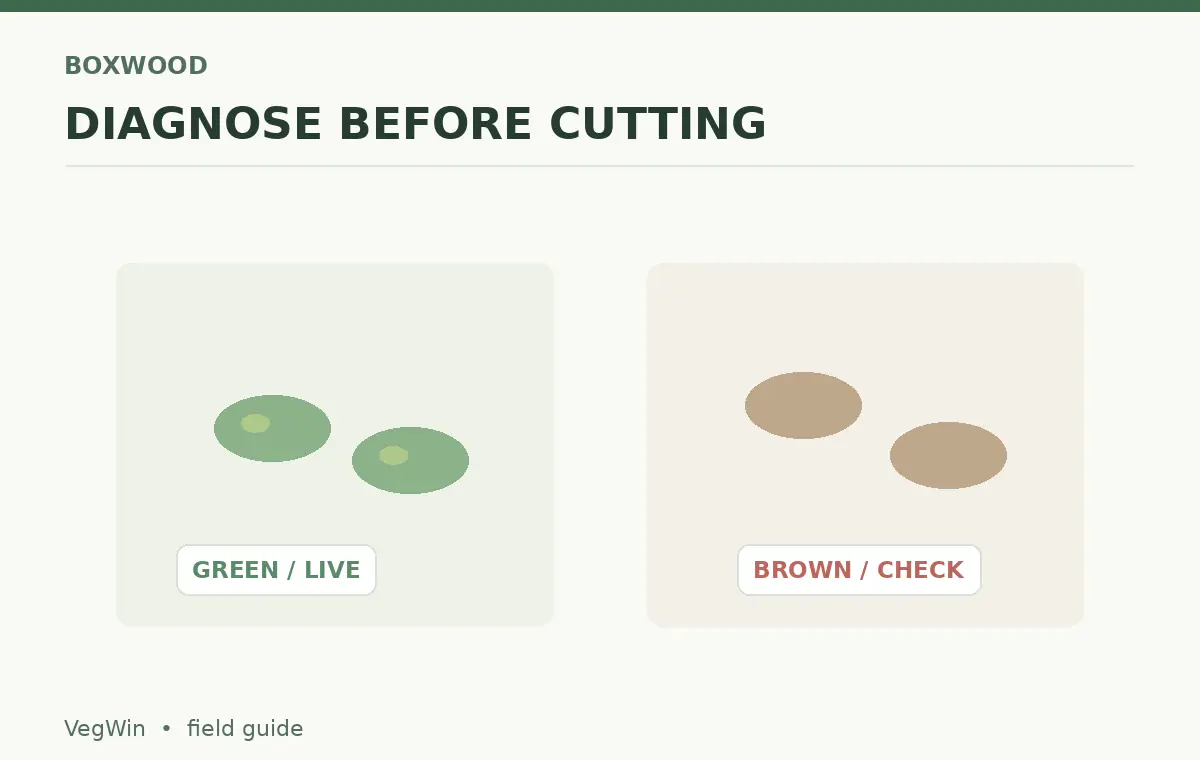
Dead or broken wood may require attention for safety or plant health outside the ideal aesthetic window. Keep that distinction clear: correcting a hazardous branch is not a license to reshape the entire shrub during drought or freezing wind. If a boxwood has fresh bronze or brown foliage after winter, wait where safe until you can determine whether twigs and buds remain alive before removing all the damaged-looking outer growth.
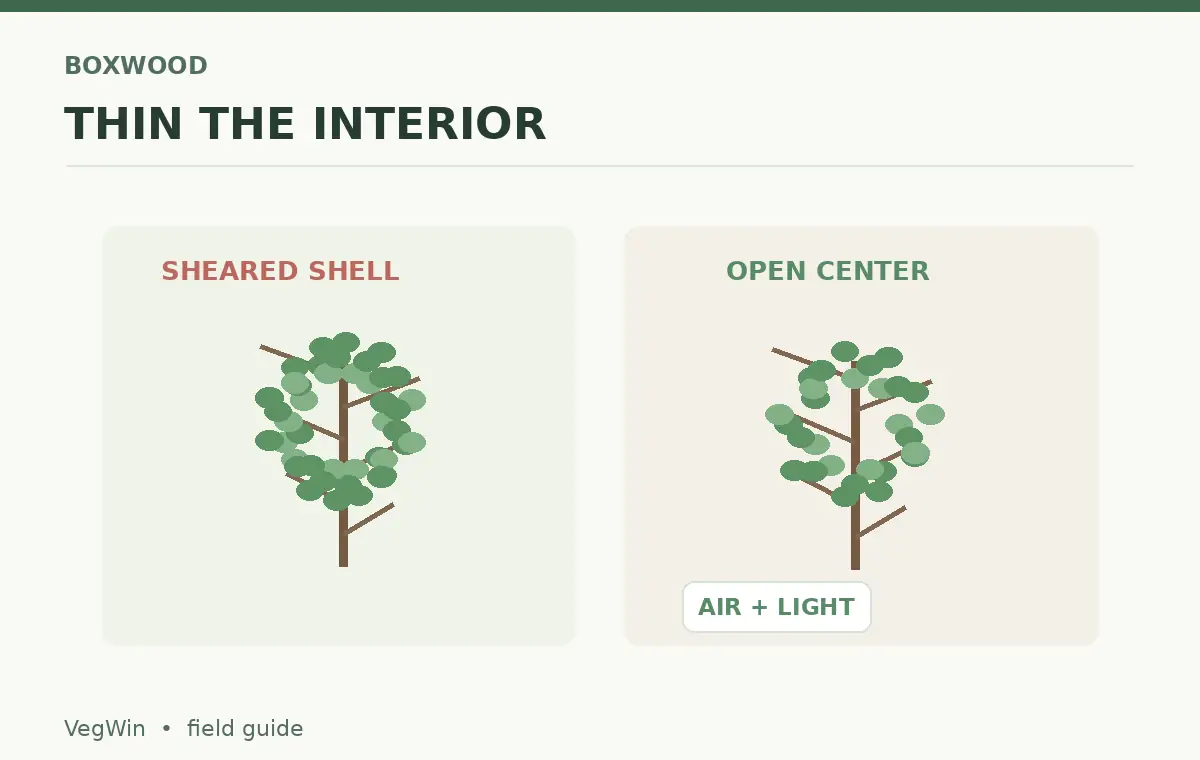
Remove selected whole shoots to let light in
Locate a stem that crowds the interior and trace it back to a sensible point of attachment. Make a clean selective cut rather than clipping only the last inch of dozens of shoots. Repeat sparingly across the plant to create channels for light and air. University of Maryland explains that a boxwood should have foliage along more of its branch length, rather than just a dense shell. The exact number of shoots to remove depends on plant size and condition.
Step back repeatedly so you do not create a large hole in one face while leaving the rest untouched. Begin conservatively; a cut stem cannot be instantly restored. When a branch rubs another, decide which of the two supports the intended form and remove the less suitable one. Keep tools sharp enough to make a clean cut without crushing stems. Clean tools between suspect disease sites to reduce the chance of carrying debris through the entire row.
Reserve shearing for defined ornamental shapes
A topiary or tightly defined hedge sometimes needs limited surface shaping, but that is not the same as maintaining a biologically healthy branching structure. University of Maryland warns that repeatedly sheared boxwood tends to produce dense outer growth associated with leaf and stem disease issues. For a hedge that must keep a formal outline, combine restraint with periodic selective interior thinning rather than simply clipping every green tip whenever a new flush appears.
A plant grown for a more natural rounded form may require little or no repeated shearing. Consider the space available as it matures: a boxwood selected for a narrow walkway may become a perpetual pruning problem if its natural size is much larger than the location. Redesigning the bed or replacing an unsuitable plant can be preferable to removing major amounts of growth each year.

Do not confuse winter burn with infectious dieback
Brown boxwood foliage can follow cold wind and winter sun, but fungal disease, root stress, drought and insect injury can also produce discoloration. University of Maryland details several different boxwood problems whose symptoms overlap superficially. Look for distribution, branch survival and accompanying signs instead of naming a disease from a single tan leaf. A pinkish spore structure in moist conditions, for instance, leads to a different investigation than uniformly bronzed foliage after winter exposure.
Photograph suspect stems and leaf undersides, including a wider view that shows whether only the outer south-facing side is affected. If diagnosis is uncertain, ask your local Extension or plant diagnostic laboratory. Do not prescribe fungicide just because leaves are brown. Where disease is confirmed, remove affected material under appropriate dry conditions and follow current local disposal advice; do not shred or compost clearly diseased clippings beside healthy stock.
Avoid stressing shallow roots while pruning
Boxwood roots can be shallow and vulnerable to cultivation injury. Do not dig aggressively around the base merely to reach a branch from a convenient angle. University of Maryland advises a light mulch layer kept away from the trunk rather than deep piles against the stems. Check soil moisture and drainage while inspecting the plant because pruning cannot cure drowned roots or a prolonged dry root zone.
Refrain from routine high-nitrogen feeding to force new leaves after a heavy trim. A soil test may identify a real nutrient problem, but weak growth can also reflect light, water and root health. Give the shrub a chance to recover in appropriate growing conditions. Where a compact formal hedge is essential, choose a cultivar and spacing matched to the site from the beginning; good design reduces constant corrective cutting.
Record the change instead of repeating heavy cuts
Before and after a small thinning, take photographs from the same angle with the plant’s interior gently parted. Over the growing season, look for renewed leaves farther along branches and quicker drying after rain. Compare any disease symptoms with the previous year. If the shrub looks thin immediately after pruning, that is not proof of failure; the intended benefit is healthier interior structure, not perfect instant fullness.
Reevaluate after a growing season before making another major round of cuts. If the hedge still has an empty center, avoid attempting to solve it by more frequent surface shearing. If the plant continues to decline, pursue diagnosis of water, root and disease issues. The decision is to prune for a purpose, cut selectively and monitor what changes, rather than to keep cutting because new foliage has appeared.
A practical decision table for your garden
| Situation | Preferred response | What to avoid |
|---|---|---|
| Healthy but crowded inside | Thin selected stems | Shearing only outer surface |
| A few dead broken branches | Remove to sound attachment | Cutting all healthy growth |
| Tan leaves after winter | Assess branch survival and exposure | Assuming every case is fungus |
| Widespread unexplained dieback | Seek diagnosis | Unverified pesticide treatment |
How We Research and Verify This Guide
This guide was prepared using the university Cooperative Extension and other plant-science references linked below, reviewed on October 22, 2026. This is not a full text-by-text cannibalization audit of every historical page, and site-specific conditions always need local Extension confirmation. The diagrams are simplified educational drawings, not photographs or measured diagnostic illustrations. No affiliate approval has been independently verified; review our affiliate disclosure.
Source notes (checked October 22, 2026): extension.umd.edu — Maryland Extension favors thinning to increase light and airflow and cautions against frequent shearing. extension.umn.edu — Minnesota Extension describes dormant-season pruning and health-based removal of dead, damaged or crossing wood. extension.umd.edu — Maryland Extension explains thinning and removing disease-affected branches when foliage is dry.
Dormant-season thinning is commonly advised, but use local Extension for your winter climate.
Formal topiaries may need shaping; excessive surface shearing can cause overly dense outer foliage.
First determine whether branches are alive and what caused the discoloration.
Make selective cuts to a sound attachment and proceed conservatively rather than cutting the whole hedge hard.
Not by itself. Improve light penetration and diagnose actual soil or root problems before feeding.