
Seeing tomato leaves curl is a symptom report, not a diagnosis. Older leaves rolled into a firm green tube under summer stress can be a largely harmless physiological response. Narrow, twisted new growth, mosaic-like color patterns, stunting or visible sap-feeding pests point toward very different questions. Treating all of these as “leaf curl disease” wastes time and may damage plants further. This guide starts with which leaves changed, the direction and texture of curling, and what else changed around the plant. It complements VegWin’s tomato blight and aphid guides; neither a brown leaf spot nor a colony of aphids is automatically the cause of every curled leaf.
Start With Leaf Age and Curl Shape
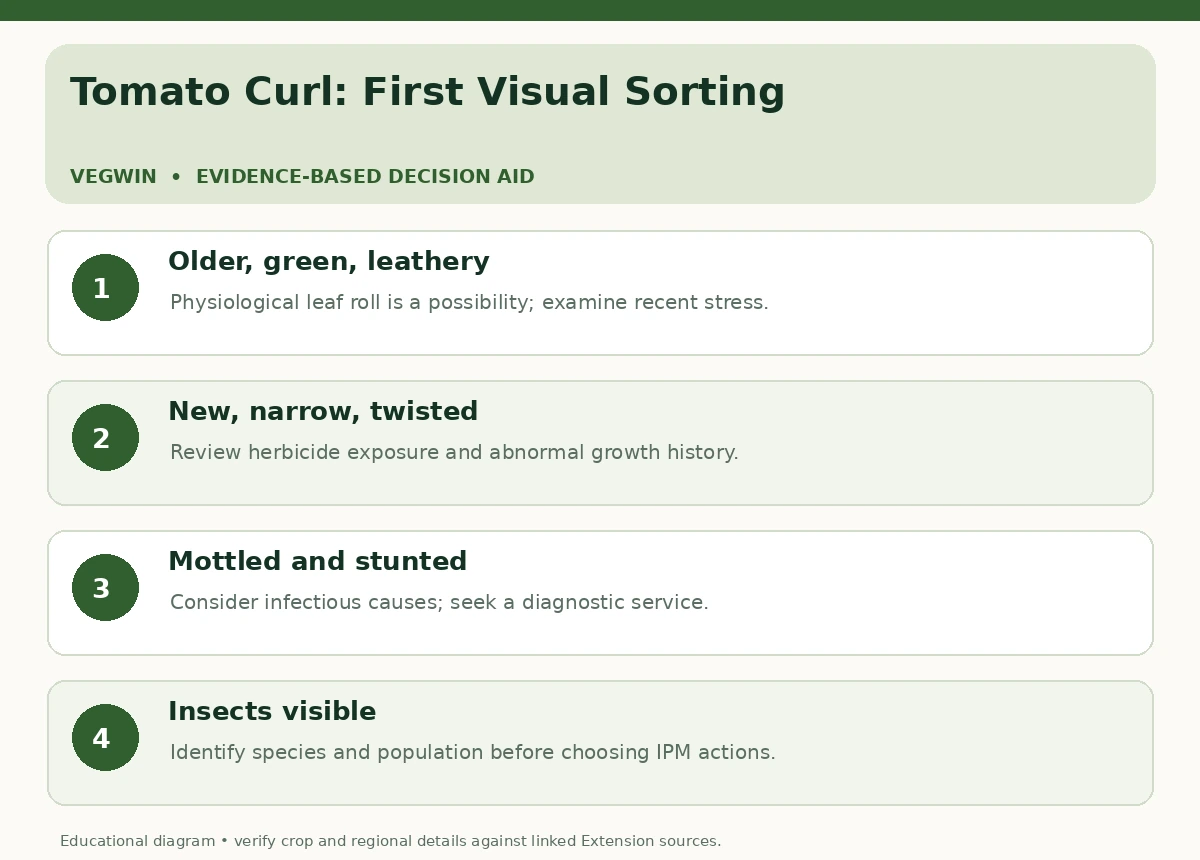
Look at several leaves from the top, middle and bottom of the same tomato plant. Note whether the oldest leaves curl upward into a firm tube while staying normally green or whether tiny newer leaves are narrow, crinkled, twisted or discolored. Minnesota Extension describes physiological leaf roll as upward-curled, leathery leaves often starting low on the plant. That pattern is common in warm or stressful conditions and usually does not significantly reduce yields. Rolled leaves may not flatten even when conditions improve.
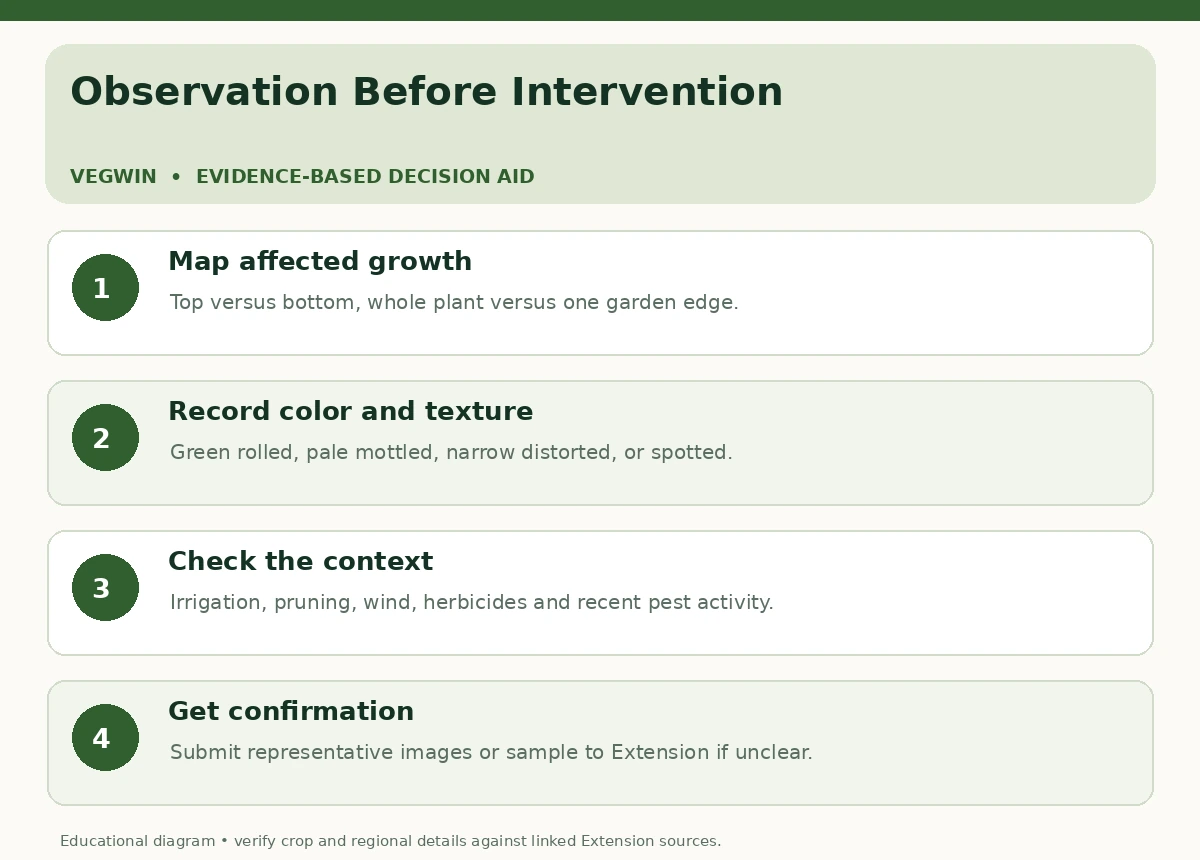
Do not assume that every upward curl is harmless. Record whether the plant is otherwise growing normally, flowers and fruit are forming, and neighboring tomatoes have a similar pattern. A quickly worsening plant with yellow mottling, severe stunting or damaged fruit needs deeper identification. Photograph a whole plant, one affected lower leaf, and a new shoot from the same position each day. This prevents a single close-up from obscuring the distribution that makes a diagnosis possible.
Assess Common Physiological Leaf Roll
If lower leaves remain green but roll or cup, examine recent water stress, hot weather, overly aggressive pruning and growth conditions before reaching for pest spray. Minnesota Extension lists hot dry weather, rapid growth and pruning among associations with physiological roll. Some tomato varieties show it more readily than others. The rolled leaf itself is often not a reason to remove the plant, and spraying a fungicide cannot reverse a noninfectious leaf response.
Check whether soil is repeatedly soaked and then allowed to dry hard. Provide reasonably even root-zone moisture without converting watering into a fixed daily quantity, and avoid drastic pruning of already stressed plants. If plants are vigorous and fruiting normally, monitor them rather than treating an aesthetic change as a crisis. A deformed leaflet that is already stiff may stay rolled despite better conditions, so look for healthy new growth over time. A true diagnosis still requires checking the exceptions below.
Treat Distorted New Growth as a Separate Clue
Young leaves that emerge unusually narrow, strapped, twisted or cupped merit a different investigation. University of Maryland and Minnesota Extension list herbicide damage among causes of such distortion; tomatoes are sensitive to some broadleaf weed-control chemicals and injury can arise from drift or contaminated material. Ask whether spraying occurred nearby, whether lawn clippings or compost might have been exposed to persistent herbicides, and whether only the garden edge facing a neighbor shows damage. These are clues, not proof.
Stop introducing any potentially contaminated mulch or compost until its history is clarified. Do not attempt to counteract suspected herbicide injury with a strong fertilizer or homemade spray. Photograph affected plants and note dates, wind direction, lawn applications and the location of the worst distortion. Local Extension specialists or diagnostic clinics can help separate chemical injury from viruses and growth anomalies. Recovery varies with substance, dose and plant stage; it cannot be guaranteed from an online image.
Look for Mosaic Patterns, Stunting and Pest Evidence
A mottled mix of lighter and darker green, rings or spots on fruit, distorted leaves and stunted growth can point toward a virus problem, though no individual symptom confirms the pathogen. University of Maryland lists several mosaic and other viruses among common tomato issues. Confirm with an appropriate diagnostic service rather than guessing which virus is present. Avoid moving from suspect plants to healthy seedlings without cleaning hands and tools as locally recommended; actual transmission routes differ by disease.
Inspect leaf undersides and tender tips for aphids or other arthropods, honeydew and associated feeding injury. Minnesota Extension notes that larger aphid infestations can curl and stunt leaves, but a few insects on a leaf do not establish that they caused every symptom. Identify the organism and gauge damage before any response. Natural enemies and prevention are part of an IPM approach. If treatment ever becomes warranted, use local Extension advice and follow the legal label; a generalized homemade mix is not a validated solution.
Compare Patterns Across Plants and Time
Use the garden as a comparison, not as a substitute for a laboratory. If one side of several plants shows the same distortion after a local spray event, exposure may be relevant. If only lower, older leaves curl during heat while new foliage stays normal, physiological roll rises on the shortlist. Also, if a few plants are dwarfed and show mottled leaves plus abnormal fruit, infectious causes deserve consideration. None of these distributions can prove a final diagnosis by themselves.
Look back at the last two weeks of irrigation, pruning, weather changes, transplanting and any herbicide use in the vicinity. Avoid immediately removing all affected leaves, which destroys helpful diagnostic evidence and can stress plants. Mark an affected shoot and observe whether subsequent growth is normal, increasingly distorted or stunted. An Extension plant-diagnostic clinic can advise on sampling when multiple causes remain possible. Always confirm before making destructive disease-management decisions.
| Symptom pattern | Possible explanation | Best next move |
|---|---|---|
| Older leaves roll upward but stay green | Physiological leaf roll possible | Check heat, water and pruning; observe vigor |
| New growth strappy, twisted or cupped | Herbicide injury among possibilities | Review exposure history; request diagnosis |
| Mosaic color, stunting or abnormal fruit | Virus or other complex disorder possible | Isolate tools as appropriate; consult clinic |
| Insects clustered beneath distorted tips | Sap-feeder injury possible | Identify insect and use an IPM threshold |
Choose Management That Matches the Cause
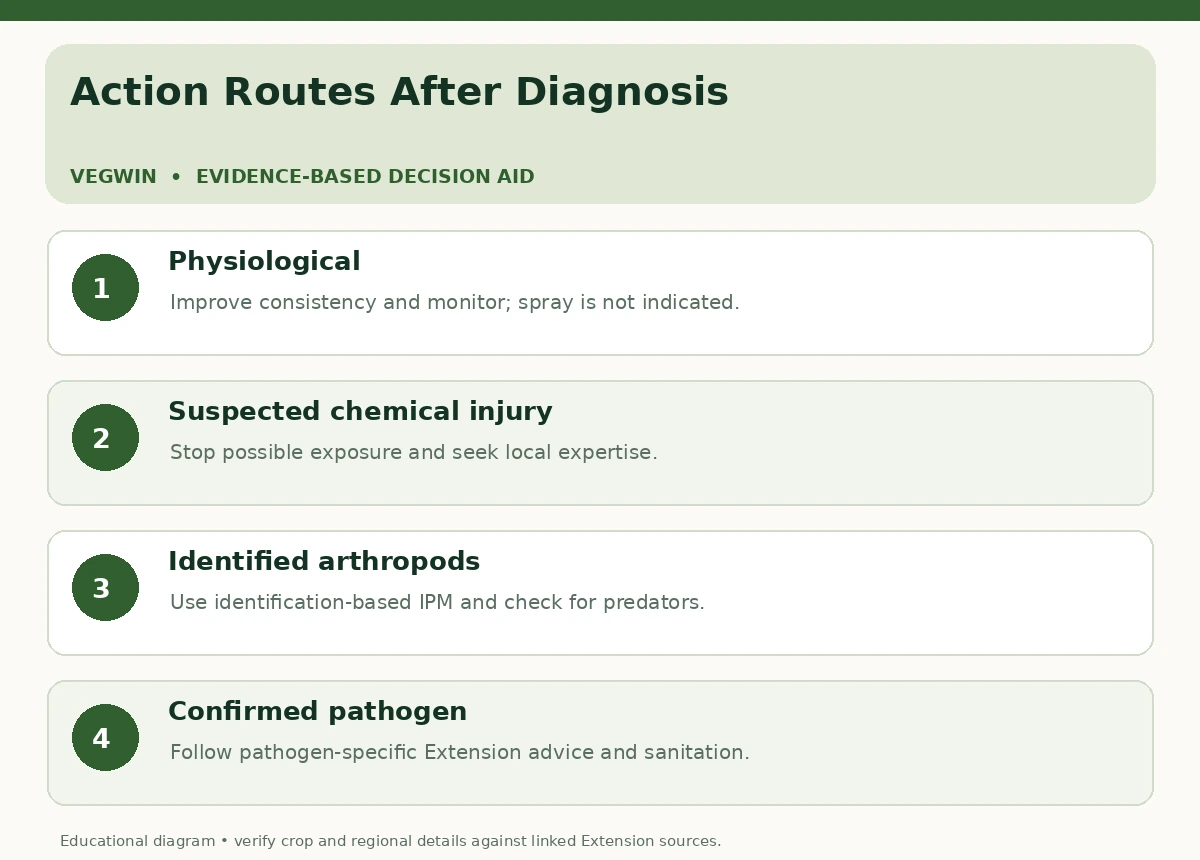
For typical physiological rolling on a vigorous green plant, prioritize consistent growing conditions and observation. Minnesota Extension notes that leaf roll itself usually does not reduce growth or yield and need not be treated. A case with identified insect colonies should follow insect-specific IPM guidance; a case with confirmed virus requires disease-specific sanitation and management advice. Diagnosed herbicide exposure requires stopping the source and evaluating injury, not applying a fungicide.
Avoid blanket recommendations to spray, fertilize heavily, prune every curled leaf or discard a plant without confirming the underlying issue. Do not market leaf curl as a reliable sign of a single nutrient deficiency. Where uncertainty remains or valuable crops are affected, preserve photographs and a timeline and consult local Extension. Product labels, registered uses and regional restrictions matter if any pesticide treatment is proposed. A good outcome is a correct decision even when there is no chemical intervention.
Keep Leaf Curl Separate From Blight and Aphids
Tomato blight articles address characteristic lesions, disease progression and weather-related infection pressure; leaf curl may occur with or without any foliar disease. The dedicated aphid guide concerns identification and pest management on tomatoes; leaf curling alone is not enough to establish an aphid outbreak. This page is a front-door differential diagnosis for rolling and distortion. When inspection identifies a specific problem, move to that focused guide rather than combining every tomato symptom under one unsupported treatment.
A short observation record should include leaf age, color, shape, pest findings, new growth, fruit condition and recent exposures. Share it with a local Extension clinic if the pattern is atypical. Do not automatically conclude tomato yellow leaf curl virus from a search-engine image: multiple viruses and noninfectious injuries cause similar symptoms, and regional vectors differ. The reader’s next step should be evidence gathering that narrows the problem safely before attempting any cure.
Related Guides
- Growing Tomatoes: A Step-by-Step Plan from Transplant to Harvest
- Potted Tomato Plants: Choose the Right Container and Prevent Water Stress
- Why Tomato Flowers Drop Without Fruit: Check Weather Before Fertilizer
- How to Identify Tomato Suckers and Prune by Growth Habit, Not Guesswork
- Tomato Trellis Choices: Match Support and Training to Plant Growth
How We Research and Maintain This Guide
We checked the linked sources on October 19, 2026. Claims below are tied to specific university Extension or National Center for Home Food Preservation guidance, not to invented trials, a product endorsement, or universal regional conditions. These original graphics are simplified decision aids, not diagnostic photographs. The site owner should check local Extension recommendations, crop identity, packaging instructions and WordPress overlap before manually publishing. Symptoms can overlap and cannot establish virus or herbicide identity by themselves. Pesticides are not suggested without diagnosis, local legality and label review.
Evidence and further reading: [1] University of Minnesota Extension [2] University of Maryland Extension [3] University of Minnesota Extension tomato symptom key [4] University of Maryland Extension
All three buttons lead to independent educational sources and are not paid recommendations. We checked sources including affiliate disclosure.
No. Older green leaves that roll upward can reflect physiological stress without reducing yield, but distorted new growth and other symptoms deserve investigation.
Water stress is one possible contributor to physiological roll. Check moisture patterns while also considering heat, pruning and other causes.
No. Curling is nonspecific and cannot identify a virus. Virus-like mottling, stunting and deformity merit a local diagnostic evaluation.
Not without a confirmed relevant fungal disease and a legally labeled indication. Physiological rolling, herbicide damage and many viruses are not fixed by fungicides.
Not necessarily. Physiologically rolled leaves can remain curved; watch new growth, plant vigor and fruiting for a more useful trend.