
A tomato trellis is not simply a taller cage. The correct choice depends on whether the variety grows as a compact determinate plant or continues extending as an indeterminate vine, how many plants you are supporting and how often you can tie or prune them. A fence of heavy fruiting stems can still tip over if its anchor points are weak. This guide compares four support styles using workload and plant behavior, rather than claiming one trendy arrangement always produces the best harvest. It expands the support decision in VegWin’s general tomato-growing article without repeating the full planting and watering instructions.
Match the Support to Growth Habit First
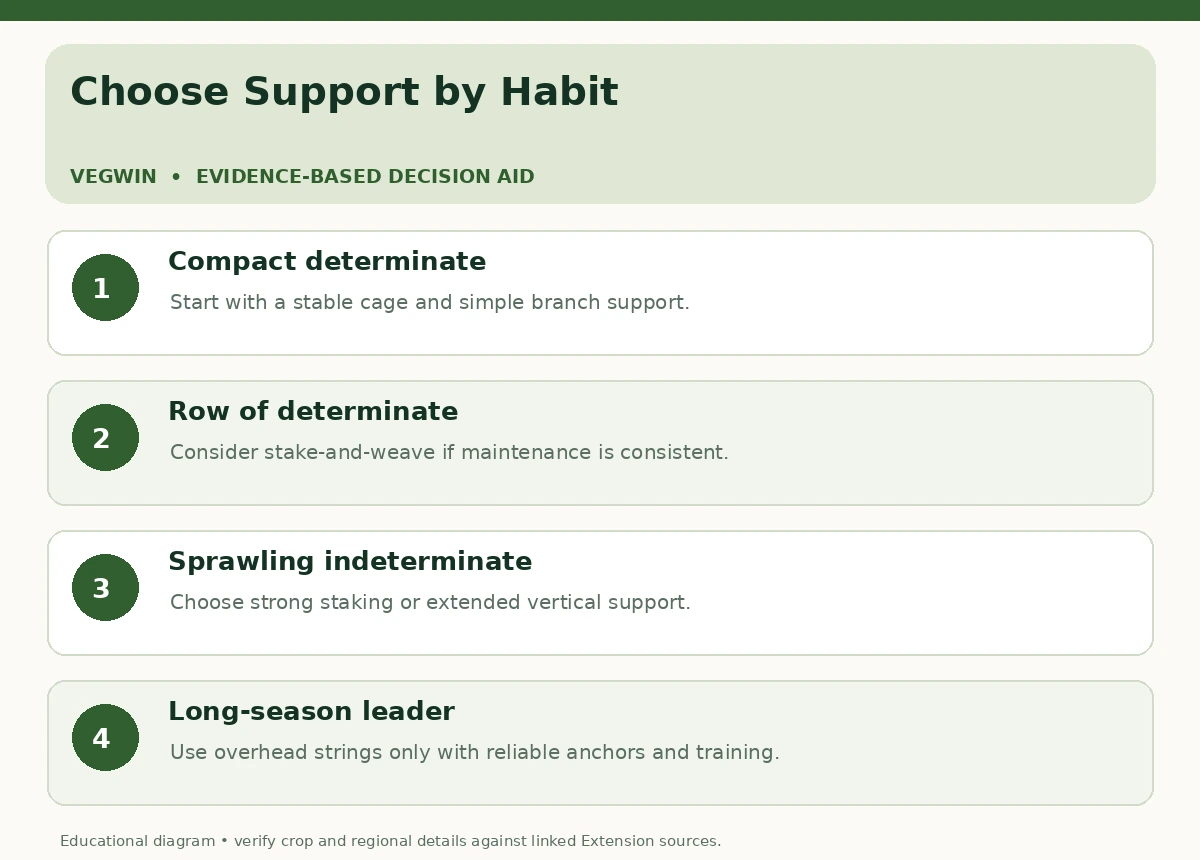
Read the actual cultivar description before buying posts. The University of Florida distinguishes indeterminate vines, which continue growing and typically require ongoing support, from more compact determinate tomatoes. Determinate does not mean every plant stays small or holds its fruit above soil without help. Heavy fruit, wind and wet foliage still increase the load on branches. Some patio-type cultivars need modest cages; vigorous indeterminate vines need a structure that can remain useful through an extended harvest.
Missouri Extension explains that determinate and semideterminate crops can suit stake-and-weave systems, while indeterminate tomatoes are commonly staked, caged or trellised. Consider the mature plant, not the size of the transplant. Write down projected growth habit, number of stems you intend to train and whether a helper will maintain ties during busy weeks. A support you cannot reach safely or revisit regularly is a poor fit even if it looks impressive at installation.
Compare Cages, Stakes, Weave and Strings
A sturdy cage provides broad support around the plant and may reduce individual tying, which can work well where pruning is minimal. Single stakes save footprint but require repeated attachment and training; the stems must not be cinched tightly. Stake-and-weave runs twine between supports to corral rows and can suit multiple determinate or semideterminate plants. An overhead line with individual strings offers structured vertical training for long-season indeterminate vines, but it adds anchors, clipping, monitoring and decisions about stem number.
Missouri Extension describes each system in a commercial context; a home gardener should scale the principles down, not copy the dimensions as mandatory for every raised bed. A heavy cage should resist toppling, a stake should be driven where it will not injure roots, and overhead supports must tolerate plant load and weather. The decision is about access and maintenance as much as yield. A trellis that leaves no space to inspect undersides of leaves is not a well-planned plant health system.
Install Supports Before the Plants Are Heavy
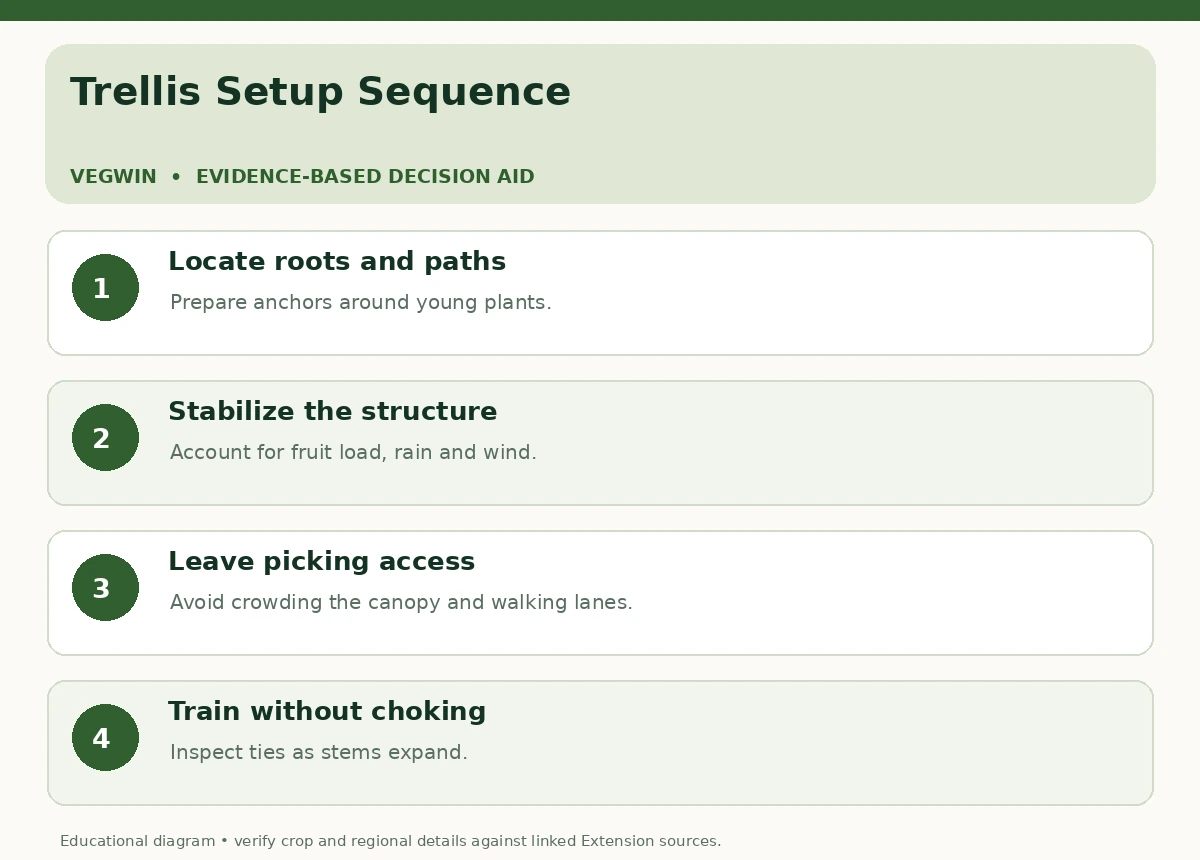
Prepare anchor positions while plants are small, ideally at transplanting when root placement is visible. Check where irrigation tubing passes, where a person will walk, and where fruit will hang as stems lengthen. Fastening strong uprights to a flimsy bed border does not make the assembly stable. For a row, consider end posts and cross-bracing appropriate for wind exposure; for a container, choose a cage that is proportionate to the container’s stability and weight.
Position supports so the crop can dry after irrigation, light can reach leaves and ripe tomatoes can be picked without breaking branches. A support system should not force the gardener to step into a densely planted bed or stretch over wet foliage. The recommended spacing belongs to the crop and planting system, not to a universal trellis template. Check the seed packet and regional Extension advice for the variety; different support and pruning systems may change how much room a plant needs.
Train Stems Without Cutting Away the Crop
Training means directing stems and distributing weight, not stripping every side shoot. Some indeterminate systems use one or two leaders and regular removal of selected suckers; others allow more branching within a cage. Determinate tomato pruning requires extra care because heavy removal can sacrifice fruiting shoots. Missouri Extension discusses how its trellising styles differ in pruning intensity. Your goal is a structure the stems can use without sharp friction, choking ties or branch bends that make harvesting difficult. Our walkthrough on how to identify tomato suckers and prune indeterminate vines carefully sets out each step.
Use soft purpose-made ties or clips as appropriate to the structure and inspect them while stems thicken. Keep twine and clips from cutting into the plant. On string systems, follow the publication’s described training method and verify that its anchor can carry a mature vine. In a typical backyard cage, avoid needless aggressive pruning just to imitate high-wire greenhouse techniques. Stop tying when a stem is already damaged and decide whether nearby support is safer than forcing it upright.
Plan Around Access and Disease Prevention
Spacing, airflow and dry foliage are part of the support decision. Support can keep some foliage and fruit off damp ground, but it does not make tomato disease impossible. Leaves may still become wet from rain, splash or humidity, and plant health requires identification before treatment. Build enough aisle width for a person to photograph suspicious lesions and remove ripe fruit without tearing branches. If the structure is too dense, future preventive care becomes harder.
A practical grower chooses the least elaborate system that reliably carries the plant. For one determinate garden plant, a sturdy cage may be sufficient; for an intensively tended indeterminate crop, stakes or strings may earn their added maintenance. For a long row, a weave may distribute support economically but needs attentive timing as the canopy expands. Inspect support fittings after storms and before fruit load grows. Reinforcement at the first sign of leaning is more useful than emergency reconstruction after the crop falls.
| Plant or situation | Likely support fit | Ongoing task |
|---|---|---|
| Compact determinate | Sturdy cage | Keep branches contained; check stability |
| Determinate row | Stake-and-weave | Extend weave before stems fall outward |
| Indeterminate garden vine | Strong stake or cage | Manage shoots and attachment points |
| Long-season single leader | Overhead string trellis | Check anchors, clips and leader regularly |
Set a Repeatable Trellis Maintenance Routine
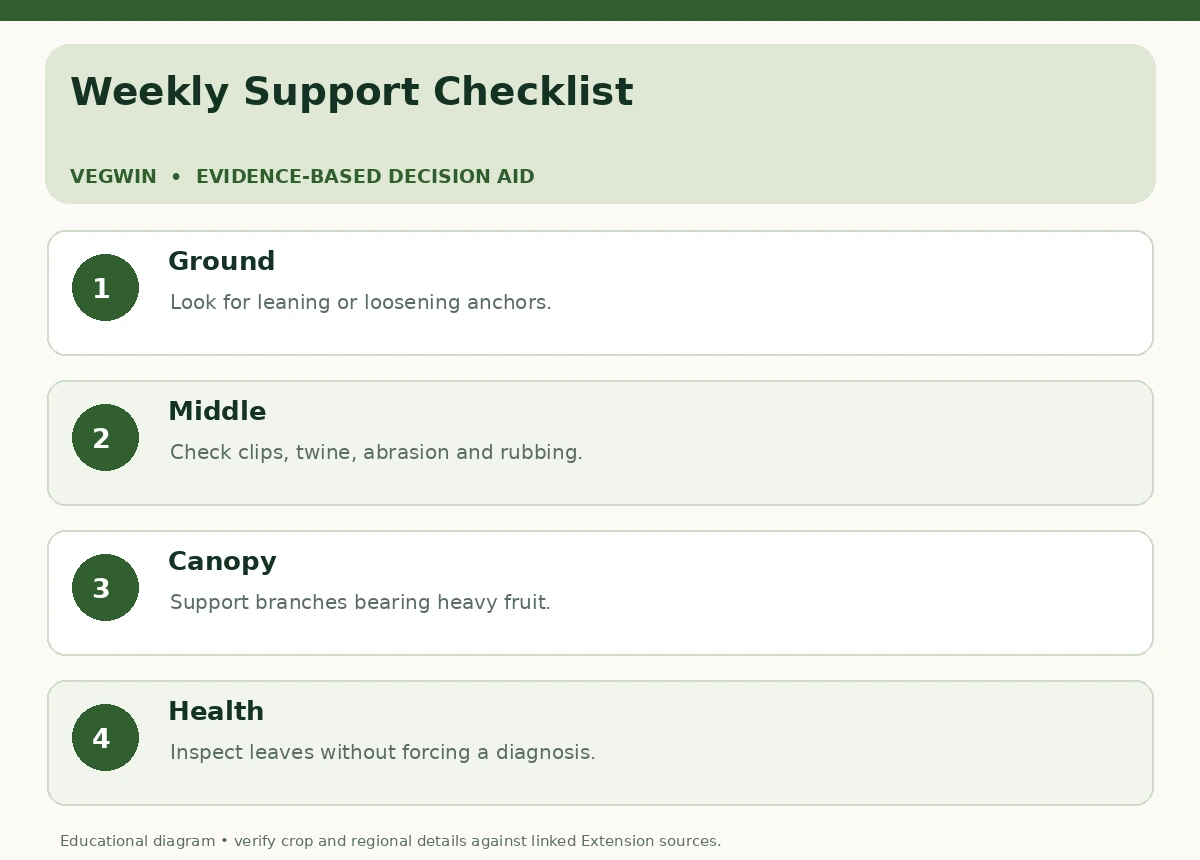
Once a week, examine three zones: ground-level anchors, mid-stem attachment points and fruit-heavy outer branches. Gently guide unsupported shoots toward the frame and retie only as needed. For cages, check whether shoots have escaped through openings and are bearing weight against a sharp edge. For twine, inspect abrasion and sag. Also, for overhead strings, monitor the top wire and individual leader clips. Record these tasks with the same tomato log used for watering and disease observations.
Do not prune or tie when foliage is wet if the regional Extension guidance recommends minimizing handling in disease-prone conditions. Sanitize tools when moving between affected plants according to local plant-disease recommendations. If a branch breaks, do not wrap the cut with unproven sealants. The support design should make plant inspection easier, not replace it. When a system is consistently too tall, too weak or too labor-intensive, revise it for the next crop rather than assuming the tomato cultivar failed.
Choose the Simplest Reliable System for Your Bed
Make a four-question choice: what is the variety’s growth habit; how much weight and weather must the structure handle; how much time will you spend tying; and can you harvest without damaging stems? If the answers point to a modest cage, do not overbuild a high-wire rig. If a vigorous indeterminate vine repeatedly grows beyond its support, invest first in structural stability and a feasible training method, not excessive pruning. Match the system to the gardener as well as the plant.
This page intentionally stays with the physical mechanics of support. For transplant timing, water, mulch and harvest progression, use the existing general tomato guide. For specific leaf disease symptoms, use a tomato diagnosis resource rather than assuming a crowded trellis is the sole cause. Confirm local wind exposure, cultivar growth habit and manufacturer guidance for any structural hardware. No support design can guarantee disease resistance or a specific yield. If you want the full process, read how to identify tomato suckers and prune by growth habit, not guesswork.
Related Guides
- Growing Tomatoes: A Step-by-Step Plan from Transplant to Harvest
- Potted Tomato Plants: Choose the Right Container and Prevent Water Stress
- Saving Tomato Seeds: Select True-to-Type Fruit, Clean, Dry, and Store
- Heirloom Tomato Varieties: Choose by Fruit, Vigor, and Local Risk
- Tomato Plants Care: A Weekly Checklist for Water, Leaves, and Fruit
How We Research and Maintain This Guide
We checked the linked sources on October 19, 2026. Claims below are tied to specific university Extension or National Center for Home Food Preservation guidance, not to invented trials, a product endorsement, or universal regional conditions. These original graphics are simplified decision aids, not diagnostic photographs. The site owner should check local Extension recommendations, crop identity, packaging instructions and WordPress overlap before manually publishing. Support methods reflect variety growth habit, site wind load and differing household versus commercial structures; no universal dimension or pruning quota is asserted.
Evidence and further reading: [1] University of Missouri Extension [2] University of Florida IFAS [3] University of Florida IFAS research
All three buttons lead to independent educational sources and are not paid recommendations. We checked sources including affiliate disclosure.
Many still benefit from some support to hold fruiting stems off the ground; a cage or weave can be more suitable than elaborate overhead training.
Sometimes if it is large and exceptionally sturdy, but continued growth can exceed a small cage. Select the system from the cultivar and your maintenance plan.
No. Pruning intensity depends on the variety and support method. Aggressive pruning of determinate tomatoes can reduce productive growth.
While plants are small, generally at planting or soon afterward, so stakes and posts can be positioned without harming established roots.
No. Support can improve access and reduce soil contact, but disease identification and prevention depend on weather, irrigation, pathogen and local IPM guidance.