
A tomato ‘sucker’ is not a parasite draining strength from a fruiting plant. It is a new side shoot that grows from the angle between a leaf stalk and the main stem. Given time, that shoot can make leaves, flowers and tomatoes of its own. Whether removing it helps depends on the variety’s growth habit, how the plant is supported and what you want to achieve. Pinching every little shoot on every tomato can reduce the harvest, especially on compact determinate varieties.
Cornell Cooperative Extension and North Carolina State Extension distinguish determinate from indeterminate tomatoes before recommending pruning. Training an indeterminate vine to one or a few stems can simplify support and improve access; pruning a determinate plant heavily removes part of its planned crop. The essential skill is to identify a genuine axillary shoot without confusing it with a flower truss or ordinary leaf. This guide shows what to examine before making each cut. Our guide “Tomato Trellis Choices” covers how to match support and training to plant growth.
Locate the true sucker in the leaf axil
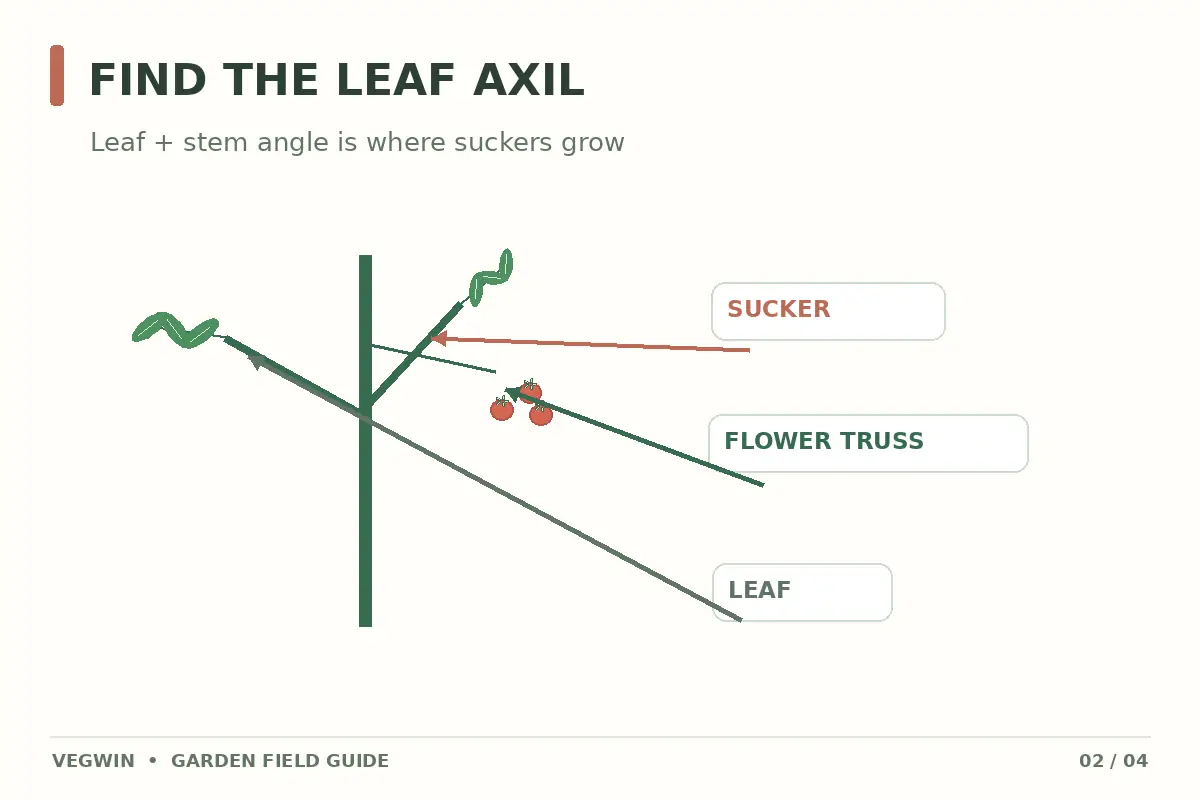
Start at the main stem and follow one full leaf outward. The angle where that leaf’s stalk meets the stem is called the axil. A small pointed shoot may develop there with its own tiny leaves. That is the sucker. A flower cluster usually branches away with buds or blossoms rather than leaflets. The leaf itself extends outward as a compound leaf with many leaflets and is not a sucker merely because it looks branchlike.
Trace each structure back before breaking anything. If the side shoot already has its own flower truss, it is producing potential fruit. This is a stronger reason to reconsider the cut than a generic rule that all side shoots ‘steal energy.’ New gardeners can practice identification on a few untouched plants or photograph the same leaf axil over several days. Pulling at the wrong spot can tear the main stem and expose tissue unnecessarily.
Read the variety label before removing shoots
Determinate tomatoes make a relatively compact plant and set many fruit within a more concentrated period. Cornell recommends little or no sucker pruning on these types because branches are a finite part of the fruiting framework. Indeterminate vines continue adding stem growth and flower clusters through the season; selected sucker removal can help train them. Semi-determinate and unfamiliar varieties require the supplier’s specific information rather than guessing based on fruit size or plant height alone.
A dwarf indeterminate plant can still have indeterminate growth despite a small stature, while a tall determinate can still finish as a bush. Do not infer habit from whether the fruit is a cherry or slicer. Save the seed packet and plant tag; the correct growth-habit label makes subsequent decisions much safer. If you cannot identify it, favor conservative pruning of clearly interfering or soil-contacting foliage while you observe growth.
Match pruning intensity to the support system
A single-stake or string-trained indeterminate tomato is commonly managed with fewer main stems and regular attention to side shoots. A large, well-supported cage allows more stems to grow naturally. Missouri Extension notes that caged plants need less pruning than tightly trained plants, and Cornell points out that tomatoes can grow well without pruning. The question is therefore how much foliage your specific support can hold without sprawling on the soil.
Do not create a skinny, leafless vine merely to mimic a greenhouse training photograph. Leaves make the sugars used by fruit, and adequate leaf cover protects developing tomatoes from excessive sun exposure. Keep enough productive canopy for your climate while removing the shoots needed to prevent uncontrolled tangles. Check ties and supports before pruning. Sometimes adding a taller stake or second tie solves the real problem better than removing another bearing stem.
Pinch small shoots without creating large wounds
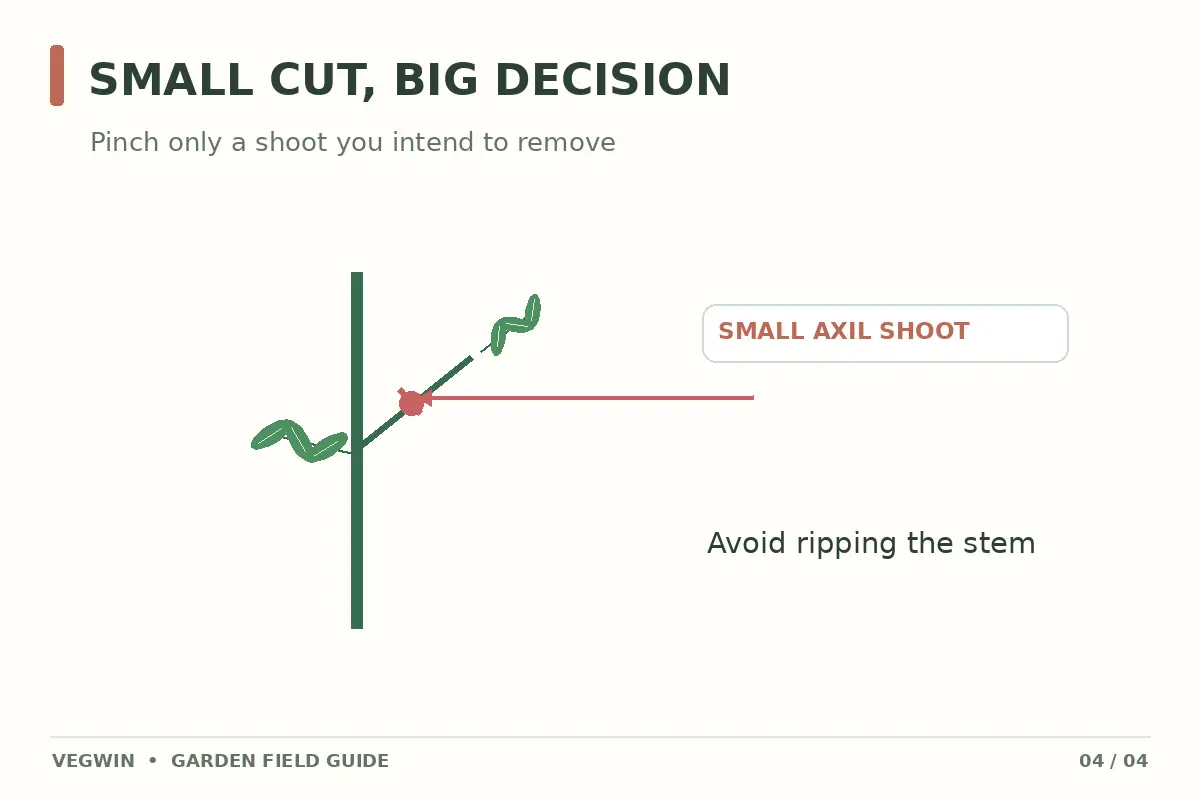
When a side shoot truly needs removal, smaller growth usually breaks away more cleanly than a mature thick branch. North Carolina State Extension recommends removing selected suckers while they are short. Use clean fingers for a tender tip or a sharp bypass pruner for firmer growth. Support the main stem while cutting and avoid ripping the branch downward, which can strip skin from the trunk.
If a sucker has become a large fruit-bearing branch, reassess instead of cutting it automatically. Taking off a big shoot creates a larger wound and removes current or future tomatoes. Sometimes the better choice is to tie the branch separately and keep it. Work when foliage is dry where practical, especially in gardens with disease pressure, and sanitize tools appropriately between suspect plants. Pruning should be deliberate maintenance, not a weekly harvest of every green shoot.

Remove lower problem foliage with restraint
Leaves touching soil can create contact with splash-borne debris and make watering and inspection difficult. Carefully remove damaged leaves or the lowest leaves directly contacting the ground where appropriate, but avoid stripping the plant far above the lowest fruit cluster. A plant’s normal leaf canopy supports photosynthesis and protects fruit. Soil mulch and drip or careful ground-level watering may reduce splash while retaining more healthy foliage.
Do not confuse a dying lower leaf with a sucker problem. Yellowing, spotting or wilting may have several causes, including aging, pests, nutrient imbalance, moisture issues and infectious disease. Identify an actual pest or disease before using pesticides; follow local Extension and product labels. Repeatedly removing symptomatic leaves without understanding the cause can hide a pattern until damage is advanced.
Balance airflow against yield and sunscald
A dense, unsupported plant may be hard to harvest and slower to dry after rain, but aggressively opened foliage can leave fruit exposed to strong sun. Cornell and other Extension guides acknowledge a tradeoff: pruning can improve management and, under some training systems, fruit size or timing, while reducing total fruiting shoots. The goal is a manageable living canopy, not maximum bare space around each cluster.
Stand back from the plant after a few careful cuts. Can you still identify the main stems, move leaves aside to harvest and reach soil for watering? Are the fruit clusters partly shaded during your hottest afternoons? Has pruning destabilized a tall plant on a weak support? The answer may be to stop for the day. A compact bush bearing several clusters should not be transformed into a thin single cordon just because that technique works for another variety.
Keep a repeatable inspection routine through harvest
Once a week, inspect new axils, support ties, moisture, lower leaves and fruit. On a trained indeterminate vine, this is a convenient time to pinch a few small side shoots according to your chosen stem count. On a determinate plant, most shoots should remain unless dead, diseased or physically problematic. Keep a note of when flowers first open and whether the plant continues producing new clusters.
As the season winds down, some Extension guides discuss topping indeterminate vines ahead of a first fall frost to concentrate remaining growth, but the appropriate date depends on your local frost forecast and fruit maturity. That is a separate choice from removing every sucker all summer. Clean tools, reliable support and good water management continue to matter after pruning. A healthy harvest matters more than how many shoots you have removed. For a step-by-step method, see how to identify tomato suckers and prune indeterminate vines carefully.
A practical decision table for your next step
| Tomato situation | Sucker decision | Main reason |
|---|---|---|
| Determinate in a cage | Keep most side shoots | Each can carry part of the crop |
| Indeterminate on a single stake | Train selected main stems | Manage vine length and support |
| Large sucker with fruit | Reassess or support it | Cutting removes potential yield |
| Leaf touching the soil | Consider removing lowest leaf | Reduce direct soil contact |
Related Guides
- Growing Tomatoes: A Step-by-Step Plan from Transplant to Harvest
- Tomato Leaf Curl: Diagnose Stress, Herbicide Injury, or Disease
- Saving Tomato Seeds: Select True-to-Type Fruit, Clean, Dry, and Store
- Heirloom Tomato Varieties: Choose by Fruit, Vigor, and Local Risk
- Tomato Plants Care: A Weekly Checklist for Water, Leaves, and Fruit
How We Research and Verify This Guidance
This article was prepared from the university Extension and university-library materials identified below, checked October 22, 2026. That is a title- and intent-level overlap review, not a complete comparison against the full text of every published post. The original WebP illustrations are simplified teaching diagrams, not photographs or exact botanical measurements. Always apply local Extension guidance and the named species or cultivar before making climate-sensitive decisions. No paid affiliate relationship is verified for this article; read our affiliate disclosure.
University research references, checked October 22, 2026: cals.cornell.edu — Differences between determinate and indeterminate pruning, and tradeoffs.. content.ces.ncsu.edu — Sucker location, selective stem training and limitations of determinate pruning.. extension.umd.edu — Leaf-axil identification and training a staked tomato to limited main stems.. extension.missouri.edu — Tomato supports and lower pruning requirements with cages..
A shoot that emerges in the leaf axil between the main stem and a leaf stalk; it can grow its own fruit.
No. Heavy pruning is especially likely to reduce fruit on determinate bush tomatoes.
Fruit size does not identify growth habit. Read the variety label and match pruning to support.
You can, but the cut removes potential fruit, so consider keeping or separately supporting the branch.
Selective pruning may improve access and airflow, but it does not replace disease identification, site care or appropriate IPM.