
A tray of empty cells tells you something different from a tray full of fallen seedlings. The first can mean seed age, sowing depth, temperature or moisture; the second may require urgent attention to a root or stem problem. This is a diagnostic companion to VegWin’s broader guide on how to start seeds indoors, not another planting-calendar tutorial. It begins with what you actually see and works backward to one likely cause at a time. Keep the seed packet and your tray label nearby, because germination requirements differ by species and cultivar. Never use USDA winter hardiness zones as a substitute for local transplant timing.
Sort the Tray by Symptom Before Taking Action
Record the crop, sowing date, seed lot, number of cells sown and number that emerged. Then place the tray into one of four observation groups: no seedlings, patchy emergence, seedlings that emerged but collapsed, or living seedlings that look stretched or stalled. A tray may have more than one problem. Photograph the whole tray before pulling apart cells, and compare the outer cells with the center where moisture or light might differ. Avoid calling every failed pot “damping-off”; the term does not describe seeds that never sprouted.
Iowa State University Extension separates poor germination from spindly growth and disease-associated collapse. That distinction matters because adding a brighter lamp cannot revive rotted roots, and a heating mat is not an answer to every lanky plant. Before restarting, keep two example cells as evidence if safe to do so, and investigate one variable at a time. An observation-first notebook helps you avoid changing watering, temperature and lighting simultaneously and then not knowing which change helped.
Investigate Empty Cells and Patchy Emergence
Check the packet for seed age and crop-specific germination instructions. Iowa State identifies over-deep sowing, uneven water, unsuitable temperatures and old seed as common reasons that trays emerge poorly. Some very fine seeds or light-requiring seeds should remain at or near the surface; that does not mean every vegetable seed belongs there. If the seed is buried beyond its label depth, do not repeatedly dig through the cells looking for it. Mark the suspect row and compare with a correctly planted small test sowing.
Look for differences between dry edges and saturated centers. If the medium has crusted over, become waterlogged or dried completely, correct the irrigation method rather than adding more seed into unpredictable conditions. A thermometer in the growing medium can be more informative than a thermostat across the room. Heating guidance is crop dependent; general suggested conditions in a university article are not a universal setting for every species. For older seed, a small germination test can help decide whether resowing is worthwhile. To go further, our guide to germinating seeds indoors shows how to test seed viability and control conditions.

Separate Moisture Stress From Damping-Off
Seedlings that fall at a narrowed, dark, water-soaked stem base raise a different concern from a healthy shoot that is merely leaning toward light. Iowa State lists damping-off among common indoor propagation problems. Keep the affected tray away from healthy trays while you investigate, photograph affected stems and roots, and consult a local Extension diagnostic service if the diagnosis is uncertain. Do not apply an improvised fungicide or household disinfectant to living seedlings; such treatments can damage plants and may be inappropriate or unregistered for the use.
For future sowings, start with clean pots, a suitable seed-starting medium, drainage and measured watering. Moist does not mean permanently saturated. A humidity dome can help retain moisture during germination, but Iowa State advises removing a plastic cover once seedlings emerge. Air movement and avoiding constantly wet surfaces can reduce conditions that favor disease. If a group is clearly diseased, local Extension guidance should determine disposal and sanitation; contaminated seedlings should not be shuffled into a healthy tray in a rescue attempt. Our walkthrough on how to prevent damping-off in indoor seedling trays sets out each step.
Evaluate Living Seedlings Without Overcorrecting
Tall pale seedlings often point toward inadequate light, although overcrowding, excessive warmth and excess fertility can also contribute. Revisit VegWin’s earlier dedicated grow-lights article for coverage and fixture-height decisions rather than treating this page as a lighting specification. For present troubleshooting, inspect whether every plant stretches in the same direction and whether the fixture covers the far corners. Follow the light manufacturer’s distance and heat guidance, and increase light consistency before considering new equipment.
A seedling that remains short but develops poor color may need root-zone inspection, not just more nutrients. Lift one spare cell gently to see whether roots have adequate air and drainage; leave unaffected roots alone. Check for standing runoff, a potting mix that remains soggy and repeated fertilizer use. Transplant shock is separate from poor germination, and a severely damaged stem will not become strong just because the lamp was moved. Change the probable limiting factor and reassess surviving seedlings over several days.
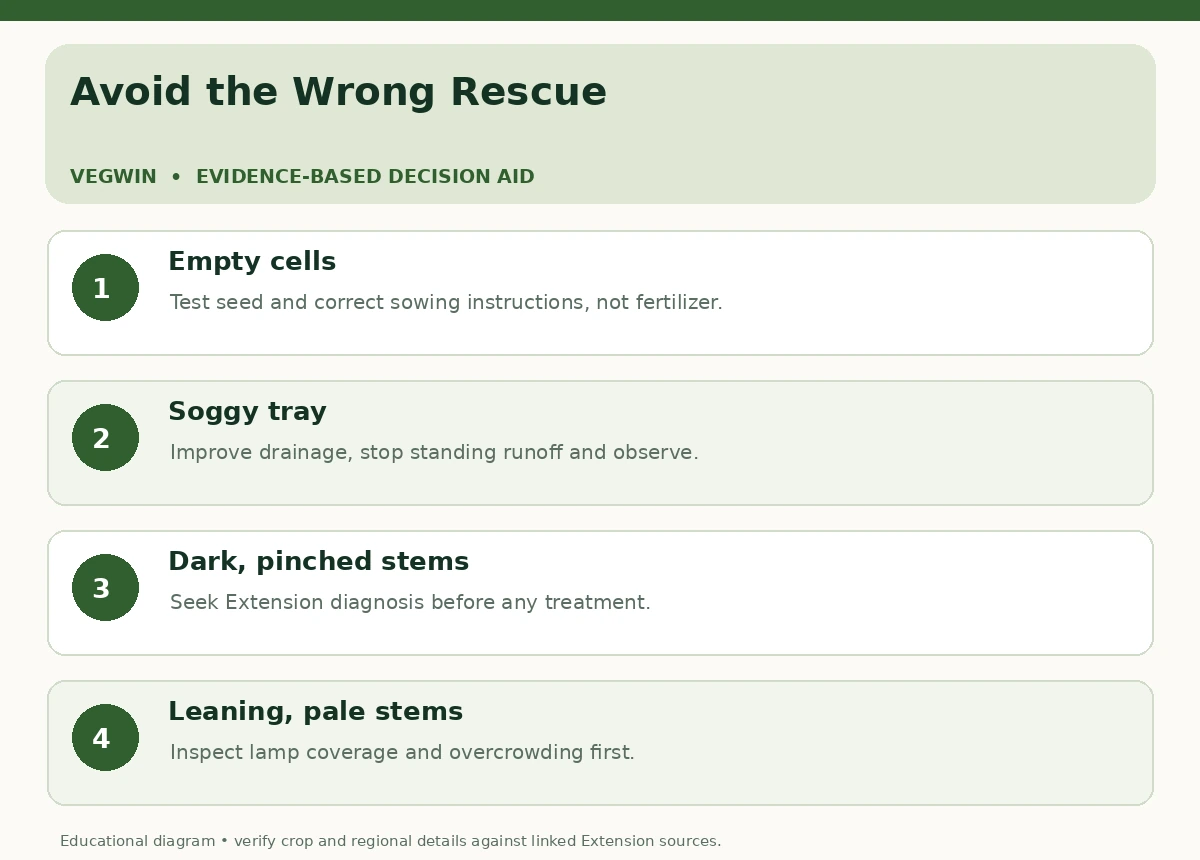
Use a Decision Table for the Next Correction
The same visible outcome may have several explanations, so the safest next step is a low-risk check rather than a broad chemical fix. If emergence is inconsistent, compare cells with the same seed lot; if a whole row is late, confirm its variety and packet window. For collapse, inspect the stem base and medium conditions before deciding to discard. For stretching, compare distance from light and crowding. A diagnosis made from only one photograph is provisional, especially for unusual leaf discoloration. If you want the full process, read how to start parsley from seed without giving up before it germinates.
Keep the first correction small enough to evaluate. For example, adjust bottom watering for a persistently wet tray and observe the next irrigation cycle, rather than repotting every seedling. If the seed is old, sow a labeled fresh-seed comparison instead of assuming room temperature caused failure. Follow crop-specific requirements when deciding whether to restart. Local Extension can help with suspected pathogens and regional transplant timing, which is not supplied by the USDA hardiness zone map.
| Observation | Check before acting | Appropriate next step |
|---|---|---|
| No emergence | Seed age; label depth; moisture | Compare fresh seed and correct sowing instructions |
| Patchy tray | Dry/wet zones; temperature variation | Measure medium conditions, change one variable |
| Stem-base collapse | Narrow dark stems; saturated mix | Isolate suspected disease and seek Extension diagnosis |
| Pale, stretched growth | Coverage; crowding; excessive warmth | Adjust growing environment, not pesticide |
Run a Small Comparison Instead of Guessing
A practical retry uses two small groups of cells with the same seed variety and sowing date. Hold most conditions steady while changing one suspect variable, such as fresh versus older seed, a corrected depth, or a better-drained medium. Label each group clearly and record whether the first seedlings appear evenly, not simply whether any plant emerges. The purpose is garden learning, not a controlled scientific trial; room microclimate and individual seed variation can still affect outcomes.
Keep questionable diseased material separate from new sowings. Do not reuse mix from a collapsed tray when you suspect damping-off. Where repeated failures occur despite clean procedures, ask local Extension about water quality, media storage and other conditions rather than buying an unproven seed treatment. The best outcome of troubleshooting is an adjusted repeatable method and fewer avoidable losses, not a universal formula promising perfect germination for all vegetables.

Decide Whether to Resow or Keep Growing
Keep stocky healthy seedlings whose roots and leaves are developing steadily. If an entire tray has poor emergence well beyond the crop-specific packet expectation and a fresh-seed comparison succeeds, resowing may save time. For severely collapsed or rotting seedlings, replacement is usually a more realistic path than attempting to straighten the stems. Factor in your actual outdoor planting window before committing to a new sowing; direct sowing outdoors may be preferable for some crops.
Close the loop by recording what changed and which remedy actually improved the next tray. This diagnosis-centered page complements the earlier step-by-step seed-starting guide instead of copying its calendar, container selection and hardening-off workflow.
How We Research and Maintain This Guide
We checked the linked sources on October 19, 2026. Claims below are tied to specific university Extension or National Center for Home Food Preservation guidance, not to invented trials, a product endorsement, or universal regional conditions. These original graphics are simplified decision aids, not diagnostic photographs. The site owner should check local Extension recommendations, crop identity, packaging instructions and WordPress overlap before manually publishing. High keyword-intent collision risk with B002 How to Start Seeds Indoors: manual search-cannibalization sign-off explicitly required; if overlap persists, merge rather than publish.
Evidence and further reading: [1] Iowa State University Extension [2] Iowa State University Extension [3] Iowa State University Extension
All three buttons lead to independent educational sources and are not paid recommendations. We checked sources including affiliate disclosure.
Check the seed lot, packet depth, sustained moisture and temperature in the medium; each is a documented cause of poor emergence. Do not presume the same rule applies to every crop.
Avoid reusing potentially contaminated seed-starting mix when damping-off is suspected. Check local Extension sanitation guidance and begin a fresh tray with a suitable medium.
Not necessarily. Weak, stretched growth often relates to light and growing conditions; excessive fertilizer may make nursery problems worse.
Iowa State recommends removing covers promptly after emergence; sustained excess humidity and wet conditions can favor seedling problems.
No. This page focuses on symptom triage and failed-tray decisions. The earlier B002 guide covers timing, containers, sowing and transplant planning.