
Tomato Leaf Mold: Check Leaf Undersides Before Treating Yellow Spots. This hands-on guide tackles the specific question behind leaf mold of tomato with Extension-grounded checks and a practical decision sequence. Conditions differ by region, plant variety and site history, so treat the source-linked observations as a starting point for local verification.
The unique value here is this: A two-sided leaf inspection and tunnel-humidity workflow that separates tomato leaf mold from early blight, gray mold, and ordinary yellowing before any treatment choice. All factual plant and safety advice is backed by the named university references below; no commercial partner or pesticide treatment is assumed. Our guide “Tomato Blight Symptoms” goes into more detail.
Turn the yellow leaf over before naming a disease
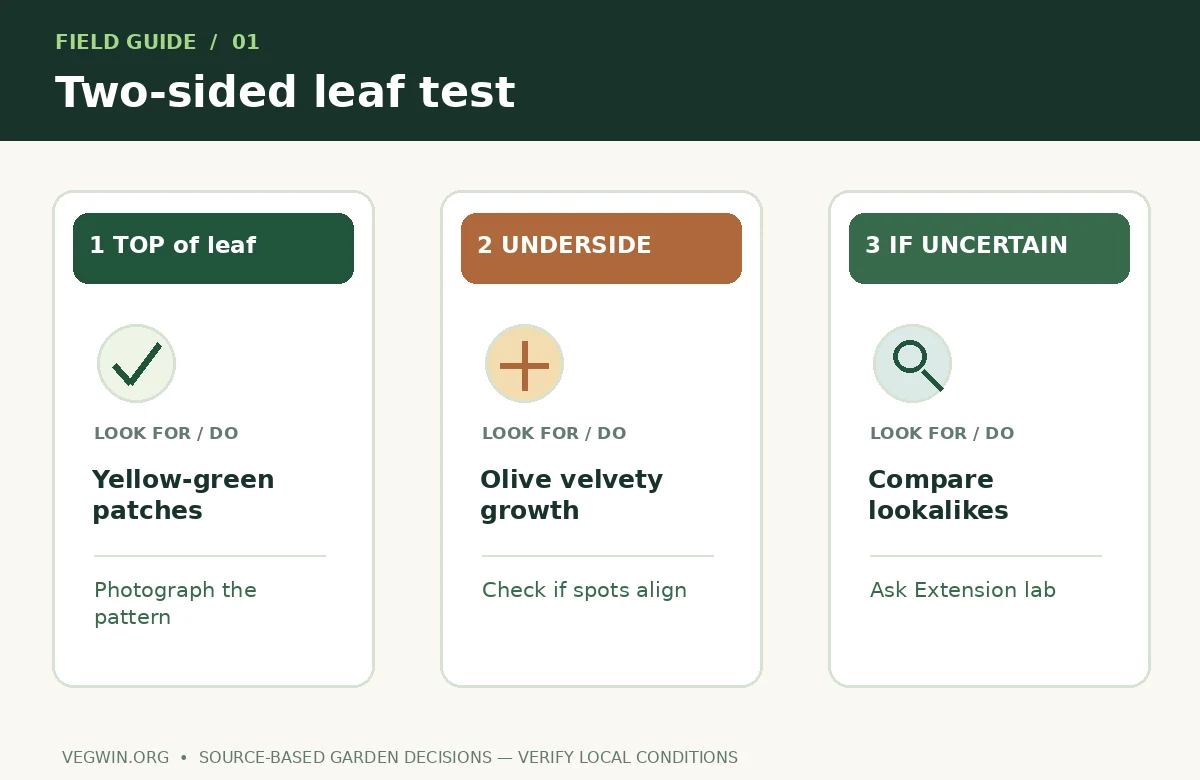
A yellow spot on a tomato leaf is a symptom, not a diagnosis. Tomato leaf mold is a fungus-associated disease that most often develops where high humidity is trapped around tomatoes, particularly greenhouses and high tunnels. Its useful distinguishing sign is the pairing of pale green to yellowish spots on the upper leaf with a matching olive-green to brown velvety layer on the underside. Looking only from the walkway misses that clue.
Begin with the oldest affected leaves and inspect both surfaces in bright light. Note whether the fuzzy area lines up directly beneath the pale spot, or whether you are seeing dry brown spots, concentric rings, water-soaked areas or uniform pale foliage instead. Photograph both sides and record the growing setting. A possible match is a reason to verify with Extension diagnostics, not permission to diagnose by color alone.
Distinguish leaf mold from several lookalikes
Early blight may produce target-like concentric patterns and yellowing, while gray mold often has a different pattern of gray fuzzy growth on dying tissues. Nutrient stress, wet roots and age-related lower-leaf decline can also make leaves look pale. Tomato leaf mold is particularly associated with velvety spore growth below corresponding yellow lesions, as University of Minnesota Extension and the University of Connecticut IPM describe.
The growing context matters. If your plants are outdoors in a breezy dry bed, tomato leaf mold is possible but less likely than in persistently humid covered production. Do not rule it out absolutely, and do not assume every fuzzy spot is the same fungus. When symptoms are atypical, rapidly spreading or threatening many plants, consult your regional diagnostic laboratory rather than applying a fungicide to a guessed target.
Measure the air environment as well as the leaves
The leaf-mold pathogen Passalora fulva is favored by very humid conditions, with Extension emphasizing prolonged relative humidity around or above 85 percent. An enclosed tunnel may look dry at midday and still hold damp foliage overnight when temperature falls. A simple record of condensation, ventilation position, watering method and affected canopy zones provides more useful information than an occasional temperature number alone.
Inspect the interior early in the day: wet walls, dripping cover material, dense lower foliage and stagnant corners are actionable clues. Vent windows or roll up tunnel sides as conditions and structure safety allow. Use airflow and weather-aware watering to shorten leaf wetness; this is ongoing management, not a claim that ventilation will instantly cure already infected tissue. Conditions and tunnel designs vary by site.
| Stage | Look for | Action |
|---|---|---|
| 1. TOP of leaf | Yellow-green patches | Photograph the pattern |
| 2. UNDERSIDE | Olive velvety growth | Check if spots align |
| 3. IF UNCERTAIN | Compare lookalikes | Ask Extension lab |
| 4. Covered crop | Log condensation | Check after nightfall |
| 5. Improve airflow | Vent and train canopy | Avoid leaf-wetting water |
| 6. Reinspect | Check new symptoms | Repeat observations |
Make a staged cultural-control response
First confirm symptoms. Then separate heavily affected foliage from sound growth with clean handling, following local Extension guidance. Increase spacing or carefully prune crowded foliage where plant health and training permit. Water the root zone instead of misting leaves, and avoid working among wet plants because hands and tools can move spores. Sanitize tools and supports between affected areas following an appropriate product label. To go further, our guide “Powdery Mildew on Squash” shows how to confirm leaf symptoms and slow spread.
Keep an observation record for the next week: where new upper yellow spots appear, whether underside sporulation expands, and whether morning condensation improves. Cultural controls can slow the environment that favors disease but are not guaranteed to stop a severe outbreak. Do not strip a plant of most photosynthetic foliage simply to satisfy an imagined percentage of pruning. Aim for a more open, dry canopy without destroying the crop.

Understand why a resistant label is not absolute
Resistance to leaf mold is more complex than a one-word promise. University of Minnesota and Penn State Extension describe multiple pathogen races and varying performance of varieties. A cultivar marketed as resistant may reduce risk against some races while remaining vulnerable to others, or under different local conditions. Avoid stating that a named commercial hybrid is immune without current verified evidence.
For a site with repeated leaf mold, record the actual cultivar, year, tunnel humidity pattern and diagnostic confirmation. Compare future cultivars carefully rather than attributing every difference to genetics. If buying seed, ask for the specific resistance information and whether regional trials support it. Varietal choice is one component of IPM alongside ventilation, crop residue removal, reasonable spacing and careful monitoring.
Keep pesticide decisions label-first and local
No spray recipe or universal application interval belongs in a general leaf-mold article. Pesticide registrations, crop uses and greenhouse or high-tunnel definitions can vary by jurisdiction. A product legal for field tomatoes may be excluded from covered production. The container label, current state rules and Extension recommendations are therefore decisive. Even permitted fungicides cannot replace diagnosis and humidity management.
If symptoms persist after cultural changes, take photographs or a sample to a trained Extension diagnostic service. Ask which treatment categories, if any, are labeled for tomatoes in your exact setting, and how harvest intervals and worker protection apply. Do not repurpose a home disinfectant as a foliage spray or transfer a field crop treatment schedule into an enclosed tunnel. Safety and identification come before shopping.

Clean up the tunnel between growing seasons
Old tomato debris can carry the pathogen into later crops. At season end, remove diseased plant remains and clean the growing space, trellising materials and supports using methods recommended for your materials and situation. Avoid leaving a mat of diseased foliage in the same production bay. Clean water delivery equipment and repair dripping fittings that produce persistent wet leaves or puddles.
Next season, focus monitoring on humid areas and lower foliage before extensive yellowing develops. Keep a short log of symptom onset and nighttime moisture; a well-ventilated tunnel still can have damp microclimates near walls and dense plants. There is no guaranteed disease-proof tunnel. A repeatable inspection habit is often more valuable than a long list of unverified remedies. If you want the full process, read how to identify hollyhock rust before removing healthy leaves.
Related Guides
- Growing Tomatoes: A Step-by-Step Plan from Transplant to Harvest
- Tomato Blossom-End Rot: Check Water Before Calcium
- How to Prevent Damping-Off in Tomato Seedlings Started Indoors
- How to Tell Tomato Early Blight From Septoria Leaf Spot and Prevent Spread
- Aphids on Tomato Plants: Identify Colonies and Choose IPM First
How We Research and Verify Disease Guidance
We compared the diagnostic photographs and descriptions from Minnesota Extension, the 2026 Connecticut IPM guide, and Penn State’s high-tunnel discussion. These authorities link the paired leaf-surface clues, high humidity, plant residue and race variability, but cannot identify a specific reader’s leaf through text alone.
This is identification-first, cultural-first educational material, not a product recommendation or pesticide label. Regional regulations and approved formulations must be checked independently before any treatment. No partner or affiliate status is represented; consult VegWin’s affiliate disclosure. The educational buttons direct readers to primary diagnostic guidance rather than a sales route.
No. Leaf mold is typically associated with paired yellow upper spots and olive velvety underside sporulation; gray mold has different signs and is caused by another fungus.
Yes, under suitable prolonged humidity, but it is more often reported in greenhouses or high tunnels.
No. Pruning may help airflow, but disease management also includes diagnosis, humidity reduction, careful watering, cleanup and monitoring.
No. Multiple pathogen races exist and cultivar performance can differ, so resistance claims must be interpreted carefully.
No. Confirm the cause, inspect the leaf underside, improve conditions where possible and check current local labels before any chemical control.