
Yellow spots on a tall hollyhock do not, by themselves, prove that a fungal rust is present. The useful observation happens when you turn over a lower leaf and compare the pale mark above with small raised rusty bumps below. Wisconsin Extension identifies these paired symptoms as typical of hollyhock rust. The disease can disfigure foliage badly, but a yellow leaf can also reflect other stresses, so start with careful inspection rather than cutting half the plant or reaching for a spray.
Hollyhock rust is associated with a rust fungus that can affect other plants in the mallow family. Wisconsin and Connecticut Extension provide recognizable descriptions and advise cultural management. The steps here emphasize identification, isolation of badly infected debris and reduced leaf wetness. This is not a pesticide prescription: any chemical treatment would need a confirmed diagnosis, current approved label and regional guidance. Early monitoring makes the nonchemical steps easier to carry out.
Check both sides of the lowest leaves
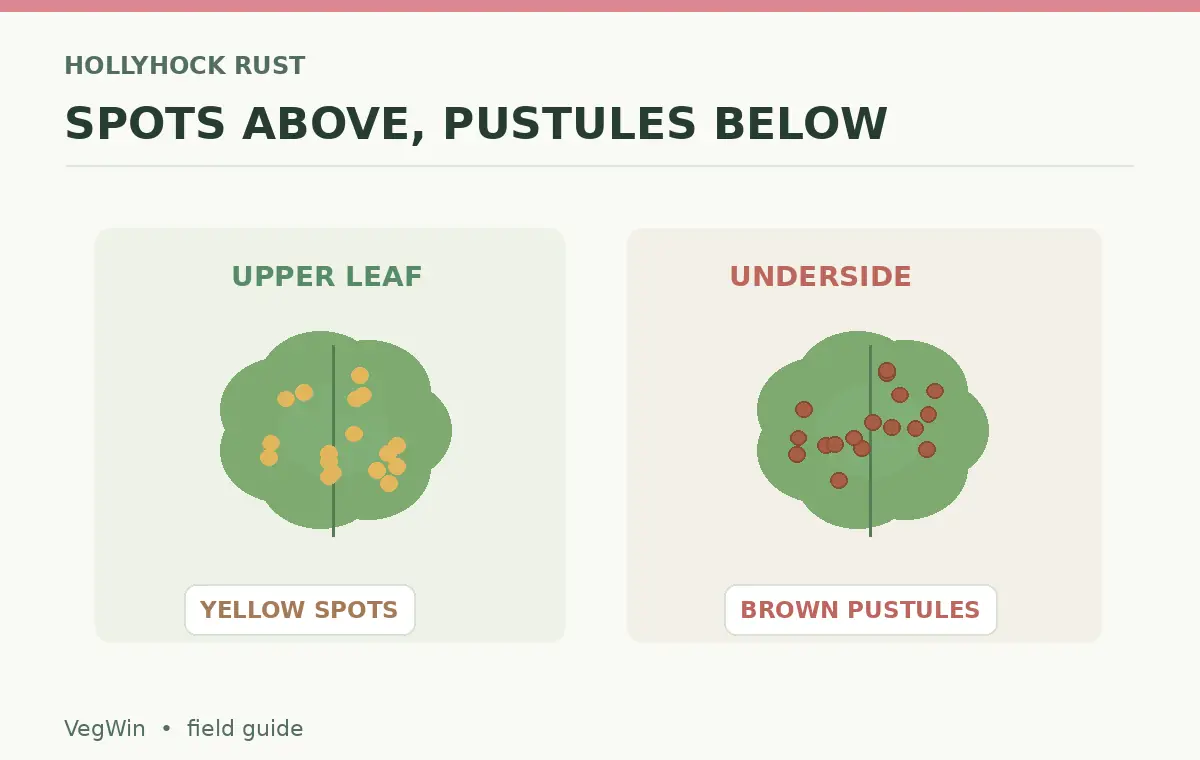
Begin with older lower leaves and work upward. Rust often appears as yellow or orange spots visible on the upper face. On the underside, the corresponding locations may show brown to reddish-brown raised pustules that contain spores. The visual pairing is more informative than a leaf color viewed from several feet away. Photograph the top and bottom of the same leaf and mark the date. Use enough natural light that the camera does not turn tiny bumps into flat shadows.
Wisconsin Extension also notes that severely infected leaves can become ragged, shrivel and fall. Do not wait for extensive damage if the paired signs are already clear. On the other hand, if the underside lacks pustules, do not declare rust from yellow spots alone. Check whether the plant shows drought stress, insect feeding, other leaf diseases or mechanical damage. If uncertainty remains, local Extension can inspect images or a properly submitted sample. Our guide “Tomato Leaf Mold” shows how to check leaf undersides before treating yellow spots.
Know what spores and weather can change
Rust spores may move on air currents and in water splash; moist weather favors disease activity. The fungus can persist on infected plant debris and on some related mallow hosts, according to university sources. That means a clean-looking top stem in spring does not necessarily rule out inoculum near the base. Keep fallen foliage from collecting densely in the crown where leaves stay wet. A few dry days of sunshine are helpful for drying leaves but do not automatically erase an established infection.
Avoid shaking or brushing an obviously infected plant unnecessarily, especially while inspecting dozens of plants in a row. Handle it gently and clean up fallen leaves without spreading debris through the bed. Try to keep overhead watering from repeatedly splashing foliage. If you have automatic sprinklers, evaluate whether a soil-level method can supply root moisture with less wetting of leaves. This targets one disease-favorable condition without inventing chemical cures. For a step-by-step method, see how to prevent powdery mildew on bee balm without guesswork.
Remove visibly affected leaves selectively
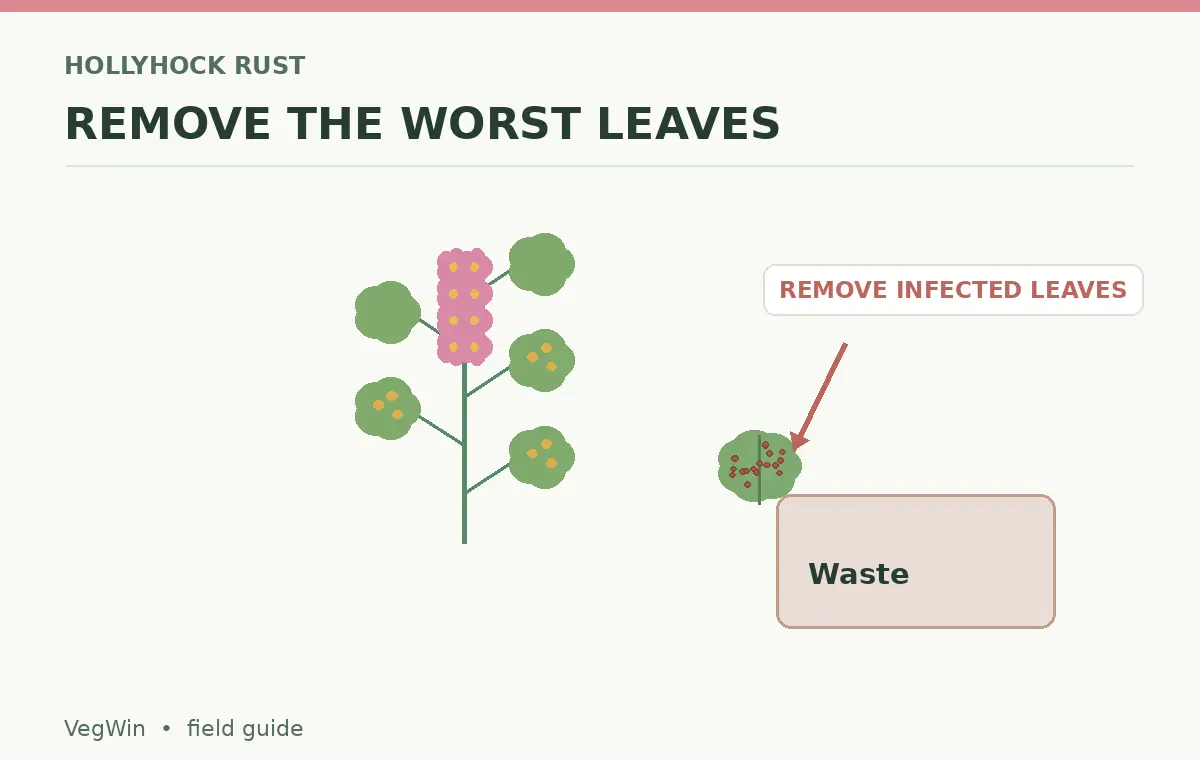
When symptoms are just appearing on a few leaves, removing the most affected ones can reduce nearby infected tissue. Work with clean tools and avoid stripping nearly all green foliage from a still functioning plant. Severely infected leaves should go to an appropriate waste route specified by local rules rather than being distributed as garden mulch. Wisconsin Extension recommends sanitation, while acknowledging that cultural control may not eliminate every infection once spores are widespread.
A plant that already has many diseased leaves may need a broader end-of-season cleanup, but that choice should reflect its remaining vigor and local disease pressure. Do not repeatedly pull leaves from healthy upper growth because they are ‘probably next.’ After you remove damaged material, return after a short interval and inspect new leaves. If the problem continues rapidly despite improved conditions, request a diagnostic opinion rather than escalating untested home treatments.
Reduce moisture around the foliage
Space hollyhocks so air can move among their large leaves. Keep nearby weeds and unrelated dense growth from pressing against the lower stems. Mulch can protect soil, but piling damp organic material against the crown may hold unwanted moisture. Water the soil at plant bases when needed, instead of routinely spraying foliage at night. Wisconsin Extension specifically recommends reducing leaf wetness through watering choices and planting density.
Dry leaf surfaces are helpful, but the plant still needs adequate root moisture. Do not intentionally drought-stress an established hollyhock because you fear rust. Check soil below the surface and water thoughtfully. In persistently damp sites, the most useful long-term improvement may be more open exposure or relocation rather than another round of sprays. If you grow hollyhocks next to a fence, consider whether trapped still air makes the bottom foliage slow to dry.
Look for related mallow hosts nearby
Some plants in the mallow family can host the rust fungus. Wisconsin and Connecticut describe common mallow as a potential reservoir near hollyhocks. Identify weeds before removing them; do not clear desirable ornamentals simply because they have superficially similar leaves. Check the base of nearby mallow plants for paired leaf symptoms and be alert to a recurring disease focus year after year.
Where common mallow weeds are confirmed, manage them before they set seed and become an ongoing shelter for rust. Removing a reservoir reduces one source of disease pressure, but spores can still arrive from elsewhere, so it is not a guarantee. Consider the entire planting: crowding, leaf wetness, debris and susceptible stock. Disease prevention is usually a series of modest cultural choices, not a single dramatic one-time treatment.
Avoid recommending chemicals from a photograph
Different diseases, mites or nutritional problems can discolor hollyhock leaves. The safest progression is identify, photograph, manage moisture and debris, then decide if specialist help is needed. If chemical control is considered, use only currently registered products that explicitly list the relevant host and use, follow every label requirement and consult regional Extension. Never copy an old application interval or a homemade mixture from an unrelated article into a present-day garden.
Some fungicides are mainly protective and cannot reverse tissue already injured by rust. That is why a rushed spray after widespread browning may provide disappointment without restoring leaves. For home gardens, cultural steps often offer the best first response. Keep pollinators, children and nearby edible crops in mind when deciding whether any pesticide is necessary. The published educational sources support diagnosis and careful management, not blanket spraying of every spotted leaf.

Finish the season with a clean start for next year
Remove fallen, infected hollyhock debris at the end of the season and dispose of it according to local disease-management advice. Wisconsin Extension also recommends checking newly acquired plants for rust before they are added to the bed. Avoid moving symptomatic plants or seed lots from visibly infected stock without advice. Next spring, inspect the first lower leaves regularly so an early small infection does not go unnoticed until the whole planting has become unsightly. Our walkthrough on how to grow hollyhocks from seed and understand first-year rosettes sets out each step.
Record whether the worst symptoms appeared after an extended wet spell, in the most crowded corner or where sprinklers hit the foliage. A photograph of both leaf surfaces and the surrounding bed helps make those correlations meaningful. If new plants repeatedly develop rust immediately, reconsider site layout and clean-plant sourcing. If symptoms look atypical, a plant diagnostic service can narrow the cause. The most useful outcome is a repeatable inspection habit, not a promise that rust can never return.
A practical decision table for your garden
| Observation | Interpretation | Next step |
|---|---|---|
| Yellow spot above, brown bump below | Typical rust pattern | Photograph both sides, remove worst leaves |
| Yellowing but no underside pustules | Diagnosis uncertain | Check stress, insects and ask Extension |
| Leaves stay wet after watering | Higher disease-favorable moisture | Redirect irrigation to soil |
| Old infected leaves under plants | Potential overwintering debris | Clean up responsibly |
Related Guides
- When to Sow Hollyhock Seeds and Why Some Bloom in Year Two
- How to Save Hollyhock Seeds From Dry Round Seed Disks
How We Research and Verify This Guide
This guide was prepared using the university Cooperative Extension and other plant-science references linked below, reviewed on October 22, 2026. This is not a full text-by-text cannibalization audit of every historical page, and site-specific conditions always need local Extension confirmation. The diagrams are simplified educational drawings, not photographs or measured diagnostic illustrations. No affiliate approval has been independently verified; review our affiliate disclosure.
Source notes (checked October 22, 2026): hort.extension.wisc.edu — Wisconsin Extension describes paired upper-leaf yellow spots and underside brown pustules plus sanitation and dry foliage practices. ipm.cahnr.uconn.edu — Connecticut IPM identifies hollyhock rust symptoms and mallow hosts. pnwhandbooks.org — Pacific Northwest Plant Disease Handbook explains spore survival and cultural approaches, updated March 2026.
No. Look underneath for raised rusty pustules and consider other causes if they are absent.
Start at lower leaves and compare each leaf upper surface with its underside.
No. It can reduce infected tissue early, but spores and favorable weather may allow new infections.
Avoid routine overhead wetting; water the root zone to reduce prolonged leaf moisture.
Do not choose a product without diagnosis and current locally applicable label and Extension guidance.