
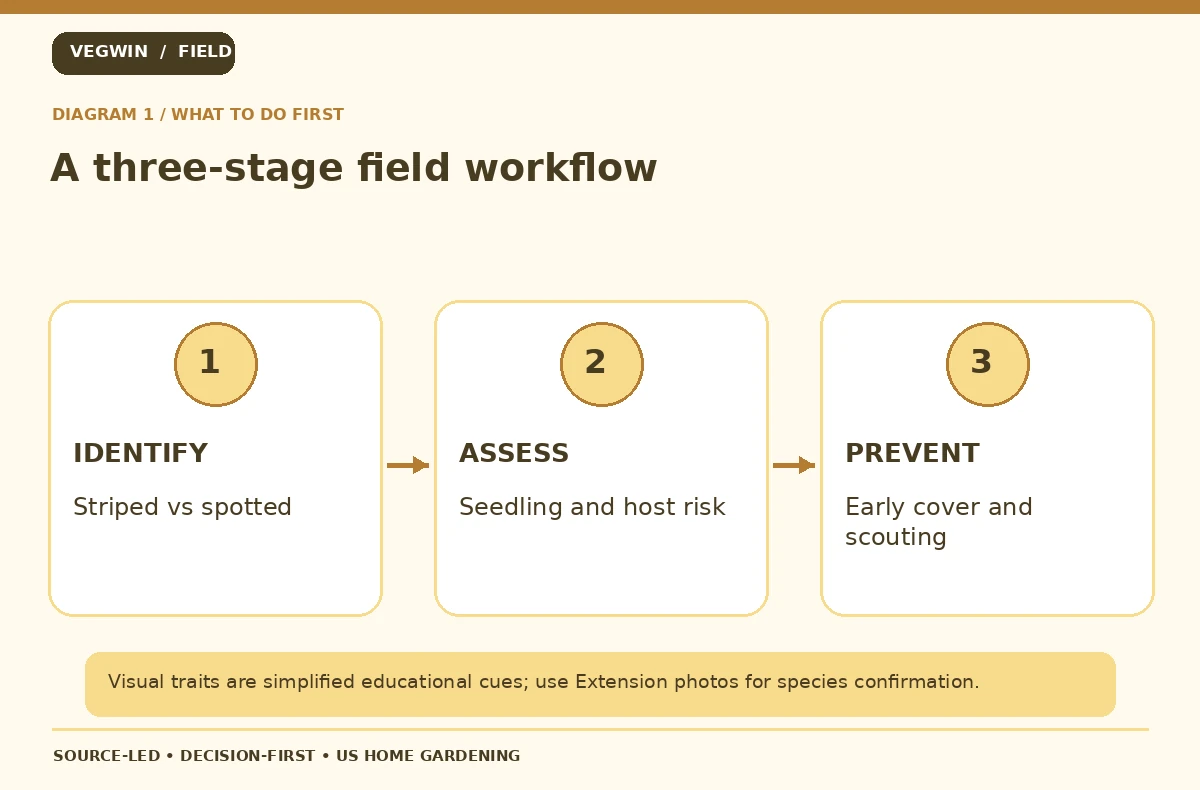
A yellow beetle on a cucumber does not automatically mean a crop needs spraying. First determine whether it is a striped or spotted cucumber beetle, whether the plant is young and vulnerable, and whether wilting is present. This matters because striped cucumber beetles can carry the bacterium responsible for bacterial wilt in cucumbers and muskmelons. Feeding injury and disease transmission are related but different problems. This diagnostic guide separates identification, plant-stage risk, physical exclusion and the point where local IPM advice is needed. It does not offer a pesticide recipe or imply that every beetle found on a pumpkin deserves treatment.
Identify Beetles Before Treating Leaf Holes
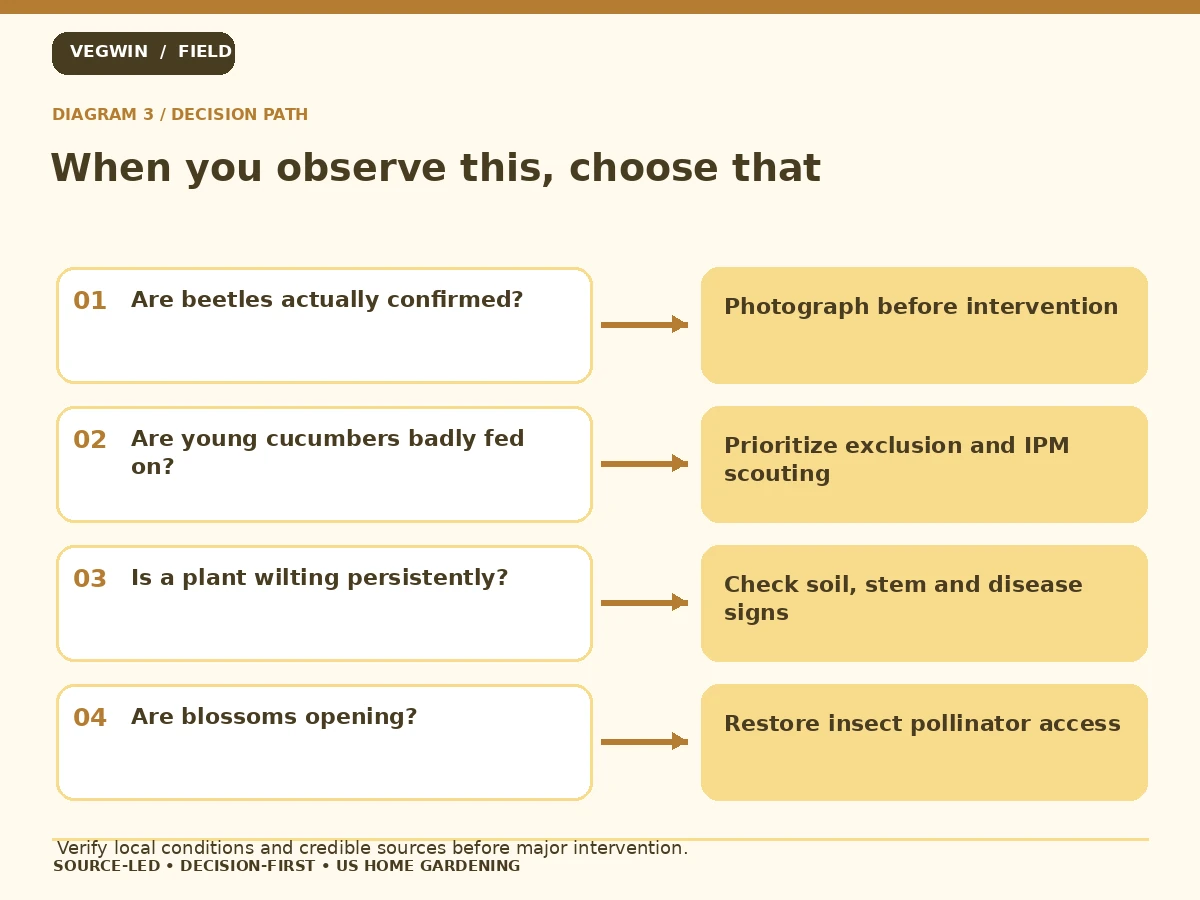
The striped cucumber beetle is a small yellow-green beetle with dark lengthwise stripes on its wing covers. The spotted cucumber beetle has dark spots on a similarly bright background, and its feeding and biology are not identical. Both can occur around vegetable plantings. Beetles may hide in flowers, at the base of seedlings or on the shaded side of fruit. Look for the insect itself and take a sharp photo of its back and body shape, preferably alongside the injured plant.
Do not confuse beetles with squash bugs. The latter are flattened, brownish true bugs with a distinctly different body shape and life cycle. Chewed holes are not a species identification either: flea beetles, caterpillars and other pests can leave visible damage. University of Minnesota and Maryland Extension provide identification photographs and descriptions; compare what you see with those resources before choosing controls. If identification remains uncertain, bring photos and the affected crop to your county Extension or a qualified diagnostic service.
Judge Crop Stage and Actual Damage
A healthy established pumpkin may tolerate scattered chewing that would seriously weaken a newly emerged cucumber seedling. Minnesota Extension emphasizes monitoring cucurbits when they have cotyledons and their first few true leaves. Examine the same plants repeatedly rather than estimating severity from one badly chewed leaf. Record whether feeding is accelerating, how many young plants are affected and whether new growth is still appearing. This is a crop-health assessment, not merely an insect-counting exercise.
If the beetle is present but plants are growing vigorously, continued scouting can be more proportionate than an immediate intervention. Conversely, a tiny cucumber seedling with heavy feeding may need quick protection. Sensitivity also depends on crop: cucumbers and muskmelons face bacterial-wilt concerns, while established pumpkins and winter squash often tolerate more leaf loss. Local thresholds and action advice may differ; do not borrow a number from a commercial field guide without checking whether it applies to home gardens and the specific plant stage.
Separate Bacterial Wilt From Water Stress
Cucumber plants can wilt after dry weather, damaged roots, vine injury or disease. Bacterial wilt is a distinct concern because some cucumber beetles transmit its causal bacterium while feeding. A plant that suddenly loses turgor and fails to recover with appropriate moisture deserves a close inspection. Check soil moisture, stem condition and whether the wilt spreads across the vine. The fact that beetles were seen nearby increases suspicion but does not prove the diagnosis.
Maryland Extension describes a stem-ooze test that can sometimes support identification, but a negative result does not rule out every cause and a positive-looking string is not laboratory confirmation. Photograph symptoms early and consult local Extension when a plant may be infected. Once bacteria are inside the plant, insect sprays cannot reverse that infection. Decisions about removing a badly affected vine and reducing beetle exposure on neighboring plants are different from trying to cure an already wilted plant.
Use Row Covers Before Flowers Need Pollinators
A floating row cover secured around its edges can prevent flying beetles from reaching susceptible seedlings. Timing is critical: install protection before or as plants emerge, not after adult beetles have become trapped inside. Inspect under the fabric and check for heat buildup or plant contact. A cover is most practical for a manageable small planting, with enough clearance for the crop to expand. Evaluate local wind and weather so fabric does not abrade tender leaves.
Standard cucumber and melon varieties normally need insect access to open flowers for pollination. University Extension recommends removing covers when blooming begins, unless another appropriate pollination plan has been made. That creates a real tradeoff: exclusion is useful early, but it cannot simply remain sealed indefinitely. Some parthenocarpic cucumber varieties differ, so confirm the seed packet’s pollination information instead of assuming every crop behaves the same. Continue inspecting exposed plants after cover removal.

Combine Scouting With Low-Risk Prevention
Inspect leaf undersides, flowers, stem bases and the soil line at regular intervals during vulnerable growth. Removing volunteer host plants and managing weeds or debris may reduce shelter, although migrating adults can still enter a clean garden. Rotate planting sites where practical, but do not present rotation as a guarantee against flying insects. Keep transplants well established through appropriate water and care so they recover from limited feeding. The aim is to remove avoidable stress without claiming that healthy soil repels beetles. Our walkthrough on how to identify bean leaf beetles on snap beans and limit damage sets out each step.
Use clean photos and a short monitoring log. Note the date, stage, species, plant location, feeding symptoms and the action taken. This prevents an ineffective intervention from being repeated out of habit. It also helps you ask a precise question of Extension if the problem worsens. Yellow sticky traps and attractive trap crops may be discussed in some regional systems, but neither should be presented as a universal stand-alone solution; they can have tradeoffs and may attract additional insects to the area.
| Observation | Interpretation | Next step |
|---|---|---|
| Young cucumber with new chewing | High vulnerability to feeding | Confirm beetle and protect seedlings promptly |
| Established squash with a few old holes | May tolerate limited feeding | Inspect new growth before escalation |
| Vine wilt despite adequate moisture | Possible disease or stem damage | Document and request diagnosis |
| Beetles on flowering plants | Pollinators may also be present | Use label-safe and pollinator-aware local IPM |
Escalate Only After an IPM Decision
For severe feeding or high disease risk, contact local Extension guidance specific to cucumber beetles, the crop, and your location. Integrated pest management includes identification, monitoring, prevention and appropriate response. Registered pesticides are regulated products, not interchangeable household remedies. A label must allow use on the plant and target pest; it also controls timing, protective gear, harvest intervals and protection of pollinators. Do not spray homemade soap, essential-oil mixtures or unlabeled materials onto edible foliage on the assumption that natural means safe.
Flowering cucurbits attract bees, so any chemical consideration needs particular attention to pollinator precautions. Even a registered treatment may have limited benefit if applied after a susceptible plant is infected with bacterial wilt. Local pest pressure can fluctuate through the season; decisions should follow observed evidence rather than a standing calendar of sprays. This article intentionally supplies no product recommendation, dose or interval because those details require current label and local assessment.
Reinspect and Distinguish Beetle Types
After moving or removing a cover, check whether beetle presence and feeding have actually changed. The goal is not to produce a garden without any insects; it is to keep crop damage and disease risk within a tolerable range. Review a few marked plants every time, looking at newly emerged leaves as well as older ones. Old holes never heal, so counting them alone can make a successful intervention look ineffective. Fresh feeding and new wilting matter more.
A spotted cucumber beetle seen later in the season does not necessarily create the same risk profile as early striped cucumber beetles on seedlings. University of Minnesota notes that spotted beetles may arrive later in its region. That regional pattern should not be exported to every climate. Take repeat photographs, verify identification and decide whether the next step is ordinary observation, renewing protection for young plantings or a local diagnostic consultation.
End the Season With Useful Records
At cleanup, remove diseased crop debris in accordance with local Extension guidance and inspect next year’s planting plan. A site record showing which beds had vulnerable plants, when beetles first arrived and when covers were removed is more actionable than a general statement that cucumber beetles are bad. For small gardens, photos, a handful of observations and the local Extension contact are sufficient documentation. Avoid saving affected plant material for propagation if a contagious disease is suspected. Our walkthrough on how to identify cucumber beetles and protect young cucurbit plants sets out each step.
Consider whether the next planting could establish faster in a suitable local window, use a supported resistant variety where appropriate, or benefit from earlier physical exclusion. None of those ideas is universally foolproof, and cultivar claims must come from reliable sources. The useful distinction is to plan prevention before damage occurs while reserving more intensive responses for observed risk, rather than treating every cucumber-beetle sighting as a pesticide emergency.
Related Guides
- How to Identify Striped Cucumber Beetles and Protect Young Cucumber Plants
- How to Identify Spider Mites on Cucumber Leaves Before Webbing Spreads
- How to Recognize Downy Mildew on Cucumber Leaves Before Vines Collapse
- Cucumber Trellis Guide: Choose Support, Train Vines, and Harvest
- Container Cucumbers: Choose the Pot, Vine Support, and Fruit-Set Plan
How We Research and Verify This Guidance
Our research was checked on October 20, 2026 against the following primary horticulture and seed-conservation references: extension.umn.edu reference 1, extension.umd.edu reference 2, extension.umn.edu reference 3, extension.umn.edu reference 4. Each supports the topic-specific points recorded in the source metadata, but some recommendations depend on cultivar, climate, soil or local pest pressure.
Disclosure: This informational article contains no approved affiliate promotion and no compensated product recommendation. Read the site affiliate disclosure for the policy; the page itself has not been independently verified as accessible. For a site-specific problem, use your local Cooperative Extension and current regulatory labels rather than extrapolating a pesticide or fertilizer rate from a general guide.
A small yellow-green beetle with dark lengthwise stripes. Confirm its body shape using Extension identification images.
Both can feed on cucurbits, but their local season and role in wilt risk differ. Identify the species and crop before acting.
Not necessarily. Water stress, roots and stem damage can also cause wilting; seek qualified diagnosis when symptoms persist.
For normally insect-pollinated cucumbers and melons, remove or manage covers when flowers need pollinator access, following the crop type.
No automatic spray is justified. Identify, assess crop stage and injury, and follow local IPM and the current registered label if needed.