
Pale speckles on cucumber leaves can be a sign of spider mites, but spots alone are not a diagnosis. Adult mites are tiny, usually feed beneath leaves and may remain unnoticed until stippling becomes obvious. This guide pairs the upper-leaf symptom with a magnified view of what to look for underneath and explains how to make an early, low-risk response while protecting beneficial organisms.
Start With Cucumber Leaf Shape and the Stippling Pattern
Cucumber, Cucumis sativus, typically has broad rough leaves with a heartlike base and angular lobes. Spider mite feeding can leave many tiny pale dots across the leaf blade as cells lose chlorophyll. The specks may first be scattered, then merge into larger pale areas when feeding increases. A pale spot is not in itself evidence of mites. Look for the fine distribution of stippling rather than a sharply bounded disease lesion or normal color variation. Check several leaves on the same vine, comparing healthy outer foliage with newer or stressed leaves. An outbreak often becomes visible on leaves that are exposed to hot dry conditions.
Inspect the Underside Rather Than Just the Visible Top
UC IPM emphasizes that spider mites usually live and feed on leaf undersides. Support a leaf gently, turn it over without tearing the petiole, and search along veins and near corners where fine silk or moving specks may appear. A hand lens is very helpful. Do not assume webbing will always be present early in an infestation; dense silk is more noticeable when numbers are high. Adults are much smaller than common aphids or cucumber beetles, so begin by locating a suspect colony rather than trying to identify single dust flecks from arm’s length. Repeat inspections during hot, dry spells.
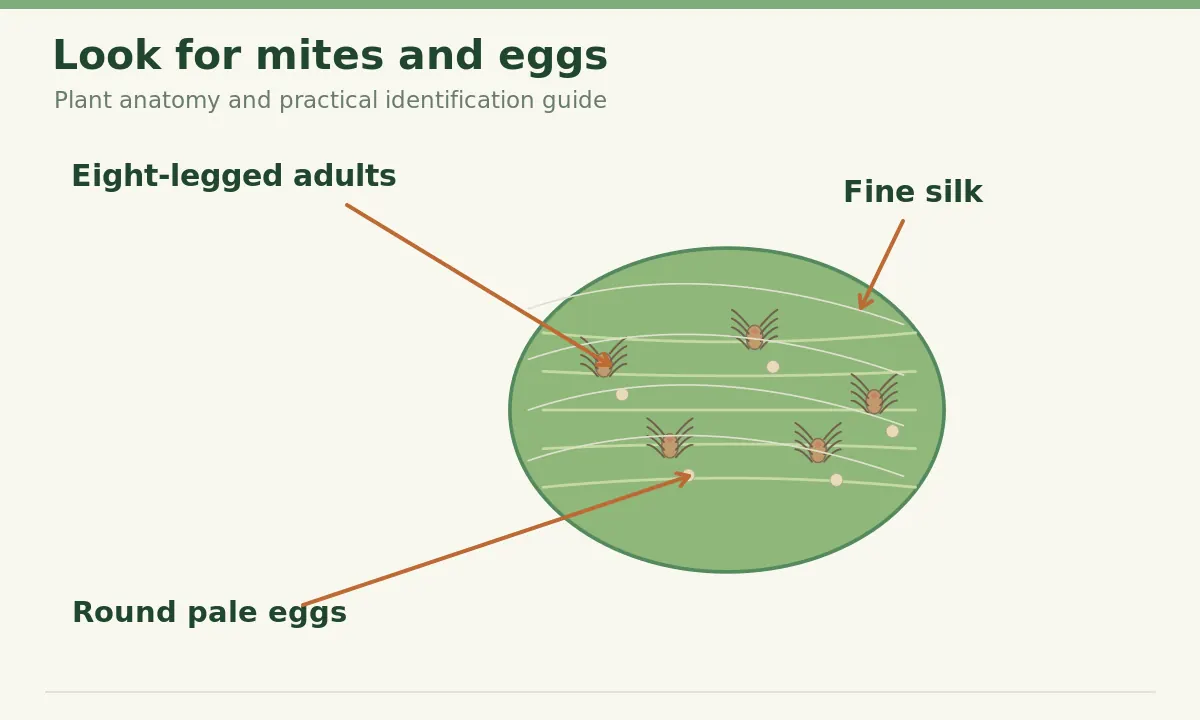
Recognize Adult Mites and Their Small Eggs
Many damaging spider mite species have oval bodies. Adult mites possess eight legs, unlike the six-legged adult insects that may also occupy leaf undersides. Two-spotted spider mites can show darker spots on either side, but coloration varies by species, season and life stage. Eggs are tiny, rounded and pale or translucent; you usually need magnification to see them. UC IPM notes that newly hatched larvae have six legs, so do not demand eight legs of every minute immature specimen. Observe whether specks move and whether groups occur with eggs or fine silk; a single stationary spot may simply be dust or plant debris.
Look for Fine Silk Without Waiting for Heavy Webbing
Spider mites produce very fine silk that can link veins, leaf edges and adjoining tissue. With heavier colonies, webbing collects dust and cast skins. Many gardeners first notice a discolored leaf before spotting silk, so absence of obvious webs does not rule out an early colony. Conversely, a larger spider web between vines does not automatically implicate damaging mites; ordinary hunting spiders can help reduce garden pests. Examine where the silk lies and whether it accompanies mites, eggs and stippling on the same leaf. The illustrated detail shows a limited fine mesh among mites on the underside, not a giant garden spider web.
Use a White-Paper Tap Test to See Moving Specks
Hold a sheet of clean white paper beneath an infested-looking cucumber leaf and tap the leaf gently. Tiny moving dots that fall may be mites. A hand lens helps distinguish them from dust and other very small arthropods. Note the color and speed of any moving specks, then inspect the underside directly for confirmation. This technique is an aid, not a species-level diagnosis. If you find no movement and the leaves have angular yellow areas bounded by veins, consider other causes such as downy mildew and seek local Extension identification. Avoid applying pesticides merely because dots appeared on a leaf photograph.
Compare Mites With Other Leaf Problems
Mite stippling is typically made of many small light specks caused by feeding. Downy mildew on cucumber may produce vein-limited, angular patches, while powdery mildew produces more conspicuous white superficial fungal growth. Nutrient or water stress can also cause pale foliage without colonies or eggs. Thrips produce other patterns and are six-legged insects; aphids are bigger, pear-shaped and often leave sticky honeydew. Sometimes more than one problem exists. The decisive next action is to look beneath the leaf and at the distribution of symptoms across the plant. Never diagnose mites from color alone when the potential response would affect beneficial insects.

Track Whether the Problem Is Increasing
Check a few leaves from different parts of the cucumber vine, including some that still look healthy. Look for live mites, webbing, eggs and new pale stippling over several days. If a small colony stays stable and predatory arthropods are present, monitoring can be more appropriate than immediate broad spraying. UC IPM emphasizes natural control and notes that low levels of mites may be tolerated. A rapidly expanding infestation causing bronzing, leaf drying and loss of vigor merits more urgent attention. Do not claim a universal numeric spray threshold for home cucumbers when local conditions and natural enemies differ.
Reduce Stress That Helps Mite Problems Escalate
Cucumber plants under water stress can suffer more strongly when mites feed on leaves. Water the root zone consistently without keeping soil waterlogged and manage irrigation based on weather and actual soil moisture. Limit dust on pathways near susceptible plants and avoid unnecessary broad-spectrum insecticides, which can remove predatory mites and beneficial insects that suppress pest mites. Do not strip away dozens of functioning cucumber leaves to make the plant look cleaner; leaves power fruit production. Where a few leaves are severely damaged, removal may be considered cautiously, but first check that it will not stress the whole vine further.
Choose a Control Only After Confirming Active Mites
If action is warranted, UC IPM discusses water sprays, insecticidal soaps and horticultural oils as possible options for some home situations. A firm water spray must reach the leaf underside to dislodge mites, but vigorous jets can damage tender cucumber tissue. Any soap or oil must be labeled for the site and crop, used precisely as directed and assessed for heat-related plant injury and local restrictions. Do not substitute household dish soap or combine chemicals based on online guesses. Avoid broad-spectrum products where predators are active. A single treatment does not guarantee elimination; follow label guidance and inspect again.

Protect Helpful Predatory Arthropods
Several naturally occurring predatory mites, thrips and other beneficial insects feed on spider mites. UC IPM stresses that insecticide choices can cause outbreaks when they kill predators faster than the pest. Look for distinct fast-moving predators during close inspection, but do not assume every tiny insect is helpful without identification. Maintaining a diversified garden and avoiding unnecessary persistent broad-spectrum sprays supports these natural enemies. Purchased predators may work in some protected cropping systems, but effectiveness outdoors depends on conditions and species; do not promise success without a specialist plan. A good management choice preserves beneficial control wherever possible.
Finish With an Evidence-Based Leaf Diagnosis
Check upper surfaces for stippling, turn leaves gently to inspect veins beneath, use a magnifier for mites and spherical eggs, and look for any fine silk. Compare symptoms with mildew, weather stress and aphid or thrips damage. Record whether active colonies are growing and whether predators are present. Then prioritize plant moisture and predator conservation, choosing only labeled targeted controls when the severity justifies it. Do not wait for a vine to be completely webbed, but do not spray automatically at the first pale dot either. This two-sided approach turns an uncertain visual symptom into a sensible next step.
Related Guides
- Cucumber Beetles: Identify the Pest and Prevent Wilt Risk Early
- How to Identify Striped Cucumber Beetles and Protect Young Cucumber Plants
- How to Recognize Downy Mildew on Cucumber Leaves Before Vines Collapse
- How to Train Vining Cucumbers Up a Trellis Without Breaking Stems
- Cucumber Trellis Guide: Choose Support, Train Vines, and Harvest
How We Research and Verify Plant Advice
Sources checked on 2026-10-26: ipm.ucanr.edu; ipm.ucanr.edu; ipm.ucanr.edu. We reviewed each institution’s plant identification, correct growth stage and relevant cultural recommendations before adapting them into an independently written step-by-step guide. Where sources are region-specific, their calendar details are not applied universally. Pictures use simplified teaching shapes and should be compared with living specimens; they are not a substitute for laboratory disease diagnosis or local climate guidance. The relevant advice is paraphrased rather than reproduced.
Safety and Independent Editorial Disclosure
This independently prepared educational article does not claim sponsorship or affiliate approval. Our category reading links are informational, not product endorsements. See the VegWin affiliate disclosure. Clean sharp tools before cutting plants, protect hands from thorns and blades, and keep cut plant material away from children and pets where appropriate. Use only locally registered plant treatments labeled for the actual crop, and observe the product label. Do not rely on unsupervised home remedies or unverified harvest-safety promises.
Mostly on the undersides of leaves, especially near veins, where eggs and fine webbing may also occur.
No. Inspect for living mites and eggs because disease, nutrient issues and other pests may discolor leaves.
Adults have eight legs; newly hatched larvae can have six.
Tap a suspect leaf gently above white paper and inspect moving dots with a hand lens; confirm with underside inspection.
Not necessarily. UC IPM notes low populations may be tolerated; protect predators and base intervention on active damage and local labels.