
Celery rewards gardeners who can provide a long, relatively moderate growing period and unusually steady moisture. It is not simply lettuce with thick stems. The edible stalks, or petioles, are part of a plant that grows slowly at first and has a comparatively shallow root system. Decide whether you intend to cut outer stalks over time or harvest a whole head. The choice affects spacing, garden access and when you should stop waiting for more growth.
Because celery responds poorly to both prolonged drying and some periods of cold, choose a planting window from local weather patterns rather than USDA hardiness zones. Seed packet estimates are useful only when interpreted with the temperatures, light and moisture a particular planting will receive. In a climate with intense midsummer heat, a shoulder-season plan may make more sense than assuming celery grows like tomatoes. Check local Extension guidance for a realistic transplant date.
Choose Stalk Celery and a Suitable Growing Window
For foundational crop recommendations, consult Utah State University Extension. Its local conditions are a research reference, not a universal planting-date rule. This page focuses on the specific decisions below; keep your seed packet and local Extension information close when making a regional plan.
Start Tiny Celery Seed Early and Expect Slow Germination
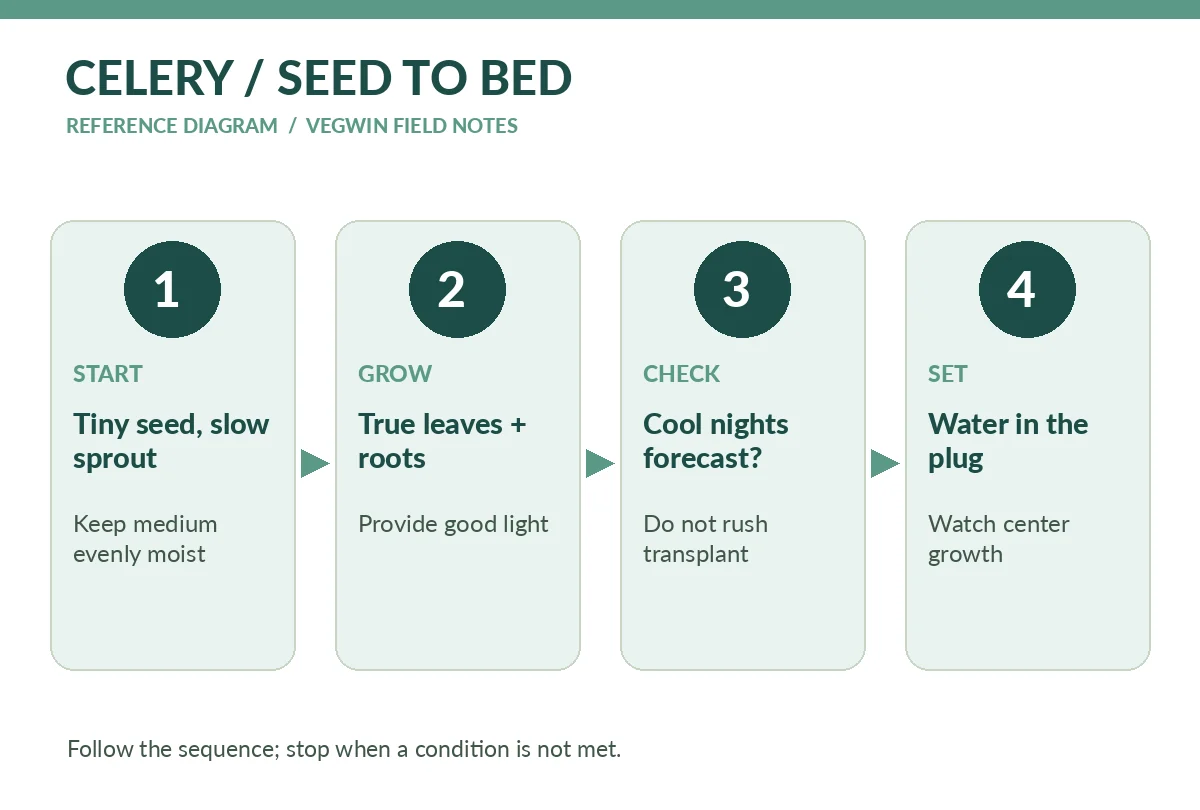
Celery seeds are tiny and seedlings can take longer to appear than many familiar vegetables. Iowa State Extension lists a comparatively long indoor-start interval and a germination period often measured in weeks rather than a few days. Sow according to the packet instructions for the specific celery type; avoid covering fine seeds deeply. Use a clean, evenly moist seed-starting medium and enough gentle light for the seeds and emerging seedlings. Do not allow the surface to crust or dry out.
Once seedlings have true leaves, maintain good light and airflow without blasting them with heat or wind. Water from a gentle source so roots remain anchored. Thin or transfer seedlings without burying the growing point. Seedlings that remain weak, very crowded or pale cannot be rescued just by transplanting them earlier. A purchased healthy transplant is a reasonable option if the seasonal window is short or an indoor space cannot provide reliable light.
Transplant After Checking Chilling and Bolting Risk
Celery is not a heat-loving fruiting crop, yet prolonged cold exposure of young plants can encourage premature flowering, or bolting. Utah State Extension discusses how cool conditions may initiate flower stalks instead of the tender vegetative growth you want. Harden young plants gradually and inspect upcoming night temperatures, not just the average last frost date. A sudden exposed transplant in a windy cold bed can be set back even when the soil looks workable.
Space plants according to the cultivar, growing method and local university guidance, and transplant only after roots and several true leaves have developed. Prepare fertile, well-drained soil and use a soil test before designing a fertilizer program. Water the root ball thoroughly after planting; check that surrounding soil makes contact without compacting it. Protect young plants when conditions warrant, but ensure any protective cover can be vented and does not hold in excessive heat. For the fuller picture, see our guide to growing leeks.
For a second independent view of the underlying horticulture, see Iowa State University Extension. Pay attention to the specific cultivar, symptom, or growing condition discussed rather than copying any regional calendar literally.
Keep the Entire Shallow Root Zone Evenly Moist
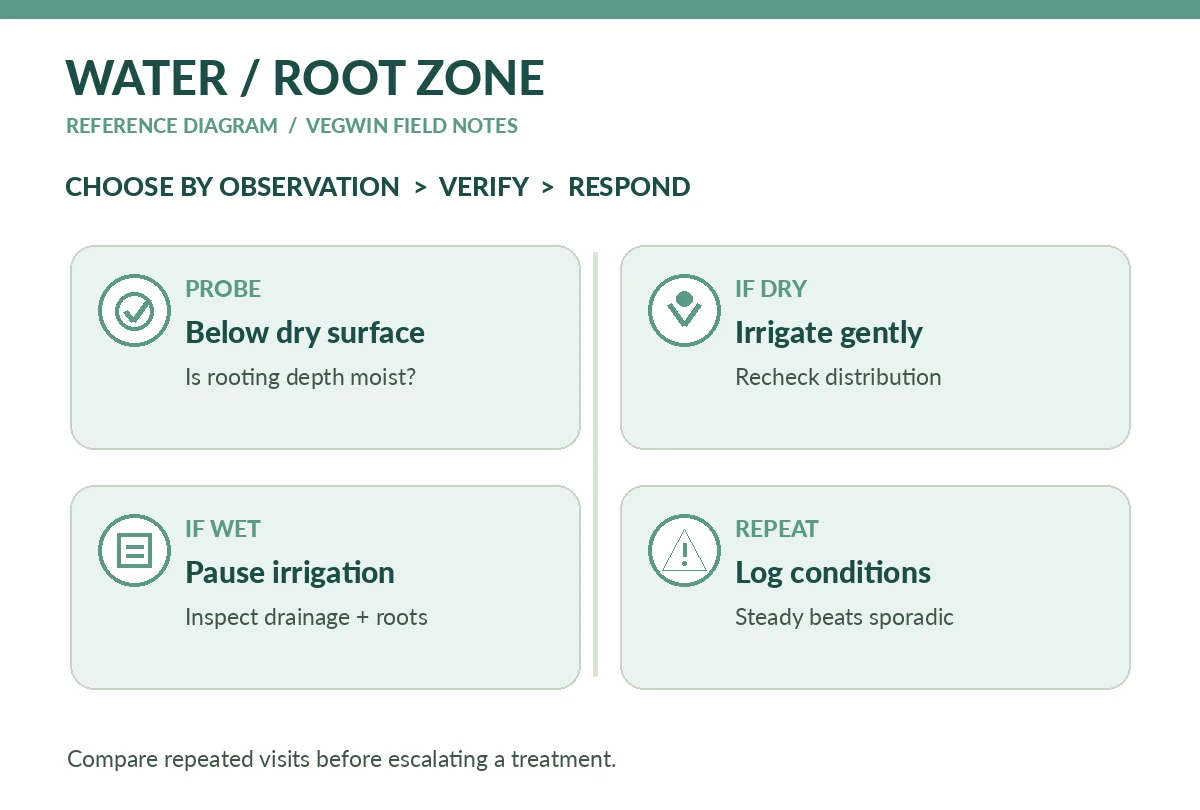
The defining celery skill is steady root-zone moisture. Utah State Extension highlights water stress as a reason stalks become stringy and strongly flavored. Inspect the soil below its top surface, then water sufficiently to reach the active roots without leaving the bed waterlogged. A watering can, soaker hose or drip line can work, provided you verify where water is actually going. Irrigation time alone is not proof that roots received enough water, particularly with uneven emitters or crusted soil.
An organic mulch can slow evaporation and suppress weeds once plants are established, but it should not be packed tightly against the crown. If the leaves droop on a hot afternoon, verify whether the deeper soil is dry before immediately adding more water. It is possible for plants to wilt temporarily while the soil is wet; in that case, investigate heat, root damage or poor drainage. Look at new growth and stalk firmness on repeated visits rather than treating a single drooping leaf as a diagnosis. For more detail, our guide “Tomato Plants Care” looks at a weekly checklist for water, leaves, and fruit.
Distinguish Blackheart From Ordinary Tough Stalks
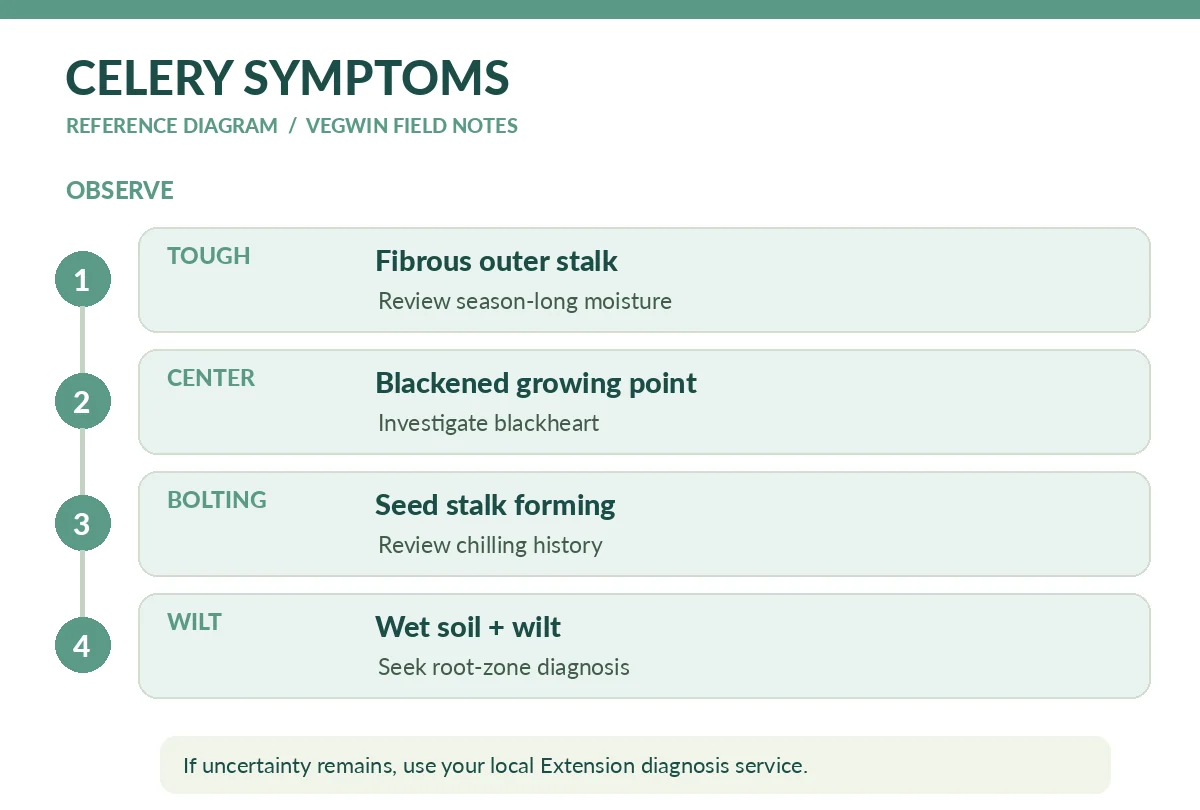
Blackheart is an internal celery disorder associated with inadequate calcium reaching developing tissue, not simply a cosmetic dark mark on an old outer leaf. Utah State Extension describes dead or blackened tissue near the growing center. Calcium movement and root-zone water supply are connected; the existence of the disorder does not prove that the entire soil lacks calcium. Start by examining the center of the plant, the distribution of symptoms and the recent watering pattern, and consult local diagnostic guidance.
Stringy outer stalks without center death are a different problem, often tied to slow growth, aging or moisture stress. Discard visibly decayed tissue and do not treat it as a safe food-quality defect. Avoid automatically adding lime, calcium sprays or concentrated nutrients when you have neither a reliable diagnosis nor a soil test. Consistent moisture, sound drainage and properly interpreted soil results are the first steps, not an invented universal remedy.
| Symptom | Likely question | First check |
|---|---|---|
| Tough, stringy petioles | Did roots repeatedly dry? | Probe soil below mulch; review water log |
| Flower stalk begins early | Was transplant chilled? | Review prolonged cool exposure |
| Center tissue turns black | Is blackheart possible? | Inspect growing point; seek diagnosis |
| Leaves wilt in wet soil | Is drainage or root health poor? | Check soil, odor and roots before watering |
| Small weak transplants | Light or crowded seedlings? | Review light, air and root development |
Harvest Outer Petioles or a Whole Celery Head
Choose harvest style before cutting. For a continuing supply, take mature outer petioles carefully and leave the center growing, as Utah State Extension describes. For a whole-head harvest, lift or cut the plant when the head has reached useful size and stalk quality. Small heads can be delicious, but do not confuse a premature seed stalk with normal maturity. Evaluate crispness and signs of pithiness as well as diameter. For the basics, see our guide: When to Harvest Celery.
Harvest when plants are hydrated and handle the stalks gently. Remove badly damaged leaves and wash food-contact surfaces with clean water before preparation. Refrigerate fresh celery promptly and use it while quality remains good. A last-minute heavy watering cannot reverse months of stringy growth, so quality must be built through the season. For long-term preservation, use tested food-safety directions for the intended method rather than improvising canning procedures. For the fuller picture, see our guide “Eggplant Gardening”.
Use a Celery Care Log for Faster Diagnosis
Each week, write down three observations: moisture several inches down, the state of the central growing point and the texture of outer stalks. A consistent record will distinguish a moisture problem developing over time from an isolated blemish. Also note long cool spells after transplanting and whether a flower stalk begins to elongate. Mark where drip water lands, especially if one side of the bed thrives and the other stays small.
Do not confuse a broad planting window from Utah or another Extension office with a nationwide date. When a problem appears, identify the likely stress first, then compare a healthy and an affected plant. If the center is blackened, or wilting persists despite appropriate moisture, obtain local diagnosis. Management should target the actual cause; extra watering into already saturated soil can make a root problem worse.
Related Guides
- How to Start Celery Seeds Indoors for Strong Leafy Transplants
- How to Start Chinese Leaf Celery From Seed for Slender Aromatic Stalks
How We Research and Update This Guide
Research checked on October 20, 2026: Utah State Extension; Iowa State Extension; Iowa State Extension, reviewed July 2026. We compare university Extension and IPM advice, prioritize observable crop-specific decisions, and avoid giving universal pesticide doses, fertilizer rates or nationwide transplant dates. Recommendations that depend on soil, cultivar, weather and local regulations must be rechecked for your location.
For the site-wide policy, see VegWin affiliate disclosure. The status and availability of that page should be verified in WordPress. Information here does not replace local Extension diagnosis, an approved pesticide label, or tested food-preservation instructions.
Celery grows slowly, has relatively shallow roots and needs consistent moisture to produce tender stalks.
No. Fine celery seed has specific light and depth requirements; follow seed packet and Extension guidance, keeping the surface evenly moist.
Prolonged cold exposure of young plants can promote bolting. Review the transplant temperature history and consult local recommendations.
Not by themselves. Repeated moisture stress and maturity can contribute to texture; blackheart is a different condition affecting internal growing tissues.
Yes, mature outer petioles can be removed while the center continues growing, if the plant remains healthy and productive.