
Romanesco is recognizable by its chartreuse head made of many repeating, pointed towers. It is a cauliflower type, not a broccoli plant with a few unusually shaped leaves. What gardeners harvest is an immature group of flower structures, called the curd. The key is to grow a vigorous leaf canopy before the plant begins forming that head, then harvest it while the cones are compact. Keeping the outer leaves tied over a green Romanesco curd, as gardeners sometimes do for white cauliflower, is the wrong borrowed technique.
Recognize the green geometric curd
The edible center of Romanesco consists of closely packed, pointed green florets nested in a larger cone-like arrangement. Around the curd, broad blue-green waxy leaves rise on sturdy stems from a central base. A Romanesco seedling looks like other young cauliflower brassicas, so rely on an accurate plant label until the head develops. The head has a firm, pebbled geometry when ready, not fluffy leaves or a fully opened flower. This matters when choosing harvest timing: individual cone tips should still be tightly composed instead of loosened into flowering structures.
Plan for cool head-forming weather
Romanesco generally performs best when the curd forms during cool conditions. University of Minnesota Extension specifically calls pointy green Romanesco a fall crop and places good cauliflower curd formation in cool weather. A warm summer can still help build leaves, but prolonged heat during head development may cause poor texture or loose florets. Work backward from a locally realistic fall or mild-season harvest rather than copying a generic hardiness zone as a planting date. In frost-free climates, select a reliably mild season and compare results with local horticultural guidance.

Raise transplants without stalled growth
Start seed according to the cultivar packet and regional planting window, using clean, well-draining seed-starting medium. Keep young seedlings under ample light and avoid overcrowded trays. Move transplants outdoors when local weather and soil conditions can support growth, hardening them off so the shift in sun and wind is gradual. A small pot-bound transplant may remain weak even after it enters a good bed. When setting plants, keep the crown near its established soil level rather than burying the leaf stems. Inspect roots before planting and water in thoroughly.
Give outer leaves room to expand
Unlike a quick-cut salad, Romanesco needs time to build a substantial crown of foliage. Use plant spacing on the chosen cultivar packet or local Extension guidance, avoiding the very tight distances suited only to baby brassicas. Broad leaves need daylight, and cramped plants compete for water and can stay moist in ways that encourage problems. The young green center does not need a stake to hold it up. Weed while the foliage is small, then use a sensible mulch if needed to moderate soil moisture without piling material against the crown.
Support steady moisture and nutrition
Cauliflower types are sensitive to interrupted growth. Maintain moisture through the active root zone instead of allowing a wilting-drying cycle, while avoiding standing water. Romanesco favors fertile, well-drained soil; UMN Extension advises a soil test to determine amendment requirements and gives cauliflower a moderately specific pH preference. Do not add indiscriminate fertilizer rates just because a curd is slow to form. Excessive nitrogen without an appropriate overall nutrient balance can encourage foliage without solving environmental problems. Compare canopy health and weather before attempting any correction.
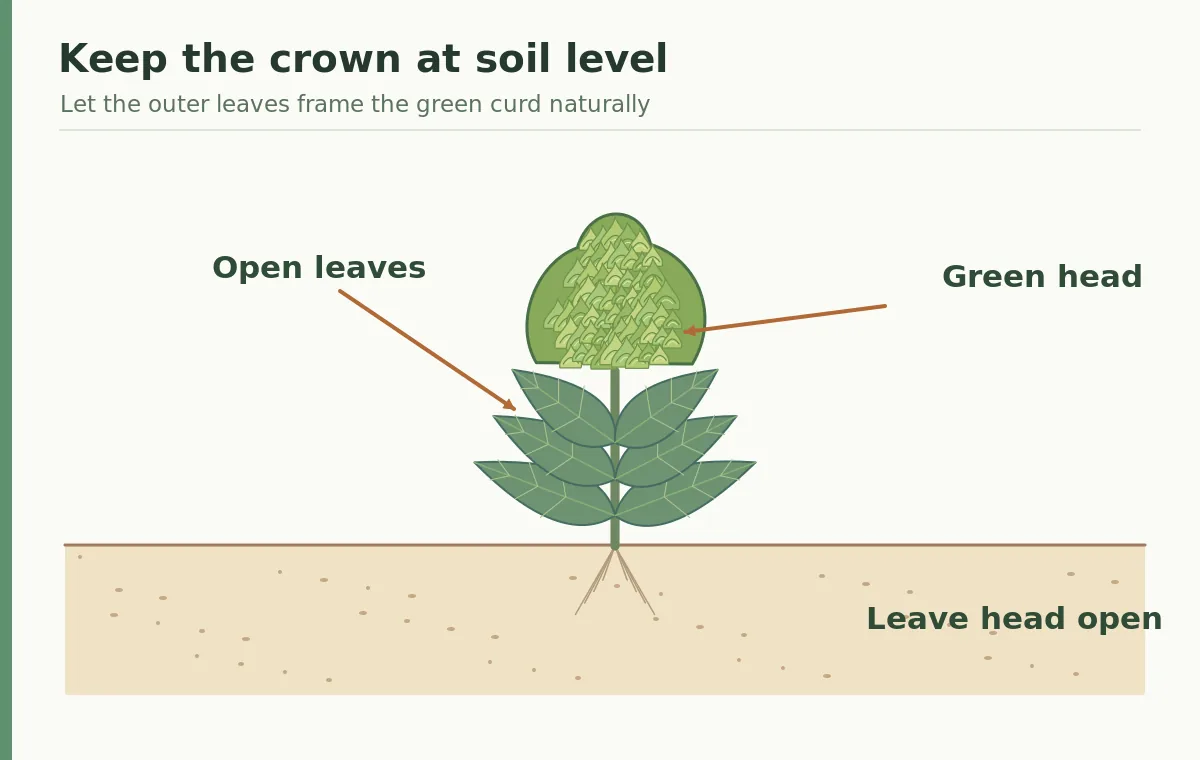
Leave green curds uncovered for color
White cauliflower is sometimes blanched by drawing surrounding leaves over its developing curd to keep the head pale. Romanesco is intentionally green; University of Minnesota Extension advises not to tie leaves around colored or Romanesco cauliflower heads. The outer leaves can naturally arch beside the curd, but they need not be bundled shut over it. Inspect for pests without peeling away the entire canopy. A useful diagram shows the visible green head inside an open collar of leaves, not a white bulb buried beneath soil or wrapped with tight twine.
Cut the head before florets separate
Look for a well-developed Romanesco head with packed cones that have not begun to lengthen into loose flowering growth. Use a sharp knife to cut the main stem below the curd, leaving a few protective leaves if practical. Put the knife at the stalk below the edible structure, not across the green cones. A mature but still tight head is generally better than one left until individual sections look open, fuzzy, or discolored. Cultivars differ in head size, so judge texture and firmness before any exact diameter promised by a calendar.
Distinguish stress from insect damage
If the head stays tiny, first check whether the plant had time to establish foliage, sufficient space, and stable temperature during its head-forming stage. Ragged holes in leaves may indicate caterpillars or other chewing pests, not an infectious disease. Inspect underside surfaces and look for actual larvae or eggs before choosing IPM steps. Avoid disturbing the main bud during inspection. If several plants decline together, review drainage and the history of brassica crops in that bed; persistent root disease concerns call for local Extension identification.

Use the harvest as a record for next season
Write down sowing and transplant dates, cultivar name, head appearance, and the pattern of warm or cool spells during curd formation. The timing of planting is often easier to improve than changing a mature crop after the head becomes loose. Gardeners in cool-summer regions may succeed on a different schedule from those who need an autumn crop. Harvest promptly and refrigerate the head rather than expecting it to improve in the field after buds start opening. Keep your own photo of a tight head as a useful next-year quality reference.
Related Guides
- Growing Cauliflower: Protect the Curd and Spot Stress Early
- How to Blanch White Cauliflower by Folding Leaves Over the Developing Head
- How to Grow Purple Cauliflower With Tight, Firm Curds
- How to Grow Romanesco Cauliflower in a Container With Firm Spiral Curds
How We Research and Verify Growing Advice
For this article we compared visible plant anatomy with topic-specific advice from extension.umn.edu, www.rhs.org.uk. Published recommendations explain general crop behavior, but your local weather, cultivar, soil and garden history govern the final decisions. We verified the sources on October 28, 2026. No commercial sponsor paid for or approved this article.
We do not present any product as a confirmed affiliate purchase. See the affiliate disclosure for site policy. Before applying pest controls, inspect the actual cause and seek local Cooperative Extension integrated pest management advice. Illustration arrows indicate the intended botanical position rather than replacing observation of your own plant.
Romanesco is generally grown as a green cauliflower type with a pointed spiral curd.
No. Unlike white cauliflower, Romanesco should remain exposed enough to develop its characteristic green color.
Heat, interrupted growth, or leaving the head too long can cause poor-quality, separated florets.
Cut when the conical green florets are firm and tightly packed, before they begin separating.
Head development usually benefits from cool conditions; choose the local season that brings cool weather at curd formation.