
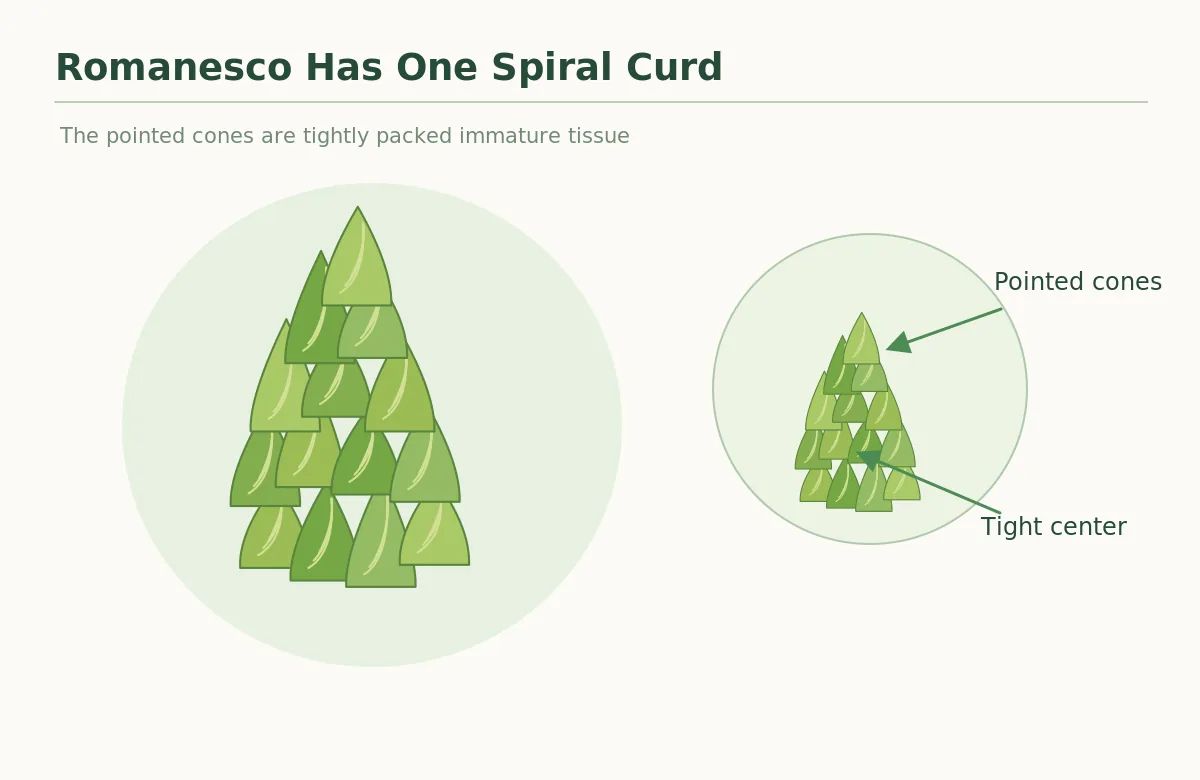
Romanesco has one of the most recognizable heads in the vegetable garden: a lime-green cluster of repeating pointed cones packed into a spiral. Although often sold as “Romanesco broccoli,” garden advice commonly groups it with cauliflower, Brassica oleracea var. botrytis. What you harvest is an immature central curd, not a bundle of leaves and not a cluster of separate seed pods. Growing this large brassica in a container can be rewarding, but a decorative little pot rarely gives its roots or broad leaves enough space. This guide turns container size, cool timing, moisture and the appearance of the developing curd into practical decisions before you cut.
Identify Romanesco as a Head-Forming Brassica
The plant starts as a leafy cauliflower relative with bluish green, broad, somewhat wavy leaves. A well-developed central head later forms repeating pointed conical units, all clustered into one edible curd. Minnesota Extension explicitly calls pointy green Romanesco cauliflower a fall crop in its growing guide. The head’s symmetry comes from plant development, not an artificial carving of broccoli florets. Do not confuse its single large center with purple sprouting broccoli, which produces many smaller branching spears over a longer period.
The true vegetable crop needs adequate room for roots and an extensive leaf canopy before the head can form. A Romanesco seedling can sit in a small starter cell, but a mature plant cannot be judged by the size of that seedling. Examine the center as it grows without tearing young leaves apart; a small central curd is normal when the plant is ready to begin heading. Healthy mature leaves are the factory supporting the head, so removing many of them to make a container look tidier is counterproductive.
Select a Wide Deep Container With Reliable Drainage
Pick a large, sturdy container that can support a full-size cauliflower relative and will not tip in wind. There is no universal magic pot volume: the space needed depends on cultivar, growing season and how often you can water. A shallow ornamental bowl encourages restricted roots and rapid dry-out. Use a quality, moisture-retentive but free-draining growing mix. Check that drainage holes are unobstructed and that runoff can escape rather than leaving the roots in stagnant water.
Leave room around the planting for spreading leaves and access for inspection. If the container sits beside a wall, make sure only the pot—not the whole canopy—fits the site. A head-forming brassica needs light; excessive shade can stall the plant. Avoid reusing potting mix from a container with a confirmed serious brassica disease without appropriate sanitation. Minnesota Extension recommends crop rotation away from other cabbage relatives in beds; in a pot, attention to clean mix and plant health matters just as much.
Start Seedlings Carefully and Transplant With Roots Intact
Sow Romanesco seeds in a clean medium and raise them in sufficient light so their stems do not stretch thin. Minnesota Extension describes cauliflower seeds sown shallowly in a seed-starting medium, then hardened-off seedlings set at their original soil level. Aim for strong young plants with several true leaves, not long, pale transplants that collapse immediately outdoors. Acclimate indoor-grown plants gradually to wind and stronger light. Climate and chosen cultivar set the best planting window: in many hot-summer regions a cooler fall crop is easier than a midsummer head.
Moisten the large container first. Open a hole large enough to receive the root ball without twisting roots sharply and place the seedling near its original potting depth. Do not bury the central growing point under wet compost. Firm gently around the root ball, then water thoroughly so roots and new mix connect. A few older leaves may droop after moving, but steadily unfolding central leaves are a better sign that growth is continuing. Cover young plants with insect mesh where relevant, keeping it off the tender head.

Provide Steady Water While the Leaf Canopy Expands
Cauliflower-family crops need regular water to build the leaves and firm curd, and containers dry more rapidly than deep beds during hot or windy weather. Minnesota Extension connects drought stress with poor cauliflower quality; RHS likewise advises adequate watering through critical growth stages. Check moisture several inches below the surface instead of relying on the top dust layer alone. Thoroughly wet the whole medium, then allow excess water to drain. Repeated shallow splashes leave the deep root zone dry.
Do not force growth with speculative fertilizer doses. Use the medium’s existing nutrient content, a suitable balanced feeding plan if needed, and local soil or media guidance. Overfeeding will not compensate for a pot that overheats, a cramped root zone or unsuitable temperatures during head initiation. Mulch can limit surface evaporation, provided it does not remain pressed against the young center. Keep the large leaves rather than stripping the canopy. If the container tips or rocks in wind, secure it before roots are repeatedly disturbed.
Keep the Spiral Curd Exposed and Watch for Pests
Romanesco is green and should not be blanched like a white cauliflower. Minnesota Extension specifically cautions against tying leaves over Romanesco-type heads because they need light for full color. The developing curd should be made of dense, pointed green sections arranged tightly together. Do not assume that every gap indicates a disease: growth stage, cultivar and weather affect appearance. If cones are noticeably separating and the head looks loose, plan harvest instead of waiting for it to enlarge indefinitely.
Inspect both upper and lower leaf surfaces for caterpillars, eggs and feeding damage. Brassica crops may suffer flea beetles, imported cabbageworm, loopers, or diamondback moths in different regions. Identify insects before using any control and follow current local labels for any treatment. A fine mesh cover can physically exclude some insects when secured early. If lower leaves turn yellow or wilt persistently, examine water conditions and roots; a curd will not be improved by ignoring a struggling plant in hopes of bigger cones.
Cut a Tight Head Before the Cones Start Loosening
Harvest Romanesco while the head remains firm and the conical units are dense, before buds spread and flower. RHS gives that principle for cauliflower curds, and Minnesota Extension notes that waiting too long makes heads loose. Use a clean sharp knife to sever the main stalk below the curd while retaining a few protective leaves as practical. The leaves are not the curd itself, and the cut belongs below the whole head, not through a row of tiny spiral tips.
If the head formed poorly, review root space, moisture records and growing temperatures before replacing the entire approach. A plant with impressive leaves and only a small head can reflect heat stress, low light, irregular care or cultivar timing; the symptom alone does not prove nutrient deficiency. For your next planting, record the container dimensions, weather at head initiation and harvest appearance. That comparison gives you a repeatable method rather than a guess based on one unusual-looking Romanesco head.

Related Guides
- Vegetables in Pots: Match Crops, Container Volume, Sun, and Water
- Growing Cauliflower: Protect the Curd and Spot Stress Early
- How to Grow Romanesco Cauliflower With Tight Green Spiral Curds
- How to Blanch White Cauliflower by Folding Leaves Over the Developing Head
- How to Grow Purple Cauliflower With Tight, Firm Curds
How We Research and Verify This Method
The following specialist horticultural pages were checked on 2026-10-27: extension.umn.edu — Minnesota Extension explicitly describes pointy green Romanesco cauliflower as a fall crop and explains transplanting, moisture, pests and harvest. www.rhs.org.uk — RHS explains developing curds, sowing, cultivation and harvest while heads stay compact. www.rhs.org.uk — RHS explains why brassica and leafy crops need steady water during development. The guidance distinguishes source-backed cultivation steps from cultivar, climate, and container choices that gardeners must adapt. The diagrams show anatomy and safe positions for actions, not exact guarantees of growth or harvest.
No paid product placement was used in producing this guide. The site-wide policy is available in the VegWin affiliate disclosure.
It is commonly sold as Romanesco broccoli but is a head-forming cauliflower type with a spiral green curd.
Yes, with a generously sized well-drained container, adequate leaf space and steady moisture.
No. Minnesota Extension advises keeping Romanesco-type heads exposed so their green color develops.
The spiral cones are tight and firm, without obvious loosening or open flowers.
Heat, water stress, insufficient growing space, timing or other plant-health problems can contribute.