
Cauliflower rewards careful timing more than heroic last-minute rescue attempts. The edible head is a compact curd of developing flower stalks, not a bundle of leafy cabbage tissue. A plant may build impressive foliage and still fail to produce a tight curd if it experiences temperature swings, water stress, or a check in growth. The practical goal is to raise a vigorous plant first, then shepherd the curd through cool, steady weather. This guide helps you decide when to plant, when to shade a white head, and when to harvest rather than waiting for a calendar date.
Choose the Cauliflower Type Before Scheduling
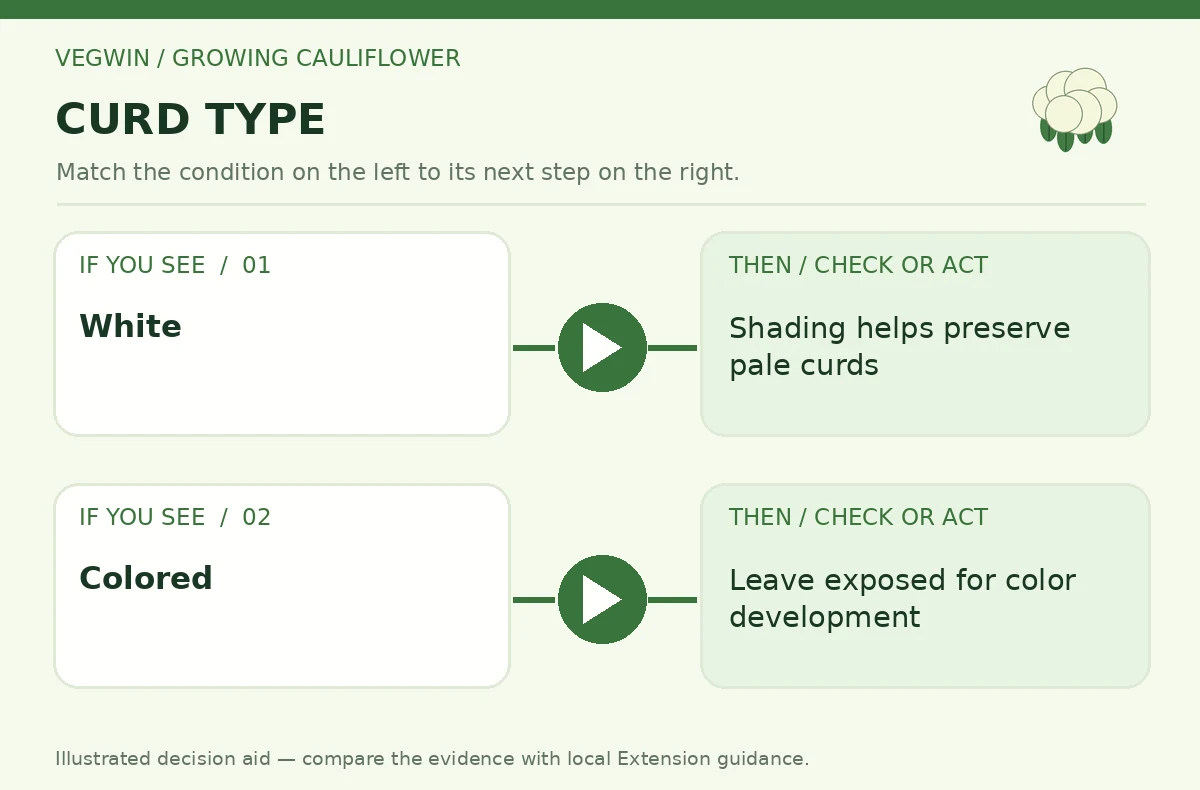
Standard white cauliflower, self-blanching types, purple or orange selections, and pointed Romanesco do not all need identical head care. University of Minnesota Extension explains that white heads commonly benefit from having outer leaves brought over the curd to retain a pale appearance; self-blanching types may do this themselves. Colored and Romanesco types need light for their characteristic appearance, so tying their leaves shut can defeat the point of choosing them.
Read the packet for cultivar development time and its recommended season. A fast spring selection and a slower fall selection can face different risks in the same garden. Avoid assuming a listed maturity number begins at seed sowing: some catalogs count from transplanting. Record when each plant was actually set outside so you can interpret its progress rather than treating a projected harvest date as a promise.
Schedule Head Formation for Mild Weather
Cauliflower is a cool-season brassica, but a cool-season label is not a universal planting date. The Minnesota and Iowa Extension guides favor establishing plants so that curds form during relatively mild conditions. Unexpected hot spells during curd development can loosen the head or interrupt formation, while long periods of early stress can reduce plant size. A fall window may be easier in regions where late-spring heat arrives abruptly, but short fall days and first frost still limit what can mature.
Begin with regional last and first frost guidance, the expected weather during head development, and the cultivar packet. For spring, check whether transplants have enough time to become established before summer heat; for fall, work backward from a realistic harvest period and include transplant recovery. USDA hardiness zones classify average extreme winter cold for perennials, not the local timing of annual cauliflower planting.
Prepare Fertile Soil Without Guesswork
Choose a bed with good drainage and dependable water access. Cauliflower performs poorly when its roots alternate between saturation and drought, especially as the edible curd develops. Incorporate finished compost where a soil test and soil structure warrant it, and avoid fresh manure around an edible vegetable crop. Extension fertility recommendations are based on local soil tests; their numerical application rates should not be copied to unknown soil.
If leaves are pale or growth appears stalled, do not immediately pour on a high-nitrogen fertilizer. Root injury, compaction, poor drainage, cold soil, insects and a genuine nutrient shortage can look similar from a distance. Compare an affected plant with healthy neighbors, inspect the root zone carefully and use a current soil analysis before choosing amendments. Strong leaves are necessary, but simply producing more foliage does not guarantee a good curd.
Establish Transplants Without Early Shock
Most home growers find it simpler to start cauliflower in a clean seed-starting mix and transplant sturdy seedlings into prepared soil. Iowa State lists an indoor seed-starting approach for spring crops, while Minnesota describes local summer sowing for fall harvests. Harden transplants gradually and avoid leaving them rootbound for too long. Water each transplant in so that soil contacts the roots and continue checking moisture below the surface.
Young plants need enough room for full outer-leaf development, not just for the eventual curd. Follow the cultivar and local Extension spacing guidance; an 18-inch spacing appears in Minnesota guidance but is not a substitute for the variety label or bed design. Secure insect-excluding row covers early, before insects get beneath them, and ventilate covers when they risk overheating the plants. Check that the cover will not abrade leaves on windy days.
Manage Moisture as the Curd Develops
The most useful irrigation test is not the number of minutes on the hose. Insert a trowel beside the root zone and check whether moisture has penetrated below the upper crust. Water more deeply when the soil is dry at root depth, then adjust for weather, soil texture and rainfall. A sandy bed and heavy soil can respond differently to identical irrigation amounts. Mulch can reduce fluctuations, provided it is kept clear of stems and does not hide standing water.
Walk the planting after a windy or unusually hot period. Wilting during midday heat does not always mean soil is dry; check moisture before adding more water. Conversely, persistently wilted plants with wet soil may have restricted or damaged roots. Consistency matters because a curd cannot simply be repaired later by one heavy watering. Keep a short observation log: date, soil condition, leaf appearance and whether the head is visible.

| What you see | Likely next check | Recommended response |
|---|---|---|
| Leaves strong, no curd | Cultivar stage and recent heat | Wait only if season still allows; replan timing |
| Tiny curd on small plant | Transplant or water stress | Document buttoning; correct next crop setup |
| White curd newly visible | Variety and leaf cover | Blanch white type if needed; inspect often |
| Colored curd developing | Color type on packet | Keep the head exposed for natural color |
| Curd tight and usable | Floret separation | Cut promptly before it loosens |
Shade White Curds but Keep Colors Exposed
As a white cauliflower curd becomes visible, bring the surrounding outer leaves loosely over it if the variety does not already self-blanch. The purpose is to prevent excessive light exposure and preserve a white appearance, not to cook or tightly seal the head inside a wet bundle. Check periodically for trapped moisture or deteriorating tissue. Follow the guidance for that exact variety rather than tying every plant by habit.
For purple, orange, green and Romanesco types, leave the curd exposed as recommended by Minnesota Extension so it can develop its intended color. A curd with unusual color is not automatically diseased: some are bred to be colorful. More useful warning signs are rotting patches, off odors, rapidly loosening curds, or visible insect feeding. Diagnose these issues independently from the decision about blanching.
Diagnose Small Buttons Versus Loose Heads
A button is a small head produced while the plant is still immature. Extension materials associate this with stresses including low moisture, poor nutrition, damaged roots and adverse transplant timing. A large but loose or flowering curd often points instead to a head held too long or exposed to unfavorable temperatures during maturation. These two failures call for different lessons for the next planting even though neither can be fixed simply by adding fertilizer at harvest.
If the plant has no curd, check cultivar, plant age and heat history first; also inspect growing tips for insect damage. If a curd exists but is browned or decaying, separate disease or nutritional diagnosis from ordinary age-related looseness. Photograph both the whole plant and a close-up, and contact a local Extension diagnostic service when symptoms are ambiguous. Avoid spraying anything before you know the cause.

Harvest a Dense Curd and Plan the Next Bed
Cut the head while its curd is still compact and before individual flower structures spread and open. Head size is variety-dependent; waiting for the largest possible diameter can sacrifice texture and flavor. Use a clean knife, keep edible parts off soil, and refrigerate promptly. This is usually a single principal-curd harvest rather than the repeated side-shoot routine many broccoli growers use. Our guide to growing broccoli adds more detail on this.
After removing spent plants, inspect the roots and record any obvious insect injury, abnormal swelling or rot. Cauliflower shares the brassica family with cabbage, broccoli, Brussels sprouts, kale and radishes, so changing from cauliflower to cabbage in the same bed is not a family rotation. Iowa State and Minnesota Extension recommend attention to brassica rotation and sanitation; in limited spaces, avoiding infected soil movement and choosing healthy transplants also matter. For the fuller picture, see our guide to growing cabbage.
Related Guides
- How to Grow Romanesco Cauliflower With Tight Green Spiral Curds
- How to Blanch White Cauliflower by Folding Leaves Over the Developing Head
- How to Grow Purple Cauliflower With Tight, Firm Curds
- How to Grow Romanesco Cauliflower in a Container With Firm Spiral Curds
How We Research These Crop Decisions
We reviewed the original university research-based crop guidance on 2026-10-20: University of Minnesota Extension, Iowa State University Extension, University of Minnesota Extension. These sources support the crop-specific growing, diagnosis, season and harvest distinctions described above. Extension publications sometimes address Minnesota or Iowa directly; their example planting months, cultivar advice and soil test recommendations are not universal US instructions. The accompanying graphics are original explanatory decision aids rather than trial data or guarantees. The first 90 VegWin queue topics and search results were examined for potential overlap, but a complete inspection of existing live WordPress pages was not possible. An editor must compare published pages, confirm internal URLs and review material for local conditions before manual publication.
Its three buttons lead only to independent university educational references. Before publication, confirm that the site’s affiliate disclosure page is live and appropriate. No homemade pesticide formulas, unverified fertilizer rates or untested food-preservation instructions are provided.
No. Minnesota Extension recommends exposing colored and Romanesco curds so their intended color can develop.
This can be buttoning linked to plant stress, poor root growth, unsuitable timing or nutrient issues; investigate conditions rather than assuming one remedy.
Regular water supports plants, but an already loose or flowering curd does not return to a compact immature stage.
Not usually. Cauliflower is typically grown for one principal curd; some broccoli varieties also supply side shoots after the central cut.
No. Use local frost information, expected heat, transplant readiness and variety maturity information for annual crops.