
A hosta clump can be divided successfully for more plants, but each new section must carry living growing points and a substantial portion of the crown and roots. The easiest moment to see these parts is often early spring, when the pointed shoots called noses are just emerging. Dividing a mature clump at the wrong spot can leave a beautiful fan of leaves without a viable root system or a mass of roots without a bud. Follow the anatomy of the clump instead of trying to cut it into equal pieces by size alone.
Choose Early Spring When the Noses First Appear
Iowa State University Extension recommends dividing hostas in spring just as leaves begin to emerge. The upright pointed structures, often purplish or green, are called noses or points. They show you exactly where developing shoots are attached to the crown before a full summer canopy hides the pattern. In a region with long cold winters this may happen much later than in a mild climate; use the visible growing stage rather than a fixed calendar date. Avoid working in waterlogged soil that will smear, compact, or tear roots when you lift the clump. For a step-by-step method, see how to divide autumn Joy sedum in spring without burying the crowns.
Understand the Difference Between Noses and Roots
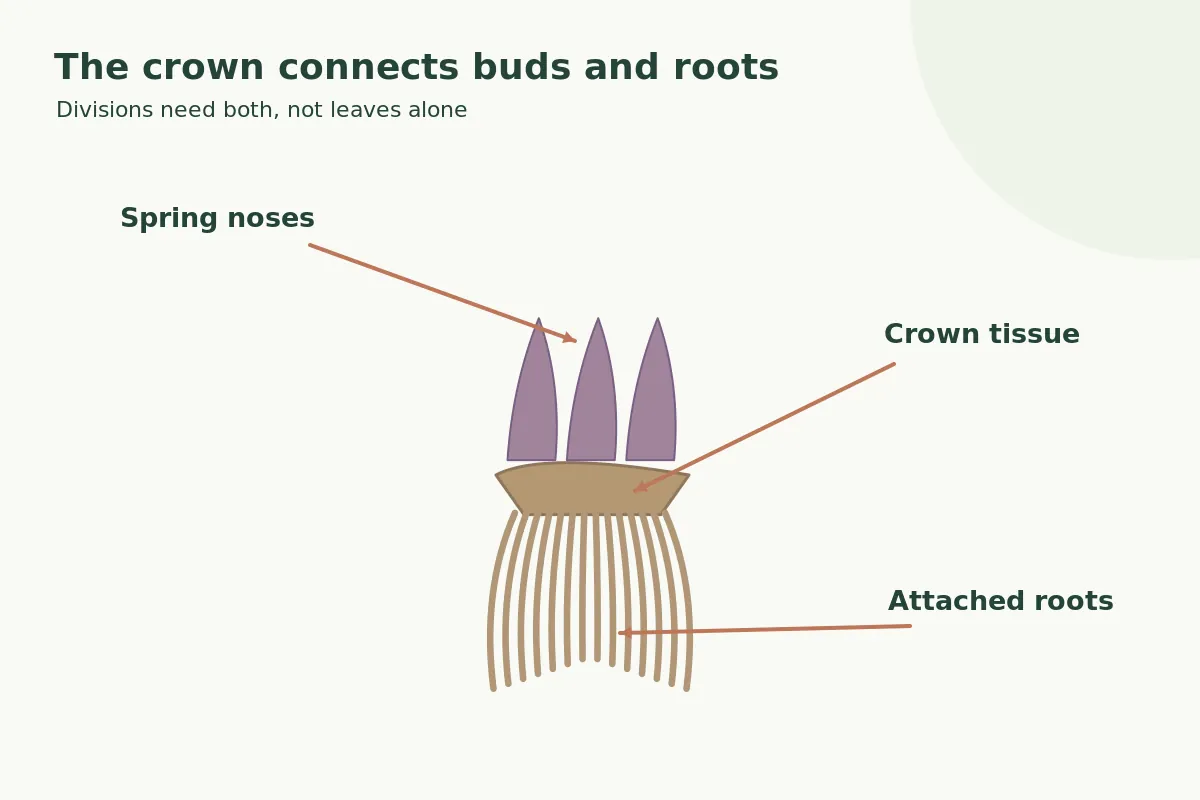
A hosta does not grow from a lily-style bulb. Its crown is a short, living stem structure from which pointed shoots emerge upward and numerous fleshy or fibrous roots extend downward. A division must include both an active growth point and its attached root system. Iowa State recommends two or three points plus a good share of crown and roots for each section. One accidentally severed leaf is not the end of a division, but a section that lacks living crown tissue is unlikely to establish. Count healthy points before putting a blade through the clump.
Decide Whether the Parent Plant Needs Division
Hostas can be left undisturbed for many years; large size alone does not mean something is wrong. Divide when you want additional plants, a clump has outgrown its spot, or a declining center needs renewal after other problems have been ruled out. Some varieties grow slowly and should not be chopped into tiny sections merely to multiply stock quickly. Check for slug injury, drought stress, and poor drainage as alternative explanations for weak foliage. A newly purchased small hosta often establishes faster if left whole until a substantial crown has formed. For the basics, see our guide: When and How to Divide Hostas Without Losing Crowns.
Prepare a Shaded Replanting Site Before Digging
New divisions have the least opportunity to dry out if planting holes are ready before the original clump comes out. Hostas usually appreciate a site with shade or morning light appropriate to the cultivar, with moisture-retentive but well-drained soil. Check drainage and loosen soil across the planting area rather than digging only a narrow deep shaft. The natural crown level should be visible when you set the division in place. Provide adequate room for mature leaves, especially with large-leaved varieties. Do not assume all light-colored or blue-leaved hostas have exactly the same exposure tolerance. For a step-by-step method, see how to divide hostas without damaging crowns or planting too deep.
Lift the Whole Clump Without Pulling the Noses
Use a spade to work around the outer edge of the hosta, keeping the blade away from the visible crown if possible. Loosen soil around several sides before levering the clump gently upward. Never grasp a bundle of pointed noses and tug; they are shoots, not handles. If the clump is heavy, slide a fork or tarp beneath it for support. Brush away enough soil to see how the crown divides into natural groups. Cutting a few perimeter roots while lifting is sometimes unavoidable, but preserving a substantial healthy system is the priority.
Find Natural Sections With Two or Three Buds
Lay the lifted plant on a protected surface and look for groups of two or three emerging points attached to continuous crown tissue. Trace roots descending from each section so you do not assign every root to one half of the clump. Iowa State specifically sets a practical minimum of at least two or three points with a good root portion. Very large clumps may divide readily along natural seams; others need a firm clean cut with a sharp spade or knife. Do not confuse a severed nose lying loosely in the soil with a rooted division. For the basics, see our guide: When to Divide Astilbe and Replant Clumps Without Drying Their Roots.

Cut Through the Crown, Not Just the Leaves
A real division splits the living crown and associated roots so each part can grow independently. Use a clean, sharp knife or spade and place the cut between clusters of points, not through the center of a nose. Keep your free hand safely away from the blade. After the cut, inspect both halves for attached growing points, solid crown tissue, and roots. Discard obviously rotten, hollow, or completely detached material rather than planting it for the sake of getting more pieces. Do not wash or scrub every root unnecessarily if a gentle shake exposes the structure. For a step-by-step method, see how to divide ornamental grasses without losing the living crown.
Replant Promptly at the Original Crown Level
Place the division in the prepared hole with roots arranged downward and outward, not twisted upward into a tight knot. Set the crown at roughly its former soil depth so new shoots point skyward and are not buried deep. Fill around roots with the native planting soil and firm gently to eliminate large air pockets. Iowa State Extension recommends immediate replanting, not leaving bare roots on a hot walkway while the gardener prepares more space. Water thoroughly after planting to settle the soil, then check whether the crown has sunk below its intended level. Our guide to dividing tall garden phlox goes into more detail.
Water During Establishment Without Making a Bog
Freshly divided hostas need even moisture while cut and disturbed roots rebuild contact with the soil. Check the actual soil below the mulch layer and water when needed, particularly during dry windy weather. New divisions can look temporarily tired even when properly handled, but persistent soft rot and foul-smelling tissue require attention to drainage. Avoid both permanent saturation and prolonged drought. Apply a light mulch around the planting area if climate warrants it, leaving the central shoots uncovered. A large dose of fertilizer is not a substitute for healthy roots and correct planting depth. For a step-by-step method, see how to divide astilbe in spring while keeping crowns and roots intact.

Understand the Late-Summer Alternative
Although spring is easiest, Iowa State notes that hostas can be divided from spring into late summer. Where winters freeze the ground, late divisions may have less time to anchor before repeated freeze–thaw cycles. Iowa State advises protective late-fall mulch over late-summer divisions to reduce frost heaving. Adjust aftercare to your climate and the timing of the division; in very hot or drought-prone periods, postpone nonurgent work. Fall is not the same practical window everywhere, and it is not wise to move newly divided plants during a severe heat wave or into frozen ground.
Expect Temporary Reduction in Leaf Size or Flowers
Division reallocates an established root system into smaller plants. The new clumps may send fewer or smaller leaves at first and can take a full growing season or longer to regain their former fullness. Do not panic if an early division produces an uneven canopy as the season develops. A named variegated cultivar ordinarily retains its pattern through vegetative division, unlike seedlings that may vary genetically. Photograph or label each division before mixing cultivars because early noses alone can look surprisingly similar. Inspect emerging leaves later to confirm the clumps are the plants you intended to move.
A Quick Field Decision Table for This Task
| Division part | Keep | Avoid |
|---|---|---|
| Spring nose | Two or three viable growing points | Bud-only piece without roots |
| Crown | Solid tissue connecting shoots to roots | Rotten or detached scraps |
| Root system | Good attached roots for each division | Leaf-only sections |
Related Guides
- When and How to Divide Siberian Irises Without Losing Healthy Fans
- When to Divide Daylilies: Keep Healthy Fans and Replant Crowns Correctly
- When to Divide Ornamental Grasses and Remove a Dead Center
- When to Divide Black-Eyed Susans Without Losing Healthy Crowns
- When to Divide Agapanthus in Pots or Borders Without Losing Blooms
How We Research and Check Garden Advice
This article is based on horticultural guidance reviewed on 2026-10-25 (UTC). Sources consulted for the specific procedures include: yardandgarden.extension.iastate.edu — Iowa State Extension; yardandgarden.extension.iastate.edu — Iowa State Extension; yardandgarden.extension.iastate.edu — Iowa State Extension. The key recommendations above were compared across those sources, with climate and plant-stage limits retained. We separate recommendations directly supported by Extension or RHS from practical observational checks such as examining fresh growth. Advice is for general home gardening and should be adapted to the cultivar and local climate rather than to a hardiness zone alone.
Plant Safety and Independent Editorial Disclosure
Use clean tools, check plant identity, and follow current regional restrictions for any purchased treatment. Plant diseases and insect populations vary by location; a local Cooperative Extension office can help with unusual symptoms. This is independent informational content, not paid product placement and not proof of any affiliate relationship. Read the VegWin affiliate disclosure. For edible plants, use safe handling practices and follow the label for any pesticide or other garden chemical used on food crops.
Early spring, as pointed shoots begin to emerge, is the preferred window according to Iowa State Extension.
A practical target is at least two or three growing points with attached crown and a good portion of roots.
No. Each division needs living crown tissue and roots; a leaf-only piece cannot form a proper new clump.
Position its crown close to the former soil level, with shoots pointing upward and roots spread below.
Yes, where conditions permit; water carefully and protect late divisions against winter freeze–thaw heaving in cold regions.