
Astilbe often rewards patience more than frequent disturbance. A clump producing a good show of feathery plumes and healthy divided leaves does not need splitting simply because a certain number of years has passed. But if the crown becomes crowded, flowering declines or the plant has expanded beyond its place in the shade border, division can restore growing room and make additional plants. The critical detail is to keep each new section attached to healthy crown buds and enough roots.
NC State Extension describes hybrid astilbes as rhizomatous plants that prefer moist, organically rich soil and notes that periodic division is possible in spring or fall. Minnesota Extension emphasizes spring as a convenient season for many perennials, when shoots are small and there is a growing season to recover. The procedure below follows the plant rather than a fixed calendar: diagnose whether division is useful, prepare a moist destination, lift the clump, find viable sections, and replant before delicate roots dry out.
Decide whether division is actually necessary
Look at the plant across at least one flowering season. An astilbe that blooms well, fills its space and has healthy foliage can remain undisturbed. Potential signals for division include a noticeably crowded mound, a declining center, poorer flowering compared with earlier seasons or growth extending into a path. None of these proves that crowding is the only problem. Too much sun, an extended dry spell and unsuitable drainage can also cause poor performance. Fixing a bad site often matters more than multiplying the same stressed plant.
NC State suggests periodically dividing hybrid astilbe, but an interval is not a command to dig every specimen on schedule. A small recently planted clump has a greater need to establish than to be split. A mature plant that is still vigorous may need only mulch maintenance and reliable water. Make the decision by comparing root space, bloom performance and the area the plant occupies. If there are obvious signs of disease or root rot, identify that problem before exchanging divisions with another gardener.
Choose mild weather and prepare the destination first
Spring is a practical time to divide as new shoots start to emerge and the soil is workable. In some regions a suitable fall period is also used, but divisions need time to establish before hard freezes or severe dry conditions. Avoid the height of summer heat or a hot windy afternoon. Minnesota Extension recommends cloudy conditions and adequately moist soil so exposed roots do not desiccate. Check your forecast for frost, extreme heat and available rainfall rather than relying solely on the plant’s hardiness-zone rating.
Prepare the new sites before digging the parent plant. Astilbe generally prefers shade or part shade and evenly moist, organically rich, well-drained soil. ‘Moist’ does not mean a stagnant puddle: waterlogged ground can suffocate damaged roots. Have a watering can, clean tools, a place to set the lifted root ball in shade, and labels ready. If dividing into pots, use containers with drainage and an appropriate growing mix. Speed from lifting to replanting is part of successful aftercare.
Lift the whole clump and expose the crown
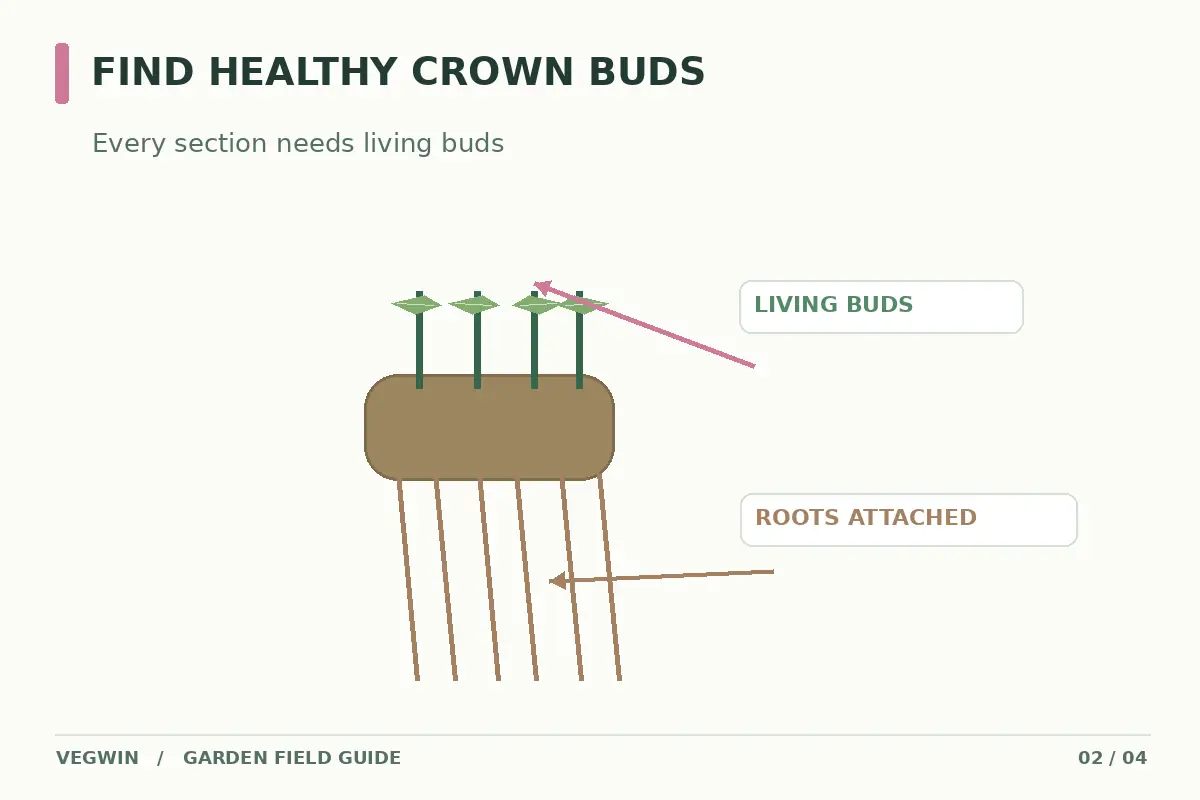
Water the ground ahead of time if it is dry. Work around the outer edge with a garden fork or spade, staying far enough from the center to avoid slicing most roots. Ease the clump upward rather than wrenching only the stems. Gently shake off loose soil or rinse minimally if necessary to reveal the root system and crowded crown. Look for live buds and rooted growing sections. Old dead tissue in the middle may be separated from the healthy outer portions if it is genuinely nonviable.
Do not treat every loose root as a potential independent plant. A viable division needs a piece of crown with shoots or viable buds and an adequate attached root system. The roots of astilbe can be dense and fibrous or intertwined with rhizomatous sections, depending on the plant. Pulling sharply by the foliage can tear growing points. Rest the lifted plant on moist material in shade while you examine it. If you need a break, protect the exposed root ball rather than leaving it in full sun.
Make substantial pieces instead of tiny fragments
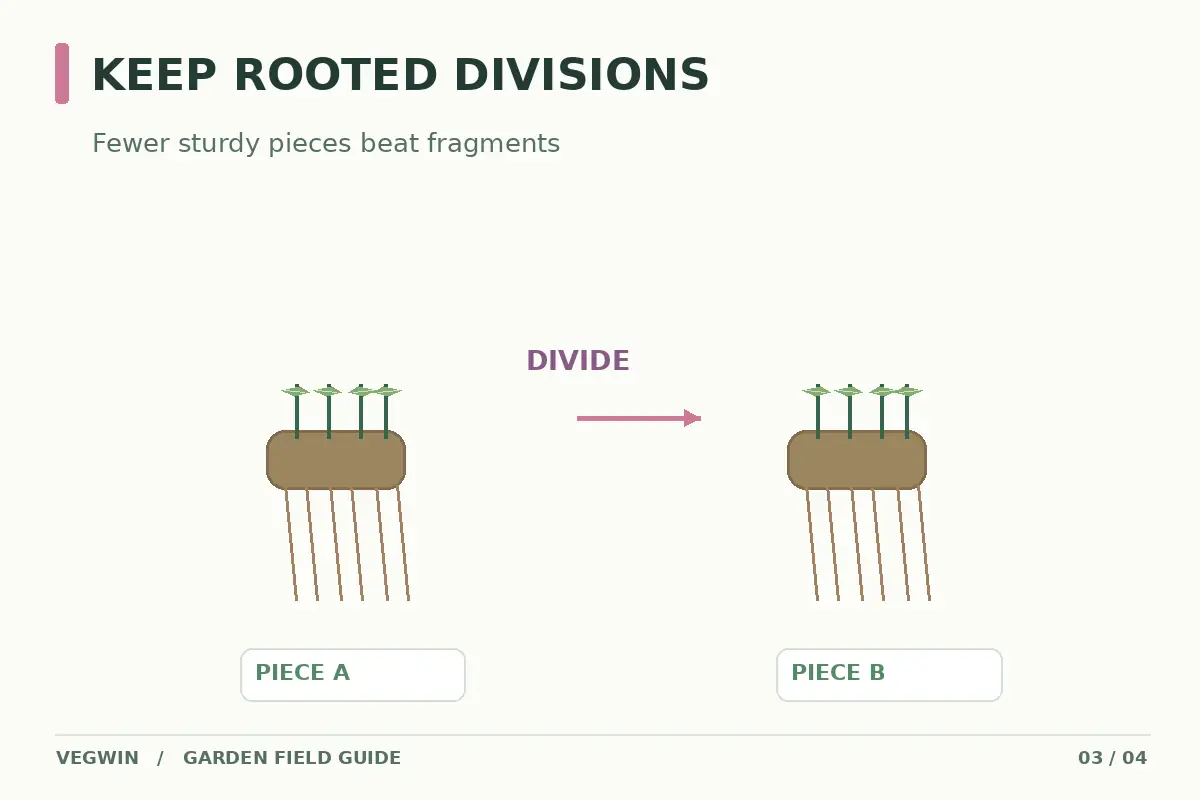
Where the clump separates naturally, tease it apart gently with gloved hands. For a tough old center, use a clean sharp spade or knife to cut along visible spaces between groups of shoots. Minnesota Extension advises keeping several vigorous shoots and a healthy supply of roots per division for many perennials. Treat that as a useful inspection principle, not an exact quota for every astilbe hybrid. Each piece should look like a small functioning plant rather than a solitary torn bud.
Remove truly dead material and badly damaged roots, but do not strip away every old root in pursuit of a perfectly clean crown. Small root injuries are difficult to avoid; extensive loss of the root system is not. Set aside damaged, doubtful fragments rather than giving them the same promise as strong divisions. If a specimen divides into only two or three healthy pieces, accept that number. Producing ten weak fragments from one plant may result in fewer successful reestablishments than making a few generous sections.
Replant at the original crown level
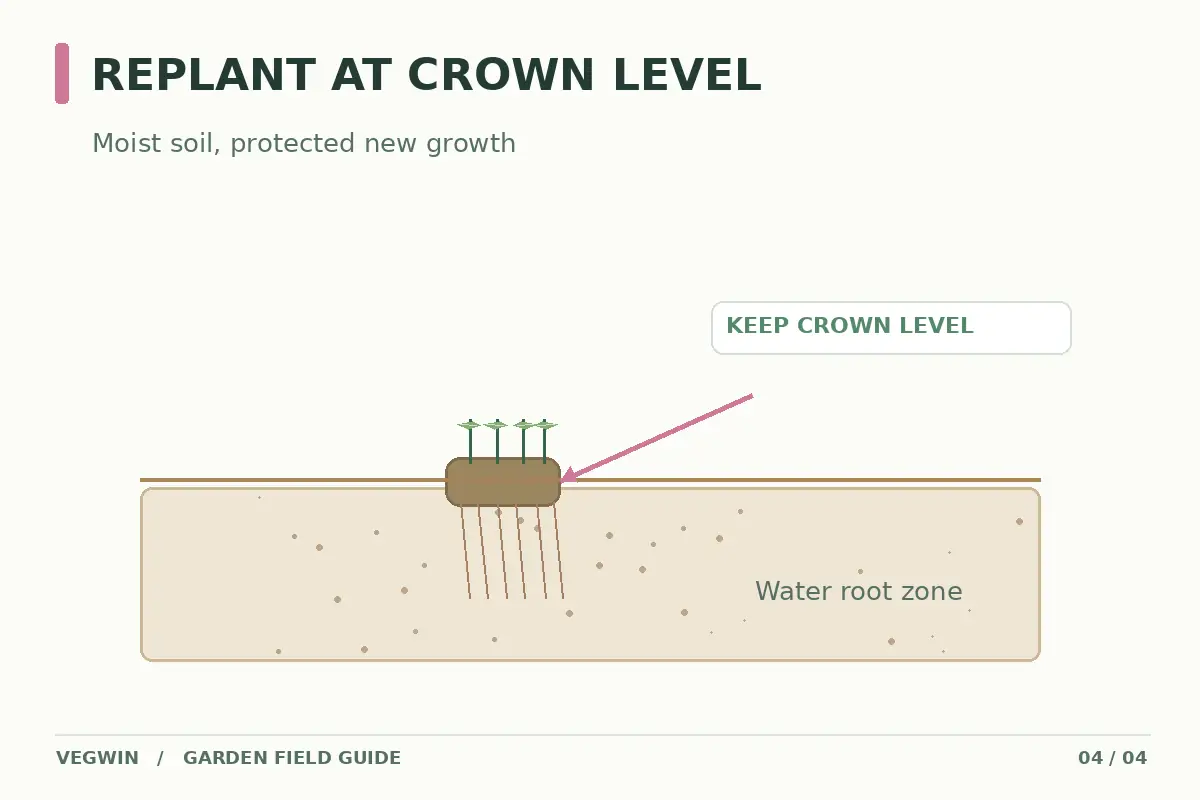
Replant the healthy pieces promptly at roughly the same level at which they were growing. Do not bury emerging shoots under a heavy mound of mulch or leave the root system protruding into drying air. Spread roots into the prepared hole without forcing them into a tight ball, backfill with suitable soil and gently firm out large air pockets. Water thoroughly to bring soil into contact with roots. A thin layer of organic mulch can reduce drying, but keep it off vulnerable crowns and fresh shoots. If you want the full process, read how to divide autumn Joy sedum without burying new crowns.
If some pieces go into pots, use the potting medium to hold roots evenly moist without becoming waterlogged. Put newly divided plants where they have shade from harsh sun and protection from drying wind. Label the pieces while the flowers are absent; several cultivars can have nearly identical emerging leaves. When adding soil amendments, avoid creating a sharply different isolated pocket that holds water like a bowl. Improving broader bed conditions is usually more important than adding a large fertilizer dose into the planting hole. If you want the full process, read how to divide astilbe in spring while keeping crowns and roots intact.
Protect the divisions while they regain roots
For the first several weeks, inspect moisture near the root zone rather than relying on a fixed daily watering schedule. New divisions have less root capacity and may wilt more readily in warm wind. Water when the actual soil indicates a need, then allow a well-drained bed to breathe. Brown leaf edges in a dry sunny site are a prompt to reconsider water and exposure, not necessarily proof of a pest. Astilbe’s normal preference for steady soil moisture continues after its first recovery period.
Avoid chasing flowers immediately. A division may invest in roots and foliage rather than a full bloom during its first season. Trim badly damaged material if appropriate, but keep healthy leaves that support recovery. Do not apply unverified pesticide or fertilizer treatments to a plant simply because it has transplant stress. If the division fails repeatedly, inspect planting depth, heavy shade versus hot afternoon sun, drainage and the original plant’s health. A poor site cannot be cured permanently by taking fresh divisions every year. For the basics, see our guide: When to Plant Primroses Outside and Keep Their Crowns Healthy.
Keep a simple record of crown health and site
Write down why you divided the clump, the season, the number of rooted pieces and the original site conditions. Photograph one healthy division before planting so next year you remember what good crown and root contact looked like. When the new plants leaf out, track whether the soil stays evenly moist and which spot performs best. This is especially useful if your garden has a dry strip under tree roots where shade looks inviting but soil moisture disappears quickly. For the basics, see our guide: When to Divide Black-eyed Susans Without Losing Healthy Crowns.
When flowers return, compare size and vigor rather than counting stems only. If the parent site remains too hot or too dry, move remaining pieces to a better location rather than dividing them again. Sharing strong, labeled divisions is more helpful than giving someone unrooted shreds and suggesting they will thrive. A careful spring division should lead to established shade-garden plants, not an annual cycle of emergency rescue. For the basics, see our guide: When and How to Divide Hellebores Without Damaging Crowns and Roots.
A quick garden decision table
| What you find | Divide now? | Best next move |
|---|---|---|
| Healthy blooming clump | Usually unnecessary | Let roots grow |
| Overcrowded rooted crown | Consider division | Keep buds and roots together |
| Hot dry planting area | Fix site first | Improve moisture and shade |
| Small root fragment without bud | Poor division | Do not promise a new plant |
Related Guides
- When to Divide Ornamental Grasses and Remove a Dead Center
- When to Divide Agapanthus in Pots or Borders Without Losing Blooms
- How to Divide Herbaceous Peonies in Fall and Set the Eyes Shallowly
- How to Divide Shasta Daisies in Spring and Replant Healthy Crowns
- When and How to Divide Siberian Irises Without Losing Healthy Fans
How We Research and Verify This Guide
This is a topic and title review, not a complete side-by-side audit of all previously published full articles. The supporting illustrations are simplified conceptual drawings rather than photographs or measured botanical plates. Climate-sensitive timing should be reconciled with regional Extension and the exact plant identity. No paid affiliate program is confirmed for this article; see the affiliate disclosure.
Source notes (checked October 22, 2026): plants.ces.ncsu.edu: NC State identifies astilbe hybrid root structure, periodic spring/fall division and the need for rich moist soil. extension.umn.edu: Minnesota Extension provides spring division, root-and-shoot selection, shady holding conditions and establishment steps. extension.illinois.edu: Illinois Extension explains the decision to divide crowded perennials, removing dead centers and replanting promptly.
Early spring as growth resumes is often convenient; suitable fall timing is also used in some regions.
No. Judge bloom performance, plant size and crown condition rather than following an automatic interval.
A reliable division needs viable crown buds or shoots plus attached healthy roots.
Generally at about the same crown level as it previously grew, with roots covered and shoots unburied.
Check root-zone moisture, hot sun, drying wind and root damage before assuming a pest or disease.