
Crop rotation means changing where related crops grow from one growing season to the next. It is easy to draw three arrows between beds, yet that diagram is not useful until you know which vegetables belong to the same botanical family and what actually grew in each space last year. A garden with two small beds also cannot achieve the separation of a farm field, so a rotation plan must be honest about its limits. This guide builds a simple bed-by-year ledger, highlights soilborne-disease history, and provides a fallback for gardeners who cannot move a crop family very far.
Classify Crops by Family Rather Than by Appearance
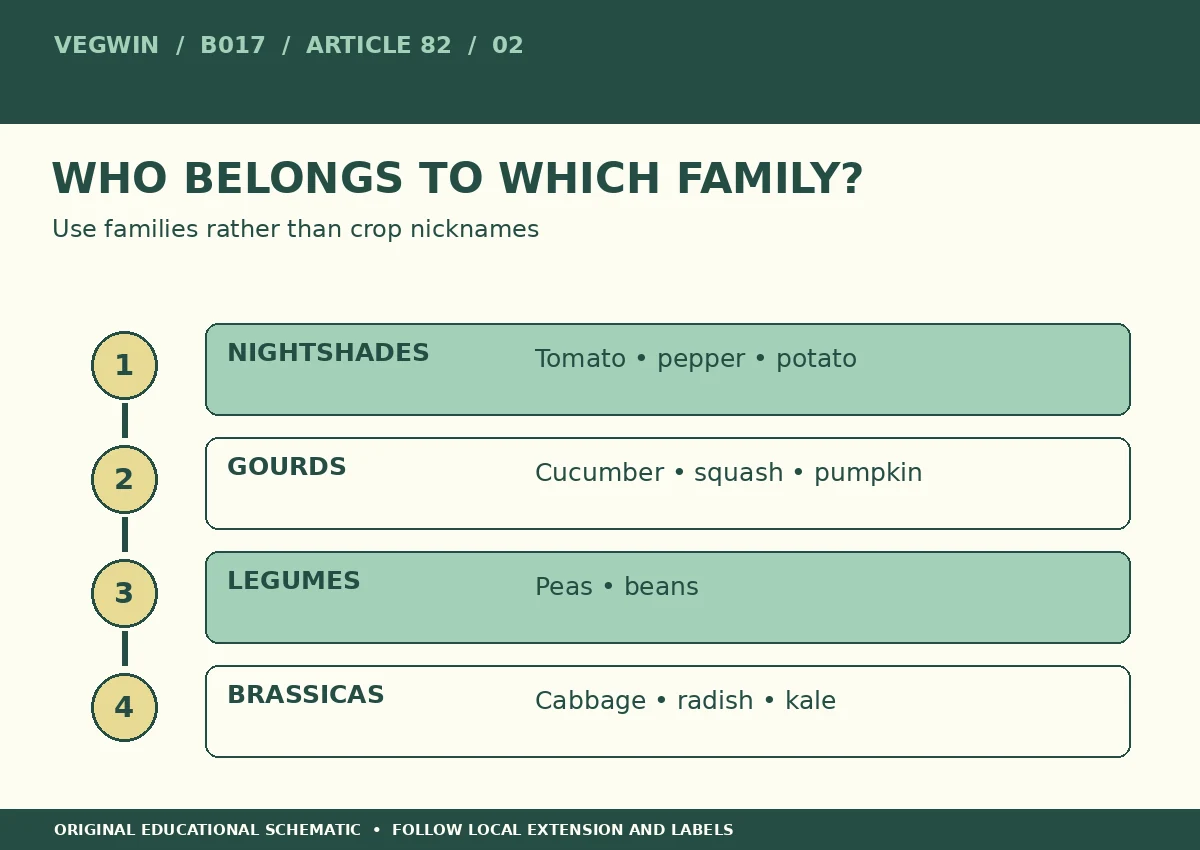
Start by assigning each crop to its botanical family. Tomatoes, peppers, potatoes and eggplants are nightshades (Solanaceae). Cucumbers, pumpkins, zucchini and melons are gourds (Cucurbitaceae). Peas and beans are legumes (Fabaceae), while broccoli, cabbage, kale and radishes belong to the mustard family (Brassicaceae). Iowa State Extension and Wisconsin Extension both organize rotation by crop family because related crops may share pathogens and insects. Two plants can look and taste very different while still bringing some overlapping disease risk to a bed.
Do not assume “root crop,” “leaf crop” or “heavy feeder” is a botanical family. Carrots and beets are not close relatives; neither are leafy lettuce and leafy cabbage. Use the species on the packet when a common name is ambiguous. Record edible volunteer plants and relevant weeds where they may host pests or pathogens. A precise family list is the foundation of the rotation; swapping a tomato for a pepper does not constitute the family change needed for a nightshade problem.
Make a Bed Map That Shows Actual Growing History
Draw the garden into units that can be managed independently: bed A, bed B, bed C, plus substantial containers. Note the family grown in each unit for the most recent seasons you can remember. In a bed that hosted several successive crops in one year, record each family, not only the spring crop. A cucumber planted after radishes means both gourds and brassicas occupied that location. These notes are more valuable than a beautiful color wheel based solely on next year’s wishes.
Use a pencil or spreadsheet with columns for location, year, crop, family, disease symptoms and source of the diagnosis. If you moved a diseased tomato to another corner of the same cramped bed, write down the actual distance instead of treating it as clean ground. Save a photo of the map before planting and one at the end of the season. It becomes a garden record you can use to avoid accidentally planting the same family repeatedly in the same soil.

Allocate the Next Season With Risk First
For each proposed crop, compare its family with the history of the intended bed. Iowa State Extension advises avoiding the same family in a location for several years where possible and provides family lists for that purpose; a common ideal is a three- to four-year break. But this is a planning goal, not a guarantee that every pest dies on schedule. Certain soilborne problems persist longer, some spread from neighboring areas, and some hosts include weeds. A specific diagnosed problem deserves crop- and pathogen-specific Extension guidance.
Fill the highest-risk cells first. For example, if one location has a confirmed disease affecting a nightshade, choose an unrelated family there and note any sanitation or soil-management advice associated with the diagnosis. Next prioritize realistic light, root space and irrigation: do not move sun-loving pumpkins into a shaded strip just to complete a mathematical rotation. Where family diversity is impossible, the plan should say “constraint,” not falsely assign an impossible disease-control benefit.
| Observed situation | Likely decision point | Safer next step |
|---|---|---|
| Tomatoes after peppers | Same nightshade family | Seek another location or document constraint |
| Peas followed by beans | Different crops, same legume family | Log both in this year’s bed history |
| Two neighboring tiny beds | Weak pest separation possible | Combine rotation with diagnosis and IPM |
| Unknown leaf injury last season | Cause not established | Do not call it soil disease without diagnosis |
Understand Why Rotation Has Limits in Tiny Beds
Large fields can separate host crops by substantial distances. In a backyard with closely spaced beds, insects and airborne spores may cross the whole garden, so rotation often has a smaller protective effect. A Maryland Extension resource updated in 2026 explicitly cautions that rotation is only marginally helpful for reducing insect and disease pressure in many home vegetable gardens because of their scale. This does not make records useless; it makes exaggerated promises inappropriate.
If there are only one or two beds, rotate where feasible and combine the plan with accurate diagnosis, clean transplants, sanitation, resistant varieties where their specific resistance is verified, and sensible watering. A larger clean container may give one disease-prone crop a separate medium, but it does not prevent insect movement. If an Extension clinic identifies a serious persistent soil problem, follow its host-specific recommendation, which may require avoiding certain crops for longer than your preferred rotation cycle.
Distinguish Rotation From Succession and Intercropping
Crop succession changes what is planted in a bed across different parts of the same growing season. Rotation tracks families by location across years. Intercropping means growing different crops together for some period. Those practices can coexist, but a successful succession chart does not automatically prove that you have rotated disease hosts. When you plant early peas followed by summer beans, for example, you used two crops across time but stayed within the legume family.
This distinction matters because online diagrams often show arrows labeled “spring, summer, fall” and call them rotation. For a rotation record, log both plant family and year. For a planting calendar, log temperature, maturity and harvest windows. Also, for intercropping, log concurrent spacing and light competition. Keeping separate columns prevents a reader from thinking a short gap between crops resets soilborne disease risk or that moving plants six inches is equivalent to moving them across fields. Our guide “Succession Planting” covers how to build a harvest relay for one garden bed.
Run an End-of-Season Rotation Audit
After harvest, mark which families truly grew in each bed and whether observed problems received a reliable diagnosis. Note when a plant failed from waterlogging or frost rather than infection; those are not soilborne disease clues. Compare the map with the next year’s desired crops and adjust one family at a time. Do not apply broad fertilizer rates on the assumption that rotation itself replenished all nutrients. Legumes may fix nitrogen in symbiosis under suitable conditions, but the amount available to following crops varies and soil tests still matter. Our guide “Organic Gardening Tips That Start With Soil and Pest Prevention” adds more detail on this.
If your rotation plan leaves no home for a favorite tomato variety, document the decision: perhaps grow it in a large pot using clean medium, perhaps accept a monitored risk if no particular pathogen is present, or perhaps plant an unrelated crop this year. A good plan helps you make a transparent tradeoff instead of obeying an unworkable rule. Retain your maps for the next season and update them with any confirmed plant clinic reports.

Related Guides
How We Research and Review These Gardening Decisions
We consulted these original public university Extension and government resources on 2026-10-20: Iowa State University Extension, University of Wisconsin Extension, University of Maryland Extension. We checked how their recommendations depend on crop biology, growing environment, cultivar and region. The custom diagrams visualize decisions; they are educational illustrations, not experimental measurements or photographs. We compared the first 80 planned article topics for intent overlap, but could not independently inspect the full live WordPress index on VegWin.org. Current local advice, crop packets, measured conditions, and updated guidance take precedence over generic rules. Structural preflight cannot confirm every biological fact.
Buttons lead to public Extension or government educational resources; no partnership or approval is implied. We checked sources including affiliate disclosure. If products or treatments are later added, review labels, affiliations, and applicable rules first.
Frequently Asked Questions
Iowa State Extension describes three to four years as a useful rotation goal when practical, but disease-specific guidance and tiny-garden limits can change the decision.
Yes. Both are Solanaceae, along with peppers and eggplants, so changing one for the other is not a family rotation.
The crops differ, but both are legumes. A succession can occur without moving to a different botanical family.
Rotation may still help organize planting, but short distances limit separation. Use diagnosis, sanitation and resistant varieties when appropriate.
Family changes can diversify nutrient demand but do not replace soil testing, appropriate amendments or irrigation and drainage management.