
Intercropping means intentionally growing two or more crops in the same area during overlapping periods. In a small vegetable garden, that can be useful when a quick low-growing crop occupies space before a slower crop expands, or when crops use light and space in complementary ways. It can also backfire: a dense mix may reduce airflow, obscure pests, or force two plants to compete for water. This guide builds an intercropping trial you can evaluate. It does not promise that basil protects every tomato or that any herb repels every insect; those claims depend on evidence, pest identity and planting conditions.
Separate Intercropping From Succession and Companion Claims
If lettuce finishes and is removed before beans are planted, that is succession planting rather than sustained intercropping. If lettuce grows beside developing cabbage for a period before being harvested, the crops overlap and the arrangement is intercropping. A traditional companion-planting chart may propose similar combinations but often adds unsupported claims that one plant universally repels insects or improves the flavor of another. The overlap in definitions is real; Maryland Extension treats interplanting as one form of companion planting, while also discussing succession as a separate scheduling technique.
Texas A&M AgriLife describes vegetable rotations, successions and intercropping as related systems with different goals. Before choosing a pair, write your actual objective: more harvest from a limited bed, earlier use of open soil, shade for a specific crop, or habitat for beneficial insects. “They are friends” is not a measurable objective. Plan how you will assess success after harvest. A two-crop planting that looks lush but yields very little food may have been overstocked. To go further, our guide “Square Foot Gardening” shows how to plan a bed without crowding your crops.
Check Height, Root Space, Water, and Crop Timing
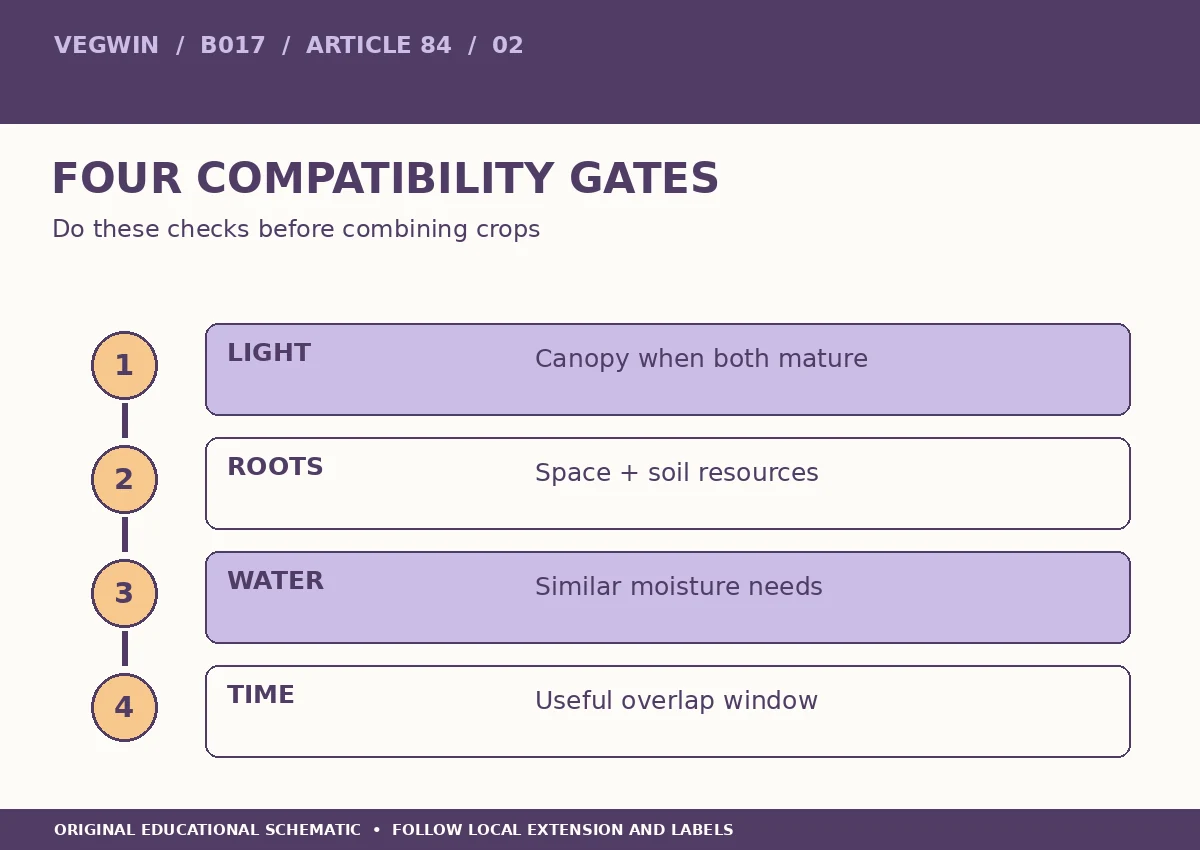
A practical pair must be compatible in four ways. First, its eventual canopy must let each crop receive sufficient light; young transplants can look uncrowded even when mature leaves will cover the whole bed. Second, there must be enough root space and soil fertility for both species. Third, water needs and drainage must be close enough that one crop is not constantly stressed to maintain the other. Fourth, harvest timing matters: a small fast crop should ideally leave before the companion fully needs the same space.
Maryland Extension gives examples such as lettuce among spring cabbage and radishes with slower carrots. These show a principle, not a universal prescription. Where summer heat damages tender greens, the fast partner may fail even if spacing looks good. Where an adjoining wall shades the bed, a tall crop may reduce light further. Design with mature plant sizes from specific cultivar guidance and local sun exposure; use a plan drawing at full size rather than seeds-per-square-foot slogans. Our guide “Crop Rotation Plan for Small Gardens” goes into more detail.

Sketch an Overlap Window Rather Than a Fixed Pair List
Draw one bed with the main crop’s expected full canopy in a solid outline. Add the second crop only in spaces that remain genuinely available while it grows. Next draw two horizontal bars: the time the main crop occupies the bed and the period the secondary crop will remain. The useful intercropping window is their overlap before competition becomes severe. This sketch reveals why a quickly harvested leafy crop alongside a slow-growing transplant can work better than two vigorous sprawling vines expected to occupy one footprint.
Do not blindly copy dates from a demonstration garden. Local soil temperature, frost risk, day length and heat tolerance determine whether the proposed overlap occurs. Use planting windows from regional Extension and days to maturity from the actual seed packets. A plan that requires spinach to remain sweet during extreme heat or asks a pumpkin vine to stay neatly between two narrow rows is not realistic. It is better to grow one crop well than two crops badly.
| Observed situation | Likely decision point | Safer next step |
|---|---|---|
| Quick greens with slower crop | Leaves harvested before canopy closes | Trial if climate and light match |
| Two sprawling vines | Strong space and light competition | Usually allocate larger separate areas |
| Flowers near vegetable bed | Possible habitat benefit, not certainty | Observe pollinators and actual pest pressure |
| Pair advertised to repel pests | Claim may lack relevant evidence | Identify pest; examine trustworthy trials |
Test a Comparison Strip and Record Both Harvests
For an informal home test, leave one short section planted with just the main crop and one similar section with the proposed intercrop, if space allows. Keep watering and management as comparable as practical. Record whether either crop germinated poorly, produced smaller edible portions, became difficult to harvest, or showed increased disease. Compare usable harvests from both species and note the effort required. These observations are more useful than a picture of a dense bed at peak foliage.
Research does not support “all intercropping increases yield” as a general statement. A 2023 meta-analysis of cabbage intercropping studies found lower average cabbage productivity alongside reduced pest injury under studied conditions, demonstrating that outcomes can trade off. This is evidence about particular systems and measurements, not a promise of identical effects in a backyard. Interpret the results at the crop, planting design, region and pest level. Your small comparison strip is a practical learning exercise, not proof that an effect applies everywhere. For the fuller picture, see our guide “Companion Planting That Makes Sense”.
Protect Pollinator Access and Plant Health
When pairing crops, leave enough room to identify a pest and reach affected leaves. Planting flowers nearby can create resources for some beneficial organisms, but it does not eliminate the need for monitoring or prove that a named neighbor keeps every pest away. If the main crop requires pollinating insects, access during flowering is especially important. A tall dense intercrop may make flower inspection harder and could shade or obstruct nearby blooms. Manage irrigation to avoid chronic leaf wetness where that worsens a known problem.
Do not spray home remedies on a mixed bed because a social-media chart says the companion plants should repel a pest. Verify the organism first, consider exclusion or cultural measures where appropriate, and follow current crop-specific labels and IPM advice when any registered treatment is contemplated. An edible crop planted under another may be exposed during treatment; label directions and preharvest intervals still apply. Many intercropping questions are really garden layout or timing questions rather than reasons to buy a product.
Decide Whether the Pair Earned Its Space
At harvest, ask whether the secondary crop produced enough food to justify its share of water, sunlight and labor. Did it finish before the main crop needed its space? Did the bed permit normal picking, scouting and removal of damaged foliage? Were there credible differences in pest injury, and was the pest actually identified? Your decision may be to repeat the pairing, widen spacing, shift sowing times or drop the second crop. That is a more defensible outcome than declaring success merely because both species survived.
Keep the note with the bed map and seed packets. Intercropping may complement succession schedules and crop-family records, but it does not replace them. A gourd planted beside a brassica is still a gourd in that bed’s rotation history; a bean growing next to corn does not automatically fertilize all neighboring plants on demand. Choose relationships you can observe and manage, and regard untested universal companion claims as hypotheses rather than gardening laws. For the fuller picture, see our guide “Organic Gardening Tips That Start With Soil and Pest Prevention”.

How We Research and Review These Gardening Decisions
We consulted these original public university Extension and government resources on 2026-10-20: University of Maryland Extension, Texas A&M AgriLife Extension, Cabbage intercropping research meta-analysis. We checked how their recommendations depend on crop biology, growing environment, cultivar and region. The custom diagrams visualize decisions; they are educational illustrations, not experimental measurements or photographs. We compared the first 80 planned article topics for intent overlap, but could not independently inspect the full live WordPress index on VegWin.org. Current local advice, crop packets, measured conditions, and updated guidance take precedence over generic rules. Structural preflight cannot confirm every biological fact.
Buttons lead to public Extension or government educational resources; no partnership or approval is implied. We checked sources including affiliate disclosure. If products or treatments are later added, review labels, affiliations, and applicable rules first.
Intercropping overlaps crops in space and time; succession often replaces a finished crop with a later crop or repeats sowings.
No. Crops can compete and studies show trade-offs. Record edible yield of both crops in your own conditions.
Do not rely on a universal repellent claim. Identify the pest and use evidence-based IPM; neighboring plants may affect habitat without guaranteeing control.
Pair a short, quickly harvested crop with a slower crop, while checking mature canopy space, water needs and local growing season.
Record both harvests, plant health, access and watering work, then compare with a similar single-crop strip when practical.