
Succession planting is not simply buying an extra packet of radishes. It is arranging the next crop so that a bed has a useful job after the current crop finishes, or sowing small additional portions while earlier portions are still producing. The difficult part is estimating when space becomes available. A crop may reach its first harvest on the packet date and still occupy that space for weeks. This guide turns the process into a bed-by-bed harvest relay with a crop-release decision, a calendar with room for delays, and a place to record what really happened in your garden.
Separate a Relay Sowing From a Replacement Crop
There are two related but different techniques. A relay sowing repeats a relatively quick crop in small groups so its harvests arrive over time. A replacement planting uses ground freed after an earlier crop is removed. Leaf lettuce, radishes or bush beans can fit a relay strategy where local temperatures permit; a bed once occupied by spring peas may later carry a summer crop. Maryland Extension discusses both methods, but it does not promise that every crop responds well to fixed repeat intervals. Decide which pattern you want before putting dates on a calendar.
Write the question beside your garden map: “Do I need another harvest from the same crop, or a different crop after this one?” Continuous-picking crops such as indeterminate tomatoes already produce across a longer window and seldom justify an identical second planting in a short growing season. Plants with a brief useful harvest can be better candidates. If one crop has a high risk of bolting in heat, repeating it throughout midsummer may only repeat the disappointment. Adapt the crop choice to the next weather window rather than forcing the same seed packet into every interval.
Calculate the Real Occupancy of Each Square of Bed
A packet’s days-to-maturity figure is usually a time to an initial harvest, not a contractual date when a whole bed becomes free. For a crop cut once, such as a head of lettuce, the release can be close to harvest. For chard or beans harvested repeatedly, the bed remains occupied during the picking window. Minnesota Extension crop-planning resources distinguish growing time from the harvest window. Add establishment time, your expected picking duration, removal and bed preparation to get a practical occupancy estimate.
Start with a four-column ledger: crop now, earliest credible final harvest, next crop and the last sensible planting opportunity. Use local Extension planting guidance and the precise cultivar packet to estimate dates. Keep a buffer for cool weather, dry weather or delayed removal; later summer and fall sowings may grow more slowly as daylight changes. A blank in the ledger is useful information: if the next crop cannot finish under likely conditions, choose a cover crop or leave the bed protected rather than sowing an unrealistic second crop.
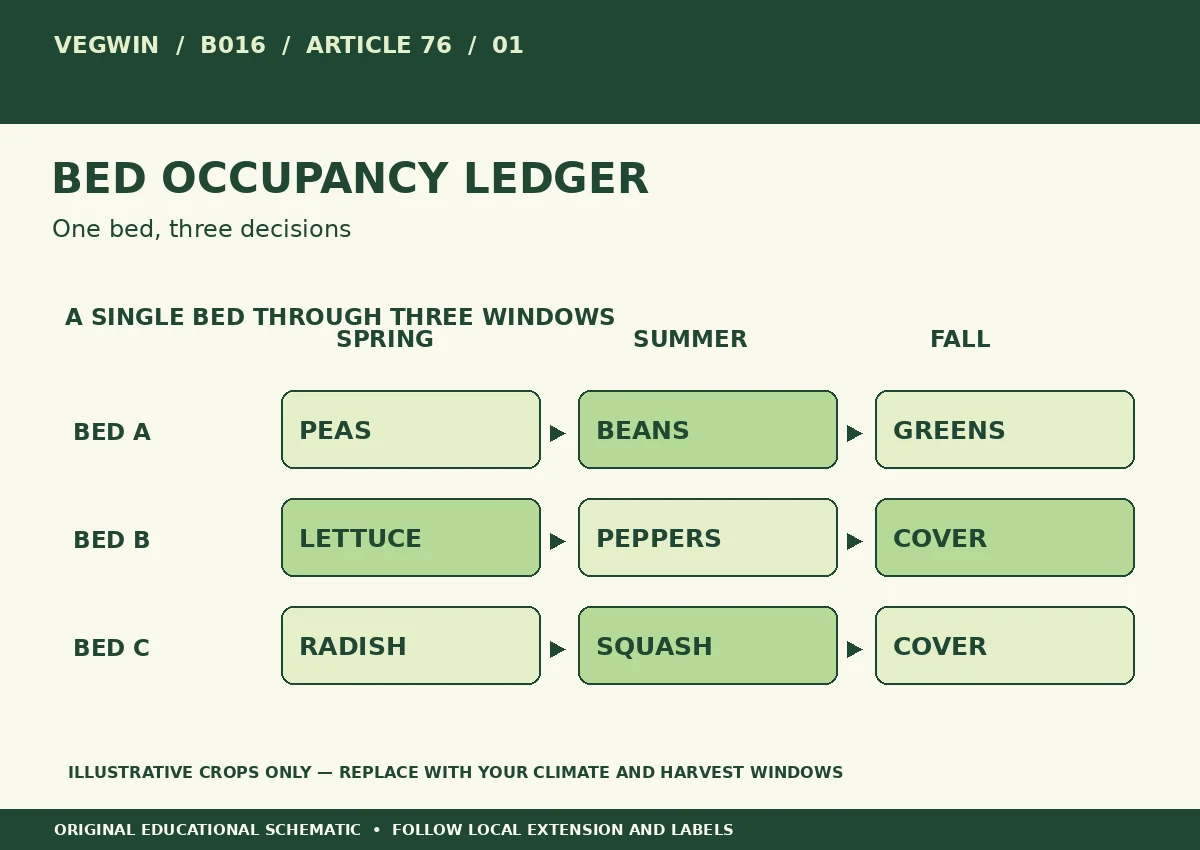
Choose Crop Pairs That Fit Temperature and Daylight
A spring-to-summer switch works because cool-season and warm-season crops prefer different conditions. A bed of spring greens can yield to bush beans or another suitable warm-weather crop, provided there is adequate growing time and seedbed moisture. Later, a warm-season crop may release ground for cool-season greens or a cover crop. The specific dates in Maryland examples are demonstrations for that region. Copying those dates into a different climate ignores the local last and first frost windows, soil condition and decreasing light in autumn.
For a cooler region, count backward from a likely frost window using the crop’s maturity information and an extra allowance for slower fall growth; then verify with nearby Extension guidance. Where winters are mild or summers are extremely hot, it may be the hot season rather than frost that interrupts growth. USDA hardiness zones are about perennial winter survival, not these annual crop scheduling decisions. Keep a simple Plan B if an unusually late harvest pushes a sensitive next crop beyond its reasonable window.
| Observed situation | Likely decision point | Safer next step |
|---|---|---|
| Relay sowing | A short-harvest crop still suits weather | Try a smaller repeat block; record first pick |
| Replacement crop | Previous crop is nearly finished | Check release date plus next crop occupancy |
| Too little season | Next crop cannot credibly finish | Choose cover crop or protect empty soil |
| Disease on prior crop | Cause uncertain | Identify before reuse; plan family choice |
Use a Bed-Release Checklist Before Replanting
Do not set new seedlings into an active crop simply because a calendar square says it is time. Confirm whether the earlier plant is still yielding enough to justify the space. When it is finished, remove diseased residues appropriately, avoid dragging infected foliage through healthy plants, and protect soil structure while clearing the bed. Check moisture and drainage; a newly vacated bed can be dry, compacted from footsteps or shaded by adjacent mature crops. If you need additional fertility, rely on soil-test information rather than automatically adding a large fertilizer dose with every succession.
A healthy previous crop and a diseased one call for different follow-up. If roots appear rotted or a plant has suspicious disease, seek a diagnosis and choose a suitable next crop before reusing the exact location. Crop-family rotation can help on large scales, although Maryland Extension cautions that the small distances in home gardens limit its disease-control value. The immediate task is practical: can the soil support fast emergence or transplant establishment now, and will neighboring crops leave enough space and light? For the fuller picture, see our guide “Crop Rotation Plan for Small Gardens”.

Sow a Small Test Block Before Filling the Whole Bed
Relay schedules are often shown with tidy two-week increments, and Maryland Extension uses this as an illustrative starting interval. But intervals are not guaranteed to create equal harvest gaps. The first sowing may grow slowly in cool soil while later sowings catch up in warmer weather, creating a glut. Instead of repeating a large block by habit, test a manageable portion and compare actual emergence and picking dates. Reduce the next planting if the first one is still producing plenty for your household.
Record how much you used, not only how much was picked. If six feet of greens produces more than you can refrigerate or share, a second six-foot planting is not a success merely because it germinates. A simple kitchen note helps: first picking date, weeks of useful harvest and amount wasted. Change the crop or spacing for the next relay based on those observations. In small raised beds, leave room to access mature plants without crushing later seedlings underfoot.
Recover Gracefully When Weather Breaks Your Sequence
A late frost, heatwave or sudden rain can make a carefully spaced schedule look wrong. Diagnose the constraint first: was establishment delayed, harvest shortened, or a planting slot lost entirely? Heat can reduce the quality of many cool-season leaves; cool wet soil can delay the next sowing. If the next crop is still suitable, shift its timing and protect moisture while it establishes. If the remaining season is too short, switch to something adapted to the actual conditions, or sow a regionally suitable cover crop.
Do not double plant density to make up for a lost week. Crowding can reduce light and airflow precisely when young plants need them. If a crop is likely to reach harvest after the local first frost, check actual frost tolerance and protective options with Extension rather than assuming fabric makes any annual crop winter-hardy. The value of a succession plan is flexibility: it flags which decisions can still be made and which growing windows are truly gone.

Keep a Four-Line Ledger for Next Year’s Relay
At the end of each changeover, write four lines: planting date and variety, first and last pick, date the space was actually released, and what the next crop did. Keep the footprint on a simple bed sketch; gardeners often underestimate how long beans, cucumbers or sprawling greens occupied an area. Compare planned and actual release dates after one season. Those differences produce a more useful local plan than copying another region’s pretty calendar.
Succession planting also has a stopping rule. If the next planting would spend most of its life in unsuitable heat, inadequate light or frost risk, the most productive choice may be mulch, soil cover or a rest period. A successful relay is not defined by maximum seed packets used; it is defined by harvests that fit real light, weather, bed space and your capacity to manage them. Use the decision diagrams below as a planning aid, not as crop-specific dates. Our guide to intercropping a vegetable garden goes into more detail.
Related Guides
How We Research and Review These Gardening Decisions
We consulted these original public university Extension and government resources on 2026-10-20: University of Maryland Extension, University of Minnesota Extension, University of Minnesota Extension. We checked how their recommendations depend on crop biology, growing environment, cultivar and region. The custom diagrams visualize decisions; they are educational illustrations, not experimental measurements or photographs. We compared the first 75 planned article topics for intent overlap, but could not independently inspect the full live WordPress index on VegWin.org. Current local advice, crop packets, measured conditions, and updated guidance take precedence over generic rules. Structural preflight cannot confirm every biological fact.
Buttons lead to public Extension or government educational resources; no partnership or approval is implied. We checked sources including affiliate disclosure. If products or treatments are later added, review labels, affiliations, and applicable rules first.
Succession planting schedules crops over time in the same area; rotation changes which crop families use an area between growing cycles. They can be planned together.
No. Two weeks is one illustrative interval for some relay crops; actual growth speed, harvest length and household demand determine a better interval.
Sometimes, but a long-season tomato may occupy its space until too late for the next crop. Check actual removal date, local climate and the next crop’s tolerance.
No. Hardiness zones describe winter cold averages for perennials, not annual-vegetable planting windows. Use frost timing, conditions and regional guidance.
Protect the soil and consider a cover crop suitable for your region rather than forcing an unlikely late vegetable sowing.