
The large flowers of summer garden gladiolus arise from a corm, not a true layered bulb. That difference matters when you find a flattened, papery, slightly pointed structure in a nursery bag and wonder which end belongs up. Most tall hybrid gladioli are planted in spring into sunny, well-drained soil after hard freezing conditions are easing locally. The depth is more substantial than a scattering of soil over the top: RHS recommends roughly 4–6 inches for large-flowered hybrids. This guide walks through sorting healthy corms, placing the growth tip, making successive plantings, supporting flower spikes, and planning for winter. Species and early hybrids may need a different schedule.
Check Whether You Have Tall Hybrid or Hardy Species Gladioli
Gladiolus is a large genus, and the common tall, summer-flowering garden hybrids are not managed exactly like every early or hardy species. RHS distinguishes familiar summer-flowering hybrids, early nanus types, and specialist species with different flowering cycles and hardiness. A packet labeled Gladiolus Grandiflorus is commonly handled as a tender summer corm, while a hardy species may suit different seasonal planting. Read the exact cultivar or species name first. If the packet states autumn planting, do not override it with a generic spring date from another group. The corm is a compact solid stem storage structure with a relatively pointed growing tip and a flatter basal plate that produces roots. It should not be treated like a daffodil’s layered bulb or a dahlia tuber. Correct identification governs depth, timing, and winter handling.
Time Spring Planting for Soil and Frost Conditions
Plant most tall summer gladiolus corms in spring once the soil is workable and sufficiently warming, with severe freezes no longer expected to threaten emerging growth. Illinois Extension describes planting its summer types around local spring frost timing, but a central Illinois calendar date is not a nationwide rule. RHS gives a different month range suitable to its UK conditions. Follow local frost expectations and soil drainage rather than translating USDA winter hardiness zones into a planting day. Warm, wet soil with little aeration can encourage corm decay, while shallow cold-soil planting may delay growth. Containers can warm and dry differently from open ground, so monitor the actual medium. If you want a longer flowering sequence, stagger small groups of corms by a couple of weeks within the appropriate season instead of planting the whole bag on one day.

Choose Full Sun and Avoid Waterlogged Soil
Tall gladioli generally perform best in open sun with a reasonably fertile, well-draining root zone. RHS trials specifically emphasize drainage to reduce corm rot and better support strong bloom. Avoid depressions where water remains after rain or irrigation. In heavy clay, improve the planting site using suitable soil preparation or consider a large, well-drained container rather than placing the corm in a water-collecting hole. Locate the bed away from dense tree roots and severe exposure to gusts that could bend tall flower spikes. Soil preparation need not involve invented doses of fertilizer; use local soil testing where fertility is uncertain. Keep a record of the planting area because dormant corms can be damaged by later cultivation. A sunny location will not compensate for continuously saturated soil around the storage structure.
Find the Tip, Basal Plate, and Dry Protective Tunic
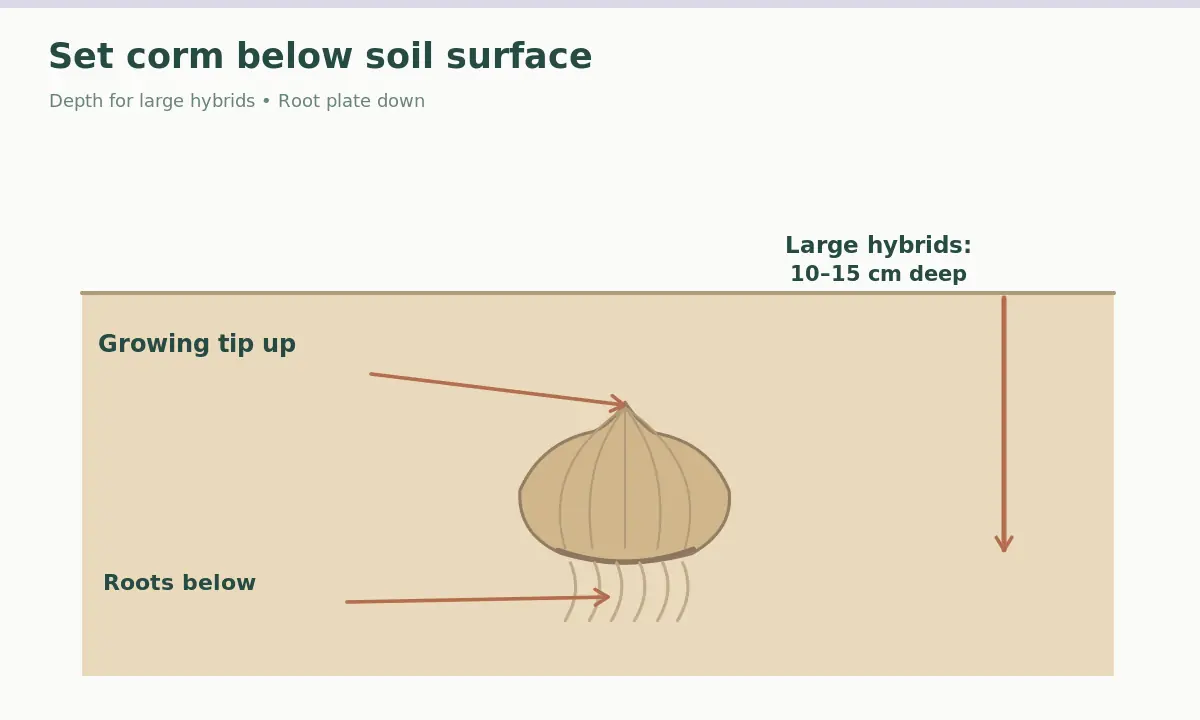
Hold a clean, healthy gladiolus corm and examine both sides before planting. The flatter underside bears an old root plate, while the opposite surface usually shows one or more pointed buds. A brown papery tunic can cover the outside. The internal storage tissue is solid rather than arranged in obvious concentric fleshy layers like an onion. A healthy dormant corm should feel firm, without collapsing soft patches, foul odor, or spreading mold. Do not remove all protective skin to make it look perfectly smooth; inspect only enough to identify obvious damage and locate the growing tip. If a bud has already begun to extend, handle it gently because a broken shoot can set back the plant. The diagram shows top and bottom clearly rather than treating an irregular corm as a symmetrical ball.
| Observation | Recommended next step | Avoid |
|---|---|---|
| Large summer garden-hybrid corm | Set pointed bud upward about 4–6 inches deep | Leaving the storage corm exposed |
| Small cormlet or specialist species | Use its specific shallower depth guidance | Applying one depth to every size |
| Tall spikes on a windy site | Install stakes or support before stems stretch | Piercing corms with a late stake |
Set Large Hybrid Corms at the Correct Soil Depth
For ordinary tall summer garden hybrids, RHS recommends setting corms about three corm-heights deep, typically roughly 4–6 inches (10–15 cm), with the growing tip upward. University of Illinois Extension describes a broader 2–6 inch range depending on corm size. The correct depth is measured from the finished soil surface to the corm’s planting position as specified in your chosen guidance, not from the bottom of a deep trench with no topsoil replacement. Smaller cormlets or specific early types may need shallower placement. Place the flat root plate down, backfill with loose soil, settle gently, and water to bring soil into contact with the corm without saturating it. In sandy soils or windy sites, somewhat deeper planting within suitable recommendations can improve stability; never bury a small corm as deeply as a large one by habit.
Leave Space Between Corms and Plan for Support
Spacing depends on whether your aim is a dense cut-flower row or an ornamental border. Illinois Extension notes closer planting for production and wider spacing for garden landscape display; RHS recommends a spacing comparable to planting depth for many hybrids. Avoid cramming tall stems tightly into a tiny pot where airflow and support become difficult. Insert a stake or a simple support grid while the corms are still easy to locate, so later insertion does not spear underground storage structures. A support should stabilize spikes without binding leaves or crowding the developing inflorescences. Use plant ties that do not pinch expanding stems. Gladiolus flower spikes can become heavy when several funnel-shaped flowers are open, especially after rain. Plan the support at planting time rather than waiting for bent flowers to tell you the bed was too exposed. For the basics, see our guide: When to Plant Gladiolus Corms for Strong Spikes and Staggered Blooms.
Consider Succession Planting for a Longer Flower Show
A single planting produces a concentrated period of bloom rather than flowers all season. Many gardeners set a few more tall hybrid corms every couple of weeks during the safe spring planting window, as Illinois Extension and RHS describe for staggered cut flowers. However, a later batch still needs enough growing season before frost and should not be planted so late that it cannot produce flowers. The total time to flowering depends on cultivar, temperatures, and light; resist promising the same exact interval to every garden. Label each planting date and cultivar so you can learn how your local bed performs. Flower spikes usually open from the lower florets upward; that makes the spike visually distinctive and helps you plan cut-flower harvest without confusing closed upper buds with damaged flowers. If you are starting from scratch, read When to Plant Ranunculus Corms for Cool Weather and Healthy Roots.

Water Growing Plants Without Saturating the Corms
After planting, moisten the soil so it settles around the corm. During active growth, check moisture several inches down rather than watering automatically every afternoon. Tall gladioli grow substantial leaf area and spikes, so prolonged drought may impair flowering, but soggy soil can rot corms. Water at soil level where feasible and allow drainage between irrigation cycles. If leaves become yellow or wilted, inspect for drainage problems, pests, or disease instead of assuming a single fertilizer deficiency. RHS notes thrips, corm rot, and other problems; diagnosing from a generic yellow-leaf symptom alone is unreliable. Mulch can help moderate surface drying, but keep it appropriate to your climate and do not conceal drainage trouble. Avoid inventing a specific feeding rate without soil analysis or a product label.
Leave Healthy Leaves After Flowers Finish
If cutting flowers for a vase, preserve enough healthy foliage on each plant to support replenishment of the replacement corm. Gladiolus makes a new corm above the exhausted previous one during the growing season, so leaves after flowering are doing useful work. A flower spike can be cut when lower florets begin opening, but stripping every leaf for a longer stem may reduce future vigor. Check for disease or pest symptoms before saving corms for another year. The RHS planting guidance explains the life cycle and storage of garden hybrids; the foliage management for specialist species may differ. Do not confuse the mature old corm with the newly formed firm one when lifting. Recording which plants bloomed well also helps choose which corms to keep rather than storing damaged or undersized material indiscriminately. If you are starting from scratch, read When to Plant Freesia Corms in Pots or Mild-climate Gardens.
Decide Whether to Lift Corms for Winter Storage
Many widely sold tall hybrids are not reliably hardy in freezing, wet winters; RHS advises lifting and drying tender types and storing them frost-free. In milder, well-drained sites some gardeners leave appropriate cultivars in place, but winter wet can be as serious as cold. Follow your cultivar and local Extension guidance rather than treating the USDA zone alone as a guarantee. If lifting, handle the new firm replacement corm carefully, allow it to dry in an airy location, remove spent material as directed, and discard moldy or rotting corms. Keep stored corms in a cool, dry, frost-free place and inspect periodically. Do not leave them sealed damp in plastic. The final diagram shows a supported summer flower spike; the following winter decision happens after active growth, not at planting time.
Related Guides
- When to Lift Gladiolus Corms and Store Them Safely Through Winter
- How to Plant Anemone Coronaria Corms Without Wet-Soil Rot
- When to Plant Ornamental Allium Bulbs and Avoid Wet-Soil Rot
- When and How to Plant Muscari Bulbs for Reliable Spring Color
- When to Plant Tuberose Bulbs for Fragrant White Flower Spikes
How We Research and Verify This Guidance
Original source pages were reviewed on 2026-10-24: www.rhs.org.uk — RHS: garden hybrid gladiolus corm anatomy, 10–15 cm planting depth, spring timing and winter storage; extension.illinois.edu — University of Illinois Extension: 2–6 inch planting depth by corm size, spacing and staking; www.rhs.org.uk — RHS trials: full sun, drainage, and representative 12.5 cm planting depth for hybrid corms. We compared the plant or insect identity, stage of development, documented actions, and limits on each recommendation. Regional calendars are qualified rather than copied from one university into a nationwide rule. Educational illustrations simplify scale while retaining the relevant plant structures and action directions. Local Cooperative Extension and cultivar documentation take priority when conditions differ.
Disclosures, Safety, and Local Differences
This article is educational gardening information and does not imply personal medical, pesticide, or agricultural consultation. We claim no sponsorship or affiliate relationship for these recommendations. Read VegWin’s affiliate disclosure. Follow regional plant restrictions and current product labels if considering pest control. Hardiness zones describe winter low-temperature patterns, not exact annual planting or harvest dates. We do not supply invented fertilizer or chemical treatment rates.
The pointed or bud-bearing growing side faces upward; the flatter basal plate that produces roots faces down.
For tall garden hybrids, RHS recommends roughly 4–6 inches (10–15 cm), with adjustments for corm size and type.
Follow your local soil and emerging-shoot conditions and cultivar instructions; a fixed calendar date does not work everywhere.
Tall hybrids often benefit from support, particularly on windy sites or in heavy rain.
It depends on type, drainage, and winter climate. Many tall hybrids are lifted and stored frost-free in cold regions.