
A market bundle of lemongrass can sometimes become a living container plant, but not every cooking stalk has enough basal tissue left to root. The key is the compact, pale lower stem and its intact root-forming base. University of Wisconsin Extension says grocery stalks can root if sufficient root plate remains; University of California guidance describes moving rooted stalks into a moist, well-draining potting medium. This guide shows what to buy, how much of the base to submerge, when roots are ready for potting, and how to protect the tropical grass from cold. It does not promise that an already-trimmed or rotting stalk will survive.
Confirm You Purchased True Culinary Lemongrass
Culinary lemongrass is most commonly Cymbopogon citratus, a clumping tropical grass with long strap-shaped leaves and swollen pale bases. Some stores sell tightly bundled trimmed stems without foliage; others offer fresh bunches with roots partly attached. Check the label rather than confusing lemongrass with lemon balm, lemon verbena, or citronella grass, which are different plants. A cooking stalk should smell distinctly lemony when bruised, but aroma alone is not a reliable botanical identification. University of Wisconsin Extension notes that several Cymbopogon species are grown for different purposes. If the bundle has no recognizable lower stem or is pre-sliced for cooking, it is a poor propagation choice. Purchase firm fresh stalks from a reputable food seller and keep several candidates, because rooting success is never guaranteed even when the plant material looks viable.
Select a Firm Basal Plate Instead of a Cut-Off Stem
Inspect the whitish bulb-like base of each stalk. Ideally it is solid, moist-looking without slime, and ends in a reasonably intact flat root-forming plate. The basal region contains the tissue from which new roots may emerge. Avoid stalks that have been cut several inches above the base, show black mushy rot, or are desiccated throughout. University of Wisconsin Extension explicitly states that enough root plate must remain for a grocery stalk to root. A clean, tightly trimmed plant can still have a viable base, but it will not root if the critical tissue was removed. Do not scrape away all the dense lower leaf sheaths to “expose” imagined roots. Remove only loose decaying outer material; preserve the compact base and any green central growth. Start two or three stalks if possible to allow for variation in freshness.

Prepare the Stalk Without Damaging Its Growing Point
If a stalk has long, dry or broken leaves, shorten damaged upper foliage for convenience, taking care not to remove the basal growing tissues. Peel off a loose yellow outer sheath if it is visibly decaying, but leave healthy protective layers around the base. Rinse off dirt with clean water and inspect for soft black areas. Do not soak stalks in bleach, fertilizer concentrate, or homemade pesticide mixtures; no such treatment is necessary for basic propagation. If the base appears hollow or has a foul odor, discard it rather than placing it beside sound stalks. Rooting in water is a temporary establishment method, not a permanent nutrient system for a mature clump. Utah State Extension describes water-rooting of grocery stems, and UC ANR provides practical home rooting guidance. Prepare a transparent clean jar so developing roots can be observed without constant handling.
Keep the Rooting Base Wet but the Upper Stem Dry
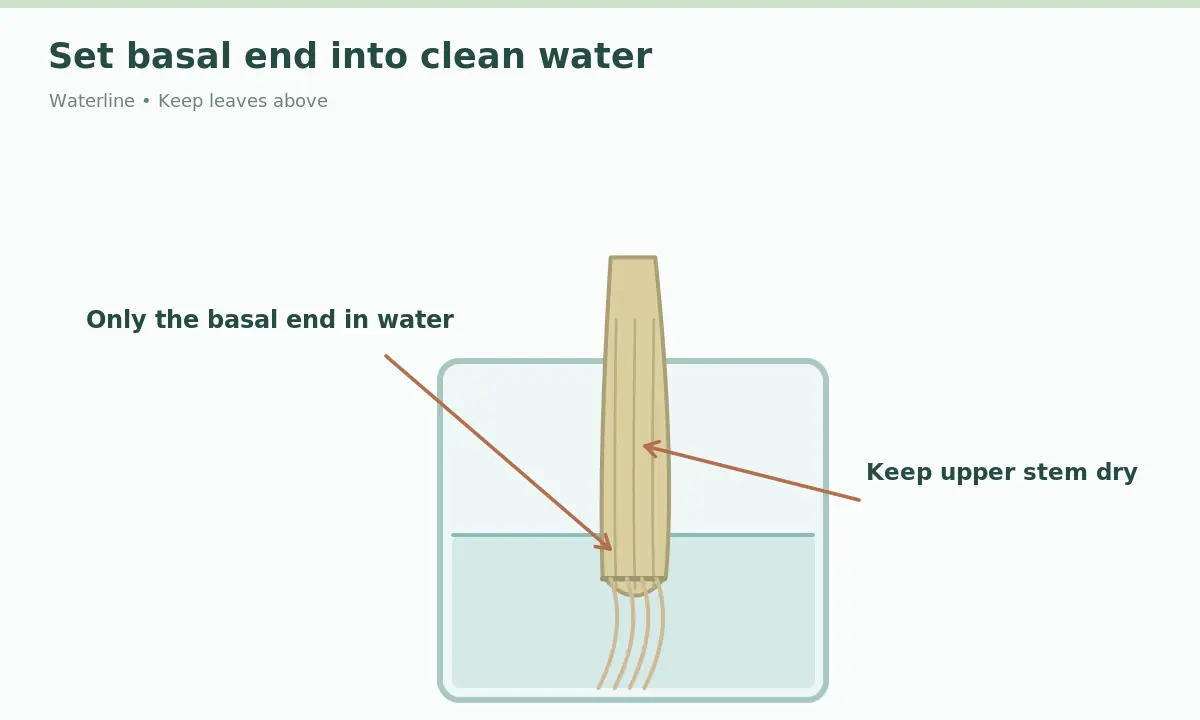
Set the stalk upright in a clean jar with enough water to cover the basal end, but do not submerge the whole leaf sheath or the growing upper stalk. The illustration marks the waterline below the retained green upper material. Check the level regularly and replace cloudy water with fresh potable water; UC Agriculture and Natural Resources recommends regular monitoring and periodic changes. A wide jar or a small support can keep stalks from tipping and bruising. Bright indirect light or gentle sun near a window suits the rooting phase better than a dark cupboard or scorching heat through glass. Do not interpret yellow outer leaves automatically as failure; the important question is whether the base remains firm and pale roots develop. Slimy, smelly water warrants immediate cleaning and inspection.
| Observation | Recommended next step | Avoid |
|---|---|---|
| Base cut above the root plate | Choose another fresh stalk with base intact | Expecting a cut stem to regrow roots |
| Firm stalk but no developed roots yet | Maintain clean water at the basal end | Burying the leafy stem under water |
| Several healthy white roots visible | Transfer to draining potting mix | Leaving roots indefinitely in a jar |
Watch for New Roots Rather Than Counting Fixed Days
Roots may begin appearing in about two weeks under suitable conditions, but cooler indoor air, stale produce, and incomplete root plates can delay or prevent development. Wisconsin Extension notes that roots, if they form, often appear within two or three weeks. Utah State gives a similar general expectation. Treat this as an observation window, not a guarantee. Look for small whitish roots growing from the basal plate and possibly new green growth from the center. Do not pull the stalk from the jar each day to measure roots; you can see them through clear glass. If no roots form after a reasonable trial and the base deteriorates, start again with fresher intact stalks. A stalk can produce limited leaf movement from stored reserves before it establishes real roots, so new green color alone is not proof of successful propagation. Our guide “Grow Lemongrass From Store-Bought Stalks” adds more detail on this.
Move Rooted Stalks Into a Drainage Pot
When several healthy roots have developed and the stalk is still firm, move it to a pot with drainage holes and a well-aerated potting mix. UC ANR recommends transplanting after roots are visible rather than maintaining the plant indefinitely in standing water. Make an opening large enough to spread delicate roots downward without folding or breaking them. Set the pale basal crown at approximately the same level it occupied before, with foliage above the potting medium. Do not bury the entire stalk deeply; wet organic material trapped around new leaves can rot. Firm the potting mix lightly and water until moisture reaches the new roots, then let excess drain. A young stalk does not need a huge, soggy container at first, although a healthy mature clump will eventually need room. Choose a stable pot that will not topple as leaves lengthen.
Acclimate the New Plant to Warm Sunlight
Established lemongrass generally appreciates sun and warm conditions. A recently water-rooted stalk, however, has tender roots and may wilt if moved immediately into intense afternoon sun or drying wind. Begin in bright shelter, then gradually increase outdoor exposure on warm days. UF/IFAS and Utah State Extension describe lemongrass as a tender warm-season herb; it should not be placed outdoors in freezing weather. A seasonal move to a sunny patio can work well in regions with chilly winters, while frost-free climates may allow continued growth outside. Watch the center of the plant for fresh leaves as evidence of establishment. A healthy new leaf may emerge while an older trimmed cooking stalk browns; evaluate the crown and roots rather than saving every outer sheath. Avoid crowding seedlings or companions around the crown.

Water a Growing Clump Without Leaving Roots Saturated
Lemongrass develops vigorous foliage and needs regular water when actively growing in warmth, especially in a container that dries quickly. Wisconsin Extension notes that it requires substantial moisture but should not be left in persistently flooded conditions. Water deeply enough to moisten the root ball, then check how the medium drains; a constantly filled saucer is a warning. The goal is even moisture with oxygen available to roots, not keeping the propagation jar waterline around a potted plant. In winter or reduced light, growth slows and watering needs often decrease. If leaves brown, inspect moisture, root condition, light, and temperature instead of assuming fertilizer is always the solution. Use soil-test or product instructions before adding nutrients; do not invent feeding amounts. In warm regions a clump can become large, so repot or divide as genuinely needed.
Protect Tropical Stems Before Cold Nights
Lemongrass is frost tender. Wisconsin Extension recommends harvesting or bringing plants to protection before freezes; Utah State suggests pot culture where cold winters would kill unprotected stems. Follow actual forecast temperatures rather than using an annual sowing date derived from a USDA hardiness-zone number. A pot can be moved indoors to a bright location; expect slower growth when days are short and indoor light is weak. Check for pests before bringing the pot among houseplants and reduce water in proportion to growth. Do not leave a full saucer in a cold dark room. If you cannot provide a suitable indoor space, harvest usable stems and start fresh in spring. Mature outdoor clumps may also be divided, but this article focuses on establishing plants from intact purchased basal stalks.
Harvest Outer Stems Without Destroying the Crown
After the rooted plant develops several strong stalks, harvest selected older outer bases rather than repeatedly cutting the only young growing stem. Wisconsin Extension describes using stalks when bases are sufficiently thick and separating or cutting outer stems near ground level. In the kitchen, remove tough fibrous exterior layers and use the fragrant lower section appropriately; the entire woody stem is not normally eaten as a tender raw vegetable. Do not harvest aggressively from a small plant that has barely rooted. Watch the crown for continued replacement growth and give it warmth, sun, and sufficient moisture. An established clump can yield repeated culinary stalks, but a grocery-rooted starter may need considerable growing time before meaningful harvest. Correct base selection at the beginning makes the whole sequence possible. For a step-by-step method, see how to grow turmeric in pots from rhizomes and harvest it safely.
Related Guides
- Growing Herbs by Type: Water, Harvest, and Winter Survival Guide
- How to Overwinter Lemongrass in a Pot Before the First Frost
How We Research and Verify This Guidance
Original source pages were reviewed on 2026-10-24: hort.extension.wisc.edu — University of Wisconsin Extension: adequate basal plate needed for grocery-stalk rooting, plant and water needs; extension.usu.edu — Utah State University Extension: grocery stalks can root in water and need warm, moist conditions; ucanr.edu — University of California Agriculture and Natural Resources: root healthy stalks in water then move to well-drained potting mix. We compared the plant or insect identity, stage of development, documented actions, and limits on each recommendation. Regional calendars are qualified rather than copied from one university into a nationwide rule. Educational illustrations simplify scale while retaining the relevant plant structures and action directions. Local Cooperative Extension and cultivar documentation take priority when conditions differ.
Disclosures, Safety, and Local Differences
This article is educational gardening information and does not imply personal medical, pesticide, or agricultural consultation. We claim no sponsorship or affiliate relationship for these recommendations. Read VegWin’s affiliate disclosure. Follow regional plant restrictions and current product labels if considering pest control. Hardiness zones describe winter low-temperature patterns, not exact annual planting or harvest dates. We do not supply invented fertilizer or chemical treatment rates.
No. The intact basal plate is essential; stalks cut above it or badly deteriorated may not root.
About two to three weeks is often reported under favorable conditions, but freshness and temperature change outcomes.
No. Keep only the lower basal end submerged, with upper foliage and the growing portion out of water.
Once several healthy roots are visible and the base remains firm, pot into a well-draining mix and acclimate gradually.
It is a tender tropical grass. Protect container plants or harvest before freezing conditions.