
Tiny pale dots on a tomato leaf can trigger a rush to spray, but spots alone do not prove a spider mite infestation. Mites are minute arachnids that commonly feed on leaf undersides. Under hot dry conditions their populations may expand quickly, creating widespread stippling, bronzing and sometimes fine silk webbing. However, nutrient stress, herbicide injury and some leaf diseases can produce overlapping symptoms. A short close inspection is therefore more useful than guessing from the top surface. This guide shows where to look on a real tomato leaflet, how to use a white-paper tap test, and which low-disruption steps protect beneficial predators.
Notice Stippling Before Heavy Webbing
Look for many pin-sized pale or yellowish dots scattered across leaf tissue rather than large clean holes. Feeding can give a tomato leaflet a washed-out, mottled look and eventually a bronze or dry appearance. University of Minnesota Extension describes the characteristic stippling and later leaf yellowing from twospotted spider mites. Fine webbing often becomes obvious only after numbers are substantial. A few pale marks do not show how many mites are currently active, so avoid treating based only on old scars. Check multiple leaflets, beginning with older foliage and plants exposed to hot dry conditions, and compare affected leaves with sound new growth.
Turn Leaves Over to Look for Mites
Most feeding colonies occupy the lower leaf surface. Hold a leaflet gently, lift it toward natural light, and inspect around veins with a small hand lens. Spider mites are smaller than most visible garden insects and appear as tiny moving specks; eggs and cast skins may occur nearby. University of California IPM explains that adults have eight legs and that large colonies can make silk webbing. On tomato plants, also check whether the pale specks are moving organisms rather than fixed leaf texture. A photograph enlarged on a phone may help, but it does not replace a magnifier or a confirmed moving mite. Inspect living foliage without crushing fragile leaves.

Try the White-Paper Tap Test
Hold clean white paper or stiff white card under an affected tomato leaflet and tap the foliage gently. Pause and look for tiny specks moving across the surface; a hand lens makes this test easier. Both Minnesota Extension and UC IPM describe shaking mites from leaves onto white material as a practical confirmation method. Repeat on several leaflets to reduce the chance that a random particle is mistaken for a mite. Distinguish a few active specks from heavy numbers throughout the planting. The visual diagram shows exactly where the paper goes and why the upper surface alone cannot confirm infestation. Dispose of the paper without transferring mites to healthy plants.
Separate Mites From Other Tomato Problems
Spider mites typically produce fine stippling, especially with colonies underneath. Early blight tends to cause larger dead areas and characteristic lesions; nutrient stress may follow particular leaf patterns without live mites; herbicide injury often distorts new foliage. These are clues rather than a complete field diagnosis. Look for actual mites or eggs before committing to a control program. If leaflets have broad yellow margins, curling and no mites after repeated checks, ask local Extension for help identifying environmental or disease causes. Avoid assuming that every curled tomato leaf means spider mites. A correct diagnosis prevents needless pesticide use that might kill the very predators holding mites in check.

| Observation | Practical next step | Avoid |
|---|---|---|
| Turn Leaves Over to Look for Mites | Most feeding colonies occupy the lower leaf surface. | Assuming timing is the same in every climate |
| Separate Mites From Other Tomato Problems | Spider mites typically produce fine stippling, especially with colonies underneath. | Treating a diagram as a substitute for examining the plant |
| Preserve Natural Enemies in the Garden | Predatory mites, minute pirate bugs, lacewings and other beneficial organisms feed on mite pests. | Repeating an action without monitoring the outcome |
Understand Why Hot Dry Weather Matters
Twospotted spider mites often build rapidly during hot dry conditions, especially when plants are water-stressed or exposed to dust. Minnesota Extension notes how quickly mite generations can progress during very warm spells. Tomatoes already under drought stress tolerate additional leaf injury poorly. Check the root zone for actual moisture and maintain steady irrigation appropriate to your soil rather than flooding the plant. A mulch layer can help limit evaporation and splashed dust if placed safely away from stems. Avoid excessive nitrogen fertilizer applied in hope that it will heal stippling; the pale scars on already damaged leaves do not simply turn green again. Monitor whether newer foliage stays healthy.
Preserve Natural Enemies in the Garden
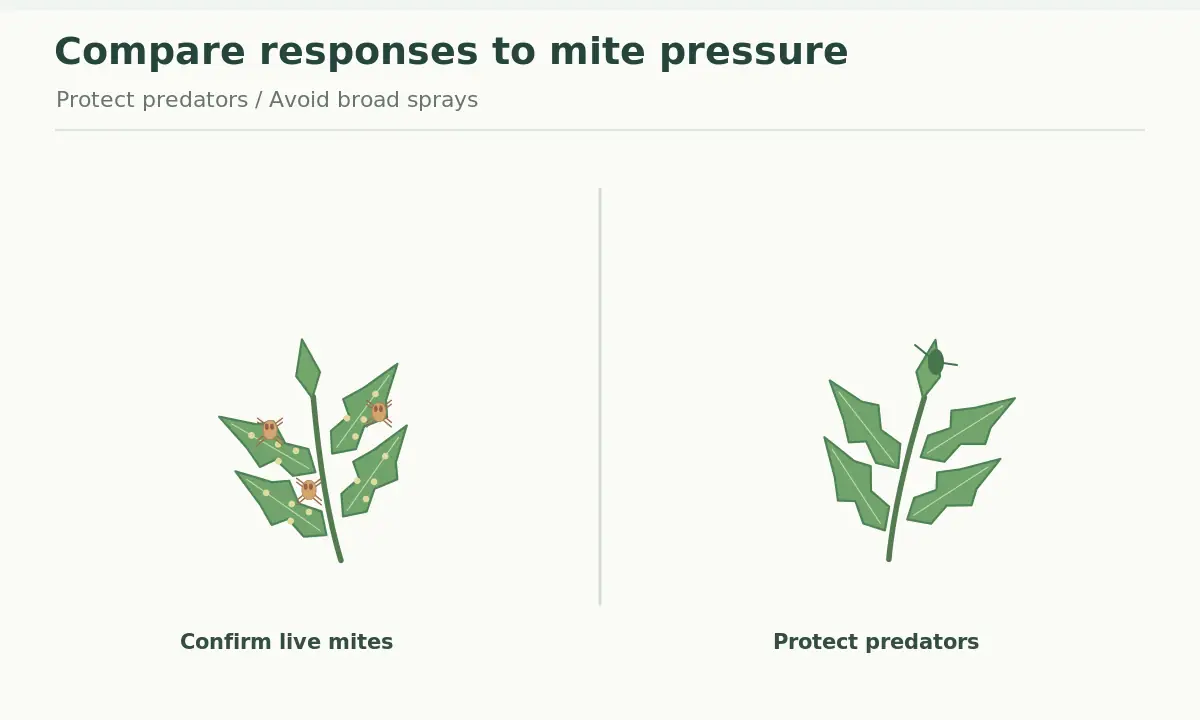
Predatory mites, minute pirate bugs, lacewings and other beneficial organisms feed on mite pests. UC IPM identifies natural enemies as an important reason small mite populations may never become a major problem. Some broad-spectrum insecticides kill predators while leaving many pest mites, sometimes causing rebound outbreaks. Do not spray a tomato plant simply because a few dots appear. Inspect for natural enemies and judge the spread across leaves. If damage is limited and new growth is sound, monitoring and better plant care may be enough. Biological control works best before very heavy populations overwhelm available predators. Gardening for a balance is not ignoring the infestation; it is a deliberate IPM choice.
Dislodge Mites With Water Carefully
A firm but controlled water rinse can physically knock mites from lower leaf surfaces. UC IPM and Minnesota Extension discuss water sprays as a practical nonchemical step for manageable infestations. Work so the water actually reaches the undersides rather than just wetting tomato fruit. Avoid snapping petioles, turning soil into mud, or leaving the canopy wet through an unsuitable cool humid night. Evaluate whether local foliar disease pressure makes repeated overhead wetting undesirable, and use morning applications if appropriate. In a greenhouse, adjust humidity and airflow responsibly; stagnant damp leaves can trade one problem for another. Check again after treatment because eggs and protected colonies may remain.
Use Soap or Oil Only Under Valid Labels
If pest pressure continues to increase, registered insecticidal soap or horticultural oil may sometimes be appropriate, but the product must actually authorize use on tomatoes in your location and at that growth stage. University of Minnesota notes that these materials depend on contact with mites and that undersides require coverage. Follow the entire label, including dilution, temperature precautions, protective equipment, pollinator protection and the preharvest interval if applicable. Homemade dish-detergent mixtures are not equivalent to tested labeled products and can damage leaves. Do not spray a heat-stressed plant at midday. No pesticide choice here substitutes for confirming the pest or checking current local restrictions.
Recheck Plants Every Few Days
A spider mite population can change quickly in warm weather, so inspect marked tomato leaves again rather than declaring success the day after one water rinse. Minnesota Extension suggests repeated checks every few days during high-risk conditions. Note the fraction of checked leaflets with moving mites, new stippling, visible predators and webbing. Old speckles remain visible after mites are gone; the more useful trend is whether live populations and fresh injury are increasing. A growing leaf with no new marks is encouraging even if an older leaflet looks unsightly. Avoid removing so much foliage that fruit becomes exposed to sunscald, especially when plants already have heat stress. For the next step, our guide “Spider Mites on Tomato Plants” explains how to confirm the pest before taking action.
Make a Small Evidence-Based Decision
Try this sequence: first, identify fine stippling; second, look underneath with a hand lens; third, perform a paper tap test; fourth, judge whether live mites and new damage are spreading; finally, choose monitoring, watering adjustments, carefully directed rinsing or only a properly labeled control. Record the weather and the date when you first found living mites. If your tomato leaf symptoms remain unexplained, bring photos and plant history to local Cooperative Extension. UC IPM and Minnesota Extension both emphasize monitoring and beneficial organisms rather than indiscriminate broad-spectrum applications. This method reduces avoidable garden chemical exposure and focuses effort on actual moving pests.
Related Guides
- Growing Tomatoes: A Step-by-Step Plan from Transplant to Harvest
- Aphids on Tomato Plants: Identify Colonies and Choose IPM First
- How to Identify Whiteflies on Tomatoes and Reduce Their Damage
- How to Identify Stink Bug Feeding Spots on Tomatoes Without Guessing
- Tomato Hornworm: Identify the Caterpillar and Choose an IPM Response
How We Research and Verify This Guidance
Updated and source-checked on 2026-10-24. We compared the specific horticultural question with the following university or Extension guidance: extension.umn.edu — Twospotted mites on tomatoes, stippling, leaf underside tests and management; ipm.ucanr.edu — Mite identification, hot dry outbreaks, water dislodging and predator preservation; extension.umn.edu — Recent integrated scouting advice for spider mites in gardens. This article separates observed plant development from local timing; seed lot, species, soil conditions and growing region can alter results. Diagram labels are simplified to teach the relevant decision, rather than reproduce any particular cultivar as a photographic specimen. Always verify current local pesticide labels and restrictions where relevant.
Disclosures, Sources and Regional Limitations
VegWin provides educational gardening information, not site-specific diagnosis. No sponsorship, product endorsement or confirmed commission-based partnership is claimed in this guide. Read the affiliate disclosure. The source links in the research section support the underlying horticultural claims; any cultivar instructions, soil test results, local freeze date or pesticide registration take precedence over a general illustration. Readers should consult local Cooperative Extension for a plant that appears infected, invasive, regulated or unsafe.
No. They are tiny arachnids related to spiders and ticks, not true insects.
Yes. Large populations cause stippling, bronzing and possible leaf drop, especially during hot dry stress.
No. Fine webbing becomes more obvious as colonies build; stippling and moving mites may be detected first.
Inspect the undersides with a hand lens and tap suspect leaves over white paper to look for moving specks.
Not reliably. Some broad-spectrum insecticides kill mite predators and can actually make outbreaks worse.