
A weigela can look messy after winter, flower heavily in spring, and send out a few more blossoms in summer. That mixed pattern is why simple advice such as ‘cut it all back in March’ can be costly. Most of the big spring show is carried on growth made the previous year. Cutting all of those stems before flowering removes the buds you wanted to see. The goal is not a perfectly round shrub; it is a living framework with enough older flowering branches and space for new replacement shoots.
Iowa State University Extension notes that weigela can bloom on both old and new growth, with the heaviest flush on last year’s stems. North Carolina State’s plant guide favors pruning just after flowering when shaping is needed. Those statements are compatible if you separate three jobs: remove dead wood when you can identify it, selectively renew aging shrubs, and shorten stray branches just after the main bloom. This guide explains how to choose among them rather than combining everything into one drastic haircut. For the basics, see our guide: When and How to Prune Forsythia Without Losing Next Spring’s Flowers.
Identify the main bloom before setting a date
Watch the plant’s flowering pattern for at least one full season if its label is missing. A weigela typically has its strong bloom in spring on previous-season stems; some plants then rebloom more lightly on new summer growth. Cultivar descriptions can vary, so a repeat-blooming selection is not a reason to remove its entire framework. Record the actual first-flower and last-flower dates for your garden rather than assuming the schedule from a neighboring state.
If you need only a tidier outline, aim to work immediately after the big spring flush. That timing leaves a longer growing period for replacement stems to mature before the next flowering season. Avoid late-summer hedge clipping merely because a few blooms are still visible. A small change today can prevent cutting off months of developing buds. If storms made branches dangerous, safety work takes priority over preserving flowers.
Distinguish dead wood from leafless living branches
In late winter or early spring, start with what is certainly broken or dead. Weigela can suffer winter dieback, and a brittle twig with no viable buds may be removable regardless of the bloom calendar. Test several points along a suspect branch rather than judging the entire cane from a dry tip. Living buds may remain farther down even when the ends are damaged; make the final cut back to healthy tissue or an appropriate branch junction. For the basics, see our guide: When to Prune Weigela Without Removing Spring Flower Buds.
Do not scrape away huge patches of bark to inspect every stem. Look instead for swelling buds, flexible young wood and small careful scratch tests where needed. Work slowly around the inside of the shrub. One dead twig is a cleaning job, not an invitation to reduce every nearby flowering branch. Disinfect equipment when a disease is suspected, and identify damage before assuming every dark twig has the same cause.

Choose thinning before cutting the whole top
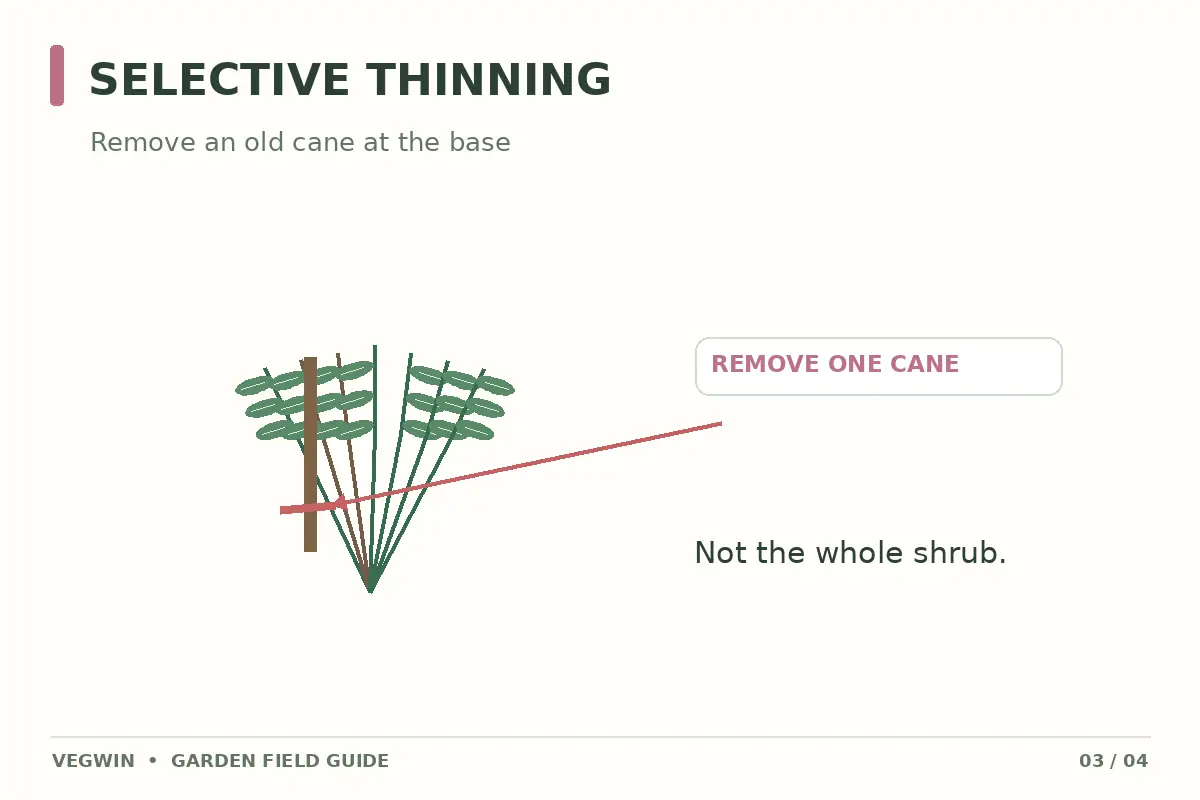
On a mature, crowded plant, begin by tracing one of the oldest thick canes down to its base. Removing selected older canes can open the center while preserving flowering younger branches. University Extension guides favor thinning over repeatedly shearing the entire surface because selective removal encourages a more natural framework. Stand back after each cut: the space left behind may already be enough.
Avoid removing a third of every stem’s length. That is different from removing a limited number of old stems completely, and it produces a dense outer shell with tangled growth underneath. Do not pull a tangled branch through the crown and tear buds off neighboring stems. Cut it into manageable pieces if necessary. The objective is air and room for replacement shoots, not a prescribed quota of pruned wood.
Shape long shoots after the spring flower flush
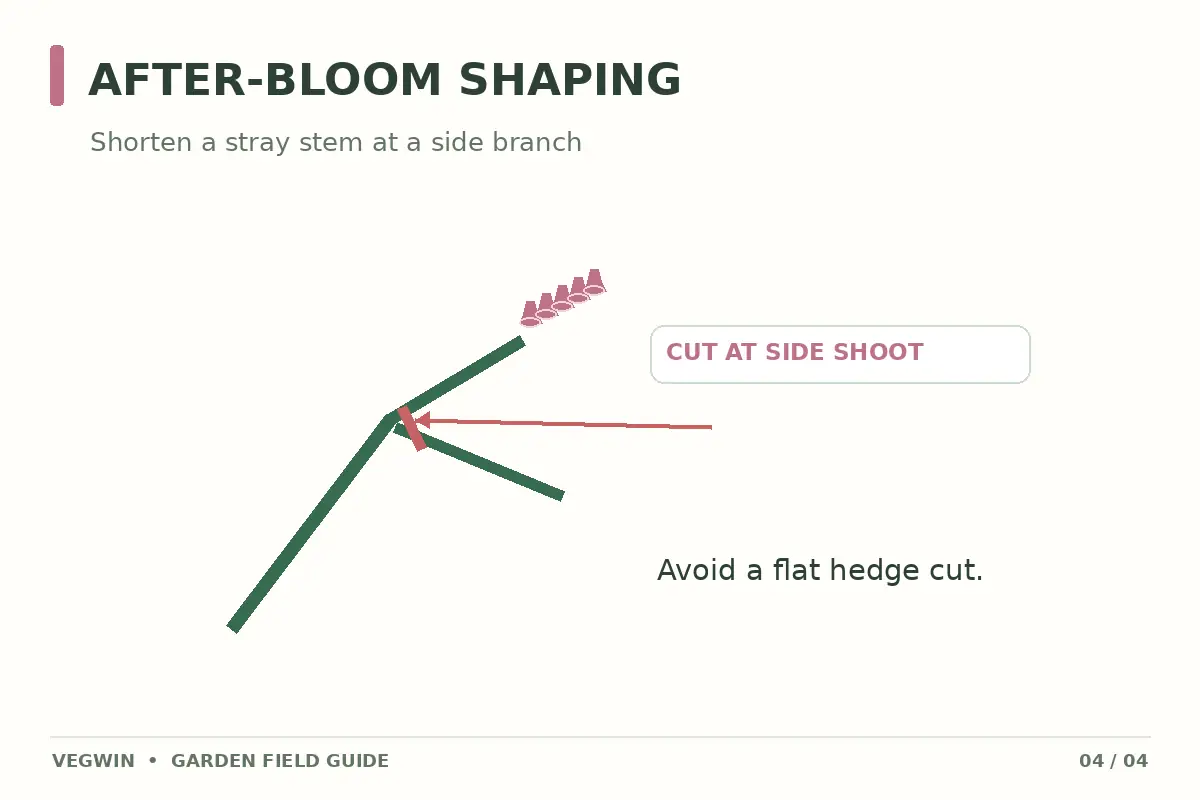
A branch that reaches over a path may need shortening even if the rest of the shrub looks fine. Follow it back to a well-positioned side branch or outward-facing live growth, and cut near that junction. A natural-looking, staggered outline is usually better than a straight line of stem stubs. For a compact cultivar, only a little correction may be necessary; small shrubs can lose their characteristic rounded shape when forced into a tight hedge.
Do not remove foliage just to expose every spent blossom. Weigela’s later, lighter bloom can be enjoyed without heavy pruning between flushes. For plants with little spring flowering, look first at excessive shade, past winter or autumn pruning, winter injury and plant maturity. Fertilizer alone cannot replace spring flower buds already cut away. Reassess the garden site before repeating the same hard pruning next year. If you want the full process, read how to prune clematis by flowering group without losing next year’s blooms.
Plan renovation without promising next-year flowers
An overgrown shrub may have thick woody bases and few flowering branches within reach. Renovation is more disruptive than normal maintenance. Selective renewal of a few oldest stems over multiple seasons usually protects more of the spring show than cutting every cane to ground level in one day. Wisconsin and Colorado Extension shrub resources explain that complete rejuvenation can sacrifice a season’s bloom and is appropriate only for plants capable of producing vigorous new growth.
If the root system is weak, soil is waterlogged or much of the plant is dead, severe cutting may not rescue it. Decide whether the shrub is still worth renovating or whether a healthier replacement of appropriate mature size would serve the site better. A plant that recovers vegetatively after a hard cut is not evidence that the timing was ideal for flowers. Write down the changes and look for strong new shoots before deciding on a second round.
Avoid the three most common weigela mistakes
First, don’t treat a few summer flowers as proof that old wood never matters. Second, don’t use shears to turn every arching branch into the same length; the result can flower mostly around its outside. Third, don’t cut an established shrub hard merely because you have seen that technique recommended for some other summer-blooming species. Each of these shortcuts ignores where the next buds develop.
Keep sharp bypass pruners for small stems and properly sized loppers for older canes. Make clean cuts without leaving tall dead stubs. If a branch appears cankered, sunken or discolored, pause and check an appropriate plant-disease resource before assuming regular renewal pruning is the fix. Healthy remaining wood and the season’s flower display are more useful success measures than a symmetrical shape immediately after pruning. For the basics, see our guide: When and How to Prune Glossy Abelia Without Spoiling Its Arching Shape.
Review bloom and shoot balance next season
Check the shrub a few weeks after spring flowering and again as growth slows in fall. New basal shoots show that replacement is occurring; retained older stems should still carry foliage and, in season, flowers. Note whether a particular corner becomes crowded again or whether the plant now has enough room for its natural arching habit. Do not repeat a heavy program automatically just because it is on a calendar.
If a harsh winter removes tips later, return to careful deadwood removal first. If the main spring display is strong, you may need almost no further pruning. This is the most efficient outcome: fewer cuts, less wasted growth, and a shrub still able to make next year’s buds. Use your observations and cultivar information to decide whether the light rebloom is worth preserving with even gentler summer shaping.
A practical decision table for your next step
| What you see | Preferred action | Timing or precaution |
|---|---|---|
| Dead tips after winter | Confirm dead wood; cut to live wood | Late winter or spring after inspection |
| Overgrown older canes | Thin a limited number at the base | Before growth or after main bloom |
| Long stem blocking a path | Shorten at a healthy side branch | After main spring flowering |
| Weak spring bloom | Review pruning history, light and injury | Diagnose before cutting more |
Related Guides
- When to Prune Rhododendrons After Bloom Without Removing Next Spring’s Buds
- When to Prune Bridal Wreath Spirea and Keep Its Arching Spring Flowers
- When to Prune Deutzia After Flowering and Thin Older Canes Correctly
- When to Prune Japanese Pieris Without Losing Next Spring’s Flowers
- When to Prune Pyracantha Without Losing Spring Flowers or Winter Berries
How We Research and Verify This Guidance
This article was prepared from the university Extension and university-library materials identified below, checked October 22, 2026. That is a title- and intent-level overlap review, not a complete comparison against the full text of every published post. The original WebP illustrations are simplified teaching diagrams, not photographs or exact botanical measurements. Always apply local Extension guidance and the named species or cultivar before making climate-sensitive decisions. No paid affiliate relationship is verified for this article; read our affiliate disclosure.
University research references, checked October 22, 2026: yardandgarden.extension.iastate.edu — Weigela can flower heavily on previous-season wood and lightly later; remove winter-killed wood and selectively thin old stems.. plants.ces.ncsu.edu — Weigela flowering, growth habit and the after-bloom window for shaping.. hort.extension.wisc.edu — Timing and selective thinning principles for spring-flowering shrubs..
Remove confirmed dead wood and consider selective old-cane renewal; widespread shortening can remove spring flower buds.
Its strongest spring flush is usually on previous-year wood, with some cultivars producing later flowers on current growth.
Only consider major rejuvenation for a vigorous, severely overgrown plant after accepting that flowering may be lost.
No. Routine individual deadheading is not necessary to keep a typical weigela healthy; prioritize structural needs.
Identify winter-killed versus living branches, then assess site conditions and bud growth before cutting indiscriminately.