
A winter vegetable garden can mean four different things: picking mature greens in cold weather, keeping plants alive until spring, growing slowly under cover or producing actively with controlled heat and lighting. Those goals are often blurred. An unheated low tunnel may protect hardy crops, but a cover does not create additional sunlight. This guide starts with the question “What harvest is realistic?” and works backward through day length, frost, crop tolerance and the structure you can monitor. It complements a fall-planting calendar rather than copying spring planting dates into December. Always follow local Extension guidance because a winter plan in Minnesota is not a winter plan in a mild coastal or southern region.
Name Your Winter Goal Before Buying a Cover
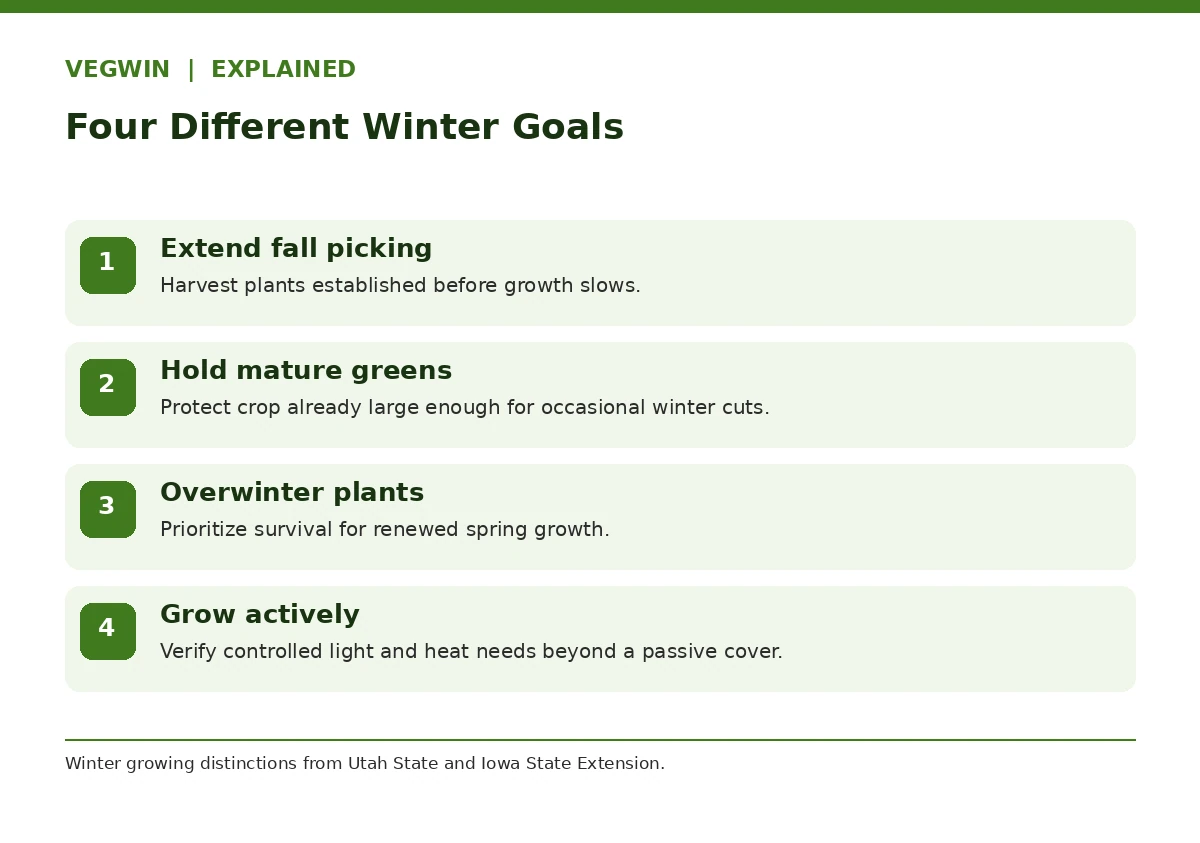
If your goal is occasional winter salad leaves, the most dependable strategy may be establishing cold-hardy greens early enough that they are nearly ready before the darkest period. If your goal is overwintering, the plants may stop growing and simply survive until longer spring days. Also, if you expect steady new growth through deep winter, you may need protection and supplemental light or heat that a simple garden cover cannot provide. Utah State Extension explicitly describes how shorter days limit passive year-round production in cold regions.
Write one goal on the bed plan: fall harvest extension, winter holding, winter survival or controlled growing. Each has a different success test. Surviving plants are not the same as weekly new harvest. A crop that was planted too late may remain small even in a protected structure. If winter vegetables are mainly a household preference, a modest salad bed and realistic harvest window are more useful than a large low tunnel that cannot be checked after every storm.
Work Backward From Daylight and Crop Maturity
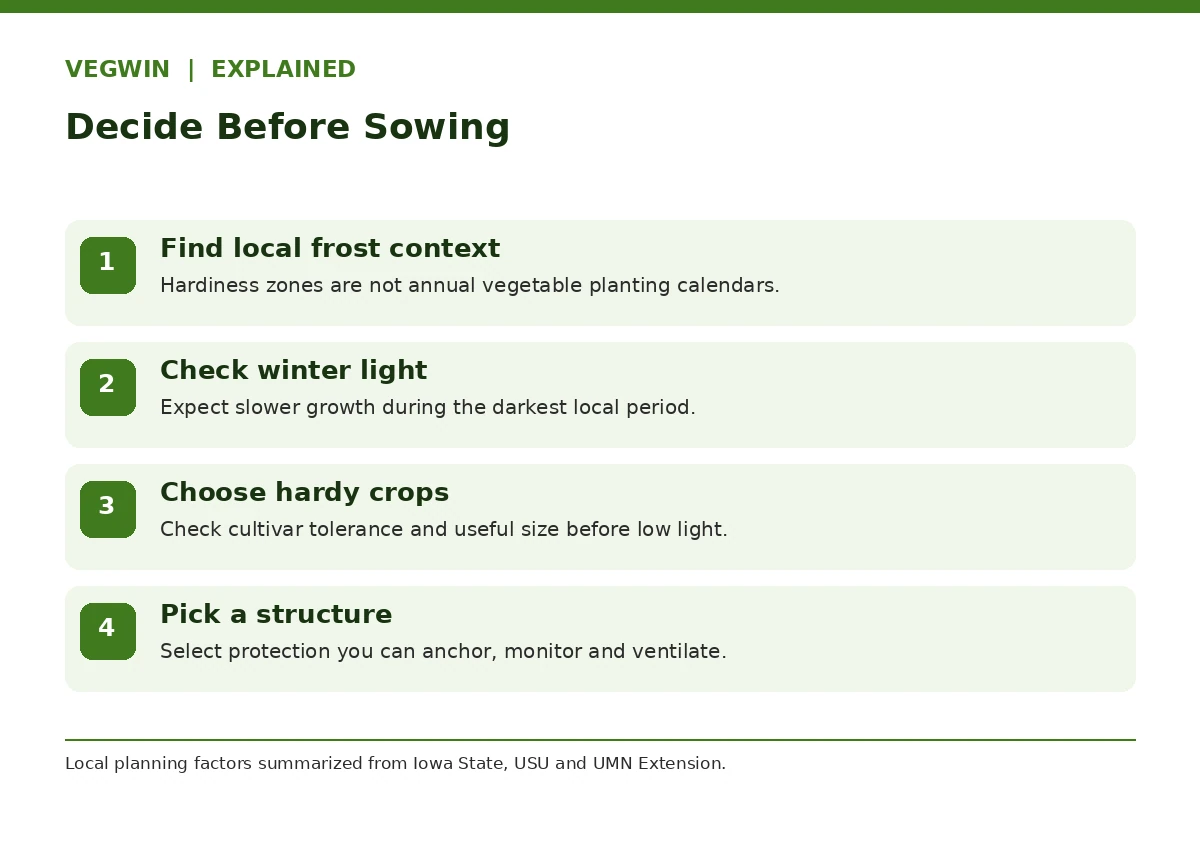
A seed packet’s days-to-maturity describes a particular growing context, not a promise that the plant will finish in the same number of dark winter days. Iowa State notes that for central Iowa, low-tunnel winter production depends strongly on establishing crops by early November, with earlier late-summer sowing dates for different greens. Those dates are regional examples, not a nationwide recommendation. Minnesota Extension’s August 2026 update likewise explains slower growth as day length drops in Minnesota.
Before buying seed, find local fall planting recommendations and expected first frost timing. Check seed-packet maturity, whether it counts from seeding or transplanting, and crop cold tolerance. Then ask when plants need to reach a harvestable size before light becomes limiting. USDA hardiness zones summarize historical winter temperature extremes of perennial plant survival; they do not provide annual vegetable planting dates or day length. Your latitude, microclimate, cultivar and actual forecast matter more for this calendar. Our guide “Plan a Fall Vegetable Garden Using Frost Dates and Crop Growth Time” adds more detail on this.
Choose Crops for Protection, Not Summer Expectations
Iowa State identifies spinach and cilantro as relatively hardy under appropriate low-tunnel conditions and notes that some greens can be carried over for spring. Lettuce and other leafy crops differ in tolerance and may be damaged by deep cold even when protected. Do not infer from one successful spinach planting that tomatoes, peppers or beans can continue producing under the same plastic. Warm-season crops need conditions fundamentally different from those of winter greens.
Variety and plant age also influence outcomes. Check the specific cultivar’s regional advice instead of promising all brassicas or leafy greens behave alike. A mature plant headed into cold weather may be more harvest-ready than a tiny seedling sown after light levels fall. Separate quick-fall crops, hardy holding crops and overwintering plants on your sketch. This distinction prevents a gardener from treating a frost-hardy leaf as a guaranteed fast-growing food source in the coldest month.
Compare Row Covers, Low Tunnels, and Cold Frames
Floating row covers, low tunnels and cold frames can buffer wind and some cold but have different accessibility and ventilation demands. Utah State University Extension describes passive structures as ways to stretch seasons rather than create a fully controlled greenhouse. Iowa State describes a cold frame as a low, transparent-lidded box that traps solar warmth. A small supported low tunnel can protect a row of hardy plants. Neither structure makes freezing nights disappear. Our guide “Build a Raised-Bed Hoop Tunnel That Can Vent and Open” adds more detail on this.
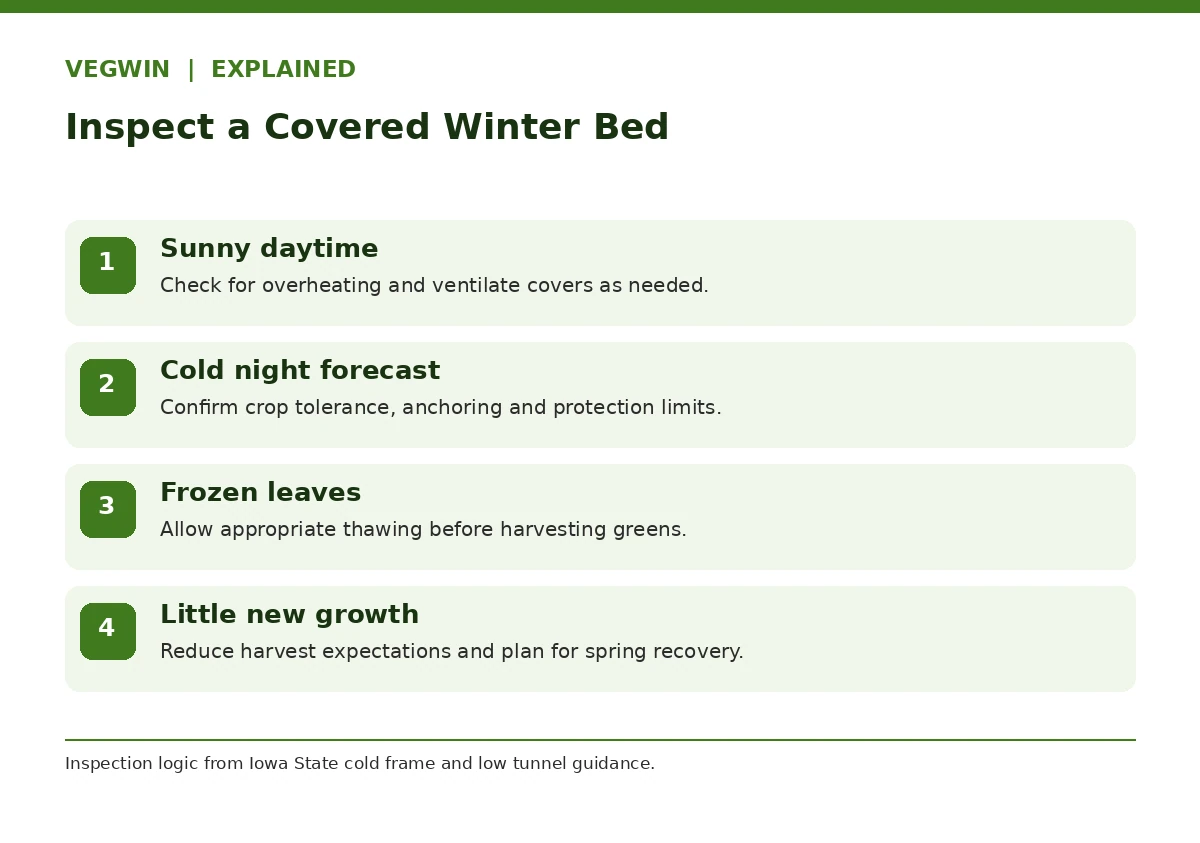
Choose based on your actual winter problem and your ability to inspect the crop. A securely fastened cover must withstand local wind and snow loads without crushing plants; follow manufacturer and Extension instructions for materials and anchoring. Cold-frame lids may overheat plants on sunny winter days, requiring ventilation. Condensation can increase leaf wetness and disease pressure, so check the inside after weather changes. Do not seal a transparent cover and assume the garden now manages itself.
Monitor the Soil, Moisture, Frost, and Air
Plants may require water under cover even when outdoor beds appear damp, but wet soil that remains cold can promote root problems. Check soil moisture near the crop before irrigating, follow local guidance and avoid using warm-season watering schedules in winter. On sunny days, observe inside temperatures, particularly in a cold frame. Iowa State stresses that frames must be ventilated when needed to prevent overheating. A warmer midday greenhouse air reading is not proof the roots are safe during a night freeze.
Snow, freezing rain and winds change access and protection. Inspect anchoring and accumulation when safe, and do not take risks on icy structures. Iowa State notes that harvesting frozen leafy crops can damage tissues; let them thaw appropriately before cutting. Plant cleanliness, airflow and pest scouting still matter under protection. A covered plant may survive but produce foliage slowly, so taking too much at once can leave little capacity for another harvest until light returns.
| Winter goal | What it requires | What it does not guarantee |
|---|---|---|
| Extended fall harvest | Crop established before cold; temporary protection | Production in deep winter darkness |
| Harvest stored on living plants | Mature hardy greens and accessible protection | Rapid regrowth after each cutting |
| Overwinter and regrow | Suitable crop and protection for local cold | A harvest every winter week |
| Active winter growing | Controlled environment and adequate light | Success with an unheated cover alone |
Separate Winter Harvest From Spring Regrowth
A low tunnel can be a holding space for established plants that yield during suitable thawed periods. Another bed may be planned mainly for survival and a flush of new spring growth. Treat those as different inventory categories. If a plant stayed green through a cold spell, that is encouraging but does not guarantee repeated weekly winter harvests. The shortest, darkest weather may reduce growth more than gardeners expect from daytime warmth alone.
Keep a log of sowing dates, cover type, inside and outside temperatures, leaf quality and how much was cut each time. If a crop dies, look for the actual cause: unsuitable cultivar, late establishment, wind damage, moisture, heat buildup under cover or a prolonged freeze. Do not solve everything by adding more plastic. An ordinary regional forecast and a soil thermometer can inform decisions more effectively than assuming any given USDA zone predicts this winter’s harvest.
Use a Winter Bed Map With a Stop Rule
Draw the bed as a simple three-column map: crop and sowing date, expected readiness before low light, and the protection or access plan. Include a stop rule such as “If this crop has not sized up by the local low-light window, stop promising a midwinter harvest.” That protects time and space for plants whose goal is survival, or for a cover crop or other soil-protection choice. Label overwintering crops as spring projects rather than quietly counting them as winter yield.
At the end of the season, compare planned with actual harvest. A successful first winter garden may involve a few leaves plus useful lessons about wind, airflow and shading. This page instead answers what happens after growth slows and how to distinguish a winter harvest, a protected holding bed and spring recovery. The distinction makes both pieces useful rather than competing versions of the same calendar.
Related Guides
How We Research and Update This Guidance
Sources and their current text were inspected on October 19, 2026. The accompanying diagrams are original decision aids summarizing those sources; they are not photos, field-trial results, or a substitute for local Extension diagnosis. Climate, crop varieties, changing pathogen prevalence and institutional revisions can change appropriate guidance. The author should revisit local recommendations before publishing or when a reader reports new field conditions.
Evidence and further reading: [1] Iowa State Extension [2] Utah State University Extension [3] Iowa State Extension [4] University of Minnesota Extension 2026 season note
Disclosure: No product or partner recommendations in this guide are sponsored or commissioned, and its buttons are educational links rather than affiliate offers. We checked sources including affiliate disclosure.
Some hardy crops may survive and offer harvest opportunities, but growth slows greatly in low light; covers alone do not guarantee ongoing production.
No. You need local first frost and climate data, daylight, soil conditions, crop tolerance and variety recommendations.
Iowa State discusses hardy spinach and cilantro, among others, under its regional methods; check Extension guidance for your location.
Often yes. The air may heat rapidly under a transparent lid even in cool weather; monitor temperatures and ventilate as advised.
They may have been sown too late to size up before short days reduced growth, or local temperature and light may be insufficient.