
Disclosure: This article offers independent educational guidance, not a paid endorsement or a verified affiliate recommendation. See our affiliate disclosure. Local Extension resources, plant variety, regional conditions and product labels take precedence over general examples.
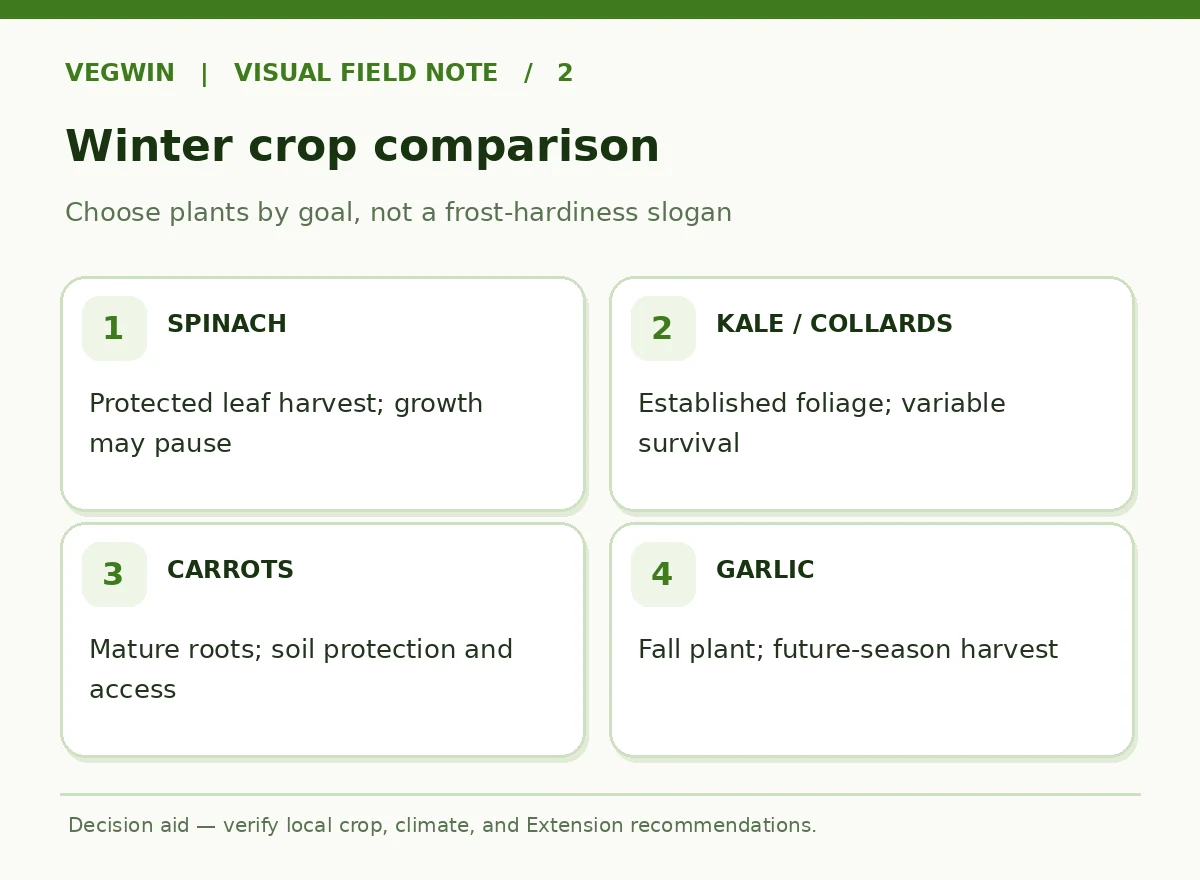
Which vegetables can actually stay productive in winter? The useful answer is not a universal top-ten list. Spinach may survive in a covered bed while barely growing during the shortest days; mature carrots can sometimes be held for later harvest; garlic planted in fall is usually a crop for a later season, not dinner next week. These are three very different winter jobs.
To choose suitable winter vegetables, first name the result you want: pick leaves in winter, hold an already-grown crop in the ground, or overwinter plants for spring growth. Then account for region, low temperatures, daylight, soil drainage and any cover you can safely maintain. Use this crop comparison as a decision aid, not a promise that unheated plastic makes summer growth possible.
Choose Your Winter Harvest Goal Before Your Crop
A winter bed can be a slow-growing food source, a cold outdoor storage space or a holding area for plants that resume growth in spring. Cornell explains that greens in winter high tunnels can make little or no new growth during the darkest stretch of winter. In climates with short winter days, establishing useful leaf mass in autumn is often more important than what is planted in December.
If you want repeated winter leaves, look first at spinach or other regionally suitable greens, and arrange for plants to reach usable size before strong growth slowdown. If you mainly want to harvest roots already formed, carrots or parsnips may fit a different strategy. Also, if you are willing to wait for spring, certain hardy onions, greens and garlic may be appropriate even when they yield little during the coldest period.
Distinguish harvest date from planting date in your notes. Choosing a winter crop is not the same as deciding when to sow it. First identify the outcome, then use local Extension schedules to plant far enough ahead for the desired result.
Match Spinach and Other Greens to Daylight
Spinach is an important candidate for protected winter greens in many temperate regions. Iowa State Extension identifies spinach and cilantro as especially reliable for overwintering in suitable low tunnels. But success depends on fall establishment, variety, local exposure and cover management. Tender lettuce may do well in a mild spell and then fail during a deeper freeze.
Kale, collards, hardy mustards and certain Asian greens may tolerate frost, but survival is not interchangeable with continuous leaf production. Local varieties can differ substantially and wet winter soil can be more damaging than a dry cold period. Choose cultivars recommended for your growing zone’s actual winter conditions; a USDA hardiness-zone number does not express winter daylight, snow load or tunnel condensation risk.
For salad greens, plan small protected harvests from established leaves. Do not take frozen leaves: Iowa State guidance advises waiting for thawing before picking. Track the center of the plant and new growth rather than stripping a weak crown in midwinter.

Separate Root Holding From Winter Growing
Carrots, parsnips and some other roots may be harvested late or held temporarily in protected soil where winter conditions allow. This is storage of a mature crop rather than active enlargement under a blanket. Check drainage and local rodents, and remember that repeated hard freezing can make digging impossible even if the root tissue survives.
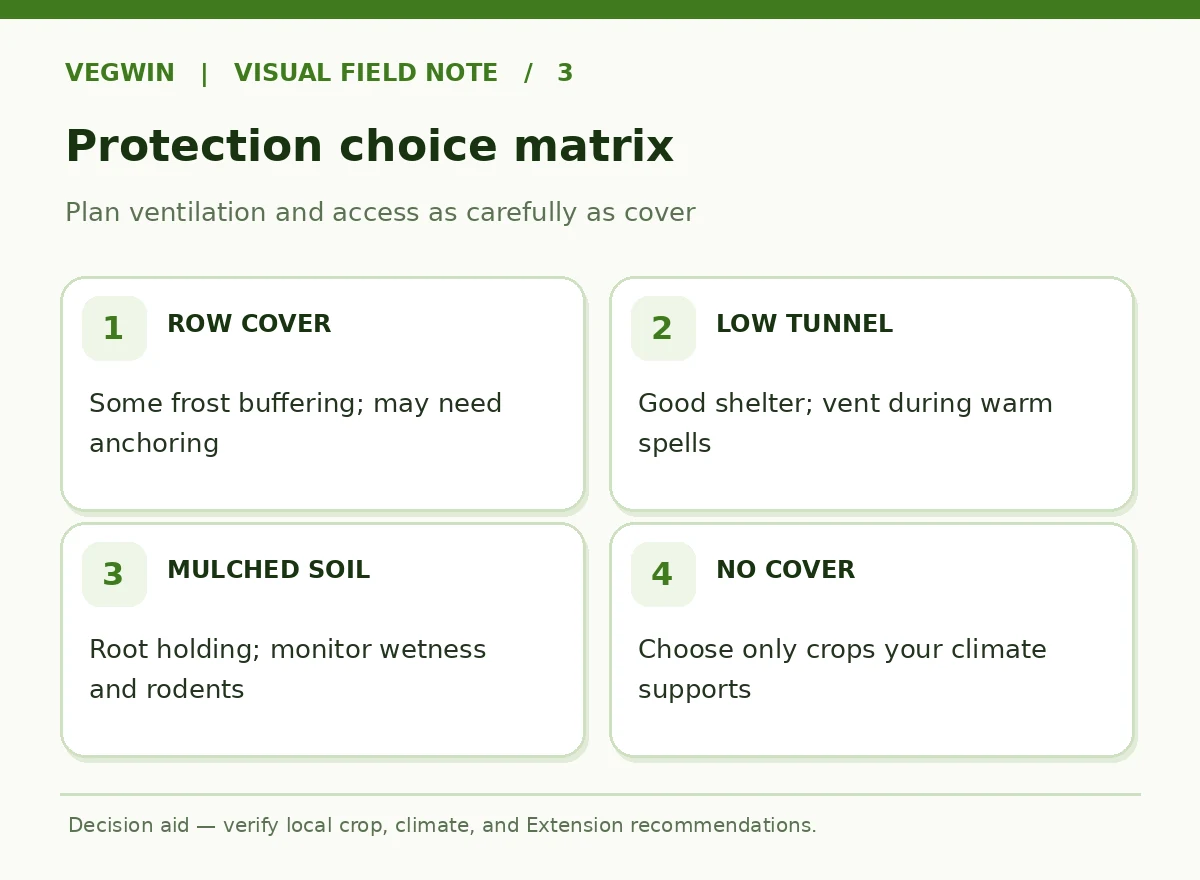
Cover is a tool, not a guarantee. A thick layer of loose organic mulch can reduce temperature swings and help keep soil workable in some regions, but it also creates habitat for pests and can trap excess moisture on heavy ground. The correct approach differs for coastal rain, dry continental cold, and mild southern winters.
Beets and turnips may be suitable for some late-season beds, but do not give them the same deep-winter reliability as a highly cold-hardy crop without local evidence. Soil type, cultivar and actual minimums drive the decision. Mark the holding bed, harvest on safe thawed days, and discard damaged or spoiled roots.
| Observation / option | What to verify | Practical decision |
|---|---|---|
| Spinach | Protected greens / possible overwintering | Fall-establish foliage; expect low-light pause |
| Cilantro | Protected foliage; sometimes overwinters | Cold tolerant in some tunnels; observe crop growth |
| Kale / collards | Leaf harvest from established plants | Variety and severity of winter are decisive |
| Carrots / parsnips | Hold mature roots for later digging | Manage wet soil, freeze and pests |
| Garlic / hardy onions | Overwinter for later harvest | Usually not an immediate midwinter crop |
| Broccoli / cauliflower | Early winter only if already mature | Do not expect continuous head formation in low light |
Understand Cold-Weather Brassica Tradeoffs
Brassicas include crops with different jobs. Kale and collards are leafy crops often considered for cold-season picking. Cabbage, broccoli and cauliflower are generally grown for heads or florets that must reach the intended harvest stage under sufficient light and temperature. A broccoli plant surviving frost does not mean it will produce a new marketable head during the shortest winter days.
Oregon State and NC State Extension both distinguish hardy vegetables that can survive winter or pause growth from actively productive crops. Choose head-forming brassicas for a fall harvest with possible extension, not an unsupported promise of continuous deep-winter production. Collard and kale selections should still be tested against local conditions, especially cold wind and long wet spells. For the next step, our guide “Fall Vegetables to Plant” explains how to choose crops by frost and time left.
If a brassica has stopped making progress, do not automatically increase fertilizer or seal its cover. Ventilation, moisture, disease pressure and daylight may be limiting factors. Healthy mature leaves can be more useful than waiting indefinitely for a head that the season cannot finish.
Decide What Protection Actually Changes
A low tunnel, row cover or cold frame can reduce wind exposure and moderate temperature, but each changes light, moisture and condensation. Plastic needs ventilation during unexpected sunny weather. A light fabric may be sufficient for one early frost yet inadequate for sustained deep cold. Snow loads and anchoring matter for any structure left up unattended. Our guide “Cold Frame Vegetables” goes deeper into a practical venting and harvest plan.
Iowa State Extension notes that spinach and cilantro can be overwintered under suitable poly low tunnels, whereas many other crops are best harvested before deep winter. Do not copy Iowa planting dates into the Southeast, high desert or coastal Northwest. Work backward from your region’s low-light period and first sustained hard freezes, comparing crop maturity and local trial results.
For windy or very cold sites, growing a small reliable selection is often more useful than planting a long list. Add a thermometer, check the soil for moisture, ventilate when needed, and preserve safe access after snow or ice.
Build a Three-Bed Crop Selection Trial
Divide an available space by job rather than by novelty: one bed for early winter greens, one for a mature holding crop, and one trial bed for an overwintered spring harvest. Record crop and cultivar, sowing date, protection, first hard freeze, midwinter survival and actual edible harvest. This creates evidence for your site without assuming regional advice automatically predicts your microclimate.
A low tunnel may be worthwhile for spinach if you can vent and monitor it. If you cannot, select a lower-maintenance holding crop or consider ending the growing season and improving soil for spring. The best crop is one that meets your real harvest goal within your care capacity, not necessarily the one with the highest advertised frost tolerance.
Compare performance over more than one winter. A mild year may flatter a marginal crop. A single failed trial does not disprove Extension results elsewhere, and one successful sheltered bed does not make a crop hardy at every location.
How We Research and Apply Local Exceptions
This article adds one specific reader job: A crop-by-outcome winter selector distinguishes fresh winter cuts, storage-in-place, fall-grown crops protected for later use and plants overwintered for spring regrowth, instead of promising winter production everywhere. We keep claims traceable to crop biology and site conditions; we do not treat a hardiness zone as an annual planting calendar or presume every cultivar reacts alike. Original diagrams illustrate decision logic rather than experimental data. This article only compares specific cold-season crop candidates by intended winter use and growing mode. Final comparison against live URLs is needed.
Sources reviewed 2026-10-20: Iowa State Extension — Low Tunnels for Vegetable Gardens; Cornell High Tunnels — Greens; Oregon State Extension — Cold-Hardy Vegetables for Spring; North Carolina State Extension — Vegetable Gardening. Each source supports the specific factual points recorded in this article’s metadata. These sources are independent educational institutions, not product partners. Recommendations and guidance may be updated; consult your regional Cooperative Extension office for local conditions and read the VegWin disclosure for the site’s commercial policy.
Frequently Asked Questions
There is no national winner. Spinach is a strong protected candidate in many cool climates, but winter light, autumn establishment and local cover management determine success.
They may survive, and some can be harvested, but growth can slow dramatically during short, cloudy winter days. Established fall foliage often provides the harvest.
Often the purpose is to hold mature roots in workable soil, not to produce substantial new growth. Conditions and cultivar determine whether that is safe.
No. Hardiness differs with variety, acclimation, wind, freeze duration, soil moisture and cover.
No. Zones describe perennial winter minimums; use local frost patterns, daylight, crop maturity, soil condition and Extension calendars.