
A calendar copied from another state can be beautifully organized and biologically wrong for your garden. Even neighbors may have different frost exposure because one plot sits in a valley or on a windy ridge. This guide shows how to build an editable yearly vegetable calendar rather than telling every American gardener to sow a crop in the same month. Its core tool is a sequence of decisions: locate reliable frost windows, label each crop by cold tolerance, check soil conditions, and schedule actual work backward from an appropriate outdoor date. USDA plant hardiness zones are not the basis of that schedule.
Start With Two Local Freeze Windows
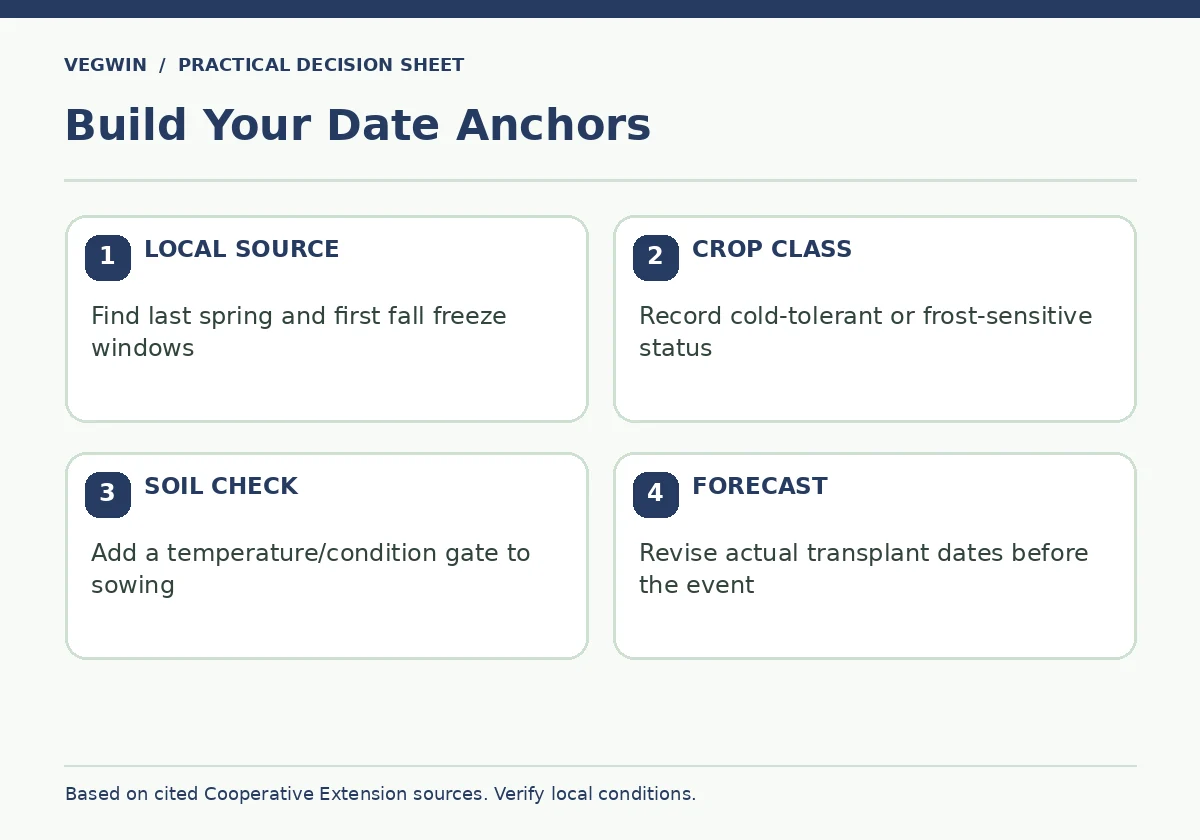
Find an average last spring frost window and first fall frost window using a nearby weather station or Extension planting guide. Record the data source and the location represented; an average date is not a guarantee. University of Maryland Extension points readers to local and county-level freeze tools and emphasizes that weather and local position affect the season. A calendar should express a range and risk, not a single magical safe day.
Write your locality, last-spring window and first-fall window at the top of the sheet. Add a warning to watch short-range forecasts before setting out tender crops. In a sloped yard, a cold pocket may warrant later transplanting than the weather station implies. If your garden is in a subtropical or mild-winter region, consult local Extension guidance about heat and rainy seasons as well; a northern freeze-based template is not enough.
Separate Cool-Season and Warm-Season Jobs
Different crops respond very differently to cold. Peas, spinach and many brassicas can tolerate conditions that damage tomatoes, cucumbers and basil. The USDA hardiness zone label on your phone is not a replacement for that distinction: it describes typical extreme winter lows for perennial survival. Read a crop-specific local Extension guide before classifying it as direct-sown early, set out as a hardened transplant, or delayed until soil warmth is adequate. For the next step, our guide “Garden Planting Zones” explains how to read the USDA map without mistiming vegetables.
The Maryland vegetable timing guide explicitly links warm-soil germination to crops such as beans, melons and cucumbers. A day that feels summery can still be followed by a cold night and cold seedbed. Make two rows on your calendar: “cool-tolerant opportunities” and “frost-sensitive or warmth-dependent work.” This simple separation prevents the common mistake of putting all seed packets into one weekend planting session.
Convert Outdoor Dates Into Lead-Time Tasks
Once you have a locally defensible outdoor date for each crop, work backward using the seed packet and Extension guidance for indoor sowing, growing transplants, and hardening off. A long indoor lead time is not automatically better. Starts that outgrow their containers can be harder to move and recover than properly aged plants. Direct-sown crops may not benefit from indoor starting at all.
Create columns for “target outdoor window,” “indoors if recommended,” “prepare beds,” and “check forecast.” For an indoor crop, the earlier entry is a planning reminder, not an absolute biological deadline. Track the time between sowing and emergence in your own conditions. If a seed lot is slow or weak, revise the plan instead of asserting that a rigid calendar must be obeyed.
| Calendar field | Question to answer | Where to verify |
|---|---|---|
| Last spring freeze window | When might tender plants face frost? | Nearest station and local Extension |
| Crop tolerance | Can this crop withstand the expected conditions? | Crop-specific Extension guide |
| Soil readiness | Is the planting layer warm and workable? | Soil measurement and crop guidance |
| Remaining season | Is a fall sowing likely to mature? | First freeze window and crop development |
Use Soil Temperature as a Second Gate
Air temperature often warms before garden soil, especially in wet spring beds. Maryland Extension advises checking soil conditions for direct-seeded warm-season crops, which can decay in cold wet soil. A soil thermometer or regional soil-temperature observations can confirm whether a planned sowing is reasonable. Take measurements where seeds will sit, not on a sunny patio surface.
Add a short “soil ready?” checkbox to every warmth-dependent sowing task. If soil remains cold or saturated, postpone sowing and keep the date as a note. Do not translate one threshold into a universal command for every crop or variety. Site drainage, seed treatment and local recommendations matter, and the actual seed packet may specify a narrower range. The calendar should tell you what to check, not pretend to control weather.

Keep a Four-Column Monthly Dashboard
A calendar is easiest to maintain when tasks are grouped into planning, planting, care, and harvest rather than a continuous stream of advice. January or February might be seed inventory in one region and outdoor harvesting in another. University of Georgia Extension provides a genuinely monthly calendar for middle Georgia and warns that dates must shift within that state. Treat such calendars as local examples of the structure you need, not a national list of exact actions.
For each month record what you expect to start, what is already in the ground, what must be monitored, and what could be harvested. Keep space for soil testing, irrigation inspection, trellis maintenance and crop cleanup. Add only work you are prepared to do. A short credible task list is better than an intimidating collection of planting dates copied from every search result.
Schedule Succession Crops Realistically
Succession planting means another planting timed to extend harvest rather than replacing everything on the same date. A second planting must still have suitable soil moisture, temperature, sun and time to mature before limiting weather. For warm-season crops near fall, compare the remaining growing window with a realistic harvest period; package days-to-maturity may describe favorable trial conditions and can lengthen in shortening autumn days. Our guide “Plan a Spring Vegetable Garden in Three Weather-Based Planting Waves” goes into more detail.
Instead of entering “plant again every two weeks” for every crop, create a conditional event: “After the first harvest, check weather, bed space and available season before replanting.” Fast-growing salad crops may work in suitable regions; large-fruited summer crops may not. Calendar reminders can include backup crops or a cover-crop plan when a new food crop no longer has a realistic harvest window.

Review the Calendar After Each Weather Shift
The true value of the schedule comes from updating it. A late freeze, prolonged rain or heatwave can delay planting, change pest pressure and compress harvest. Mark planned versus actual dates, along with the reason for any change. That record explains outcomes next season far better than a color-coded month sheet that never changed.
Use a weekly review at key transitions. Ask: Is the bed workable? Has the frost risk dropped enough for this crop? Is the seedling healthy? Will a new fall sowing mature with remaining light and warmth? If any answer is no, update the relevant row. Avoid automatically treating frost protection as permission to plant tender crops weeks too early; a covered plant can still stall in cold soil.
Audit Your Calendar Against Local Sources
Check your own calendar against a regional Extension publication at least once per season and whenever you introduce a new crop. The Georgia guide reviewed in March 2026 provides month-by-month work for that region; the Maryland guide frames decisions around frost dates and soil temperature. These resources illustrate why regional adjustment is part of responsible gardening advice, not an optional footnote. Our guide “Plan a Fall Vegetable Garden Using Frost Dates and Crop Growth Time” goes into more detail.
If a website offers a calendar that labels every task solely by USDA zone, inspect the underlying local weather assumptions. Two towns in the same zone can have very different growing seasons. Keep a citation or URL beside each critical date rather than memorizing an unexplained number. A calendar that shows where timing comes from is easier to improve and safer to share with new gardeners.
Related Guides
How We Research and Apply These Recommendations
This guide was written from research-based public university Cooperative Extension recommendations, with specific source claims checked on October 20, 2026. The diagrams are original editorial syntheses, not measurements from a VegWin field trial. Regional conditions, cultivar properties, product instructions, soil testing and current local rules can change the right action. No private product testing, guaranteed yields, controlled field experiments or verified on-site WordPress article inventory are claimed. Treat crop- and location-specific recommendations from your county Extension as the final local reference.
This guide is based on the sources linked throughout the article.
Sources reviewed on October 20, 2026: Maryland Extension (frost windows, local shifts and warm-soil sowing); Georgia Extension (2026-reviewed local monthly calendar and explicit regional date limits); Georgia Extension (garden records and planning tasks). Recommendations may be revised; recheck the institutional sources before manual publication.
This guide contains no affiliate links. We checked sources including affiliate disclosure page.
Use it only as context for average winter cold. Annual vegetables require local frost windows, crop tolerance, soil temperature and current weather.
Move tender-plant tasks to a safer window and watch forecasts. Averages are not guarantees, and low spots can be colder than a nearby weather station.
No. Many crops are suited to direct sowing. Follow crop- and region-specific advice and avoid raising transplants longer than necessary.
Compare remaining growing time, cooling soil, decreasing light and the first fall freeze window with the crop’s realistic maturity needs.
Keep a reusable framework, but update local weather, seed varieties, planting outcomes and new Extension information each season.