
Disclosure: Independent educational gardening content, not an advertisement. There are no confirmed affiliate approvals for this guide; review the site disclosure. The recommendations that follow distinguish crop biology from universal shortcuts. This article addresses zone numbers are not sowing dates, and links to source-specific Extension and federal guidance before the FAQ.
Understand Exactly What the USDA Hardiness Map Measures
Garden planting zones are often used as shorthand for where something can grow, but that phrasing hides a critical distinction. The official USDA Plant Hardiness Zone Map estimates the average annual extreme minimum winter temperature for a place. Each numbered zone spans a ten-degree Fahrenheit interval; the a and b subdivisions split that interval into five-degree segments. The map helps evaluate long-term survival potential for perennials and woody plants. It was not designed to tell you the day to sow a bean seed, set out a pepper transplant or take a risk on spring frost.
The current USDA edition is based on a defined historical climate period, 1991–2020, and represents an average extreme minimum rather than the most extreme cold that can ever occur. USDA warns that occasional colder events are still possible. Two gardens printed with the same zone number may differ in last-frost timing, spring soil warm-up, summer heat, rainfall, wind and growing-season length. A hardiness zone is valuable information, but it is only one layer in an actual planting decision.
Read the Zone Number and Half-Zone Correctly
A label such as 7a is not a calendar month and does not encode a first or last frost date. It is a temperature band from a mapped average annual extreme winter minimum. Adjacent half-zones differ by five degrees Fahrenheit in those long-run statistics. Use the official USDA map with an address or ZIP code for the approximate mapped band. Avoid relying on an anonymous chart that assigns vegetable sowing weeks to zone numbers without explaining which local climate data were used.
Microclimates may matter even within one yard. A protected wall, frost pocket, hilltop or cold-air drainage route can make plants experience different conditions from the area average. USDA notes that small local microclimates can fall below the resolution of a national map. A changed zone in the updated map is not by itself a command to remove established plants or shift every sowing date. Compare observed plant performance, seasonal weather and local advice; treat the zone as a rough perennial-survival context rather than a gardening verdict.

Use Four Inputs to Set an Annual Vegetable Date
To decide when to plant an annual vegetable, collect four inputs: local spring and fall frost probabilities, current soil temperature and trend, the specific crop’s cold tolerance, and the time it needs to establish and produce before limiting weather. University of Maryland Extension advises watching soil warmth for direct-seeded crops such as beans and cucumbers. University of Minnesota Extension likewise emphasizes soil temperature rather than selecting a date just because a neighbor in the same USDA zone has planted. Cool-season peas or leafy vegetables have a different tolerance profile from peppers and basil. For the basics, see our guide: When to Plant Vegetables.
Frost dates are statistics, not guarantees of a frost-free day. A location’s typical last spring freeze describes past patterns at a weather station; an unusually cold forecast can still occur afterward. Soil can be slow to warm in a shaded raised bed or fast to warm beside paving, but warm soil cannot protect a tender tomato top from freezing air. Conversely, a bed can be frost-free while soil remains too cold and wet for germination. Choose the date when all relevant conditions—not one printed zone label—are acceptably favorable.
| Input | Useful question | What it cannot prove |
|---|---|---|
| USDA hardiness zone | Likely perennial winter survival | Last spring frost date |
| Local frost probabilities | Seasonal freeze risk | Warm enough soil to germinate |
| Soil temperature trend | Seedbed physical readiness | Tender leaves safe from frost |
| Crop tolerance + maturity | Whether this crop can finish | Exact outcome in unusual weather |
Compare Two Gardens With the Same Zone Label
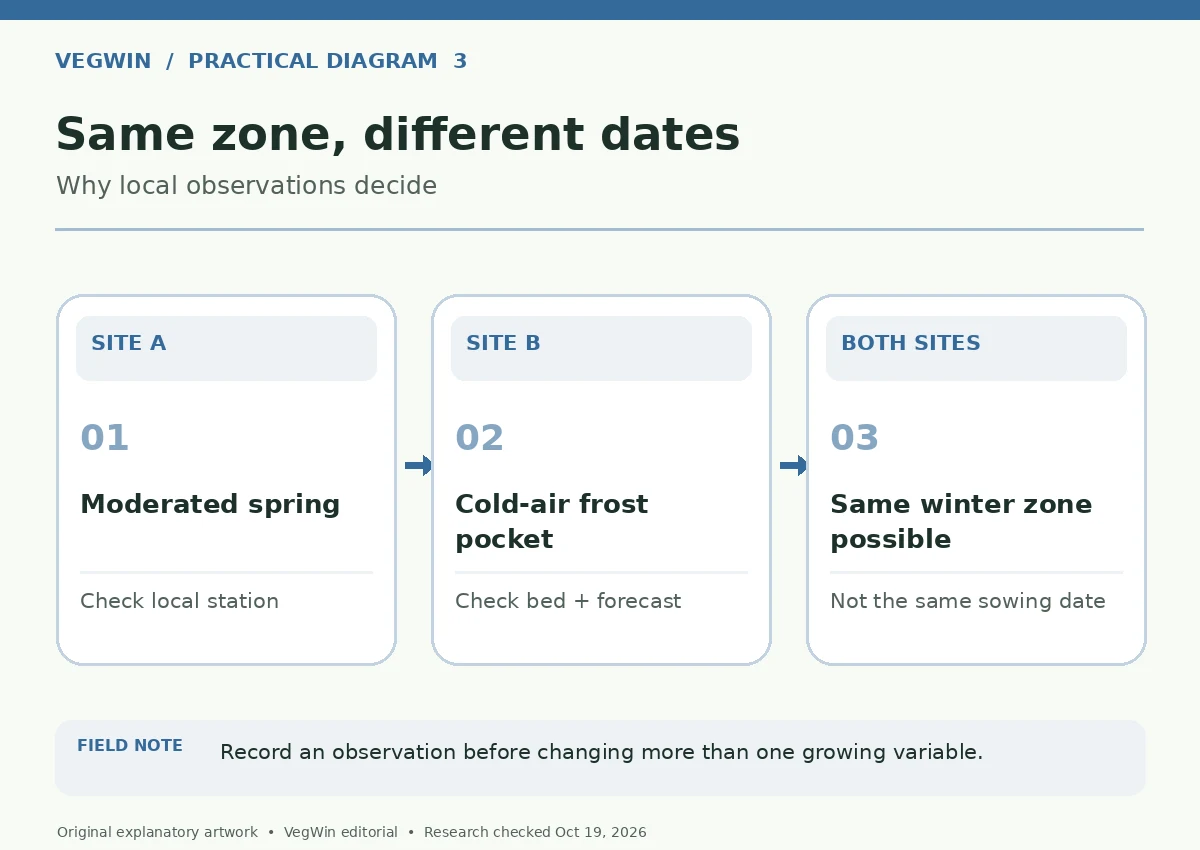
Imagine two gardeners in the same mapped hardiness half-zone. Garden A lies near a large moderating body of water; Garden B sits inland in a low valley. Their average extreme winter minimum may place them in the same USDA band, but their spring freeze patterns, soil warming and wind can differ. Garden B might experience late cold-air pooling after Garden A has started tender crops, even though a zone chart says they are equivalent. These are illustrative site conditions, not invented calendars for specific ZIP codes.
Each gardener should therefore check a nearby climate station or Extension frost tool, take soil temperature in the actual planting bed and follow the seed packet’s crop requirements. They may choose different dates for the same cucumber seed while making equally sound decisions. A third gardener with a protected tunnel might be able to shift establishment conditions, but cover can also overheat or restrict ventilation. This thought experiment illustrates why printing “plant tomatoes in zone 7 on April 15” without location, soil conditions and frost uncertainty is scientifically weak.

Use Zones Properly for Perennial Edibles and Herbs
Hardiness zones are much more useful when selecting perennial plants expected to remain outside for years. For perennial herbs, fruit trees or shrubs, a catalog’s stated hardiness range indicates broad winter-minimum suitability. Even then, the hardiness rating is not a promise of survival: roots in exposed containers, ice accumulation, waterlogged soil, winter wind and unusually cold events matter. Some herbs sold as perennials in a mild climate are grown as annuals farther north. Verify both botanical identity and the local experience of that cultivar. For the fuller picture, see our guide to growing herbs by type.
Perennial survival and annual crop timing sometimes interact. A rosemary plant may survive a mild winter in one setting but struggle in waterlogged soil, while a pepper could still be injured by a spring freeze despite the location’s relatively warm long-term zone. Keep these questions separate: “Will this plant survive my typical winter?” and “Can this crop grow productively during my next planting window?” The first uses hardiness information; the second needs season-specific weather, soil and developmental requirements.
Find Reliable Frost and Soil Data Locally
Search for a county or state Cooperative Extension planting chart that lists your crop and locality, then identify the station or climate period behind the frost probabilities. If a resource offers a range of spring frost risk rather than one absolute date, retain that uncertainty in your plan. Check current forecasts near planting and note unusually wet or cold beds. Use a soil thermometer at the depth relevant to the seed or transplant root zone; repeat measurements over several days instead of acting on one sunny afternoon.
Use current regional Extension crop guidance to decide whether you should direct-sow, transplant, use temporary protection or postpone. For autumn plantings, combine first-fall-frost risk with days to maturity and decreasing daylight; spring last-frost data are not enough. When interpreting commercial “zones,” verify whether a retailer is talking about USDA winter zones, an entirely different climatic classification or a custom delivery district. A map legend is not optional: the same word zone can describe unrelated systems.
Build a Simple Planting Note You Can Update
Create one record per crop with the site, USDA zone for reference, locally sourced frost range, bed soil temperature trend, seed or transplant method and crop-specific cold tolerance. Add the actual planting date and what happened: slow emergence, frost injury, successful growth or early harvest. After several seasons, your observations will improve decisions far more than memorizing a national “zone-to-date” table. Keep the note short enough that you really update it, and write the source and year next to any climate statistic.
Use the USDA map as a doorway to better questions, not the final answer. It can help you judge whether a perennial herb is worth overwintering and whether a hardy shrub is suited to a region. It cannot replace local weather forecasts, soil temperatures or Extension guidance for annual vegetables. If the correct crop and local data are not available, choose a conservative trial or seek local advice rather than inventing a precise sowing date. That distinction protects seedlings and makes the garden plan more defensible. Our guide “Vegetable Garden Calendar” shows how to build a local plan from frost dates.
Related Guides
How We Research and Set the Scope
This is a reference decoder for the USDA map and its limits, not an alternate planting-date table. A web attempt to access the active VegWin.org article inventory did not succeed; therefore this is an editorial overlap screening, not verification that all live WordPress URLs are unique. Check the site and category assignment in WordPress before manually publishing. Biological claims depend on the crop, variety and region. No unverified affiliate program, product rating, pesticide recipe or fertilization rate is implied.
Sources checked 2026-10-19: USDA Agricultural Research Service: 2023 USDA Plant Hardiness Zone Map; USDA Agricultural Research Service: How to Use the Plant Hardiness Zone Maps; University of Maryland Extension: When to Plant Vegetables; University of Minnesota Extension: Planting the Vegetable Garden. Each institution supports a specific claim in the source record below; these sources do not sponsor VegWin. Their evidence should be interpreted in its own geographic and crop scope. For sponsorship policy, see the affiliate disclosure.
No. Zone 7 describes a winter-temperature band; tomatoes need local freeze-risk, soil warmth and crop-specific guidance.
Their seasonal weather patterns, elevation, water proximity and microclimates can differ despite similar average winter extremes.
The letter splits a ten-degree Fahrenheit zone into two five-degree segments of average annual extreme minimum temperature.
It provides broad winter context, but crop tolerance, local temperatures, frost statistics and seasonal light are more directly useful.
No. Frost dates summarize historical probabilities; monitor actual forecasts and plan for uncertainty.