
Carrot seedlings often germinate in uneven little clumps. That is normal for such tiny seed, but leaving five plants fighting for one narrow patch of soil is not a good plan for full-sized roots. The right response is not to remove every second plant by reflex. First decide whether you want small finger carrots or mature storage-size roots, then compare the seed packet with the density in your row. Thin early enough to avoid prolonged crowding, but handle the keepers gently. Cutting unwanted seedlings at the soil surface can protect neighboring taproots when the row is especially tight.
Identify True Carrot Seedlings Before Thinning
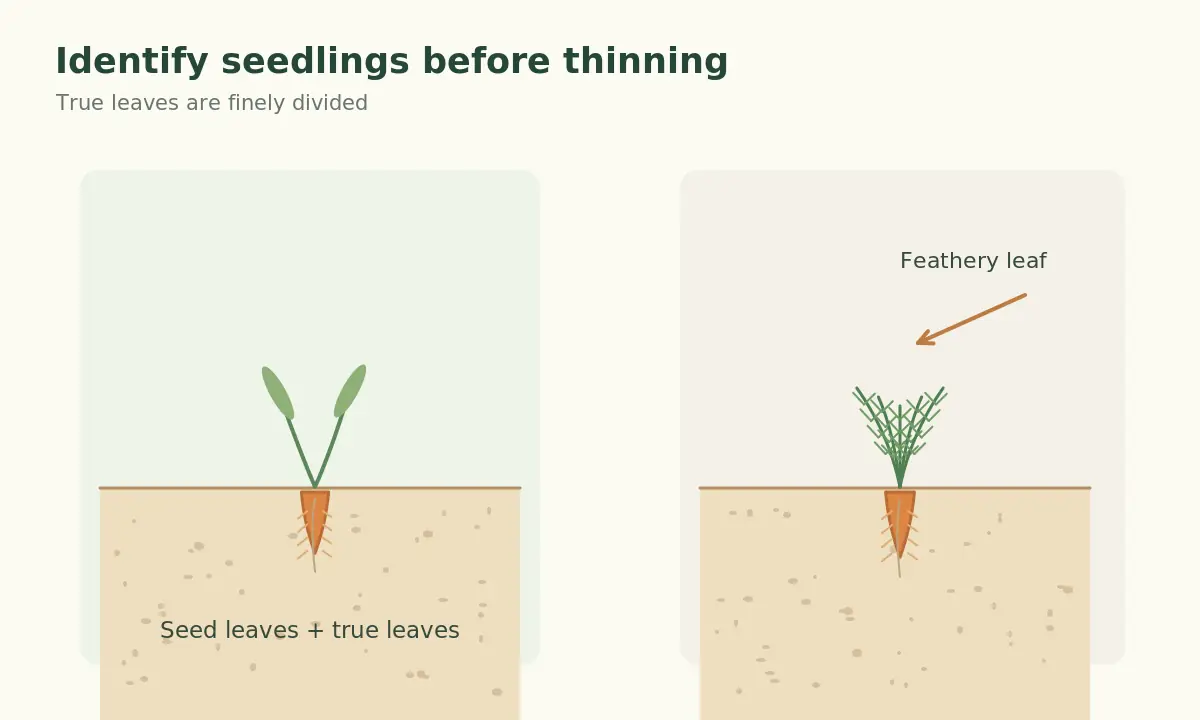
New carrot seedlings begin with two long, narrow seed leaves that can resemble thin blades of grass. The next leaves are finely divided and feathery. University of Minnesota Extension notes that germination can take up to three weeks, so a thin patch may not mean the seeds failed. Check the row carefully for weeds before deciding which plants are carrots. A weed growing between two carrots should not become a permanent resident simply because it is green. Use a small marker at the end of each sowing so you do not remove late germinators during routine weeding.
Decide Which Root Size You Actually Want
Spacing is a harvest decision, not just a tidy-looking-row decision. Smaller, young carrots may be grown somewhat closer, whereas cultivars intended to reach broad shoulders need more room. Illinois Extension provides different targets for finger carrots and larger varieties; Minnesota describes roughly 2 to 4 inches between plants once the largest seedlings reach 3 to 4 inches high. Some guides give closer initial spacing for small carrots, so there is no universal number that fits every variety. Read the cultivar packet and choose the final space for its mature root diameter, keeping the soil texture in mind.
Choose a Practical Time to Thin the Row
Do not wait until the tops are tangled and the roots are already trying to thicken against each other. Start when you can confidently identify the young carrots and see which seedlings share a spot; you can make a second pass as the stand develops. In moist, loose soil, a few plants can often be lifted with little disturbance, but very close seedlings may have intertwined fine roots. Water the row lightly if the surface is hard or dry before working. If the row is only partially emerged, avoid removing all small plants and assuming no more seed will germinate. If you want the full process, read how to grow carrots.
Use Snips Where Roots Are Crowded Together
The most conservative option for tightly clustered seedlings is to cut unwanted tops at the soil line with clean small scissors. This leaves the root of the keeper largely untouched and avoids the tug that can dislodge its slender taproot. Cut the plant you do not want; do not shear across the leaves of the carrot you intend to keep. A trimmed seedling normally does not recover well enough to be treated as a transplant. The leftover tiny root decomposes in place. This method takes time, but it is useful for precision rows and small raised beds.
Pull Extra Plants Only When the Soil Allows It
Pulling can be reasonable when seedlings are sufficiently separated and the ground is moist and crumbly. Hold the unwanted seedling near the soil, ease it out slowly, and steady neighboring plants with your other hand. Stop if a keeper rises or the soil begins to crack around its base; switch to snipping instead. Carrots develop a taproot early, and they are not normally transplanted like tomatoes. Replanting a thinned seedling may create bent or forked roots and usually is not worth the disturbance if root quality is your goal. Our walkthrough on how to thin beet seedling clusters without damaging neighboring roots sets out each step.
Check Spacing Along the Whole Bed
A row can look open from above while several plants share a single inch near the soil line. Follow the row in short sections, counting plants at the base rather than counting leaf clusters. A ruler is more reliable than judging from overlapping foliage. Leave vigorous seedlings with undamaged growing points and remove weak or crowded neighbors. Do not mistake a multi-stem appearance from feathery leaves for several seedlings until you have traced each crown to the soil. If you intend to harvest a portion young, plan that spacing deliberately rather than using dense seeding as a substitute for thinning.

Protect the Roots During Follow-Up Care
A freshly thinned row has exposed soil and less shade, so maintain an even surface moisture level without blasting the seedlings with a strong hose jet. A gentle spray or suitable irrigation helps settle disturbed soil. Shallow weeding is safer than digging around the developing taproots; a hard crust can also hinder growth. Minnesota Extension links poor moisture management with bitter, tough, undersized or misshapen roots. Avoid burying the growing point while adding a light layer of soil to cover exposed carrot shoulders. Soil texture and weather still matter after perfect spacing.
Read Forked and Stunted Roots Carefully
Crowding is one possible cause of poor roots, but it is not the only one. Stones, compaction, physical root damage and irregular watering also alter carrot shape or size. A carrot with a fork does not prove that thinning was delayed, and beautifully spaced plants are not guaranteed to be straight if the soil contains obstacles. Distinguish a narrow root caused by insufficient growing time from a plant stressed by dense competition. When problems recur, inspect soil preparation and moisture as well as spacing before adding fertilizer or restarting the bed.
Use a Small Succession Instead of One Dense Sowing
For a longer fresh harvest, consider several modest direct sowings appropriate to your local growing season rather than dumping extra seed in one row. Carrots generally dislike transplanting because their taproots develop early. A row with better seed distribution will demand less thinning later; sprinkle seed sparingly and use a marker to maintain straight planting lines. Adjust sowing dates to local frost and heat patterns rather than USDA winter hardiness zones, which do not tell you when annual vegetables should be planted. Record germination and thinning dates so next year’s seeding can be more precise.

Make a Final Thinning and Harvest Check
Revisit the row after the first pass. If remaining crowns are still touching, decide whether to make one final correction before the roots thicken. Harvest young carrots selectively only when they have reached an edible size; do not yank immature neighbors merely to create room. Use gentle loosening in heavy soil so other roots are not broken. For a variety intended to mature fully, confirm that its shoulder diameter will fit the remaining spacing. Your useful outcome is an uncrowded stand of vigorous carrots, not a perfectly symmetrical picture of bare soil.
Related Guides
- Direct Sowing Seeds Outdoors: A Crop-by-Crop Success Checklist
- How to Direct-Sow Scarlet Nantes Carrots for Smooth Straight Roots
- How to Grow Purple Carrots From Seed Without Forked or Crowded Roots
- How to Tell When Carrots Are Ready to Harvest Without Breaking Roots
How We Research and Check Gardening Advice
This guide was researched against university Cooperative Extension and other established horticultural references. We compared advice for the specific species and problem rather than treating all garden plants alike. Source recommendations were checked on October 23, 2026. Gardening seasons, cultivar behavior, soil conditions and local restrictions vary, so readers should consult their own regional Extension service for local timing and diagnosis.
Research Sources and Editorial Disclosure
References reviewed: extension.umn.edu — Carrot seedling appearance, delayed germination and 2-4 inch mature spacing guidance. extension.illinois.edu — Seedling thinning stages and different spacing for finger versus mature carrots. extension.umd.edu — Gentle snipping to protect surrounding taproots and soil preparation.
Disclosure: This educational guide contains no paid product recommendation or verified affiliate promotion. See the VegWin affiliate disclosure for the website’s disclosure policy. The diagrams illustrate concepts; adjust the actions to the plant and conditions in your own garden.
Yes. Clean scissors at soil level can avoid disturbing nearby tender taproots in a crowded clump.
Thin once you can identify the carrots confidently; local Extension guides range from early small-seedling stages to 3–4-inch seedlings for final spacing.
Follow the packet for your variety. Larger mature roots often need roughly 2–4 inches, while small finger carrots may be grown closer.
Usually not reliably. Carrots develop sensitive taproots early, and transplanting often causes misshapen roots.
No. Stones, compacted soil, root disturbance and uneven moisture can also contribute to forked or undersized carrots.