
How to Tell When Carrots Are Ready to Harvest Without Breaking Roots is a practical guide for identifying what you see on a living plant before taking action. The recommended method comes from the university Extension sources linked below; variety, weather, plant age and local conditions can change the best timing. Use the photographs or botanical diagrams as a guide, but examine the actual stem, root, leaf or seed head in your garden rather than relying on a caption alone.
Use the Variety Description Before Reading the Leaves
Carrots are not ready simply because their fernlike leaves look lush. Nantes, Danvers, round and miniature types produce roots with different mature shapes, so comparing every planting with one thick supermarket carrot is misleading. Find the seed packet, label or a saved variety description and note its stated harvest size and approximate days to maturity. Those dates are useful checkpoints rather than a guarantee: cool weather, uneven moisture, crowding and soil conditions change development. If you lost the packet, use one carefully sampled root to learn what your planting is producing; do not uproot an entire row to answer the question.
Inspect One Root Shoulder Without Pulling the Plant
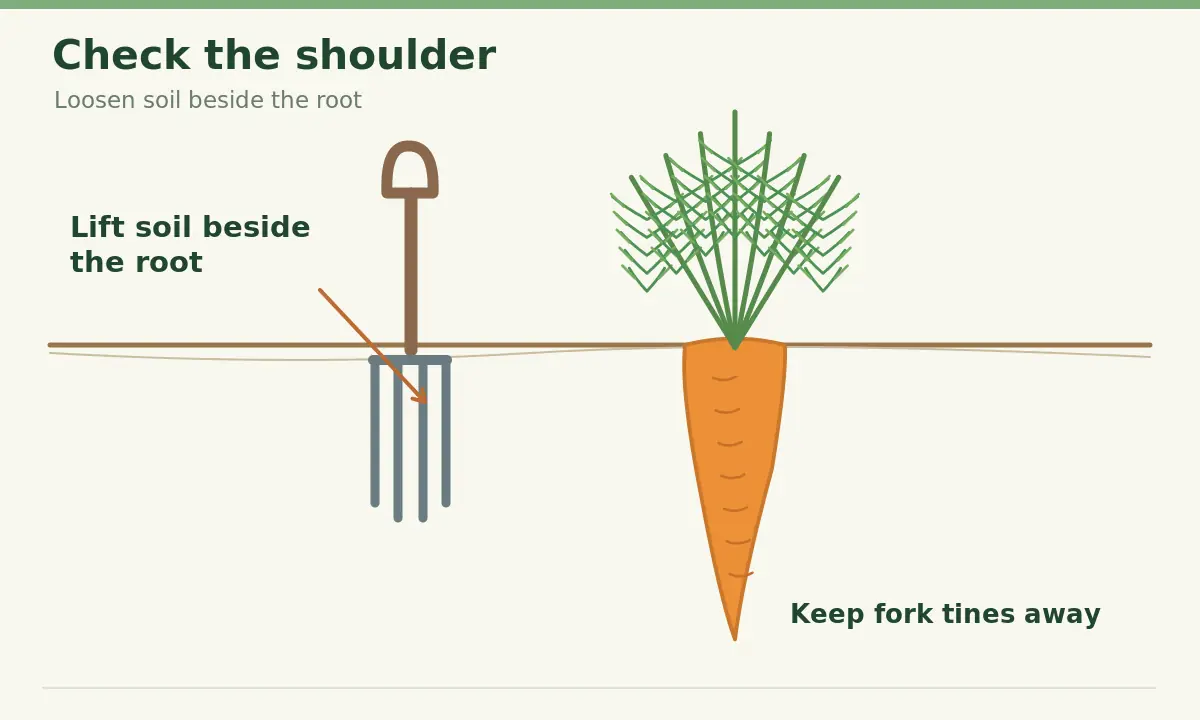
Brush a little loose soil aside at the base of one carrot so you can see where the orange or cultivar-colored root widens immediately below the leafy crown. A shoulder approaching the diameter expected for that variety suggests it may be worth harvesting. Very slender shoulders usually signal a smaller root, although a narrow-rooted type may be completely usable. Cover exposed shoulders again if you plan to let the crop grow; prolonged light exposure can make shoulders green. Never scrape downward with a knife or tug repeatedly on tops just to measure a root. A gentle look is less disruptive.

Decide Whether You Need Baby or Full-Size Carrots
A carrot can be delicious before reaching its catalog size. Young roots tend to be smaller and useful for fresh cooking, while larger roots supply more food per plant and may be better suited to holding in storage. Ask what you will do with the harvest: a few tender roots for tonight, a uniform bunch, or a larger fall harvest. The University of Minnesota notes that carrots can be harvested whenever they reach a usable size. Because flavor also depends on genetics and growing conditions, a small test harvest provides better evidence than an absolute inch measurement offered for every cultivar.
Loosen Soil Before Touching the Green Tops
The most common avoidable harvest injury is snapping a carrot by pulling against compacted soil. Moist soil releases roots more easily than dry, hard ground; Minnesota Extension recommends watering the day before harvest or digging after rain. Push a garden fork into soil to the side of the roots, keeping the tines well outside the expected carrot outline. Ease the soil upward, then grasp near the crown and lift straight out without twisting. In heavy clay or with long, tapered types, loosen a wider zone first. Do not thrust a fork directly under the visible shoulder where it could puncture the root.
Understand Why a Carrot May Be Short or Forked
Finding a short, forked or crooked root is not necessarily a sign that harvesting was late. Stones, compacted layers, root injury and unsuitable soil structure can redirect a carrot as it develops. Multiple roots may still be edible when sound and cleaned, but do not confuse growth form with rot: soft, wet, foul-smelling tissue needs a different response. Record the bed, variety and conditions if the pattern repeats. For future crops, a deep, fine seedbed with few obstacles will help roots grow more predictably. Avoid cutting into neighboring carrots just to inspect the shape of one plant.
Harvest the Biggest Roots and Leave Small Ones
You do not have to empty the bed in one afternoon. After easing out one suitably sized carrot, compare its size and texture with the remaining visible shoulders. Lift the largest neighboring roots for immediate use and leave smaller ones to develop where local weather allows. Be especially gentle when harvesting from a dense row because the tines and hand movements can dislodge roots you meant to keep. A small harvest log with sowing date and variety helps you separate slow development from a plant that is simply a short-rooted type. Continue normal irrigation for those left in place.
Watch Seasonal Weather Instead of Hardiness Zone Alone
Carrots are cool-season roots, but harvest decisions still depend on your region’s temperatures and soil. In some climates roots can remain in protected beds into cool weather; in others soil may freeze hard or become waterlogged. Prolonged warmth and plant maturity can change texture and encourage flowering as the crop completes its life cycle. Do not use USDA perennial hardiness zone as a day-by-day carrot harvest calendar. Follow local Extension guidance for fall protection and storage, especially where deep freezes, prolonged rains or warm winter weather make leaving roots in the ground unreliable.
Trim and Clean Roots Without Accelerating Water Loss
After lifting carrots, remove the leafy tops rather than storing them attached to the roots; continuing leaf evaporation can reduce crispness. Brush off loose soil and handle each root gently, avoiding bruises and knife cuts. Clean the carrots according to how you intend to use or store them; rinse thoroughly before eating. Put roots intended for short-term use into a cool refrigerator environment, preferably protected from drying. For long storage, suitable cool and humid conditions matter more than an ornamental basket. Do not assume that an unventilated wet bag is safe: excess free water can encourage deterioration.
Read Root Cracks and Bitter Flavor in Context
A split shoulder may reflect irregular moisture and growth rather than a precise signal that every carrot is overmature. Green areas near an exposed shoulder indicate light exposure, not a license to leave it uncovered. Tough or fibrous texture may develop in some aging roots and varieties; taste a clean, healthy sample before declaring the bed past its prime. Discard clearly spoiled roots rather than placing them with sound produce. If a bed repeatedly gives poor quality, compare variety choice, thinning, soil structure and watering before changing a harvest date based solely on appearance.

Follow a Gentle Harvest Decision in Three Steps
First, compare the cultivar’s expected root shape with a visible shoulder. Second, decide whether you want young or larger roots and harvest one representative carrot as a check. Third, moisten and loosen the soil before lifting additional roots. If the test carrot is much smaller than expected and conditions remain favorable, replace soil around the other plants and give them more time. If size is appropriate, lift only what you can use or store properly. This approach turns uncertain calendar advice into a reversible, low-damage decision for the actual bed.
Avoid These Frequent Harvesting Mistakes
Do not judge maturity by foliage height alone; leafy growth and root development are not identical. Do not pull hard from dry compacted soil, or you may break the carrot below the crown. Avoid using one standard diameter for Nantes, Danvers and round types. Do not leave harvested roots baking in direct sun while you finish the row. And do not interpret a single crooked root as a harvest timing failure. Give yourself a simple routine: identify, inspect, loosen, lift and cool. A careful first harvest will make the remaining crop easier to manage.
Compare the Most Important On-Plant Clues
| Where to check | What to look for | Next step |
|---|---|---|
| Shoulder | Matches cultivar size | Loosen soil and test one root |
| Shoulder | Smaller than planned | Leave neighboring roots to grow |
| Root | Dry hard soil grips root | Water and fork beside it |
Related Guides
- How to Store Root Vegetables: Sort, Cool, and Prevent Spoilage
- How to Grow Carrots: Direct-Sow, Thin, Water, and Avoid Forked Roots
- When and How to Thin Carrot Seedlings Without Disturbing Their Roots
- How to Direct-Sow Scarlet Nantes Carrots for Smooth Straight Roots
- How to Grow Purple Carrots From Seed Without Forked or Crowded Roots
How We Research and Check Garden Advice
Sources checked on 2026-10-26: University of Minnesota Extension; University of Maryland Extension; University of Minnesota Extension. We compared specific claims about plant parts, growth stage, safe handling, and regional limitations across the cited horticultural guidance. The drawings are simplified teaching illustrations, not proof that every cultivar has the same shape or every garden has the same season. Always prioritize local Extension guidance when it differs.
Safety and Independent Editorial Disclosure
This independent educational article is not sponsored and does not claim any affiliate approval. Internal reading links are educational only; review the VegWin affiliate disclosure. Use clean garden tools, keep hazardous products from children and pets, and handle edible harvests hygienically. Any pesticide use must follow the currently registered product label for your specific food crop and location. No homemade pesticide dosages or unverified safety guarantees are supplied.
Yes. Carrots are usable when the root is large enough for your purpose, though yield per plant will be smaller.
No. Leaf growth is not a dependable measurement of root diameter; check the variety and inspect a shoulder.
Moist soil generally releases roots more readily; Minnesota Extension advises watering the day before or harvesting after rain.
Compacted or dry soil can grip the root. Loosen soil beside the carrot with a garden fork before lifting.
Yes, when weather and soil conditions permit. Harvest mature roots gently and avoid disturbing neighboring plants.