
A packet labeled catmint can be an inexpensive way to establish a border of fragrant gray-green leaves and purple-blue blooms. But catmint is a group of Nepeta plants, not one uniform seed crop. NC State Extension identifies Nepeta × faassenii as a sterile hybrid commonly propagated by division. Seeds advertised as an exact named hybrid cultivar may therefore be questionable, and seedlings from other seed-producing Nepeta species will not automatically match a famous clone. Start by confirming a botanical species on the packet, then build a light, airy germination setup and avoid keeping young roots waterlogged. The practical instructions below are deliberately species-aware: you can raise reliable plants from viable seed while resisting misleading one-size-fits-all germination promises.
Check the Botanical Label Before Buying Seed
Catmint usually refers to ornamental Nepeta species and hybrids with opposite mint-family leaves and spikes of small two-lipped flowers. Catnip, Nepeta cataria, is in the same genus but is not identical in habit or ornamental use. NC State lists Nepeta × faassenii as a sterile hybrid, often sold as named cultivars including ‘Walker’s Low’. Such a cultivar is reliably maintained by division or cuttings, not by saving and resowing purported true-to-type seed. If a packet does not state a species or cultivar, ask the seller for an accurate identity. A fertile species may produce variable offspring; seedlings are individual plants, not a guarantee of the same height and flower shade as the parent. Match the eventual plant size to the garden space rather than assuming all catmints make low edging.
Choose a Seed Source With Clear Germination Directions
Obtain fresh, labeled seed from a reputable supplier and read instructions for that specific Nepeta species. Seed dormancy, age, and treatment requirements can differ within a large genus, so do not insist that every catmint must be chilled or that every packet germinates within a fixed number of days. Keep the packet until seedlings are established. A tiny test sowing can reveal whether older seed is still viable before dedicating an entire tray. If the claim is an exact clone of sterile Nepeta × faassenii, choose a nursery plant or a properly rooted cutting instead of paying for uncertain seed. Saving seed from a garden plant may also introduce crosses or self-sown plants of unknown identity. That uncertainty is acceptable for an informal meadow but not a matching formal border.
Set Up a Draining, Clean Seed Tray
Choose a clean propagation tray or small cells with open drainage holes. Use fresh seed-starting mix, moisten it evenly, and allow excess water to escape before sowing. Dense garden clay and oversized pots can stay saturated too long for fine young roots. Level the surface gently rather than compressing it into a crust. Sow sparse batches so that emerging plants have room and air circulation. A clear lid can retain humidity early on, but it should be vented or removed as soon as seedlings emerge to avoid stagnant wet foliage. Mark the species and sowing date on an external plant label, not on the artwork or in an unexplained production code. Keep the tray out of scorching direct sun until the plants have rooted and acclimated.
Sow Shallowly Without Flooding Fine Seed
Follow the seed packet for the specific species. Fine Nepeta seed is generally handled near the surface under only a light covering, rather than being buried under a deep layer of mix. Place seeds apart on moist medium, sprinkle the recommended thin layer if the packet calls for one, and mist gently so they are not washed into one corner. Water from beneath when practical, then drain the tray rather than leaving it standing in water. Do not make an absolute promise that all catmint seed either requires light or requires darkness; seed-source directions take precedence. Write down what covering and moisture method you used so a slow batch can be evaluated instead of repeatedly dug up to check for germination.

| Situation | Better approach | Avoid |
|---|---|---|
| Opposite leaves | Set Up a Draining, Clean Seed Tray | Skipping a species or growth-stage check |
| Moist mix | Give Emerging Seedlings Bright Light and Air | Relying on a rigid date or depth for every situation |
| Healthy transplant | Space Plants for Their Actual Mature Habit | Removing useful living tissue unnecessarily |
Give Emerging Seedlings Bright Light and Air
Move germinated seedlings into bright light before they lean and stretch. A suitable grow light positioned and operated according to the equipment’s directions can prevent weak, pale stems during dim indoor weeks. Provide gentle air movement without blowing fine seedlings over. Keep the seed-starting medium slightly moist rather than consistently soaked. Seedling cotyledons will not yet resemble a mature catmint bush; the paired true leaves become more informative as the stem elongates. If a mat of algae forms or stems suddenly collapse at the surface, reduce excess moisture, improve airflow, and review sanitation. Do not fertilize heavily just to speed growth. Plants that build roots and compact stems are better transplant candidates than tall, soft growth raised in warm shade. For a step-by-step method, see how to grow cleome from seed and space spider flowers without crowding.
Identify True Leaves and Pot Up at the Right Stage
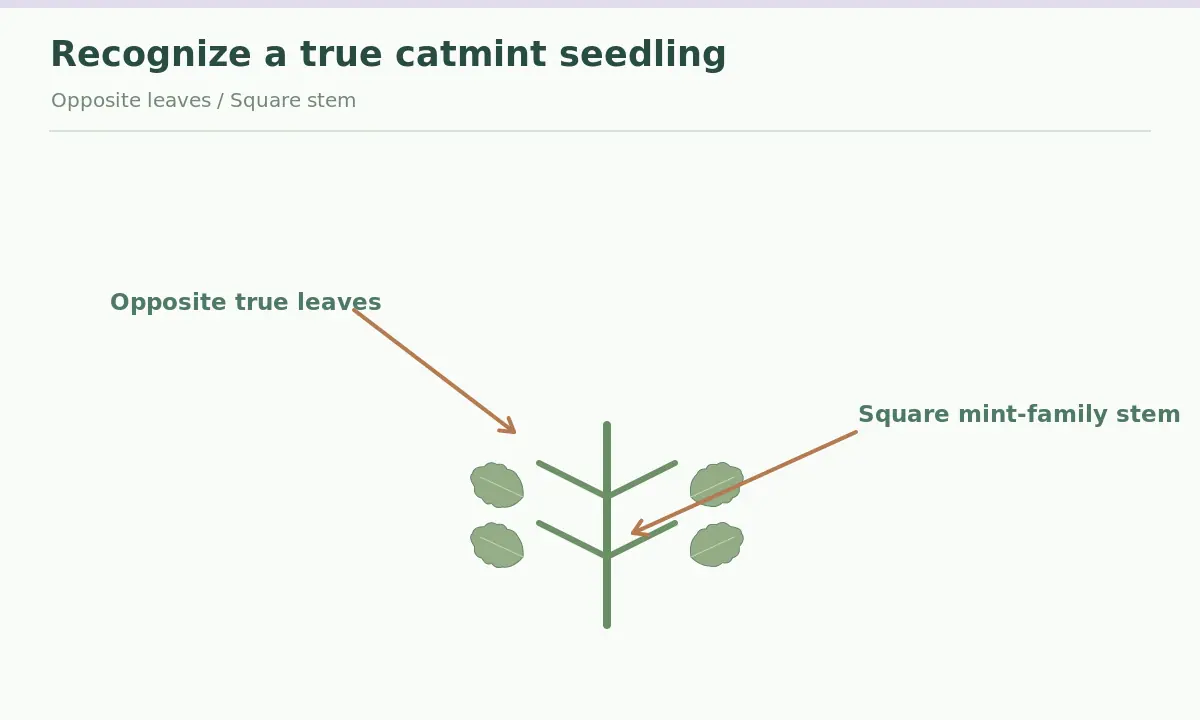
Mint-family Nepeta commonly develop paired, opposite leaves and often a square-feeling stem. These traits help distinguish catmint seedlings from grasses or random weeds in a shared tray, although several other mint relatives also share them. Once seedlings have true leaves and roots that hold a modest plug together, move each into a small draining pot. Handle by a leaf or root ball, not by pinching a tender stem. Maintain the original crown at soil level and firm mix gently around the roots. If several seedlings germinated together, tease them apart while their roots are still manageable or thin the weakest without tugging through the others. Give newly potted plants bright sheltered light while they re-establish, then gradually increase sun exposure.
Harden Off Before Moving Into Garden Sun
An indoor seedling is not adapted immediately to drying wind, cool nights, or intense outdoor light. Move pots outside for short sheltered periods and lengthen exposure gradually over several days as weather allows. Bring them back in if forecasts fall outside what young plants can tolerate. A hardiness-zone rating describes established winter survival potential, not a date for setting out unacclimated seedlings. Catmint favors full sun and well-drained soil in many regions, with some afternoon protection helpful in very hot climates. NC State notes drought tolerance once established, not while tender roots are newly transplanted. Check that water can drain through the garden bed and avoid compacted low spots where roots remain wet after a storm.

Space Plants for Their Actual Mature Habit
A small plug can eventually make a broad mound. Consult the adult spread listed for the exact species or cultivar; a generic catmint label is not enough to prescribe one universal spacing. Set plants at their existing soil depth, water around the root ball, and mulch sparingly without burying the crown. If you bought seed labeled as a fertile species, expect natural variation in flower intensity and final stature. Reserve the most desirable plants and move or thin out extras as they fill in. Avoid crowding them so tightly that foliage stays damp, particularly in humid summers. Once established, many catmints need limited supplemental watering except in prolonged drought, but newly transplanted seedlings need closer observation until roots explore surrounding soil. Our guide “Start Gerbera Daisies From Fresh Seed Without Burying the Crown” goes into more detail.
Support Flowering Without Forcing Growth
Catmint grown in strong light and adequately drained soil usually needs less feeding than many lush bedding annuals. Excess nitrogen can encourage sprawling, leafy growth at the expense of a firm habit. If plants flop after flowering, a moderate post-bloom trim may stimulate fresh foliage and sometimes another flush of flowers, as NC State describes for Nepeta. Do not cut a weak young seedling nearly to the ground merely to imitate an established perennial. Preserve enough healthy foliage for recovery and water after trimming only if the soil is genuinely dry. Let a few flowers remain if observing pollinators is a goal, but be prepared for self-sowing in fertile species. The sterile hybrid cultivars do not normally volunteer from viable seed. Our guide to growing anise hyssop from seed adds more detail on this.
Diagnose Poor Germination Before Repeating the Same Mistake
If a tray stays empty, check the seed name and age, depth of covering, moisture, temperature compared with packet instructions, and whether the supplier actually sold viable species seed. Seedlings that fail before their first true leaves often suffered from saturated or crusted mix, excessive heat, or disease-favoring stale air. Record problems rather than automatically adding more water. If plants germinate but do not resemble a purchased cultivar, the label may refer to a seed-producing species, a mixed strain, or genetic variation; it is not evidence that mature plants will become identical later. The best correction may be to switch to vegetatively propagated plants when the exact flower color, mature size, or sterile behavior is essential to a design.
Related Guides
How We Research and Verify This Guidance
Sources checked on 2026-10-24: plants.ces.ncsu.edu — NC State Extension: Nepeta genus, growing conditions, and seed or division propagation; plants.ces.ncsu.edu — NC State Extension: sterile Nepeta × faassenii hybrid and vegetative propagation; ucanr.edu — UC Master Gardeners: genus diversity and differing garden catmints. We compared identification and practical growing guidance, selected recommendations tied to observable plant or pest stages, and avoided translating regional examples into a universal U.S. calendar. The illustrations are simplified educational drawings, not life-size botanical plates. Local climate, species, cultivar and growing conditions should be checked before acting.
Disclosures, Safety, and Regional Differences
This is general educational gardening information, not personalized medical, agricultural, or pesticide advice. No endorsement, paid relationship, or affiliate arrangement is claimed in this article. See VegWin’s affiliate disclosure. Follow your local Cooperative Extension and legally required pesticide labels when applicable. USDA hardiness zones are not a sowing or pruning calendar, and no invented fertilizer or chemical application rates are supplied.
No. Some named ornamental catmints, including the sterile hybrid Nepeta × faassenii, are normally maintained by division or cuttings.
Usually not. Handle fine Nepeta seed shallowly and follow the specific species instructions on a reliable seed packet.
They are related Nepeta plants, but ornamental catmint and Nepeta cataria can differ substantially in growth and appearance.
After they have true leaves, a manageable root plug, and have been gradually acclimated to outdoor conditions.
Plants grown from fertile seed can vary genetically; they may not duplicate the traits of a selected named cultivar.