
A small garden fails when a clever-looking arrangement blocks the only doorway, hides a dry pot, or asks a shade-loving balcony to ripen sun-hungry crops. Start by choosing the form of garden that fits your constraints. The practical design goal is a reachable harvest—not the greatest number of plant labels on a diagram. This guide compares five actual layouts, including choices for renters who cannot drill into walls or attach loads to railings. Disclosure: This is independent gardening information, not a paid product placement. Affiliate partnerships for this page are not verified; see the site affiliate disclosure.
Measure the Space You Can Actually Use
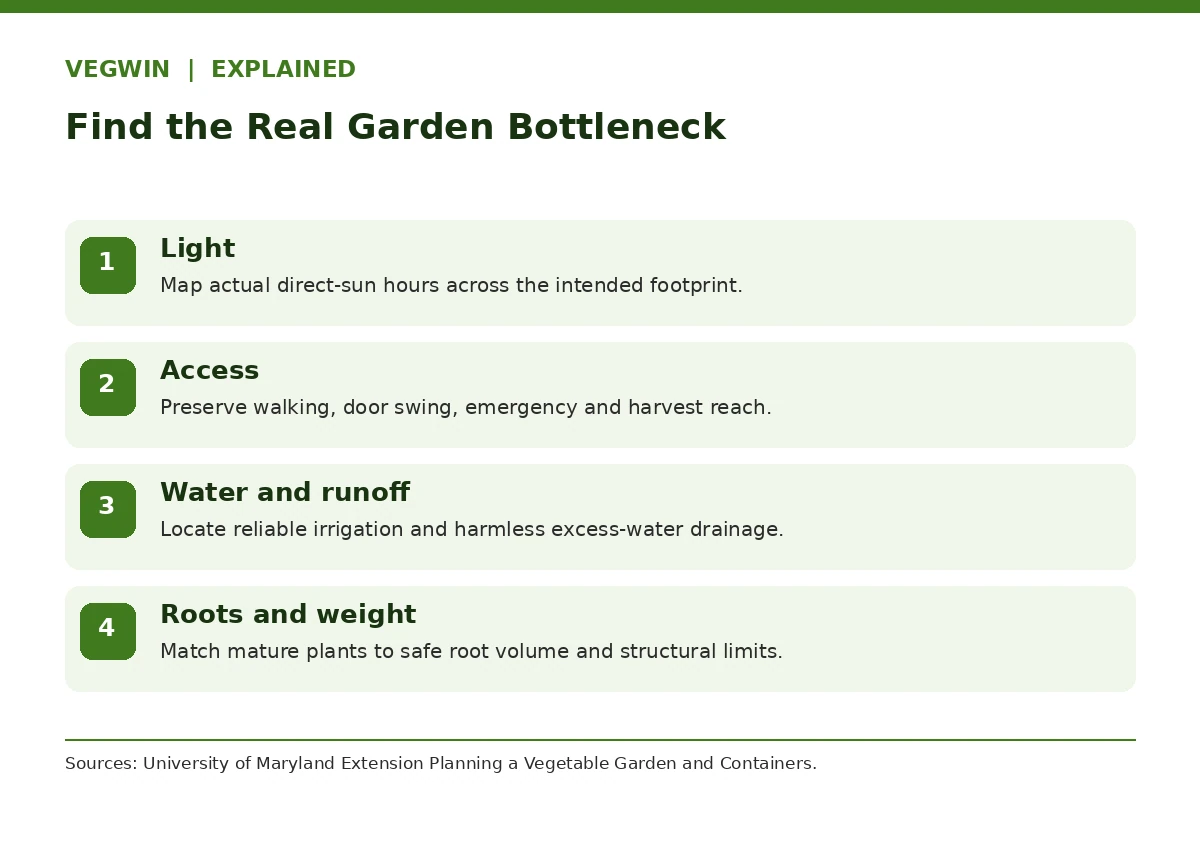
Before moving a planter, sketch the usable footprint and mark every door swing, hose connection, drain, seating area and path used by people or pets. A balcony measuring several feet across can have surprisingly little workable growing space after allowing room to turn around with a watering can. Leave access to windows, fire exits and building equipment unobstructed. For decks and balconies, consult building rules and verified load capacity before adding large, wet pots; saturated potting mix and water reservoirs are significantly heavier than empty containers.
Map direct sunlight in morning, midday and afternoon on a typical day. Do not equate a bright indoor room or open sky with six hours of direct sun. Maryland Extension recommends at least six hours of full sun for productive general vegetable sites, preferably more. If your garden receives much less, test suitable leafy crops and herbs before buying a collection of fruiting tomatoes, peppers or squash. Note reflected heat on pavement and drying wind, because tiny spaces can be exposed even when they appear sheltered. Our guide to starting a vegetable garden goes deeper into a first-bed plan for beginners.
Compare Five Layouts by Their Real Bottlenecks
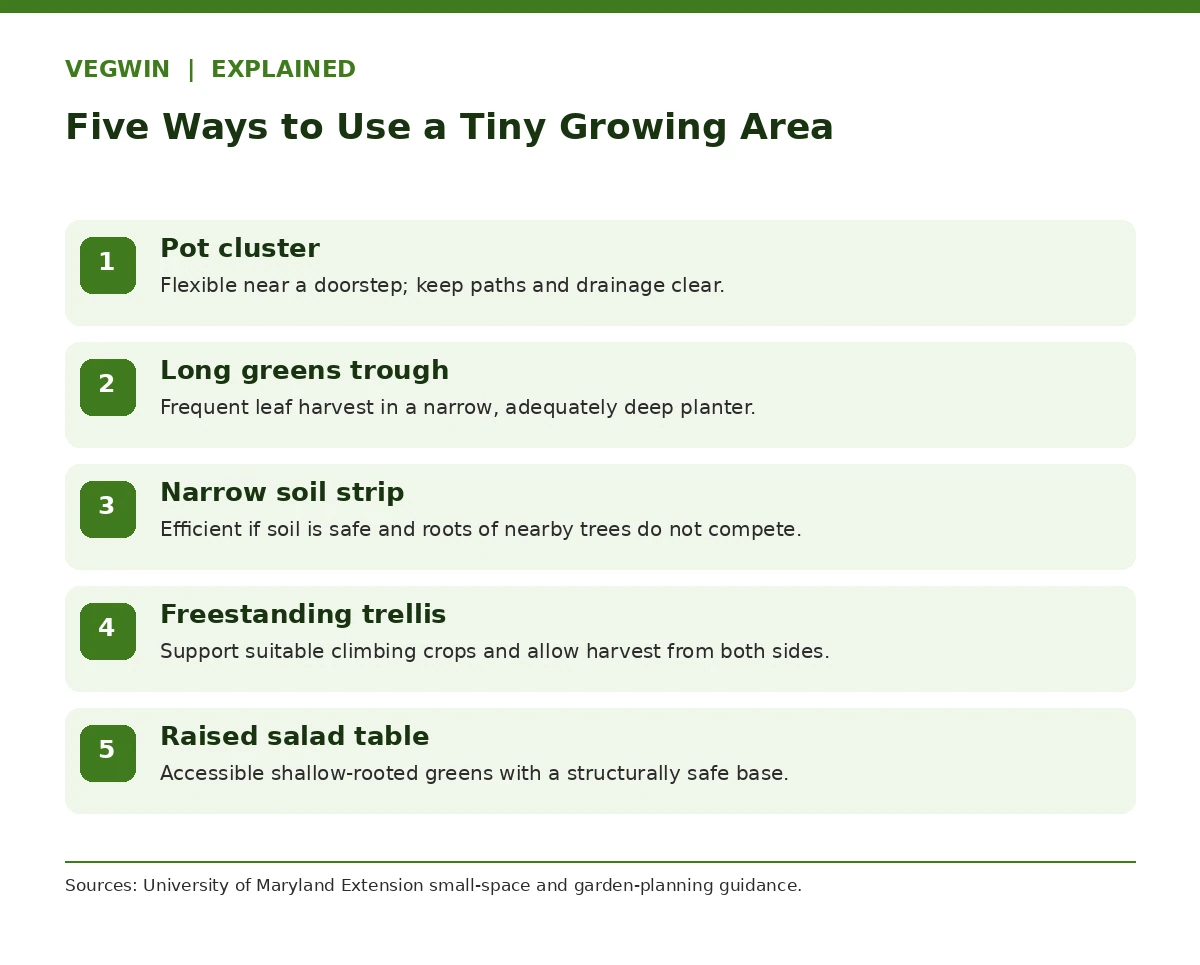
A doorstep pot cluster is easy to visit and water, but containers shade one another and a narrow path can disappear as plants enlarge. A single long trough creates efficient access for cut-and-come-again greens, provided it drains, has enough rooting room and does not overload its support. A narrow in-ground strip avoids container drying but may compete with hedge or tree roots; inspect soil and previous site use. A freestanding vertical panel saves ground area for vining beans or suitable cucumbers, but needs safe anchoring and sun on both sides. A raised salad table brings shallow-rooted greens to a comfortable working height but is not a substitute for deep soil for large fruiting plants.
Treat each option as a response to a different constraint. If you can reach the plants but lack water access, a complicated wall garden will increase maintenance rather than solve the problem. If plants receive sun only in a short window, moving smaller containers may help more than building higher. Renters should prefer freestanding supports and removable planters where permitted. A tiny growing system succeeds when its support, soil volume and watering route all fit normal daily life.
Choose Crops by Growth Habit, Not Photo Size
Look up each candidate cultivar’s mature spread, root demand and support needs. Compact bush beans can fit a low bed or appropriate container without a tall trellis; pole beans need a stable frame and room for a vine canopy. Some compact cucumbers and tomato cultivars are bred for restrained growth, but the word “compact” never makes a miniature container adequate. Large pumpkins, full-size squash vines and sweet corn usually demand more practical area or different planting arrangements than a small ledge provides.
Save the sunniest positions for crops whose harvest depends on flowers and fruit, and test leafy vegetables in slightly less exposed positions when local Extension recommendations permit. Place taller plants where their shadows will not block neighboring crops as the season develops; the appropriate side depends on orientation and local sun path. Crop packing has limits: Maryland Extension warns that very close spacing can lower airflow and increase disease risk as well as competition for moisture and nutrients. Empty space needed for harvest access is part of a productive layout, not wasted ground.
Build Access, Support, and Drainage Into the Plan
Check that you can inspect both sides of trellised crops, pull weeds and harvest fruit without stepping into planting soil. Support posts and trellis feet belong in the site plan before plants are established. Minnesota Extension discusses why bush growth habits and fruit size matter in choosing vine supports. A thin railing or decorative wall may not safely support a heavy, wet vine canopy; follow building rules and installation instructions rather than relying on improvised fixtures.
For pots, choose a container and potting medium with a safe drainage path. Water must not run across a public walkway or onto a downstairs neighbor. Never block emergency access with saucers, hoses or planters. For a bed, check how runoff moves after a hard rain, and improve drainage or relocate if the site regularly puddles. An attractive compact setup that demands moving three pots every time you harvest is a poor design even if every plant initially fits.
| Setup | Best matched situation | Most important check |
|---|---|---|
| Doorstep pot cluster | Movable sun patches near water | Drainage and path clearance |
| Long trough of greens | Small floor area; frequent leaf harvest | Root depth, water and stable base |
| Narrow soil strip | Safe usable ground soil | Tree roots, contamination, reach |
| Freestanding vertical trellis | Climbing cultivar; sound footing | Canopy load and two-sided access |
| Raised salad table | Accessible leaf and herb harvesting | Weight, drainage and crop root needs |
Use Time and Water Availability as Layout Criteria
A small space can carry a high management load because containers warm and dry differently, especially under wind or on hot pavement. Decide who can water while you are away; a living wall of many tiny pockets can need closer monitoring than a few larger, well-sized containers. Avoid making an exact daily irrigation promise. Instead check root-zone moisture and adjust for crop size, pot volume, season and weather. Group pots that can be inspected together but leave room for air movement and runoff. For the next step, our guide to vegetables in pots explains how to match crops, container volume, sun, and water.
Plan harvest by the food you actually use. Several manageable rounds of greens or radishes may be more useful than an oversized plant that blocks the only sunny corner for months. Maryland Extension recommends succession planting after short-season crops finish, with adjustments for crop season and local conditions. Keep a notebook of planting date, shade changes and how many minutes routine care requires; use the record to decide whether to add or remove a crop next year.
Run a Reversible Thirty-Day Garden Trial
For the first month, place movable pots or empty cardboard templates in their planned positions before investing in permanent carpentry. Walk your normal paths carrying a watering can. Record morning and afternoon sun, wind exposure and whether you can comfortably touch each planting position. Start with a small crop mix that fits the observed season; a living plant trial is more informative than a perfectly colored drawing. If a balcony structure has uncertain load capacity, obtain professional or building guidance instead of testing with heavy wet containers. Our guide “Balcony Gardening for Vegetables” adds more detail on this.
At the end of the trial, score each layout on useful light, watering effort, clear walking access, root capacity, structural safety and harvest reach. If one constraint fails, redesign before adding more crops. Use the comparison matrix below to pick the least complicated option that meets the real conditions. A tiny garden earns its place by supplying accessible vegetables consistently, not by photographing as many plants as possible on installation day. To go further, our guide “Garden Layout Ideas That Work” shows how to plan sun, access, water, and crop height.

How We Research This Guide and Review Regional Exceptions
We checked current results for the precise reader question and read primary university Extension horticultural guidance on October 19, 2026. Here the core decision is five contrasting tiny-site configurations with bottleneck analysis, operating access and reversible one-month trials, not generic crop advice. The VegWin.org article and category URLs could not be independently accessed during this research; consequently, we cannot confirm every live or unpublished WordPress URL, category route or ongoing site update. The editor must check competing posts and the live category in WordPress before manual publication. These recommendations reflect source-specific horticultural evidence and do not replace region-specific crop schedules, soil tests or product labels.
Sources checked October 19, 2026: University of Maryland Extension: Planning a Vegetable Garden (2026); University of Maryland Extension: Growing Vegetables in Containers and Salad Tables (2026); University of Minnesota Extension: Trellises and Cages; University of Maryland Extension: Sowing Vegetable Seeds Outdoors (2026). Each source supports the specific horticultural claim listed in the editorial record; the sources do not endorse VegWin. Statements about biological variety, planting readiness or garden pests are conditional on crop and local conditions. No pesticide mixture, fertilizer rate or commercial partnership is assumed. See our affiliate disclosure page for the general site policy.
Frequently Asked Questions
Often yes, provided building rules, load capacity, direct light, drainage and maintenance access are suitable. Start with a modest permitted container setup.
No. A vertical frame is useful for appropriate vines but may shade crops, increase wind exposure and require structural support.
Some leafy vegetables or herbs may be better candidates than fruiting crops; actual light and crop recommendations vary by site and season.
Start with a few plants you can inspect and water reliably, then increase only after learning their mature size and workload.
Sometimes, but overly tight spacing increases competition and may reduce airflow. Use crop-specific Extension spacing guidance and observe results.