
A balcony is not just a small backyard raised above the street. It has railings, a weight limit, people below, stronger wind exposure, drainage neighbors may notice, and sunlight that changes dramatically between seasons. The best balcony garden starts with a safety audit, not a shopping list of enormous pots. This guide helps determine whether the space can support a vegetable garden, where stable containers belong, and which edible plants fit the actual light and watering access. If the balcony is unsuitable for heavy planters, the right choice may be a few compact pots or no edible garden there at all.
Verify Permission and Structural Load Before Buying a Planter
Check building or landlord rules for planters, railing fixtures, watering and stored materials. A balcony has an engineering load limit that cannot be established by a gardening article or by counting the number of containers. Water-saturated growing medium, mature plants, pots, furniture and people contribute to the total. If load-bearing capacity is unknown, ask building management or a qualified professional; do not calculate a “safe maximum” from online estimates or assume an empty balcony can hold any number of large wet tubs.
Think about objects falling or spilling onto people and property. Do not balance pots on a narrow external railing or hang boxes outside a shared balcony where rules prohibit them. Fasten supports only by approved means that do not damage waterproofing or create new hazards. A heavy planter rolling in the wind is more serious here than in a yard. Set a firm boundary: no plant is important enough to justify a dangerous installation. Revisit the plan after plants grow tall and acquire a larger wind-catching canopy.
Map Light at Plant Height Across the Actual Season
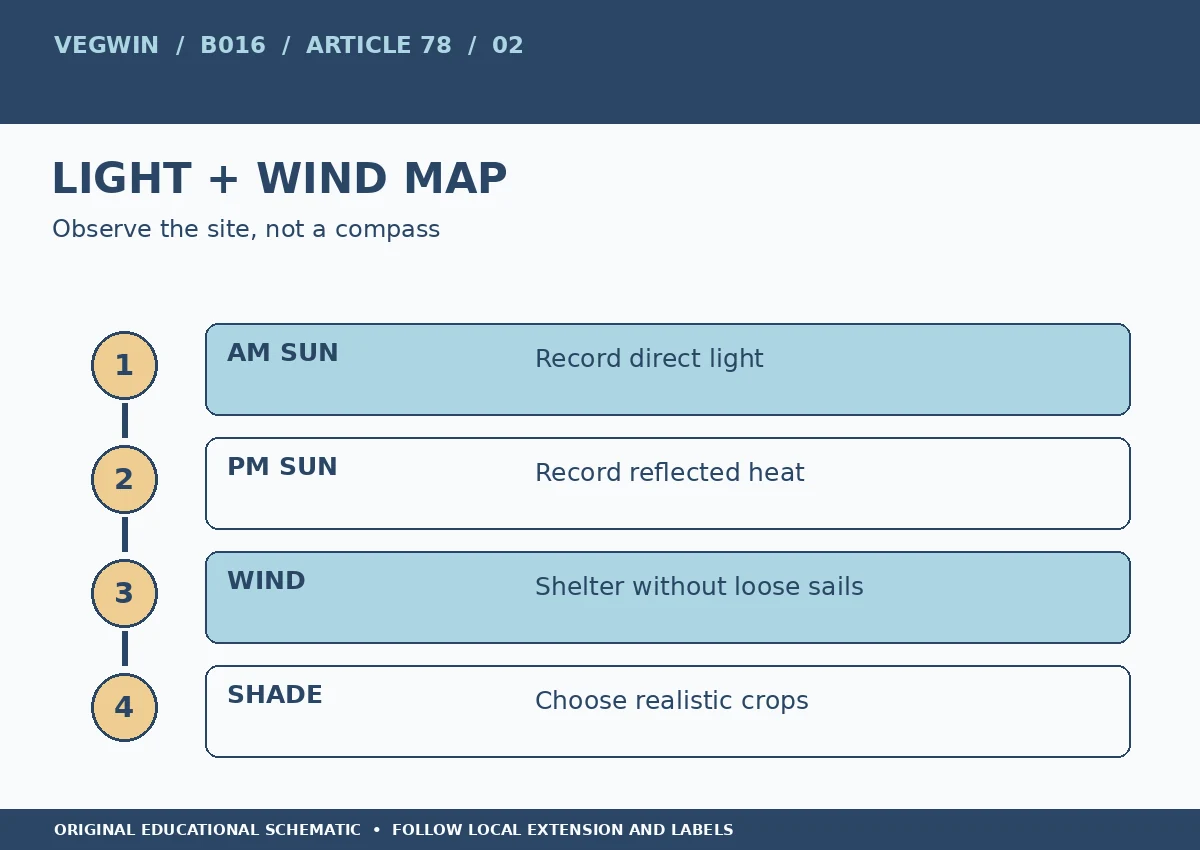
Observe where direct sunlight reaches the proposed pots rather than labeling the whole balcony “south-facing” or “sunny.” An overhang, neighboring tower and tall railing can leave the floor shady while the top of a railing is bright. Note sun exposure in morning, midday and afternoon on several days; expect the sun angle to change seasonally. Heat reflected by glass or masonry can also influence plants. Strong summer light does not imply an equally suitable winter growing window.
Full-sun fruiting crops generally need much more light than some leafy greens. If direct light is limited, choose greens or herbs that match the available conditions and accept slower growth or smaller harvests. Do not promise that an LED lamp will automatically turn a dark outdoor balcony into a productive tomato farm; weather, electricity safety and plant area still matter. A simple sun map marked “morning only,” “afternoon only” and “all-day shade” is a better buying guide than the balcony compass direction alone.
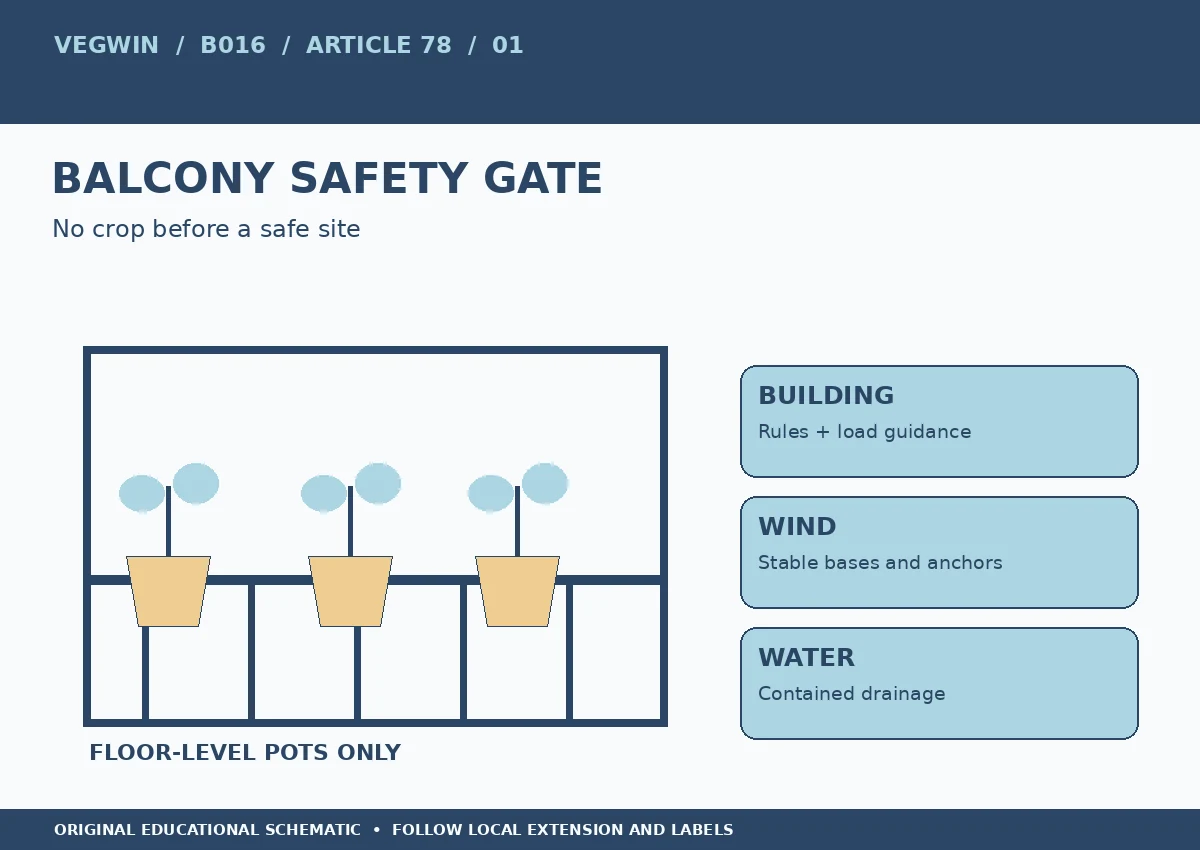
Choose Containers That Cannot Easily Tip in Gusts
University of Illinois Extension explains that pot shape and stability are important on exposed balconies and rooftops. A broad base and low center of gravity are generally preferable to a narrow tall pot carrying a large top-heavy plant. Maryland Extension similarly notes that a wide five-gallon container can be more stable than a narrow one of equal volume. Plan for the plant at mature height, not only the tiny transplant you bring home. Use sturdy stands on level surfaces and follow the building’s attachment rules.
Do not solve wind exposure with unsecured plastic sheeting or tall screens that can themselves act as sails. Where permitted, use stable sheltered wall locations without blocking emergency routes, doors, ventilation or access for building maintenance. Wind also increases moisture loss from foliage and pots. Watch how often plants wilt and whether a trellis or stand begins moving. Relocate or reduce exposed crops if the site cannot safely support them. The most productive layout is one you can water and inspect without leaning over a railing. To go further, our guide “Garden Layout Ideas That Work” shows how to plan sun, access, water, and crop height.
| Observed situation | Likely decision point | Safer next step |
|---|---|---|
| Unknown safe structural load | Heavy wet containers could exceed limits | Get qualified approval; do not estimate yourself |
| Gusty open railing | Planters or supports might tip or fall | Move to approved stable sheltered placement |
| Little direct sun | Fruiting crop harvest likely limited | Select shade-tolerant edibles realistically |
| Runoff reaches neighbors | Water and fertilizer create a hazard | Control drainage, saucers and tray emptying |
Plan Drainage Without Sending Water Downstairs
Every food-plant container needs drainage to avoid trapping water around roots, but that water needs a controlled destination. Check building rules for runoff and avoid allowing fertilizer solution or soil fines to drip onto lower balconies or passersby. Use appropriately sized saucers or contained trays that you empty safely. A permanently full saucer can turn a well-draining pot into a waterlogged system. Inspect outlets after rain and verify that irrigation will not damage waterproofing or create a slippery walking surface.
Use a quality soilless potting mix suitable for edible crops instead of loading a balcony with dense garden soil. Illinois and Maryland Extension emphasize proper container drainage and medium choice. Avoid the temptation to put rocks in the bottom as a substitute for functional holes; rocks do not fix a pot without proper drainage. Record where water will go during a thunderstorm as well as during a careful hand watering. A successful balcony design protects the building and neighbors as well as the root system.
Build a Crop List From Pot Volume and Reachability
Match mature plant size and root volume to a container, not simply how attractive the seed packet appears. Maryland Extension provides crop-specific minimum container sizes and recommends considering both plant top growth and the root system. Compact leaf lettuce and certain herbs can fit smaller containers; many standard tomatoes and peppers require larger ones. Choose dwarf or bush varieties only when their actual packet characteristics support the intended space. Do not assume that one pot size fits every vegetable. Our guide to growing peppers in pots goes into more detail.
Put frequently harvested greens where you can comfortably reach them without moving heavy planters. Keep trellised crops away from door swings and shared walking paths. A plant growing against hot reflective glass may need more frequent monitoring than the same crop in a calm yard. If several crops need mutually incompatible moisture or exposure, group them by care needs instead of packing everything together to look lush on day one. Leave room to access drainage trays and remove a diseased plant without tipping nearby containers.
Create a Wind and Heat Watering Routine
Balcony containers can dry fast on hot, windy days, but “water every morning” is not a diagnostic test. Check the actual root-zone moisture and pot weight as practical cues, then water thoroughly enough for the mix and drainage system being used. A rain shower may miss pots under an overhang, while an unprotected pot may be soaked. Remember that a shallow small pot and a deep large tub respond differently. Never leave a hose running unattended where a blocked drain could flood the property below.
Container nutrients are depleted over time, especially with repeated watering, but fertilizer rates should come from the product directions and crop needs, not a universal balcony formula. Watch for crusted media, blocked holes, salt buildup or pale leaves, but do not assume every leaf problem is a deficiency. Keep a safe, accessible watering can or other permitted supply nearby. In strong wind warnings, first secure or move approved planters to a safer position; plant care is secondary to preventing falling objects.

Use a Four-Point Go or Redesign Checklist
Mark four results: BUILDING approval and known loading guidance; PLACEMENT away from falling hazards and blocked access; LIGHT sufficient for intended crops; WATER with a controlled drainage route. If any safety item fails, redesign before planting. If safety passes but light is limited, adjust the crop list rather than trying to force sun-loving species into darkness. Also, if pots move in gusts, change shape, placement or crop height; do not wait for the first accident to provide evidence. If that is your next decision, our guide to vegetables in pots explains how to match crops, container volume, sun, and water.
Treat a balcony as an evolving microclimate. When a nearby building casts a new shadow, plants become taller or seasonal wind increases, repeat the audit. A few healthy, reachable pots are a stronger result than a dense display that cannot be watered or evacuated safely. For crop care once the site is approved, consult separate vegetable-specific and container-growing guides. This page’s decision is whether a safe, workable food garden belongs in this particular elevated space. For the fuller picture, see our guide “Small-Space Gardening Ideas That Fit Your Light, Footprint, and Time”.
How We Research and Review These Gardening Decisions
We consulted these original public university Extension and government resources on 2026-10-20: Illinois Extension, University of Maryland Extension, Illinois Extension. We checked how their recommendations depend on crop biology, growing environment, cultivar and region. The custom diagrams visualize decisions; they are educational illustrations, not experimental measurements or photographs. We compared the first 75 planned article topics for intent overlap, but could not independently inspect the full live WordPress index on VegWin.org. Current local advice, crop packets, measured conditions, and updated guidance take precedence over generic rules. Structural preflight cannot confirm every biological fact.
Buttons lead to public Extension or government educational resources; no partnership or approval is implied. We checked sources including affiliate disclosure. If products or treatments are later added, review labels, affiliations, and applicable rules first.
Only if building rules and a safe, approved installation explicitly allow it. Never place falling-object risks above neighbors or the public.
Consult building management or a qualified structural professional. Online rules of thumb cannot establish the safe capacity of your particular balcony.
Some leafy vegetables and herbs are more forgiving of reduced sunlight than heavy fruiting crops, but assess actual light and regional temperatures.
A purpose-made potting mix is generally preferable for weight and drainage. Garden soil can compact, drain poorly, and add unnecessary mass.
Safely secure or relocate planters using approved arrangements; avoid loose screens and over-railing pots. Protect people and property first.