
The question “When should I prune my roses?” has no safe one-date answer. Some garden roses bloom repeatedly on current-season growth, some flower once on stems formed the year before, and climbing roses need their long framework preserved. Cutting every rose hard in early spring can produce neat-looking bushes while removing the only flowers a once-blooming rose would make that year. The most useful tool is a correct identification of the rose’s flowering habit.
Pruning should solve a problem: winter-killed stems, rubbing canes, weak growth, poor air circulation, or a framework that no longer fits its support. It should not simply reduce every bush to the same height. Examine healthy buds, learn where the variety produces its flowers, and use small, deliberate cuts. Climate shifts the timing of spring work, so live bud growth and the risk of severe cold are more useful than an internet calendar.
Find out whether your rose flowers once or repeatedly
Watch the plant or consult its cultivar label. A once-blooming old garden rose or rambler flowers during one main season, often on established canes. It needs the prior season’s wood to carry its flower buds. Modern hybrid teas, many floribundas, and other repeat-blooming roses generally produce new flowering shoots through the season. Shrub roses vary: some are repeat bloomers but do not respond well to the severe cuts used on hybrid teas. If you inherited an unidentified plant, photograph its flowers and note the dates rather than guessing from flower color. An uncertain rose deserves conservative deadwood removal until its flowering pattern becomes clear.
Prune modern repeat-blooming bush roses in spring
Modern hybrid tea and floribunda roses are commonly pruned as the coldest weather passes and growth begins to stir. University Extension recommendations vary in severity with climate, cultivar, and desired bloom size. Remove dead wood first and then weak, rubbing, inward-growing shoots. Select well-spaced strong canes and shorten them to healthy buds where needed. Harder pruning may yield fewer, larger stems on some cut-flower types but is not appropriate for every shrub or landscape rose. Protect new buds from predicted hard freezes in cold regions. A plant struggling to establish may benefit from restrained shaping rather than maximum reduction.
Wait until after bloom for once-flowering roses
A once-blooming rose has already set the flower potential for spring on older stems. If you shorten those stems in late winter, the blossoms do not simply move to new wood. Let the plant flower, then thin or redirect the canes soon after that main display. Removing a few dead, damaged, or dangerously rubbing branches is different from a major shaping cut and can be done as needed. Rambling roses that flower once are often managed after bloom for the same reason. Plan the job early enough that the plant can make replacement growth for the next flowering cycle. Labeling the variety or bloom habit prevents repeated annual mistakes.
Keep the framework of climbing roses intact
Climbing roses rely on long structural canes tied to a support. Shortening them as though they were compact bush roses can remove years of established framework. Start by checking ties for girdling, sharp edges, and wind damage. Remove dead canes and badly crowded growth, then train healthy main canes along the support so side shoots can flower. The correct main pruning season depends on whether the climber or rambler blooms once or repeats. Shortening laterals can be useful, but the degree varies by class and climate. Wear eye protection and gloves around thorns, and use secure ladders only where access is safe.
Distinguish living buds from dead cane tissue
Live stems typically show healthy-colored tissue and plump buds, while dead wood can be dry, shriveled, and discolored through its center. Follow damaged sections downward to a healthy point before cutting, but avoid making multiple exploratory wounds throughout the plant. Look for buds facing away from the center when shaping a bush for airflow. A clean cut just above a sound bud is better than leaving a long dead stub. Illinois Extension describes using sharp, clean tools and a sloping cut above an outward-facing bud. The exact angle is less important than not crushing the stem or slicing through a living bud.
Open a crowded center without stripping the plant
Crossing stems rub and create wounds; closely packed canes make inspection and harvest of flowers difficult. Select a few truly problematic stems for removal rather than assuming every inward-pointing twig must go. Begin with dead and damaged wood, then weak shoots, then rubbing stems. View the bush from multiple directions after each cut. Shrub roses often require a lighter renewal plan than hybrid teas: removing some older canes gradually preserves much of the flowering wood. Drastic summer or fall pruning in cold climates can stimulate tender new growth at the wrong time. Leave a healthy, balanced framework rather than a precise geometric shape.

Identify rootstock suckers on grafted roses
Some grafted roses send shoots from below the graft union. These may look unlike the desired rose, with different leaf color, vigor, or flowers. Inspect the point where a vigorous shoot originates before calling it a sucker: a strong new cane from above the union can be valuable replacement wood. Rootstock suckers are best addressed at their origin according to regional Extension guidance, rather than repeatedly clipping the tips and encouraging branching. For own-root roses, the same vigorous basal shoot may be part of the desired plant. If the graft union is hard to see, avoid aggressive digging that exposes or damages roots; request help identifying the plant. Our walkthrough on how to plant bare-root roses and check the graft depth for your climate sets out each step.
Clean your tools and handle diseased wood separately
Use bypass pruners for small healthy stems, loppers for larger canes, and a suitable saw when needed. Sharp blades leave cleaner wounds and require less force. Remove diseased or dead material from around the bush and follow local guidance about disposal rather than leaving contaminated cuttings in the bed. When working among suspected diseased stems, clean tools as recommended by plant-health authorities, especially between plants. The biggest pruning errors are not a few degrees of cut angle but choosing the wrong season, leaving crowded damaged wood, or removing the flowering framework. Steady, planned work is faster than a series of panicked corrections. For the basics, see our guide: When to Prune Lavender Without Cutting into Bare Woody Stems.

Choose a pruning window in three decisions
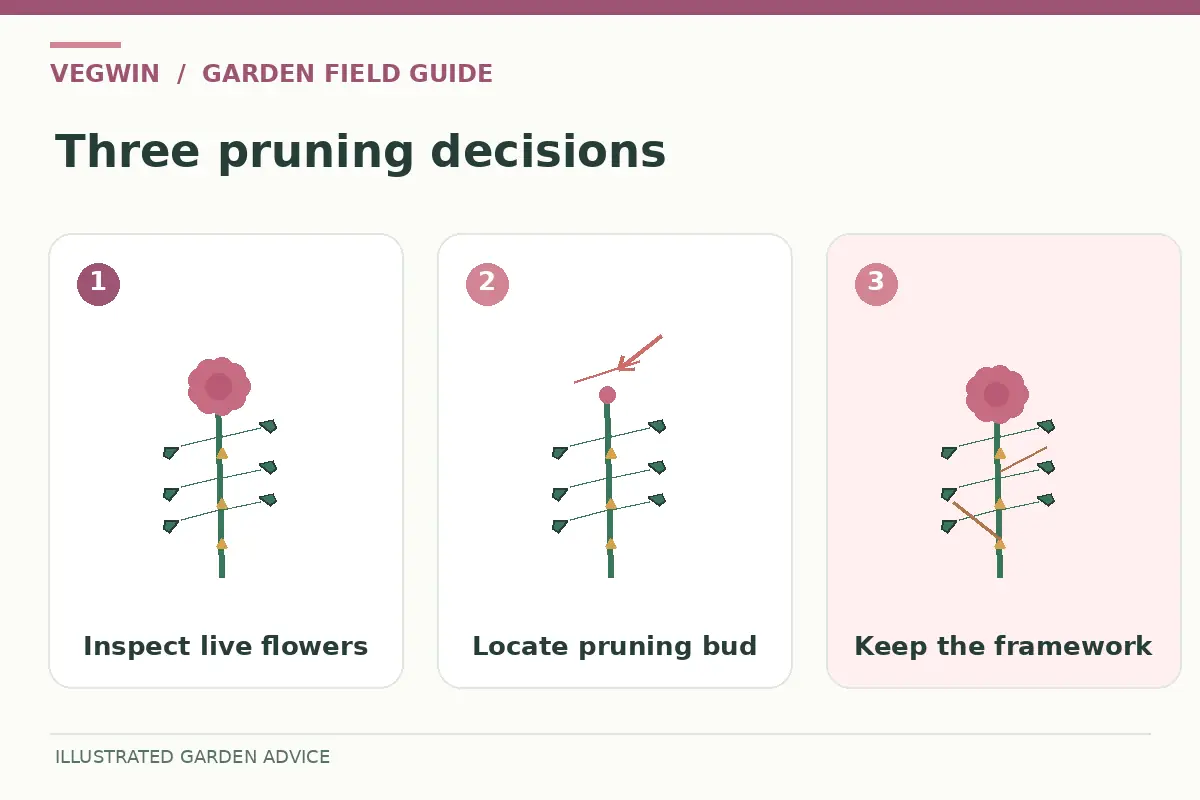
First, identify whether the plant blooms once or repeats; if uncertain, observe before making major cuts. Second, decide whether you are removing dead wood, shaping, or renewing old canes, since these jobs have different urgency. Third, check local spring conditions and use live buds as a guide for safe cuts. Repeat-blooming bush roses often get their main work in spring; once-bloomers are shaped after flowers fade; climbers keep long structural canes. Write the variety and its schedule on a garden label. A modest first pruning followed by observation teaches more than an irreversible hard cut across an entire rose collection.
Related Guides
- How to Identify Aphids on Roses and Control Them Without Harming Allies
- How to Identify Rose Sawfly Larvae and Stop Windowpane Leaf Damage
- How to Identify Japanese Beetles on Roses and Reduce Flower Damage
How We Research and Verify Garden Advice
Our research starts with the specific reader problem and checks university Extension guidance against the plant part, season, and regional limitations involved. We checked the linked sources on October 21, 2026. This is editorial guidance, not a plant diagnosis from a laboratory. If symptoms suggest disease, local Extension diagnosis should precede treatment. This guide contains no paid recommendations. Read the affiliate disclosure for the site’s relationship policy.
Original supporting sources, checked October 21, 2026: Extension reference 1 — Rose type, once-blooming timing, shrub rose restraint, and outward-facing cuts. Extension reference 2 — Spring deadwood inspection and differences across rose types. Extension reference 3 — Rose classes, cane renewal and climbing rose pruning. Recommendations may differ with cultivar, region, and garden conditions.
No. Once-blooming old garden roses and many ramblers can lose their flower buds if heavily pruned before their main bloom.
Check for shriveled dark bark, lack of live buds, and discolored interior tissue; trim conservatively to healthy growth.
Usually not. Preserve the climber’s main framework and use the blooming habit to time selective pruning.
An outward-facing live bud is often useful when shaping an open bush, but first remove dead or damaged material.
Heavy fall cuts may stimulate tender growth in cold climates; follow regional guidance for your rose class.