
Lavender shrubs often begin as tidy silver-green mounds and slowly develop bare woody bases. Once that happens, cutting every stem down to the brown framework may not rejuvenate the plant—it may leave dead-looking stubs that do not sprout. The most useful pruning guide therefore starts by finding living leaves below the intended cut, not by measuring the whole shrub with a ruler.
RHS recommends regular pruning after flowering and warns that lavender does not readily regenerate from old bare wood. Oregon State Extension also stresses the need to adapt pruning to lavender type and approaching winter. The following plan distinguishes light shaping, ordinary post-bloom maintenance and the difficult decision to replace a very woody plant.
Identify the lavender group and its growth habit
English lavender commonly has narrow aromatic leaves and slender flower spikes. Spanish and some French lavenders may have showy colored bracts or different seasonal bloom patterns and are often less cold hardy. The plant label matters because an instruction designed for robust English lavender should not automatically be applied as a hard cut to every lavender in the garden.
Inspect more than the tips: find the junction where old woody stems change into leafy younger shoots. This living zone sets the safe lower limit for shaping. If your shrub is mostly bare wood with a few remote green tips, it has a different problem from a vigorous young mound that simply finished blooming.
Choose a time around flowering and frost risk
RHS recommends trimming annual lavender after flowers fade, usually in late summer under its local conditions. This helps preserve a compact mound and reduces excessive woody growth. In a cooler continental region, leaving a long period before severe frost is prudent; a hard late-autumn trim may expose new tissue to winter damage.
OSU Extension describes spring shaping as an option once living growth is clear, and postflowering pruning as especially important. Work from flowering stage and local frost forecasts rather than assuming September always means the same thing. If the plant is flowering later than usual and hard frost is close, prioritize mild cleanup and defer more extensive shaping.
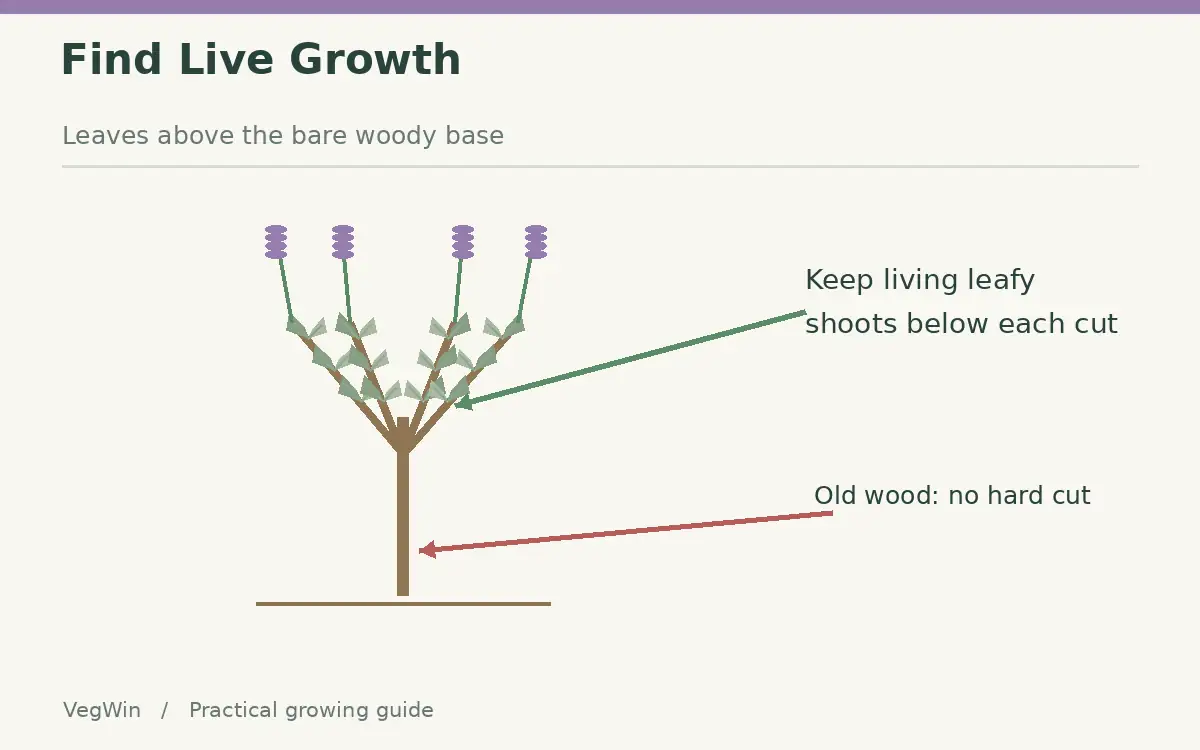
Find the cut boundary above live green shoots
Trace several lavender stems from their leafy ends down toward the gray-brown woody center. Leaves and visible living nodes mark sections with potential for regrowth. RHS warns against cutting into bare old wood because a branch may not break new shoots there. A pruning line should always leave enough live green growth below it. If you are starting from scratch, read When to Prune Lavender Without Cutting Into Old Woody Stems.
Do not apply a fixed “cut halfway down” command to a leggy old plant. Two plants of equal height can have very different amounts of living foliage. On a young, leafy plant, a little shaping can be useful; on a very woody lavender, the same depth may destroy the remaining green nodes. Cut less when uncertain.
Remove spent spikes while preserving the mound
Start by clipping finished flower stalks, then take a modest amount of leafy tip growth if the shrub is vigorous and conditions are suitable. Follow its natural rounded outline rather than cutting all growth to one horizontal plane. Stepping back every few stems helps keep the center slightly full and avoids accidental gaps.
Use clean, sharp shears on dry foliage. A patchy plant may benefit more from selective hand pruning than from powered hedge trimmers. Keep flowers and leaves distinct in your plan: removing a dry stalk is not the same as cutting into basal wood. Avoid stripping every living leaf from the outer shell of the plant.

Keep spring pruning light until the living tissue is obvious
Winter may leave gray or browning tips that look dead while the shrub remains viable below. In spring, wait until new green growth confirms where the live boundary sits before removing obvious winter damage. This is particularly important where freeze-thaw cycles or wet winter soil have stressed the lavender.
A light tidy-up may improve shape, but large pruning wounds into bare older branches are not a reliable way to force new shoots. If an entire branch is clearly dead, prune it at its origin with care. Where the center is structurally dead and the shell is sparse, replacement may be more realistic than attempting radical rejuvenation.
Do not apply English lavender severity to every type
OSU Extension notes that Spanish and French lavender types generally need a gentler touch than English lavender. They can be damaged by a hard reduction. Identify the flowering and foliage features, check the botanical name, then choose restrained trimming after flowering for tender varieties.
Even within English lavender, cultivars and climates affect growth. If you inherited an unlabeled shrub, perform small conservative cuts and watch its response instead of treating a generic online fraction as a guarantee. Keeping the living leafy boundary is the shared principle across types.

Recognize when pruning cannot solve woody decline
A narrow live canopy over a thick bare skeleton may be an aged plant reaching the limits of routine trimming. If there are no green shoots near the desired height, a drastic low cut can leave a plant unable to recover. RHS suggests that older extremely woody lavender is often best replaced when appearance is the main concern.
Take softwood or semi-ripe cuttings from healthy growth at a suitable season before removing an old favorite; propagation guidance is different from pruning guidance. Where roots sit in chronically wet soil, also correct drainage and planting location. New replacements in equally soggy ground may fail regardless of trimming technique.
| What you observe | Best next step |
|---|---|
| Flower spikes spent; mound leafy | Remove stalks and shape lightly after bloom. |
| Leaves present just below planned cut | Use a conservative cut in the living zone. |
| Only bare brown wood below planned cut | Move the cut higher; do not rely on old wood resprouting. |
| Hard frost expected soon | Limit trimming and follow regional timing. |
| Almost no green growth near base | Consider replacement or propagation instead of severe pruning. |
Check pruning results through one full season
Good pruning is evident in a healthy layer of shoots the following season, not merely in a perfect half-circle immediately after cutting. Photograph the plant before and after; note which sections had green leaves beneath the cuts and how many stems responded. This makes the next round more precise. If you are starting from scratch, read When to Prune Roses.
Retain a readable maintenance rule: trim after blooms, avoid bare wood, protect against late-frost timing, and adjust to species. If you cannot find living growth below the intended cut, do not cut there. That single check prevents many of the most frustrating lavender pruning mistakes.
Related Guides
- How to Root Lavender Cuttings: Choose Nonflowering Stems and Avoid Rot
- How to Start English Lavender Seeds Indoors Without Soggy Seedlings
How We Research This Gardening Advice
Research checked on October 23, 2026. We consulted the named university Cooperative Extension and/or Royal Horticultural Society materials and compared the recommended growing decisions. Numerical recommendations and seasonal windows are regional examples where noted, not guaranteed dates for every garden. The botanical sketches simplify plant structure rather than depicting a particular cultivar to scale.
Sources consulted: rhs.org.uk; ask.extension.org; ask.extension.org. Where advice differs by local climate or plant variety, follow your local Extension office or the specific plant label.
Editorial disclosure: These instructions are educational and contain no claim of paid endorsement or verified partner recommendations. For site-wide information, see our affiliate disclosure.
Bare woody stems often fail to produce new growth. Leave living leafy shoots below the cut.
The main shaping trim is usually after flowering; some regions and types also benefit from light spring cleanup.
Use the location of live leaves as your boundary instead of a universal fraction for all plants.
Severe late pruning near a hard frost may increase winter risk. Follow local conditions and keep cuts light when uncertain.
Selective maintenance helps only where live shoots remain. Extremely woody plants may be better replaced or propagated.