
Small white insects that rise in a cloud when tomato foliage is disturbed may be whiteflies, but the most telling evidence remains on the underside of leaves. Adults fly; their young nymph stages stay attached and feed on the foliage. Sticky honeydew and dark sooty mold may follow when populations rise. Identifying the stage and recognizing natural enemies is more useful than spraying every pale speck you see.
Look Under Leaves Rather Than Only at Flying Adults
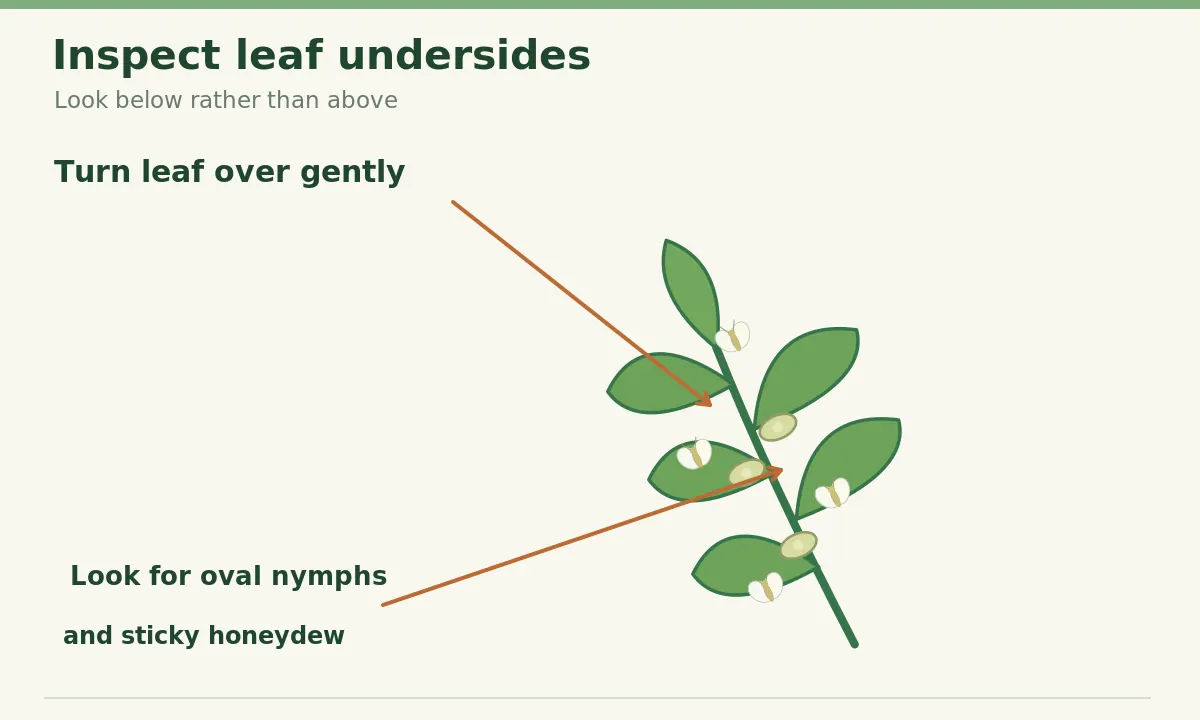
Gently turn over a lower or middle tomato leaf without tearing the petiole. Whitefly adults are tiny mothlike insects with pale powdery wings; they often flutter up when disturbed. Eggs and flattened, oval immature stages remain under the leaf surface. UC IPM emphasizes inspecting leaf undersides because populations may be overlooked from above. Use a hand lens for close observation. Do not call every drifting white insect a true fly: whiteflies are sap-feeding insects in the same broad order as aphids. A short video or photograph taken in place can help distinguish them from harmless airborne insects.
Recognize the Stationary Flattened Nymphs
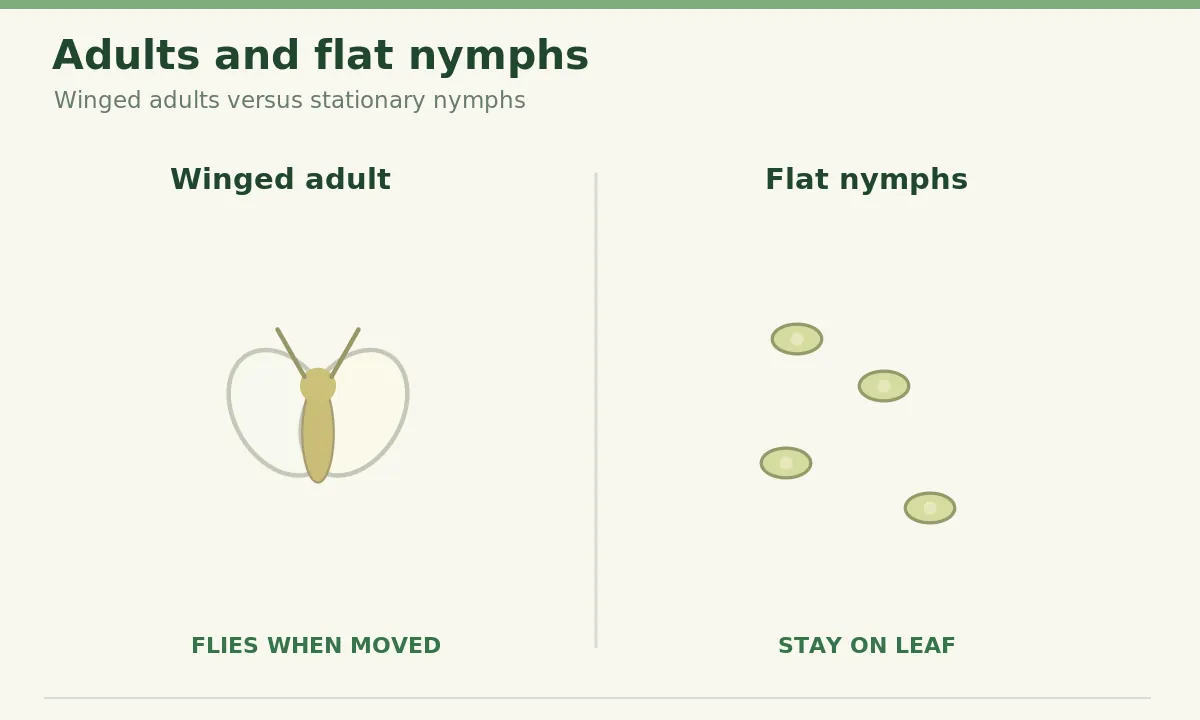
Whitefly nymphs can resemble tiny pale flattened scales attached to the leaf, unlike the more conspicuous flying adults. They feed on plant sap and generally remain in place as they grow. UC IPM notes that nymphs account for much of the damage, so counting adults alone misses an important stage. Inspect several leaves at different heights because colonies can be clustered. Look for small oval forms on the lower surface, but do not scrape all tiny dots away before checking their identity; some dark or damaged nymphs may contain beneficial parasitoids. The magnified illustration separates adult wings from the oval attached stage.
Check for Honeydew and Sooty Mold
Sap-feeding whiteflies excrete a sticky sugary material called honeydew, which can coat lower leaves and surfaces beneath an infested plant. Black sooty mold may grow on that residue, making the canopy look dirty and interfering with light capture. A sticky shiny leaf and a black surface coating are supportive signs, not enough by themselves to prove whiteflies; aphids and other sap feeders also produce honeydew. Inspect undersides for actual insects before concluding what caused it. Remove severely infested isolated leaves when practical and keep removed plant debris away from healthy seedlings.
Distinguish Whiteflies From Other Tomato Insects
Aphids are usually pear-shaped and often cluster along tender shoots, while adult whiteflies have pale wings and flutter from the underside of foliage. Spider mites are extremely small arachnids associated with stippling and sometimes webbing rather than white mothlike flights. Thrips are slender insects that can cause silvering, and many leaf spots arise from noninsect causes. Do not diagnose from yellowing alone: nutrition, drought and disease can also discolor tomato leaves. Use both insect form and its location. If a specimen looks unlike the reference, request identification through local Extension before applying a treatment.
Monitor Plants and Nearby Weed Hosts
Check the oldest infested leaves and fresh new growth on a consistent schedule, noting where adult insects and attached nymphs are concentrated. UC IPM advises routine monitoring and identifies areas near host plants as potential trouble spots. Inspect transplants before placing them beside established tomatoes. Removing spent vegetable residues and controlling weeds that harbor whiteflies may reduce pressure, but adults can still fly in from another crop. Keep simple notes with date, weather and visible colony locations. A single adult caught on yellow tape is a prompt to inspect, not proof that chemical intervention is required.
Use Early Physical and Cultural Steps
For a small garden, gently washing an infested leaf underside with a stream of water can remove some insects, as UC IPM suggests. Test the water force first so it does not break tender tomato shoots or spread contaminated soil. Remove only heavily infested leaves when the plant can spare them, and bag plant debris where appropriate. Reflective mulch around young tomatoes can delay whitefly colonization in some growing systems, but UC IPM notes the effect declines once foliage shades the mulch. Match a tactic to plant size and infestation rather than adding every possible barrier to a crowded bed.
Conserve Beneficial Predators and Parasitoids
Lacewing larvae, lady beetles and several tiny parasitic wasps help suppress whitefly populations. UC IPM describes Encarsia and Eretmocerus parasitoids, especially in managed greenhouse programs. Some parasitized nymphs change color or develop emergence holes. Avoid broad-spectrum insecticides when beneficial activity is present, because killing natural enemies can make an outbreak worse. Manage dust and ant tending where they interfere with beneficial insects. Do not assume commercially purchased predators will establish in every open garden; local climate, crop type and pest species matter.
Use Sticky Traps as a Monitoring Aid, Not a Cure
Yellow sticky cards can reveal when flying adults appear and provide a rough comparison between locations or weeks. They do not remove every attached nymph and can trap small non-target insects as well. Position them so they do not adhere to tomato foliage, and replace them when soiled. Check the undersides of leaves alongside trap counts; a clean card does not prove there are no developing nymphs. In small beds, learning to spot the first few adults early is generally easier than responding to heavy sooty mold later. Use recorded trends rather than treating every single capture as an emergency.
Understand Why Contact Sprays Often Miss Whiteflies
If nonchemical steps are insufficient and a labeled product is appropriate, contact insecticidal soaps or horticultural oils require coverage of infested leaf undersides. UC IPM warns that adults and nymphs can be difficult to control and repeated applications may be necessary. Never invent a household detergent mixture or a universal application rate. Follow the exact tomato label, weather restrictions, preharvest interval and instructions to protect bees, beneficial insects and sensitive foliage. Do not spray a drought-stressed or overheated crop merely because a calendar says it is time. A registered treatment can reduce insects without reversing old leaf damage.
Judge Success by New Foliage and Falling Colonies
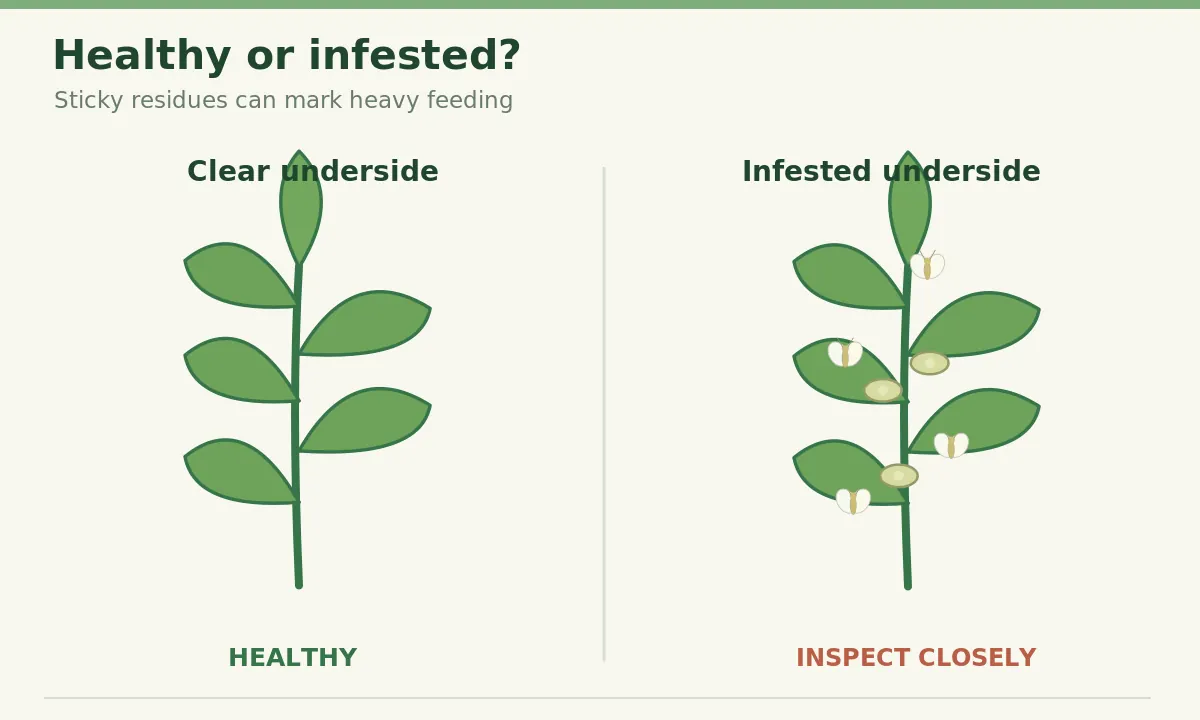
Recheck the same plant after action. Count or photograph oval nymphs on an identified leaf area and look for fewer new adults, less fresh honeydew and healthy expanding tomato tips. Yellowed older leaves may not return to green; that alone does not prove control failed. UC IPM emphasizes monitoring and conserving biological control over repeated broad-spectrum treatments. If tomato plants show severe curling or widespread decline, consider nutrient, water and virus-related causes in addition to whiteflies; consult local Extension when diagnosis affects major decisions. The comparison image shows a healthy leaf underside beside one bearing a colony and sticky residue.
Related Guides
- How to Identify Whiteflies on Tomatoes and Reduce Their Damage
- Growing Tomatoes: A Step-by-Step Plan from Transplant to Harvest
- How to Identify Leaffooted Bugs on Tomatoes and Protect Developing Fruit
- How to Identify Stink Bug Feeding Spots on Tomatoes Without Guessing
- Tomato Hornworm: Identify the Caterpillar and Choose an IPM Response
How We Research and Verify Plant Advice
Sources checked on 2026-10-26: ipm.ucanr.edu; ipm.ucanr.edu; ipm.ucanr.edu. We reviewed each institution’s plant identification, correct growth stage and relevant cultural recommendations before adapting them into an independently written step-by-step guide. Where sources are region-specific, their calendar details are not applied universally. Pictures use simplified teaching shapes and should be compared with living specimens; they are not a substitute for laboratory disease diagnosis or local climate guidance. The relevant advice is paraphrased rather than reproduced.
Safety and Independent Editorial Disclosure
This independently prepared educational article does not claim sponsorship or affiliate approval. Our category reading links are informational, not product endorsements. See the VegWin affiliate disclosure. Clean sharp tools before cutting plants, protect hands from thorns and blades, and keep cut plant material away from children and pets where appropriate. Use only locally registered plant treatments labeled for the actual crop, and observe the product label. Do not rely on unsupervised home remedies or unverified harvest-safety promises.
Adults, eggs and many flattened nymphs are found mostly on leaf undersides.
Adults fly when disturbed; young feeding nymphs are largely immobile.
Honeydew excreted by sap-feeding insects; sooty mold may grow on it.
No. It can help monitor adults but does not remove attached eggs and nymphs.
Not automatically. Identify the pest, inspect natural enemies and start with suitable IPM measures.