
Pale, papery islands inside a beet leaf can look like sunscald, but some are tunnels made by the tiny larvae of leafminer flies. The most useful clues are a thin intact surface over the pale patch, possible white eggs beneath nearby leaves, and feeding damage contained between leaf layers. Not every spotted leaf calls for an insecticide: when growing beets for roots, limited damage often matters less than damage to greens you plan to eat. This guide shows where to look and how to intervene before adults lay another round of eggs.
Recognize a Mine Rather Than a Surface Spot
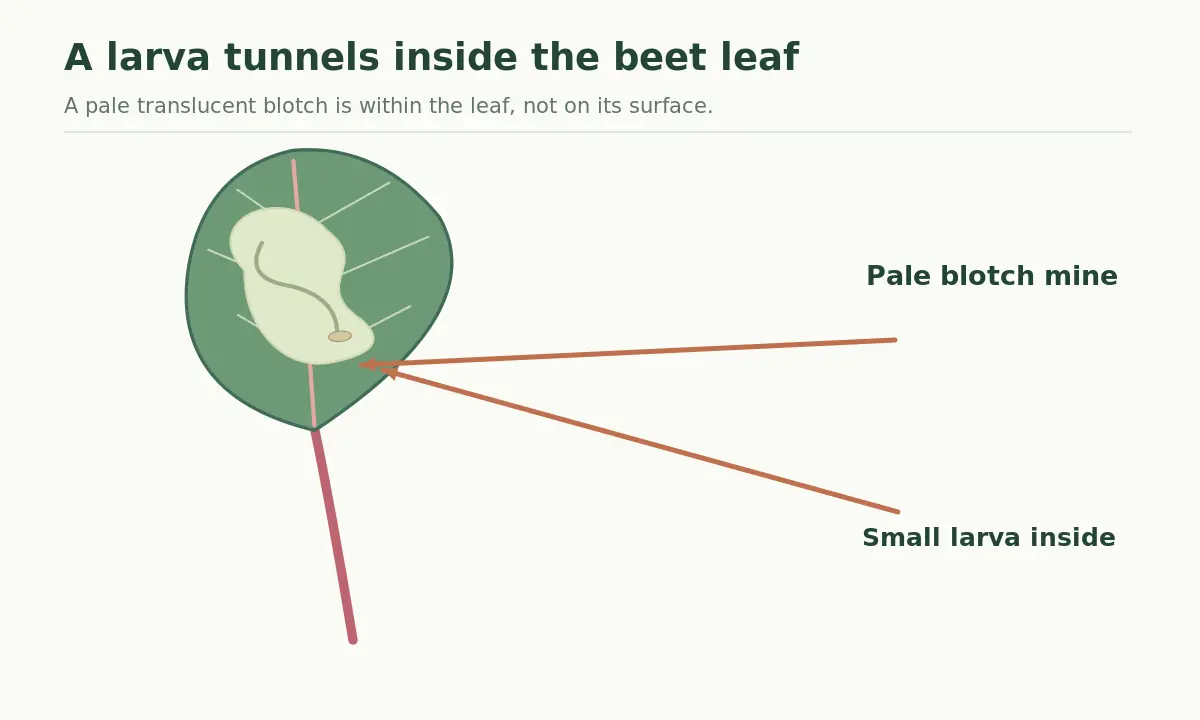
A leafminer larva eats tissue between the upper and lower leaf surfaces. Affected areas may look pale, translucent or irregularly blotched, sometimes with a darker line of frass inside the mine. Beet and spinach leafminers commonly create broader blotches; other vegetable leafminers produce winding lines. Fungal leaf spots more often develop dead colored lesions without a distinct tunnel between intact leaf layers. Hold a leaf toward the light and inspect both sides with a hand lens. One symptom alone does not identify the exact fly species, so avoid making pesticide decisions based only on a light patch.
Inspect the Underside for Small White Eggs
Before mining appears, adult flies may leave small pale elongate eggs, sometimes clustered on the lower surface of beet, spinach or chard leaves. Maryland Extension illustrates eggs on beet leaves. Check a few young leaves across the bed, including less obvious undersides, rather than scanning only from above. These eggs are far smaller than beet seed. Do not mistake white mineral residue or insect shed skins for viable eggs: gently inspect shape and attachment. Photograph an uncertain sample, or bring it to local Extension for confirmation if infestations recur. Early monitoring reveals a window for prevention that disappears after larvae enter the leaf.
Understand Why Larvae Hide From Sprays
After eggs hatch, maggot-like larvae penetrate leaf tissue and feed protected inside it. They are not surface caterpillars that can simply be washed off with a hose. Once mature, some leafminer larvae exit the leaf to pupate in the soil, and adult flies emerge later to start another generation. Actual timing varies with species, temperature and region. Spraying damaged patches often has little effect on larvae already hidden within leaves. The better home-garden approach starts with identification, selective removal of affected tissue when practical, weed management, and adult exclusion before egg laying.
Decide Whether the Root or Greens Are the Crop
Minnesota Extension notes that leafminers on beets grown for roots generally do not require treatment when damage is modest. A few mined leaves can still photosynthesize through their remaining green tissue. In contrast, if you mainly harvest young beet greens or chard, the same feeding damage directly reduces the quality of your edible harvest. Examine overall plant growth, number of mined leaves and severity over time before acting. Do not strip away most foliage from a root crop merely to remove every cosmetic blotch; that can reduce the plant’s ability to enlarge its root.
Remove Mined Leaves Without Stripping the Plant
When only a few leaves carry active mines, pinch the mined portion to destroy the larva or remove and discard the affected leaf. Do not leave infested leaves beside the bed where larvae might finish development. Keep healthy leaves in place, especially on small root-producing plants. If the planting is heavily damaged, removing every leaf can do more harm than living with some injury. Maryland Extension identifies selective leaf removal as a primary control for many vegetable leafminers. Check nearby spinach, Swiss chard and host weeds because moving adults can reinfest a cleaned beet bed. Wash edible greens thoroughly and discard badly damaged leaves.
| Observation | Likely importance | Practical next step |
|---|---|---|
| Few mined leaves; roots are goal | Often cosmetic | Monitor; retain foliage |
| Fresh eggs beneath leaves | Active egg laying | Remove eggs; plan exclusion |
| Many mined leaves; greens crop | Harvest quality affected | Remove worst leaves; prevent new flies |

Install Fine Mesh Before Adult Egg Laying
Fine-mesh insect netting can keep adult flies off a susceptible crop if used before new eggs are laid. Anchor edges so the insects cannot slip under gaps, while making room for leaves to grow and water to pass through. A critical exception comes from Minnesota Extension: if the same soil already holds overwintering leafminer pupae, a cover can trap emerging adults inside with the crop. Crop rotation and bed history matter. Place the barrier over clean soil or a new planting area rather than assuming that covering an already infested plot is protective. Periodically lift it to inspect plants for pests trapped underneath.
Preserve Small Parasitoid Wasps and Other Allies
Leafminer populations can be limited by parasitoid wasps and other natural enemies. Maryland Extension cautions that unnecessary broad insecticide use may reduce these allies while doing little to larvae inside leaves. If you see tiny adult flies, it still does not prove an outbreak is economically or horticulturally significant. Track new mines over a week or more, and compare vulnerable leafy greens with sturdier plants grown for roots. Do not release a purchased biological-control organism without local expert guidance. For edible crops, pesticide choices must follow current product labels and jurisdictional restrictions; this guide intentionally gives no improvised spray or dosage.
Distinguish Light and Heavy Damage Patterns
A plant with one or two mined older leaves and vigorous clean inner leaves usually needs observation rather than drastic measures, particularly when the root is the crop. A bed with expanding mines across nearly every edible leaf deserves faster action: remove the worst affected foliage, check for new eggs, consider adult exclusion in a suitable rotated bed, and improve weed sanitation. Some leafminers also damage spinach and chard; protect these nearby crops before extensive mining begins. Keep a photograph sequence to distinguish old pale mines from genuinely new activity after your first intervention.

Reduce Return Visits From Adjacent Host Plants
Adult leafminers can use weeds or nearby vegetable hosts between plantings. Remove known host weeds such as lambsquarters and chickweed without disturbing desirable native plants unnecessarily. Plan rotations so new beets do not follow a highly infested crop in the same soil when alternatives exist. At season’s end, remove heavily mined crop remnants and follow locally appropriate sanitation guidance. Turning soil can affect beneficial organisms and structure, so do not indiscriminately till an otherwise healthy bed as a default. Weigh the infestation history against the costs of cultivation. The goal is to interrupt repeated cycles, not sterilize a vegetable garden.
Check Progress Before Changing Tactics
After removing a small number of infested leaves, revisit at intervals to look specifically for fresh eggs and new pale mines. Old patches do not heal, so a persistent mark is not evidence that a control failed. If clean new foliage emerges, continue to monitor while allowing enough leaves to support beet root development. If new mines spread, reconsider whether the netting was placed over previously infested soil or whether a gap admits adult flies. When identification remains uncertain, contact local Extension with close photographs of the leaf surface and underside. Avoid treating every pale beet leaf as the same pest.
Related Guides
- How to Recognize Spinach Leafminer Blotches and Remove Infested Leaves
- Growing Beets: Thin Seed Clusters for Tender Roots and Greens
- How to Thin Beet Seedling Clusters Without Damaging Neighboring Roots
- How to Sow Beet Seed Clusters and Thin Multiple Seedlings Correctly
- How to Grow Sugar Beets From Seed Without Crowding Their White Roots
How We Research and Verify This Guidance
This article was checked on 2026-10-24 against plant-specific university Cooperative Extension and government guidance: University of Minnesota Extension; Maryland Extension; Illinois Extension. We separated directly supported cultivation, pruning, and insect-life-cycle recommendations from choices that depend on local weather, crop genetics, and gardening goals. Illustrations are simplified teaching diagrams, not photographs or treatment labels. Consult your regional Extension office for local timing, pest identification, and regulations.
Sources, Disclosure, and Regional Limitations
Source links and their supported claims are preserved in the article metadata and linked above. No field trial was performed for this particular garden, and results are not guaranteed. This guide does not assert a paid partnership or endorse a pesticide product. Review VegWin’s affiliate disclosure for site-wide transparency. No pesticide application or home-mixed spray is recommended; follow the exact current crop label and local regulations if chemical control is considered.
Light leaf mining usually affects foliage more than the root, so root-grown beets often need monitoring rather than treatment.
They can be tiny pale elongated eggs on the underside of leaves; use a hand lens for confirmation.
Yes, if installed before adult egg laying and not enclosing adults emerging from pupae already in that soil.
Many contact treatments cannot reach larvae between leaf layers; use prevention and selective leaf removal first.
No. The tissue does not become green again; monitor for clean new leaves rather than expecting patches to heal.