
Freezing preserves a garden harvest through cold, but it does not magically wash vegetables, inactivate every enzyme or kill every microbe. Most vegetables need a tested blanching step for good frozen quality, while a few crop-specific preparations may be frozen without blanching. The National Center for Home Food Preservation (NCHFP) publishes separate directions for individual vegetables; this article explains how to choose the correct directions and carry them through without improvising a timing chart. It is about freezing, not canning or dehydrating. Use the latest NCHFP page for the actual crop and cut size before heating any food.
Start With Clean Produce and a Crop-Specific Plan
Harvest vegetables while in good condition and freeze them as soon as practical to protect quality. Sort away spoiled or visibly moldy produce rather than expecting freezing to reverse spoilage. Wash hands, work surfaces, utensils and suitable vegetables according to standard food-safety practices. Remove inedible portions and prepare the crop as described in the NCHFP vegetable-specific instructions. Small pieces and whole specimens may require different treatment. Do not generalize one broccoli instruction to corn, potatoes or peppers. If you want the full process, read how to store root vegetables.
Before cutting, find the exact NCHFP entry for the vegetable you have, not merely a general social-media chart. The NCHFP vegetable-freezing collection distinguishes methods and forms, including kernels versus corn on the cob and slices versus whole items. Some foods are cooked before freezing, while others can be prepared fresh. Write the crop, form and source instruction on a note by the stove so someone helping does not confuse a recommended treatment time with the amount of time needed for the water to return to boiling.
Decide Whether Blanching Is Required
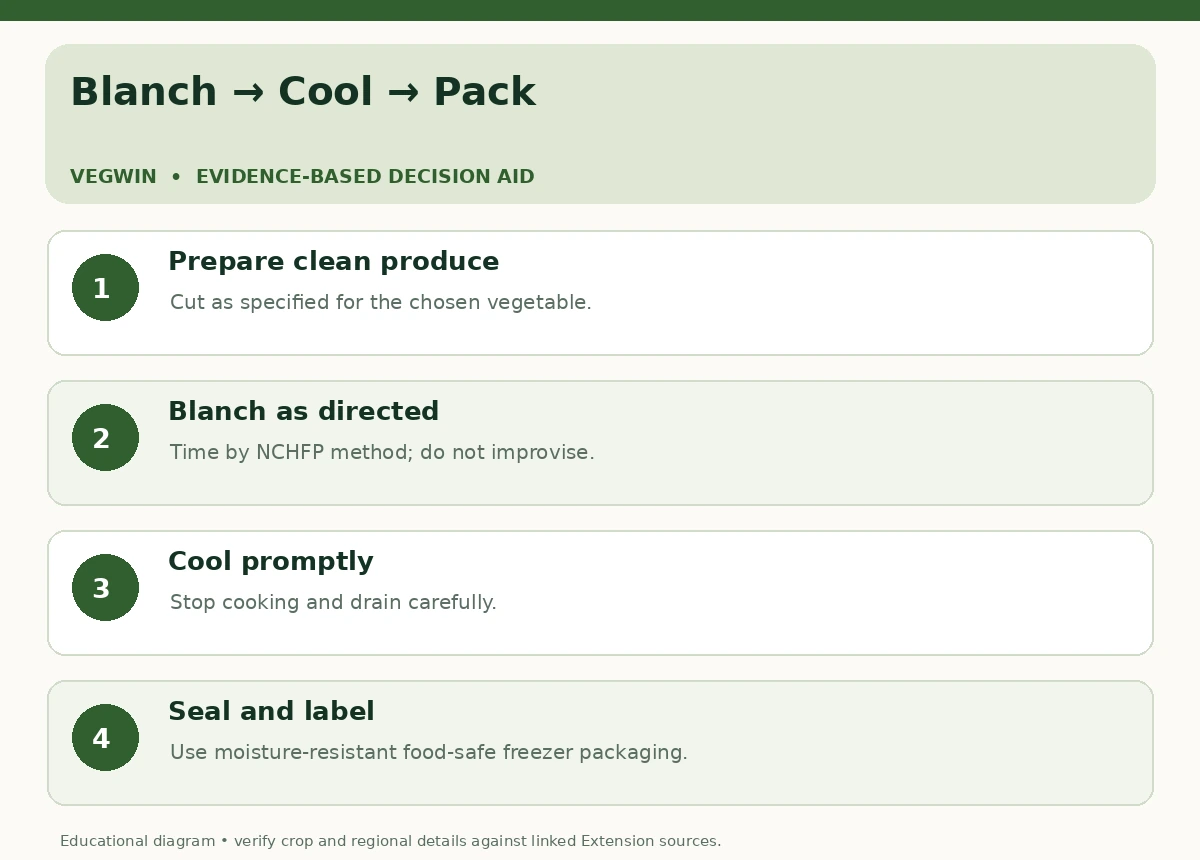
NCHFP says blanching is important for almost all vegetables before freezing. The brief heating slows enzyme activity associated with loss of flavor, texture and color during frozen storage. Both underblanching and overblanching harm quality: underblanching can stimulate enzyme activity, and extended heating damages food. Because the method and time depend on the vegetable and cut size, no single “blanch everything for three minutes” rule is acceptable. Use the official directions for the exact form of produce. If you want the full process, read how to dehydrate garden vegetables safely.
The exceptions also must be crop specific. NCHFP lists raw, unheated bell or sweet pepper strips as an option, and separately describes heated pepper preparation for cooking. That does not mean green beans, broccoli or carrots can be frozen raw with equivalent quality. Similarly, freezing cooked vegetables is not interchangeable with following a fresh-vegetable blanching time. When uncertain, stop and consult the specific NCHFP page or your local food preservation Extension service instead of using a guessed shortcut.

Blanch in Batches Using Tested Directions
For water blanching, NCHFP describes using a covered pot and blanching basket with adequate vigorously boiling water. Timing begins when the water has returned to a boil after adding the prepared vegetables, not whenever the pan was placed on the burner. Overcrowding can delay the return to boiling and interfere with a reliable process. Use the crop-specific time and method; a steam blanching option is appropriate only when the source recommends it. Follow the exact treatment instructions rather than assuming steaming equals boiling in duration.
Keep separate batches for vegetables with different instructions and sizes. If a container holds a mixture, it becomes easy to under-treat one ingredient while overcooking another. Use a timer, record the treatment for the batch and have a clean cooling station ready before cooking starts. This is a quality-preservation process, not a canning sterilization step. Neither water blanching nor home freezing converts a food into a shelf-stable canned product, and no canning processing times are provided here.
Cool Quickly, Drain Thoroughly, Then Pack
Immediately cool blanched vegetables according to NCHFP instructions to halt cooking. The organization describes moving produce into abundant cold water, changing water or adding ice as needed, then draining thoroughly. Warm vegetables left in a pile continue cooking and take longer to freeze. Excess surface water encourages large ice crystals or clumping and can reduce final texture. Handle food in clean containers and avoid returning cooled vegetables to a surface that contacted dirty raw produce.
Choose food-safe freezer bags or rigid containers designed to resist moisture and vapor transfer. NCHFP emphasizes leak resistance, good closure and appropriate headspace for expansion. A freezer bag does not need the same headspace as a rigid liquid-filled container, and loose vegetables may use a tray pack before bagging to prevent a solid block. Press out unnecessary air without crushing tender pieces. Label the actual vegetable, preparation form and freezing date so the next cook does not have to identify a mystery bag months later.
Use the Right Container and Freezer Conditions
Different packs suit different cooking habits. A small household might choose meal-sized flat bags that freeze relatively quickly; another might prefer rigid leakproof containers for soft or liquid-containing foods. NCHFP’s packaging instructions emphasize moisture-vapor protection, cleanliness and closure rather than one brand of container. Do not put a container that may shatter or leak under freeze expansion into use without following manufacturer food-contact and freezer-safety guidance.
NCHFP recommends maintaining frozen food at 0°F or below for best quality. A freezer thermometer provides a check independent of the temperature dial. Freeze newly packed food promptly and avoid filling every bit of air space around unfrozen packages so they cool too slowly. Once fully frozen, packages can be organized more tightly. Keep an inventory and rotate oldest packages first. The frequently cited eight- to twelve-month quality estimate for many vegetables assumes correct preparation, packaging and steady freezing conditions; it is not an expiration guarantee. Our guide “Best Garden Vegetables to Freeze” shows how to choose by texture and intended use.
| Vegetable or form | Method decision | Source to open before heating |
|---|---|---|
| Green beans | Use tested water-blanch guidance | NCHFP green bean page |
| Broccoli | Follow form-specific water/steam option | NCHFP broccoli page |
| Sweet pepper strips | Raw or heated preparation has distinct uses | NCHFP sweet pepper page |
| Corn kernels | Different from corn-on-cob handling | NCHFP corn page |
Avoid Common Shortcuts That Reduce Quality
The mistake with the greatest reach is substituting a generic blanching time for an individual crop’s published procedure. The NCHFP table varies across vegetables and sometimes across cut sizes. Another error is allowing a batch to continue heating in the strainer while packaging is prepared. Set up cold water first, then blanch. Reusing poorly sealed household bags can cause freezer burn through moisture loss. Freezer burn harms quality, and it does not automatically mean that the food was microbiologically spoiled, but the actual handling history still matters.
Freezing is not a reliable treatment for vegetables that were already spoiled or improperly handled. It does not sterilize food, so follow ordinary food safety during thawing and preparation. Where a source specifies cooking from frozen, follow that instruction. Do not invent a pressure-canning or water-bath substitute for unused frozen vegetables. Canning low-acid vegetables is a separate high-burden process that should be based only on tested USDA/NCHFP procedures, not on the blanching schedule on this page.

Use a Repeatable Harvest-to-Freezer Card
Write a short card for each crop: harvest condition, source page, specific form, recommended heat treatment, start and stop of cooling, packaging method and date. Keep it with your food preservation records, not only in a phone photo of a mixed harvest. When there are two crops with different blanching needs, run separate batches. If a household member asks why peppers were packed differently from beans, point to the vegetable-specific NCHFP procedures rather than saying one is simply “stronger.”
Review your freezer’s temperature and package seals periodically. Use the oldest correctly frozen vegetables first, and investigate any signs of thawing or power loss with current food-safety guidance instead of assuming refreezing makes food safe. This freezing guide is independent of VegWin’s vegetable dehydration article: the two processes have different preparation steps, equipment, safety considerations and food textures. It is intentionally not a recipe generator, preserves no undocumented timings and recommends no food-preparation product affiliate offer.
How We Research and Maintain This Guide
We checked the linked sources on October 19, 2026. Claims below are tied to specific university Extension or National Center for Home Food Preservation guidance, not to invented trials, a product endorsement, or universal regional conditions. These original graphics are simplified decision aids, not diagnostic photographs. The site owner should check local Extension recommendations, crop identity, packaging instructions and WordPress overlap before manually publishing. All freezing procedure timing must come from the specific tested NCHFP vegetable entry; no new time, pressure or canning recipe invented. Quality estimates assume correct preparation and continuous freezer conditions.
Evidence and further reading: [1] National Center for Home Food Preservation [2] National Center for Home Food Preservation [3] National Center for Home Food Preservation [4] National Center for Home Food Preservation
All three buttons lead to independent educational sources and are not paid recommendations. We checked sources including affiliate disclosure.
Most vegetables benefit from tested blanching, but NCHFP gives crop-specific exceptions, including an unheated option for certain pepper preparations.
No. The appropriate method and time vary with the exact vegetable and form. Use the NCHFP directions for the crop you prepared.
No. Freezing slows microbial growth at proper temperature but does not reliably kill all organisms or reverse unsafe handling.
NCHFP recommends 0°F or below for optimal quality. Check an actual freezer thermometer instead of relying only on a dial.
No. Freezer burn is a quality problem due to moisture loss, but safe use still depends on handling and whether food remained properly frozen.