
Bush snap beans give gardeners a compact way to grow tender pods without constructing a tall trellis. They are not miniature versions of the long twining pole-bean vine: their branching shoots stand relatively upright and set a more concentrated crop. The practical challenges are early planting into cold wet ground, crowding, and waiting until pods are fibrous. A correctly placed seed and a clearly recognized trifoliate leaf help prevent those mistakes.
Choose True Bush Snap Bean Seed
Look for Phaseolus vulgaris varieties explicitly labeled bush, dwarf or dwarf French snap bean. A bush plant produces short branching stems and usually stands without climbing support, while pole types elongate and twine around tall structures. Common snap bean pods may be green, yellow or purple, and variety labels determine expected mature color. Do not confuse them with cowpeas, fava beans or scarlet runner beans; their growth habits and temperature preferences differ. Check the packet for your intended fresh-pod use instead of buying a dry-shelling cultivar.
Wait for Soil That Has Warmed
University of Minnesota Extension warns that cold soil can cause bean seed to rot or grow very slowly. Schedule outdoor sowing after local frost danger has passed and garden soil has genuinely warmed rather than using a USDA winter-hardiness zone as a planting date. Wet heavy beds also deserve patience; working sticky soil damages structure. If weather turns rainy and chilly again, wait rather than trying to compensate with constant watering. The seed needs oxygen as well as moisture, and a warm well-drained bed gives it a much better start.
Make a Shallow Seed Furrow
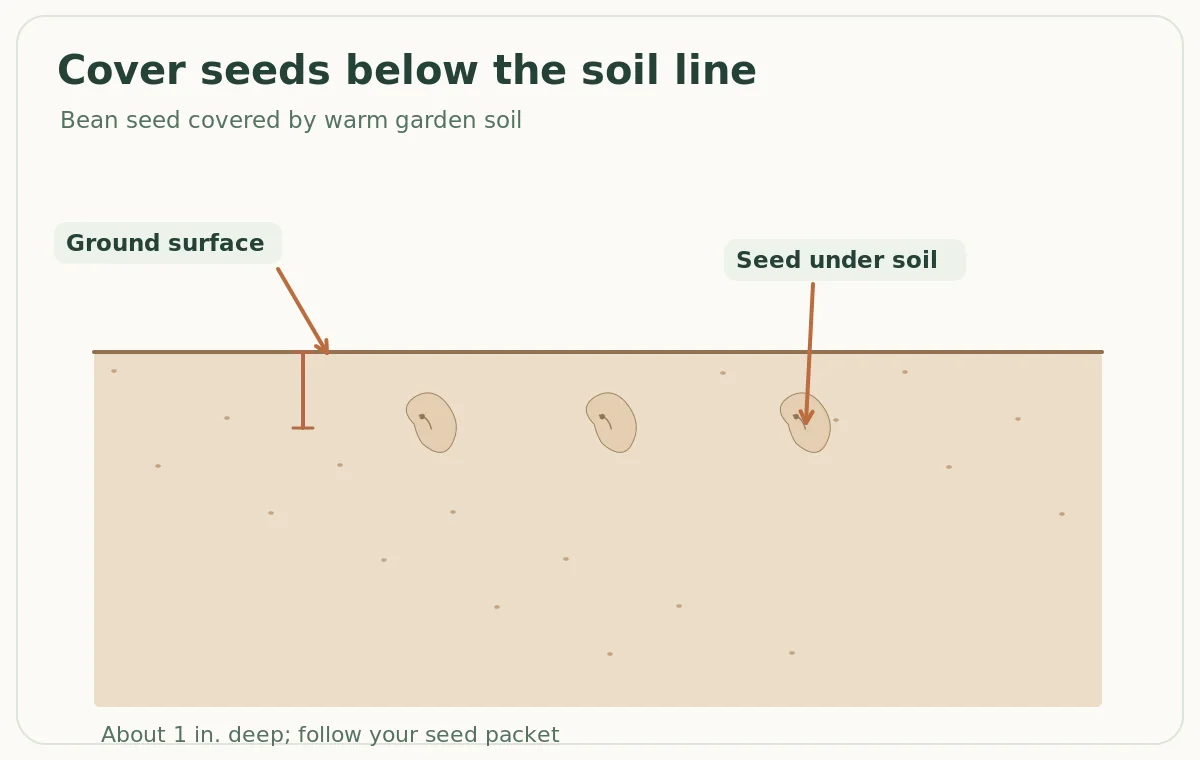
Minnesota Extension advises around one inch deep for common garden beans, with the seed packet taking precedence for differing seed sizes and local conditions. Open a narrow furrow in prepared soil and lay each bean sideways or naturally flat rather than planting it point-up like a garlic clove. Cover the seed with the measured layer of soil and firm lightly without compacting it hard. The soil-cutaway illustration shows the entire seed below the ground line, not perched on its surface. Water gently to settle the furrow without washing seed into a mound.
Space Bush Plants So Air Can Move
A useful starting point from Minnesota Extension is roughly four inches between bush-bean seeds and two to three feet between rows. Final spacing may differ with the variety or bed arrangement, so follow the packet and make sure you can reach the center of the bed for harvest. Crowding can keep leaves damp and make pods difficult to find, while excessively wide spacing wastes bed space. You need not place a pole-bean trellis beside every bush plant; if the variety is truly bush type, its own framework normally supports it.
Recognize First Leaves and Trifoliate Growth
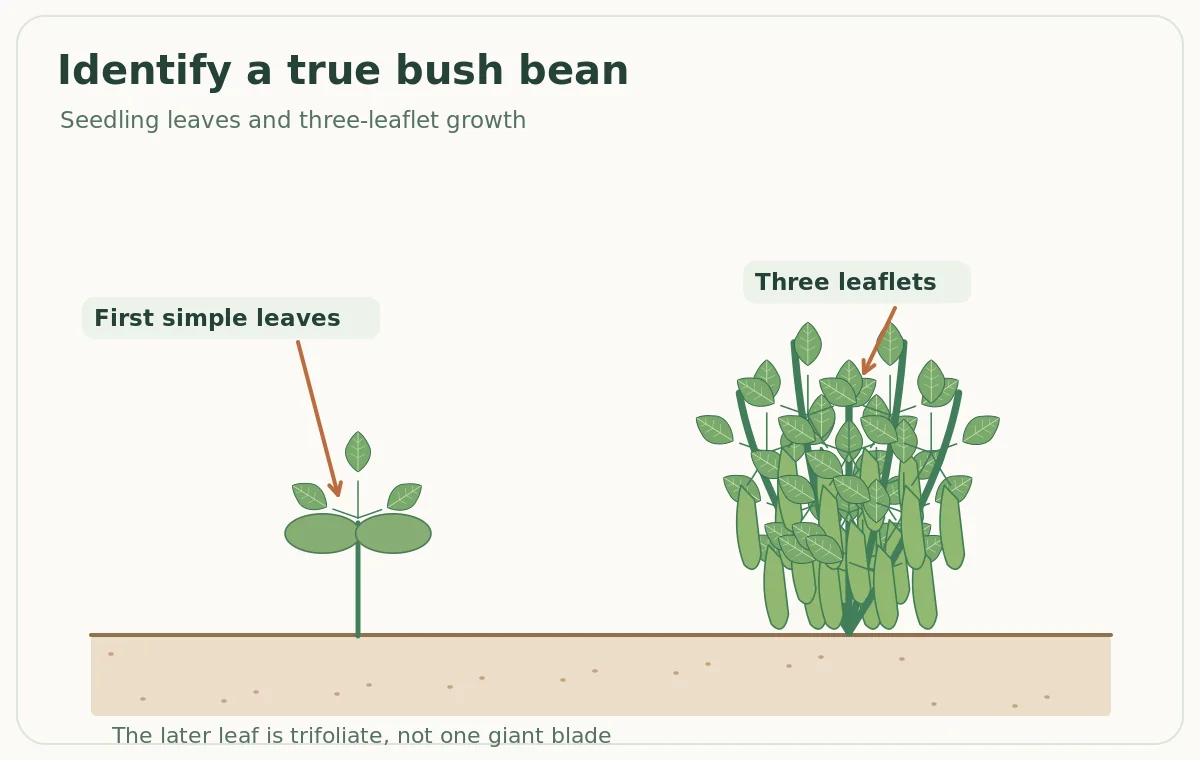
A germinating bean sends up thick seed leaves and then its first simple true leaves. Later mature leaves commonly appear as groups of three leaflets attached to one petiole, called trifoliate foliage. This differs from a long grass blade or an arugula rosette and helps identify healthy young bean plants. Inspect damaged stems before thinning because pulling a nearby seedling can disturb roots. If a gap never emerges, gently check conditions and seed quality rather than repeatedly soaking the same cold spot with water.
Water Roots Without Keeping the Row Soggy
Bush beans need adequate moisture during active growth, especially while flowering and filling pods, but constantly waterlogged roots struggle. Give water at soil level where practical, and allow the surface to dry somewhat between appropriate irrigations depending on soil and weather. Mulch after seedlings are established to moderate moisture and splash. Avoid walking in muddy paths or wetting leaves immediately before a long humid night. If lower leaves yellow, check roots, water patterns and local disease symptoms before automatically adding fertilizer or spraying an unknown product.
Expect a Concentrated Flowering Window
Bush beans commonly flower and set much of their crop within a shorter period than climbing pole types. Small pea-like flowers develop in the leaf axils and are followed by slender pods attached by short stalks. Heat stress during flowering may affect set, so give plants stable moisture and do not assume missing pods mean a lack of fertilizer. Some gardeners sow small successive blocks during suitable warm-weather windows to spread the harvest. The plant itself remains compact; providing a giant trellis cannot convert its genetic growth habit into a pole bean.
Pick Before Individual Seeds Bulge
For tender snap beans, harvest while the pod walls are still succulent and the individual beans inside have not become strongly visible as bumps. Hold the stem or branch with one hand while gently picking with the other, or use scissors to avoid ripping the plant. Pods may be round or flat depending on cultivar, so do not use an invented universal length as the only readiness test. Visit the patch regularly during peak production: mature, fibrous pods discourage continued tender harvesting and make it harder to distinguish fresh picks.
Diagnose Poor Emergence and Chewed Leaves
Missing seedlings after a cold wet spell may result from rotted seed rather than a mysterious surface pest. Dig cautiously at the edge of the row to see whether seed is still intact, swollen or decayed. Leaf holes may be caused by beetles or other animals; inspect closely before taking action. Rotate beans away from repeated legume plantings where feasible and discard seriously diseased debris as local guidance advises. For leaf spotting, root rot or major insect outbreaks, consult local Extension IPM resources for identification and acceptable control options.

Choose Bush or Pole Beans Deliberately
Bush beans fit smaller support budgets and offer relatively concentrated pod harvests, while pole beans require tall sturdy supports and can crop over a longer period. For a raised bed next to a path, compact bush plants avoid a wind-loaded trellis. For limited ground space with vertical capacity, pole beans may be worthwhile instead. Choose based on the physical space and desired picking pattern, not on the assumption that all beans climb. The comparison diagram shows a short branch-bearing bush with trifoliate leaves beside a twining stem on a support.
Related Guides
- Direct Sowing Seeds Outdoors: A Crop-by-Crop Success Checklist
- Growing Green Beans: Bush or Pole, Planting, Picking, and Problems
- How to Grow Rattlesnake Pole Beans and Pick Purple-Streaked Pods
- How to Identify Bean Leaf Beetles on Snap Beans and Limit Damage
- How to Identify Potato Leafhoppers and Hopperburn on Snap Beans
How We Research and Check Plant Care Advice
We compare the visible plant structures and suggested actions with published horticultural guidance rather than treating a decorative diagram as proof. Useful starting points for this specific topic include extension.umn.edu and www.rhs.org.uk. Recommendations must still be adjusted for species or cultivar, weather, local season and conditions of the site. We do not claim that a named company sponsors this article.
This article contains no commissioned product recommendations or affiliate promotions. For the site policy, see our affiliate disclosure. The illustrations explain garden decisions but do not replace inspection of your actual plant. When a photo or symptom does not match, check local Cooperative Extension information before using tools, fertilizers or pest controls.
True bush snap beans generally stand without a tall trellis; pole and half-runner types differ.
Around one inch is a common Extension guide, adjusted by seed packet and soil conditions.
No. Bean seed may rot in cold wet soil, and young plants dislike frost.
Pick while pods are tender and individual seeds inside have not formed strong bulges.
Check for cold wet soil, rot, poor seed viability and soil crusting before resowing.