
A cucumber trellis works best when the variety actually makes long climbing vines and the support is installed before the plant becomes tangled. Cucumber stems are brittle enough that lifting a long mature vine abruptly may snap it. Instead, guide young growing tips toward a firm mesh or twine support and let their curling tendrils take hold. Trellising can conserve bed space and keep cucumbers straighter, but it does not remove the need for watering, pollination, inspection and safe harvesting. The steps below focus on the difference between supporting the vine and incorrectly pulling on its leaves or fruit.
Confirm You Have a Vining Cucumber Variety
Most familiar slicing and pickling cucumbers produce trailing vines, but compact bush cultivars are designed for smaller spaces and may not need the same trellis. Check the seed packet for growth habit and mature height rather than assuming every cucumber climbs several feet. University of Illinois Extension notes the practical benefits of supporting long-vined cucumbers in small gardens. A container-bred bush type might instead benefit from a modest cage to keep foliage tidy. The aim is to match support to real plant vigor and site exposure. If you have mixed cultivars, label the trellis row so you can keep training decisions separate. For a step-by-step method, see how to choose a pea trellis for bush and climbing peas.
Install Stable Support Before Vines Become Long
Place posts and mesh before planting if possible, or while plants are still small enough that installation will not disrupt roots. University of Minnesota describes training cucumber vines up a trellis several feet tall. Anchor posts securely and ensure the mesh will stay upright during wind and while loaded with foliage and wet fruit. Thin cord, garden twine or grid openings provide surfaces for tendrils to grip. Avoid sharp cut wire ends that could rub stems or gardeners. Situate the support to allow access for harvest on both sides. A trellis that folds over is worse than letting a vine run across mulched soil.
Recognize Tendrils Leaves and Growing Tips
Cucumber vines make broad, somewhat triangular to heart-shaped leaves with noticeable lobes, a rough stem, and thin curling tendrils at nodes. A tendril is an attachment organ, not a future cucumber fruit. A flower or young ovary has a different structure and should not be twisted into the mesh. Look for actively reaching tendrils near the soft growing tip and give them a nearby strand. Do not tie a leaf blade tightly against the trellis; the blade needs air and room to expand. Understanding the plant’s nodes lets you guide it without snagging its reproductive parts.

Direct Young Growth Toward the Mesh Carefully
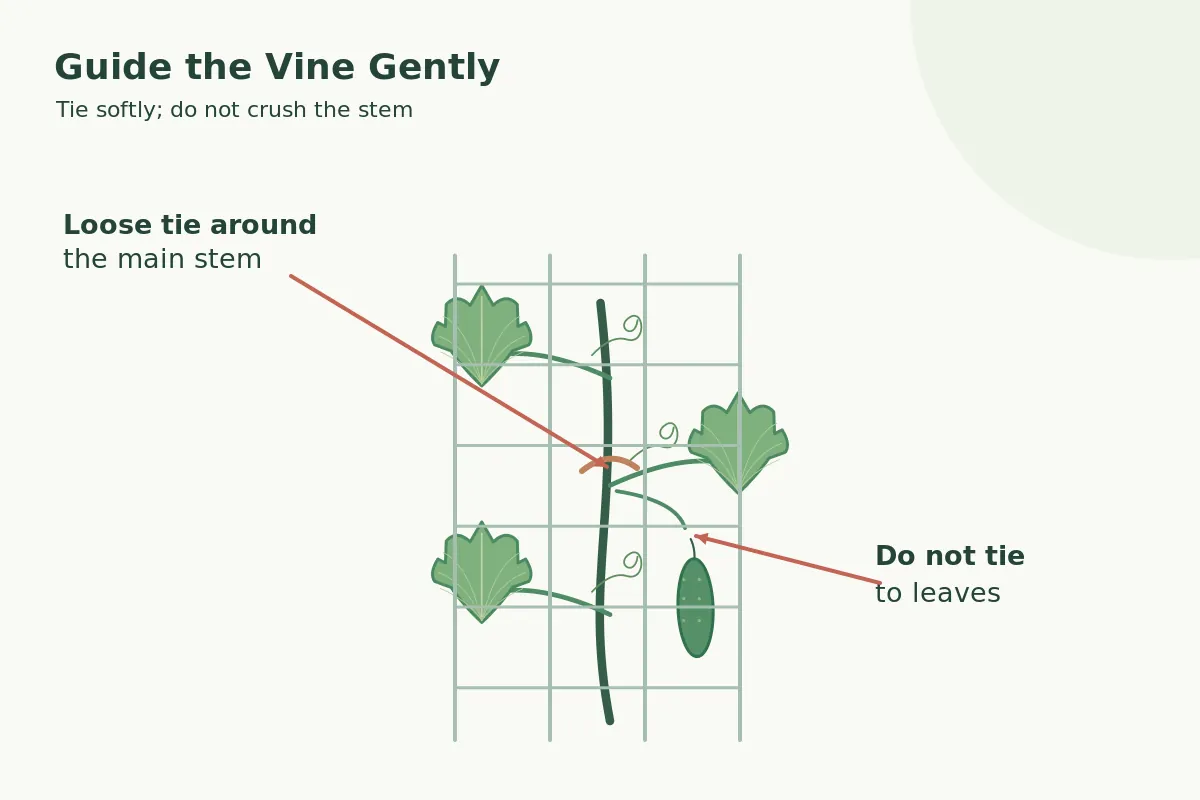
When a vine begins to lean outward, gently lift just its flexible upper portion and place it against the support. Do not yank on distant older stems whose nodes are already rooted, tangled or anchored. Guide a loose tendril around a nearby mesh strand only if it can be moved without snapping. On subsequent visits the vine often finds the support by itself. Check again after wind and rain as a young tip can slip away. If a plant consistently falls back, a soft loose tie around the stem at a firm section can help until tendrils secure it.
Tie a Soft Loop Around the Stem Not the Tendril
Use soft reusable garden ties or a wide strip of suitable fabric and leave enough space for stem expansion. Attach the tie to the trellis without compressing the cucumber stem, preferably near a node that can support its weight. A figure-eight style loop can create a little distance between wire and plant if needed. Do not fasten around flower stalks, tiny developing cucumbers, or a leaf petiole alone. Do not make a tight knot that girdles the vine later in the season. Inspect ties weekly and loosen or reposition them as stems grow, especially after rapid warm-weather extension.
Let Developing Cucumbers Hang Free
A supported cucumber generally hangs from its own fruit stalk, often straighter and cleaner than fruit resting on wet ground. University of Minnesota Extension notes that cucumbers and small squash normally do not need individual slings. This is different from very heavy pumpkins or winter squash on vertical supports. Do check mesh openings, because a fast-growing cucumber can become wedged between wires and suffer distortion. Guide the young fruit to hang outside the mesh when it is still small. Do not tug a full-size cucumber through a hole; cut the stem during harvest if fruit has become trapped.
Maintain Roots and Moisture Under a Vertical Canopy
Cucumbers need regular moisture and warm soil as their leaf area expands. Trellising does not reduce their water requirements to zero; the canopy can lose considerable water on windy days. Mulch may help conserve soil moisture while keeping most vine growth off the ground. Water at soil level when practical to avoid prolonged wet foliage. Roots are easily disturbed by deep cultivation near the plant base, so weed carefully after vines establish. A trellised planting often fits into a narrower bed, but avoid crowding multiple root systems at the post simply because the stems can climb upward. For a step-by-step method, see how to identify tomato suckers and prune indeterminate vines carefully.
Keep Pollination and Row Covers in Mind
Many standard cucumber cultivars rely on pollinating insects for fruit set, although some greenhouse or seedless types differ. University of Minnesota warns that insect-protective row covers can keep pollinators out, so covers over insect-pollinated varieties generally must be removed when flowering begins. A trellis with mesh support is not the same thing as a pest-exclusion fabric barrier. If small fruits abort, consider pollination and temperature along with watering. Do not assume hand-pollination instructions apply to every parthenocarpic or specialized variety. Protect bees by avoiding unnecessary pesticide use while flowers are open.
Inspect the Trellis for Wind and Stem Rub
Walk both sides after strong winds or storms. Look for a stem stretched across a hard wire edge, a fruit trapped in the mesh or a tie that has become tight. Correct these while the affected growth is still flexible. In extremely exposed sites, Illinois Extension cautions that wind can make vertical cucumber training difficult. A lower, sturdier structure or ground culture may be more reliable there. Avoid forcing a heavy vine back onto the trellis all at once if it has already escaped onto the ground. Give it support where it naturally reaches and plan to improve the initial setup next season.

Harvest by Cutting Rather Than Tearing Vines
Check for harvestable cucumbers frequently; pickling cultivars often need more frequent harvest than large slicers. Support the fruit with one hand, then cut its stalk using clean scissors or pruners instead of pulling the cucumber and tearing the vine from the support. Overmature cucumbers can compete with developing fruit and may become yellow and seedy. Harvesting also offers a chance to check tendrils, leaf health and hidden undersides for pests. Fruit shape alone is not a reliable diagnosis of a nutrient problem, and a mature twisted cucumber that grew through a mesh opening cannot be straightened by force.
Use This Quick Vertical Training Sequence
Begin with a cultivar that makes long vines, a stable trellis, and warm well-drained soil. As each growing tip approaches the support, guide it gently and let tendrils curl around mesh. Add a loose stem tie only when necessary; keep ties off leaf blades and flower stalks. Allow fruit to hang outside the wires, then inspect regularly for snags. Check temperature, moisture and pollination as the crop sets fruit. If vines repeatedly break or are violently wind-whipped, stop trying to force them upward and reconsider a more sheltered or lower system.
Use This Quick On-Plant Decision Table
| Part | Appropriate support | Avoid |
|---|---|---|
| Soft growing vine | Guide gently to mesh | Pulling mature vine hard |
| Tendril | Allow it to curl around fine support | Tight knots on leaf stalks |
| Young hanging cucumber | Leave fruit outside grid | Fruit trapped between wires |
Related Guides
- Growing Cucumbers in Garden Beds: Flowers, Vines, and Harvest
- Container Cucumbers: Choose the Pot, Vine Support, and Fruit-Set Plan
- How to Grow Lemon Cucumbers and Pick Round Yellow Fruits
- How to Grow Lemon Cucumbers Vertically in a Container and Pick Round Fruit
How We Research and Verify Garden Instructions
We checked the specific plant-care procedures on 2026-10-25 using original horticultural sources: University of Minnesota Extension; University of Illinois Extension; University of Minnesota Extension. Each recommendation was compared against the plant type, growth stage and regional context rather than being converted into a universal calendar rule. The accompanying diagrams are simplified instructional drawings that show relevant plant parts and cuts; they are not photographs or laboratory diagnoses. Where Extension and RHS recommendations vary, use the source matched to your climate and growing system rather than generalizing.
Plant Safety and Independent Editorial Disclosure
This guide is independent horticultural education, not paid placement or a representation of affiliate approval. Read the VegWin affiliate disclosure. Use clean sharp tools, follow basic garden hygiene, and keep tools or plant materials out of reach of children and pets where appropriate. If a crop looks infected or a regional weather extreme complicates your decision, contact local Cooperative Extension for specific help. Any pesticide decisions must follow a currently approved local product label; no off-label treatment or dosage is recommended here.
They mainly attach with slender curling tendrils; guide young vines so those tendrils can reach suitable mesh or cord.
Not always. Bush cultivars have shorter vines; use a modest support only if their size and site make it useful.
Most cucumber fruits support themselves. Check mesh for trapped fruit rather than automatically adding slings.
No. A soft loose tie avoids cutting into growing stems and should be checked and adjusted.
Check variety, pollination, growing temperatures, moisture and flower development rather than blaming the trellis alone.