
A grass clump that once made a neat fountain can become dense, crowded or bare in the center. Division can renew it, but the job is not simply chopping a ball of dead stems into equal slices. Each new piece needs viable shoots or growing points and attached roots. Timing also changes with the grass: cool-season plants restart early, while warm-season grasses may still be dormant when the garden first looks green. Here is how to identify which clump to divide, keep the useful living perimeter, and replant the sections at the original crown level.
Identify the Grass and Its Growth Season
Ornamental grass is a garden description, not one species. Feather reed grass and blue fescue are examples of cool-season growers that respond early in spring; switchgrass and many Miscanthus types wait for warmer late-spring conditions. Illinois Extension explains that the two groups use different seasonal growth patterns. Look up the exact botanical name or a reliable plant label before dividing. A grass that is still tan in April might be perfectly dormant rather than dead. Also distinguish a clump-forming plant from a running or rhizomatous spreader, because the latter may require separate containment decisions. Avoid division of protected, restricted or invasive plants without checking local rules.
Decide Whether the Center Is Truly Congested
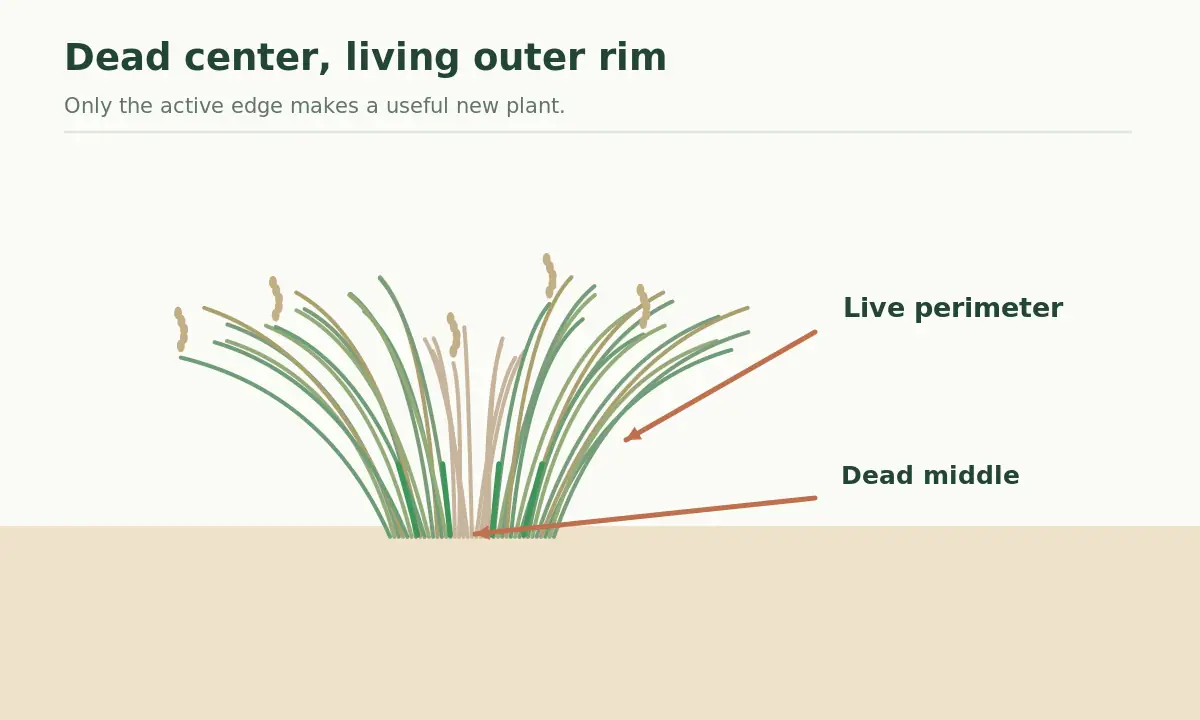
Crowded clumps often grow a ring of leaves with a thin, dry or dead center. Colorado State Extension cites center dieback and loss of vigor as reasons to consider division. Brown blades after winter alone are not proof: many ornamental grasses naturally retain dead leaves until spring renewal. Part the stems and look for live basal shoots or firm growing points along the perimeter. Also check whether poor flowering reflects shade, drought or an unsuitable site rather than age. Divide for a useful reason, such as a dead center, size reduction or propagation, not just because a schedule says every clump must be split annually.
Time Cool-Season Clumps Near Early Growth
The RHS recommends late winter to early spring for grasses associated with cool climates, as they come into new growth. Examples include Calamagrostis, Festuca and Deschampsia. The objective is to complete the disruptive root work when the plant can resume growth but is not yet carrying a full canopy of summer foliage. Watch local soil workability and the first new green blades rather than a fixed month. In colder areas, frozen saturated ground is not suitable for digging even if the calendar says spring. Divide and replant promptly; leaving a newly split cool-season clump unprotected on a hot driveway dries vulnerable roots.
Wait Longer for Warm-Season Grasses
Warm-season grasses such as switchgrass, Miscanthus and many fountain grasses usually emerge later in spring. RHS recommends postponing their division until late spring, when new growth is beginning. A cool early spring day can be too early to judge which sections are alive; a very late summer split may leave too little favorable weather for establishment. Colorado State also emphasizes regional differences, especially its cold dry winters. Identify whether your specific grass is tender or hardy where you live; the best timing shifts across climates. Treat advice for a cool-season grass as a different instruction, not a universal answer for all perennial grasses.
Lift the Clump Without Shearing All Its Roots
Water dry soil beforehand so it holds together yet remains workable. Use a sharp spade to trace a circle outside the living perimeter and dig beneath as much of the fibrous root mass as practical. Large older grasses can be extremely heavy, especially when damp; ask for help or divide an exposed section rather than attempting a dangerous lift. Wear strong gloves, long sleeves and eye protection, since some species have blade edges sharp enough to cut skin. Set the clump on a tarp for inspection. Working carefully prevents unnecessary root loss and lets you separate living crown pieces from a truly dead center. For the basics, see our guide: When to Divide Ornamental Grasses and Remove a Dead Center.
| Grass growth pattern | Practical division window | Living tissue to retain |
|---|---|---|
| Cool-season (e.g., feather reed) | Late winter/early spring as growth resumes | Rooted outer shoots |
| Warm-season (e.g., switchgrass) | Later spring as growth emerges | Firm live basal crown |
| Old clump with dead center | At suitable species window | Discard dead center; keep living rim |
Split Into Rooted, Living Crown Sections
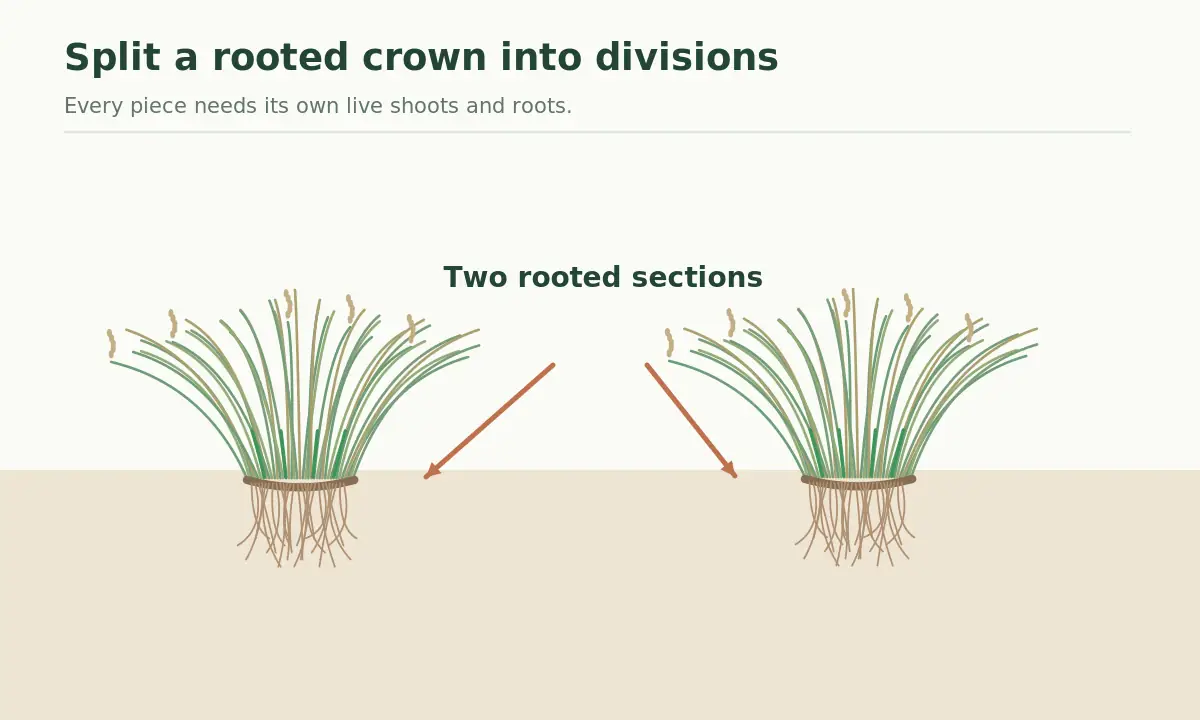
Use two garden forks back to back to prise a manageable clump apart, or a spade or saw for very tough fibrous roots. RHS lists these approaches and recommends retaining reasonably large divisions. Every kept piece should contain a visible growing crown and an adequate share of roots. A wedge cut from a completely dead hollow center will not recover just because roots are nearby; concentrate on the living rim. Discard hollow, rotted or weak material where appropriate. Do not produce tiny fragments merely to maximize plant count. Larger sturdy sections are easier to handle and usually have more reserves for re-establishment than shredded scraps.
Replant at the Existing Crown Height
Prepare soil compatible with the species’ drainage and sunlight requirements. Make a hole wide enough to spread the division’s roots without forcing them into a tight vertical column. Set the old crown at approximately the same level it occupied before lifting, firm the soil gently and water well to eliminate large air pockets. Burying the new shoots under a deep mound of soil can cause problems; placing roots exposed above the surface can dry them out. The diagram shows the level of the living crown in relation to the soil line. Keep mulch away from the actual crown and adapt watering to soil type and establishment needs.
Care for Divisions While Roots Reconnect
Recently divided grasses are not as resilient as mature established clumps, even if their species is eventually drought tolerant. Keep the root zone adequately moist while new roots establish, especially in dry spring weather, but avoid constant saturation. Watch for firm emerging shoots rather than expecting instant full-height foliage. Trim dead leaves according to the plant’s seasonal care needs without ripping out living blades. If a division turns brown or fails to resume growth, inspect the crown condition, planting depth, root contact and drainage before adding fertilizer. Give the new plant sufficient spacing for its mature size; another crowded planting will recreate the original problem.

Take Extra Care With Unusual and Restricted Grasses
Some ornamental grasses spread by rhizomes, self-seed into nearby ecosystems or have invasive restrictions. Miscanthus sinensis, for example, raises management concerns in some regions; verify local recommendations before intentionally multiplying it. Some evergreen grasses or sedges benefit from different cleanup methods than deciduous clump formers. Sharp-leaved species such as pampas grass demand heavy protective clothing and may be invasive. Never assume division is ecologically neutral merely because a plant is sold ornamentally. A suitable noninvasive substitute can be a better long-term garden decision, especially near natural areas or waterways.
Make the Healthy Perimeter Your Selection Guide
Before starting, mark the growing outer edge with three or four prospective sections that visibly contain green basal shoots. Compare the center: if it has no viable crown, remove it instead of creating a useless middle division. Check whether the grass is currently active according to its cool- or warm-season pattern. Lift with roots intact, separate only a few good sections, place them at the original soil line and water thoroughly. Photograph the result after replanting so you can assess recovery. The purpose is renewed vigor and healthy new growth, not a visually perfect set of equal-sized divisions on the day of splitting.
Related Guides
- How to Divide Hostas Without Damaging Crowns or Planting Too Deep
- When to Divide Astilbe and Replant Clumps Without Drying Their Roots
- How to Divide Autumn Joy Sedum Without Burying New Crowns
- When to Divide Agapanthus in Pots or Borders Without Losing Blooms
- How to Divide Herbaceous Peonies in Fall and Set the Eyes Shallowly
How We Research and Verify This Guidance
Checked on 2026-10-24, this guide combines botanical and garden-specific recommendations from Royal Horticultural Society; Colorado State University Extension; University of Illinois Extension. We compared their supported claims with the named plant or pest and avoided turning region-specific seasons into universal dates. These are simplified teaching illustrations, not photographs or product labels. Consult your county Extension office where climate, cultivar, regulation or site drainage changes the best decision.
Sources, Disclosure, and Local Considerations
Each source and its factual scope are recorded in the article metadata and linked above. We did not run a site-specific cultivation trial, promise a particular outcome, or claim a paid sponsorship. See the site-wide affiliate disclosure. Consult local regulations before multiplying potentially invasive ornamental grasses and use appropriate protective equipment for sharp leaves.
Usually spring; divide cool-season grasses near early growth and warm-season grasses later as they begin growing.
Some regional guidance allows particular cool-season types in fall, but many grasses do better with spring division. Check species and climate.
No. Keep pieces with living crown and roots, and discard completely dead central material.
Back-to-back digging forks, a sharp spade or a suitable saw can separate dense fibrous roots; use protective equipment.
Keep its living crown close to its previous soil level, with roots covered and growing shoots not buried deeply.