
Astilbe fills partly shaded borders with fernlike foliage and soft plumes of tiny flowers. An old congested clump may bloom less freely or be ready to make several new plants. Division works when each piece retains a live crown bud and a useful cluster of roots. Cutting an apparently large root mat into arbitrary chunks can leave you with root-only fragments that never grow. This guide explains when to lift the clump, how to find viable shoots, where to divide, and how to protect newly planted divisions from drying out.
Decide Whether the Clump Actually Needs Division
A vigorous astilbe can remain undisturbed for years. Consider division when the center weakens, outside shoots become crowded, flowering declines or the plant occupies more ground than planned. Iowa State and Clemson Extension give intervals of roughly three to four years as practical guidance, not a rule that every specimen must be cut on schedule. A drought-stressed plant that has browned foliage may need better moisture rather than division. Evaluate the growing site and look for genuinely dense healthy shoots. If you want more plants for another shady bed, a vigorous established clump also makes a reasonable donor even if it still flowers well.
Use Spring Growth to Find Live Crowns
Early spring is a particularly clear time to identify the new shoots or eyes that will power future stems. Work when soil is moist enough to release roots but not waterlogged and compacted by your steps. Astilbe can also be divided in fall in suitable climates, according to Clemson, but avoid severe heat or imminent ground freeze when plants cannot establish. Do not use USDA zone numbers as precise division dates. Wait for local ground conditions and visible signs of life. Mark any tiny shoots before digging, since faded winter stems can make the growing crown difficult to recognize. Keep the root system protected from drying air while you work. For a step-by-step method, see how to divide herbaceous peonies in fall and set the eyes shallowly.
Understand the Difference Between Crowns and Roots
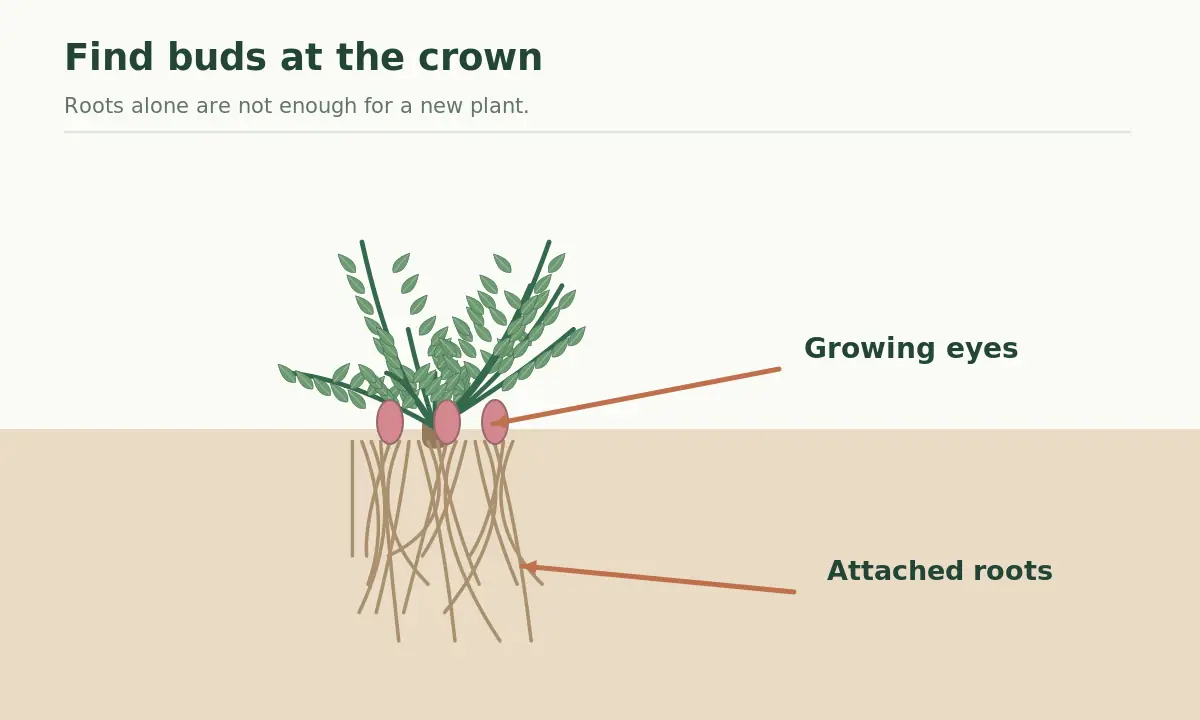
The crown is the short, living junction between last season’s shoots and the root system. Several new pinkish or green growing eyes can emerge across an established astilbe clump. The spreading fibrous or somewhat fleshy roots below take up water, but a section of roots without a viable crown bud will not necessarily regenerate a new top. Each intended division needs at least one healthy eye and its connected roots. Larger divisions with several healthy eyes tend to recover faster than a tiny isolated bud. Look for firm sound tissue, not just the size of the root ball. Brown dead center tissue may be discarded where it has no viable eyes.
Lift the Whole Clump With a Wide Margin
Water the area if soil is dusty, then place a garden fork outside the visible foliage circle. Lift gently around the perimeter so much of the root system remains attached. A spade can be used where soil is tight, but slicing directly through the center before seeing the crown may destroy useful shoots. Shake or wash off enough soil to expose the buds without stripping off all fine roots. Lay the clump on a shaded tarp rather than bare hot pavement. Once the root ball is visible, decide which sections naturally separate and which need a clean cut. Do not leave newly exposed crowns in direct sun. If you are starting from scratch, read When and How to Divide Hostas Without Losing Crowns.
Separate Pieces That Have Both Eyes and Roots
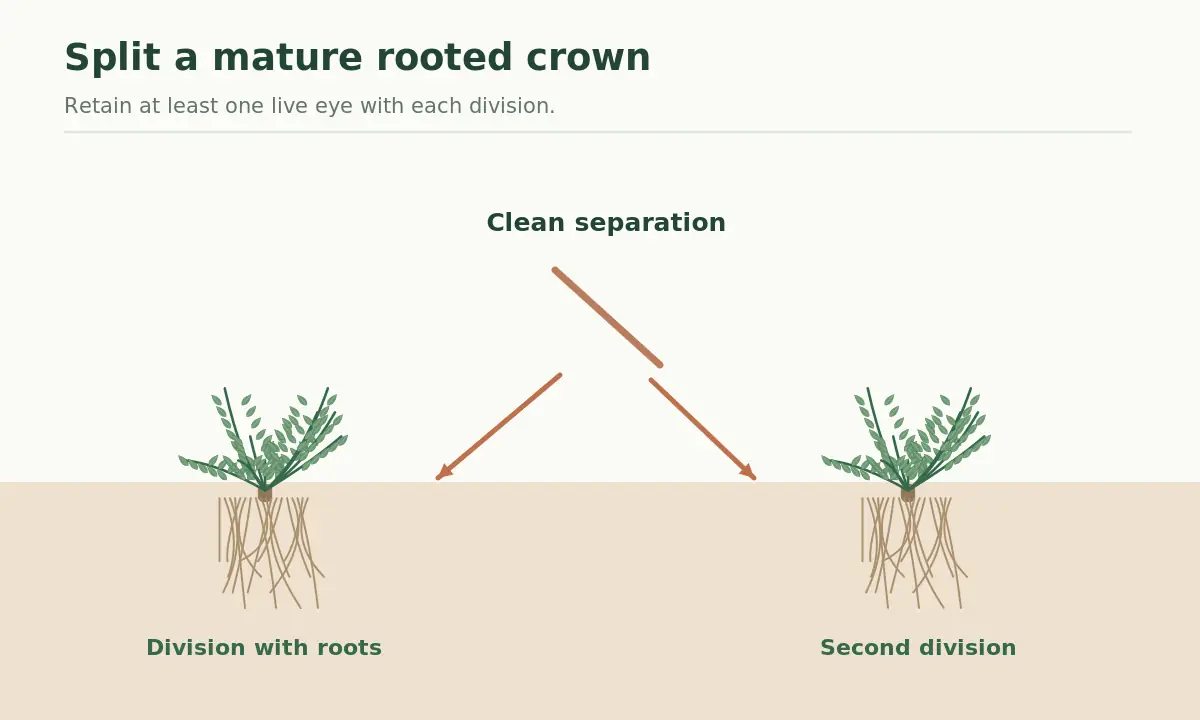
Use your hands or two forks to tease apart easier sections, and a clean sharp knife for tightly knit sections. Clemson notes that astilbe-type clumps may have thick crowns requiring cutting. Divide along natural groupings of buds when possible. Check each section before setting it aside: at least one growing eye above a meaningful attached root network is the nonnegotiable combination. Discard rotten or completely dead sections rather than planting them as fillers. A very small viable piece can survive but will take more time to bulk up. When sharing divisions, label plant cultivar and color, because many astilbe selections are hybrids that would not reproduce identical colors from seed. For a step-by-step method, see how to divide hostas without damaging crowns or planting too deep.
| Division part | Healthy sign | Action |
|---|---|---|
| Crown | Firm with active eyes | Keep on every piece |
| Roots | Numerous attached roots | Protect from drying |
| Old center | Dead, woody or rotten | Discard if no viable buds |
Replant Crowns at Their Original Level
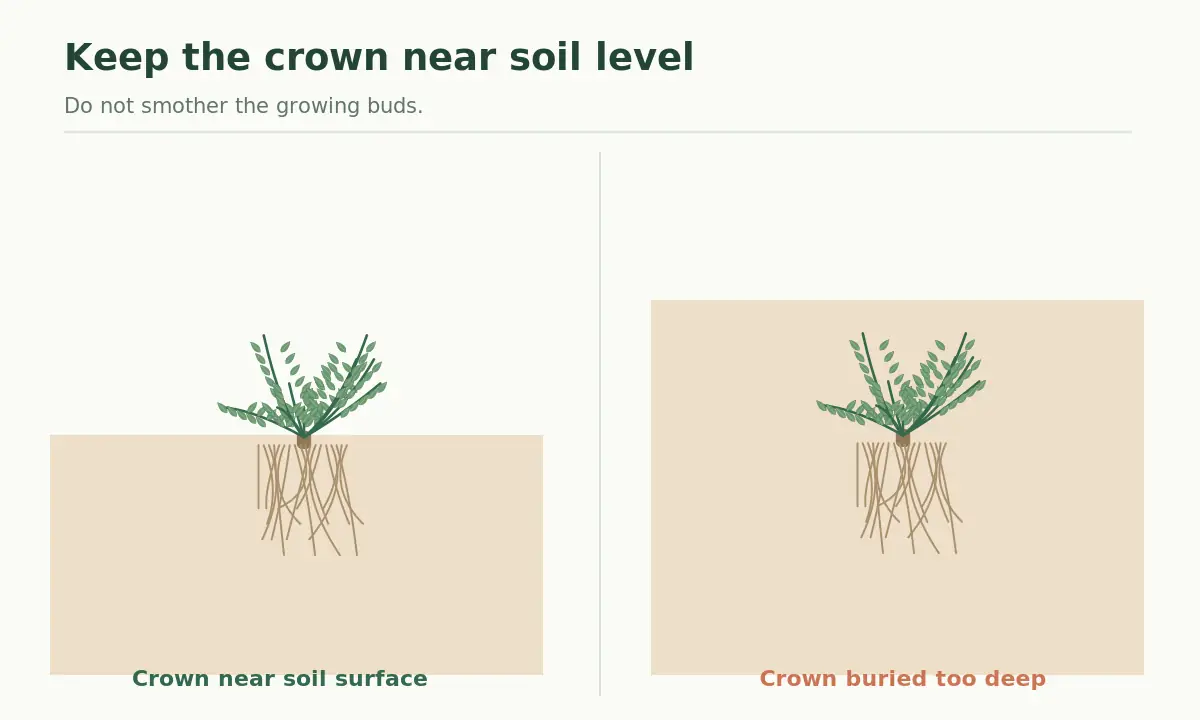
Prepare loosened soil with appropriate organic matter in a part-shaded position. Astilbe prefers moisture-retentive but draining soil, not a dry sandy bank or persistently stagnant puddle. Set a division so its crown is approximately where it grew before, without burying emerging buds under a thick layer of soil. Arrange roots naturally downward and outward, backfill and gently firm. Water thoroughly to settle pockets around the roots. Adjust spacing for the actual mature cultivar instead of crowding every division together. The instructional diagram should show soil level beside the crown, with buds visible, rather than a buried growth point below a deep mound of mulch. Our walkthrough on how to divide autumn Joy sedum in spring without burying the crowns sets out each step.
Prevent Drying During the Recovery Period
New divisions have fewer working roots and lose water faster than established clumps. Keep the root zone consistently moist through re-establishment, especially in bright or windy spring weather. Clemson Extension recommends regular water and notes that hot dry weather can scorch leaf edges. Mulch the surrounding surface to reduce evaporation, but pull mulch back from the growing crown. Check moisture below the mulch rather than watering by a rigid daily schedule. Temporary shade may help a division exposed during an unusually warm spell. Avoid excessive fertilizer until there is healthy new growth; fertilizer cannot compensate for a detached bud or dry root system.
Tell True Failure From Temporary Transplant Stress
Some older leaves may droop as a division adapts. Healthy emerging shoots are the clearest sign of recovery. If shoots collapse and the crown turns soft or foul-smelling, inspect drainage and root condition rather than pouring on more water. If leaf margins crisp in hot wind, check whether soil is drying out. An apparent lack of flowers in the first season does not prove that the division failed, since energy may be going into new roots. Photograph each planting when it is divided, then compare growth later. Remove dead stems, but do not repeatedly dig up apparently slow divisions and further disturb their developing roots. If you are starting from scratch, read When to Divide Astilbe and Replant Clumps Without Drying Their Roots.
Keep the Best Sections and Skip Unnecessary Splitting
Division is not a contest to produce the highest count of pieces. A clump can be broken into two or three sturdy rooted crowns if that best preserves viable growth. Tiny divisions left with minimal root tissue may need extra nursery care. When you discover a healthy plant whose crown is not crowded and whose flowering is good, leave it in place or take only a small outer portion. Record the parent plant location and mark where each new division was placed. This avoids losing cultivar labels and helps identify a planting-site problem later. Well-placed astilbe adds reliable texture to moist shade without constant disturbance. For the basics, see our guide: When and How to Divide Hellebores Without Damaging Crowns and Roots.
Review the Spring Division Checklist
Before starting, verify that the clump is established, the soil is workable and living eyes are visible. Prepare the destination bed, water supply and clean tools first. Lift with root margin, expose crowns, and cut only where each daughter section retains roots plus shoots. Replant at the proper crown level, water well and protect new divisions from drought. If conditions turn hot or dry, delay dividing additional plants. Keep one intact strong section as insurance. The central botanical fact is simple: roots provide uptake, but healthy crown buds provide next season’s shoots; both must remain connected in every planted piece.
Related Guides
- When to Divide Agapanthus in Pots or Borders Without Losing Blooms
- Dividing Tall Garden Phlox: When, Where to Cut, and How to Replant
- When to Divide Daylilies: Keep Healthy Fans and Replant Crowns Correctly
- When to Divide Ornamental Grasses and Remove a Dead Center
- When to Divide Black-Eyed Susans Without Losing Healthy Crowns
How We Research and Verify This Guidance
This article was checked on 2026-10-24 against plant-specific university Cooperative Extension and government guidance: Iowa State Extension; Clemson University Extension; Clemson University Extension. We separated directly supported cultivation, pruning, and insect-life-cycle recommendations from choices that depend on local weather, crop genetics, and gardening goals. Illustrations are simplified teaching diagrams, not photographs or treatment labels. Consult your regional Extension office for local timing, pest identification, and regulations.
Sources, Disclosure, and Regional Limitations
Source links and their supported claims are preserved in the article metadata and linked above. No field trial was performed for this particular garden, and results are not guaranteed. This guide does not assert a paid partnership or endorse a pesticide product. Review VegWin’s affiliate disclosure for site-wide transparency.
Early spring as new growth begins is a reliable time; some climates also permit fall division.
No. Divide when the clump becomes congested or to make new plants; vigorous plants can be left longer.
Do not rely on it. Keep at least one live crown eye with attached roots on every division.
No. Set it near its original soil level and keep thick mulch off emerging growth.
Dry soil and transplant stress are common causes; also inspect crown health and drainage.