
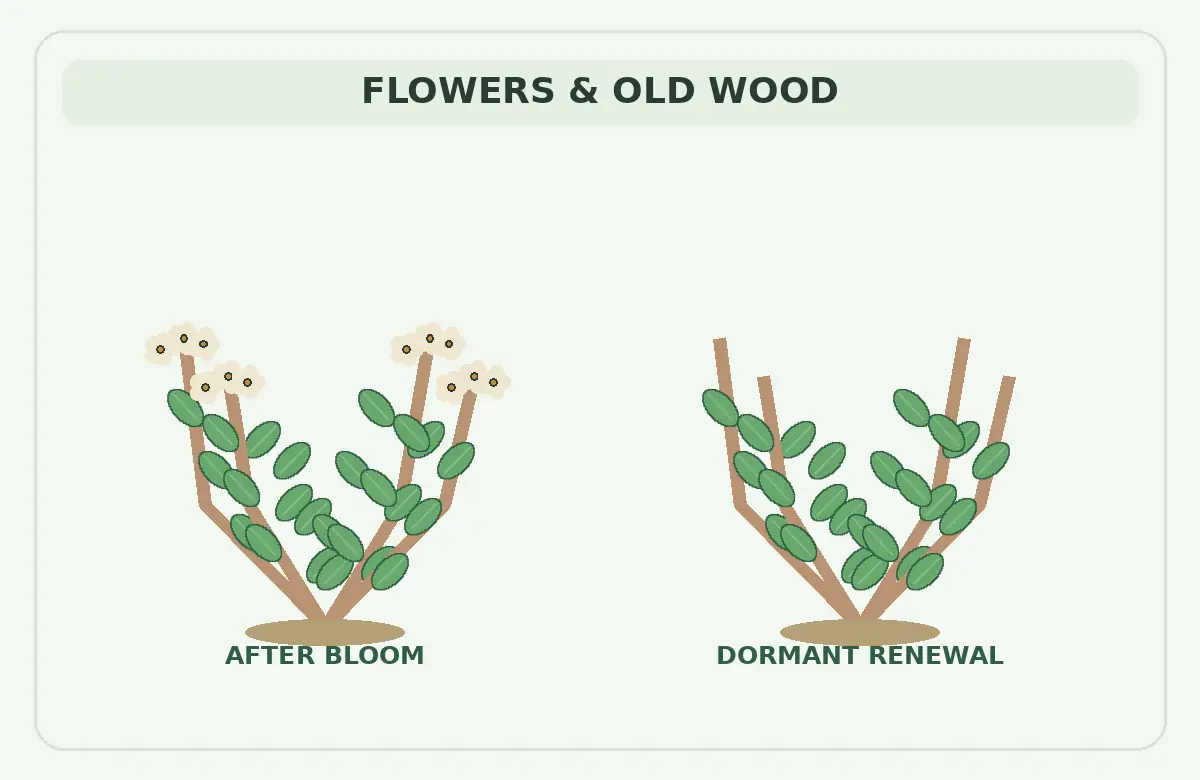
The most common ninebark pruning mistake is treating its arching, flowering canes like a hedge that must be leveled every year. Common ninebark (Physocarpus opulifolius) produces spring to early-summer flowers on wood made in the previous growing season. If you shorten most branch tips in fall or winter, the shrub may recover vigorously but put on a much smaller flower display. The better choice depends on what you want: preserve bloom, remove a few untidy canes, or rebuild an overgrown plant. First identify your goal, then choose an appropriate cut rather than a date from a generic calendar. This guide focuses on established landscape ninebarks rather than newly planted shrubs still establishing roots.
The aim is a condition-based decision that works with the actual plant and local growing conditions. Keep the plant label and local Extension guidance handy rather than treating a nationwide calendar as a guarantee.
Decide whether flowers or size matters most
For the best flower show, plan ordinary shaping immediately after the blooms fade in your own garden. That leaves more of the growing season for replacement stems and next season’s buds. A few dead or rubbing branches can be removed whenever you notice them. Severe renovation is a different project: a winter or early-spring cut may be effective for an old, oversized shrub, but it often removes the wood that would flower that spring. Decide beforehand whether you can accept that tradeoff. If a plant has grown beyond the available space year after year, the mature size of the cultivar may be a site problem rather than a pruning problem. If you want the full process, read how to prune flowering quince after bloom without losing next year’s flowers.
Cultivars differ considerably in final spread and habit. A compact selection should not need the same intervention as a tall screening shrub. Record how many flowers you actually want, what access or sightline is blocked, and whether the center is bare. Those observations keep the job from becoming automatic annual shearing.
Recognize the oldest canes before cutting
Stand several feet back and follow the stems from the ground upward. Younger canes are generally smoother and more flexible; older canes are thicker, more branched, and often show the peeling bark that gives ninebark its name. Peeling bark alone is not evidence of disease. Look for genuine problems: dead tips with no live buds, broken stems, and branches that rub or trap each other. Tag a few candidates with string if the shrub is dense. This prevents a series of impulsive cuts that leaves a hole on one side.
Check for wildlife activity before cutting. Birds may be nesting in a mature thicket. Also avoid mistaking pale leaf color on a gold-leafed cultivar for drought damage. Leaf variety and season matter, so diagnose a suspected health issue separately from your shaping plan.
Thin whole stems for a natural outline
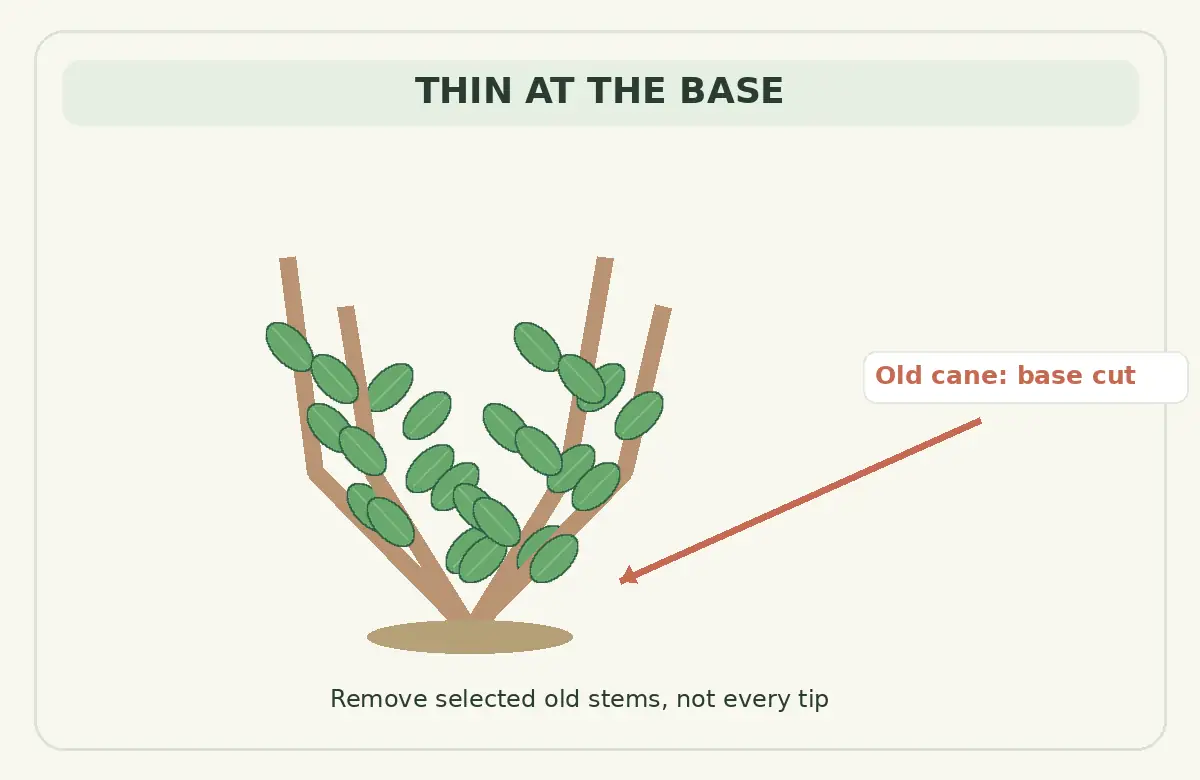
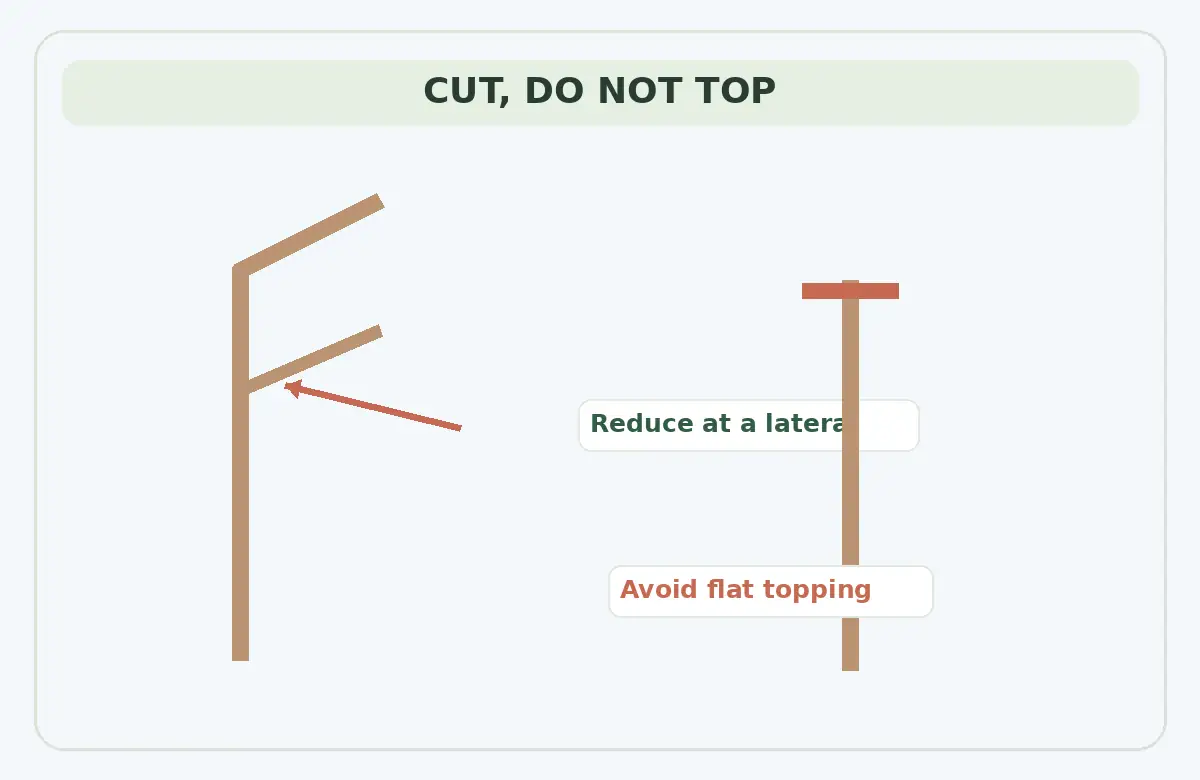
To preserve the informal, fountain-like habit, begin with removal cuts: take an undesirable cane back near its point of origin without leaving a long stub. On a multi-stem shrub, that usually means removing the whole old cane near the base. Next take out a stem that crosses another or grows into a walkway. After each cut, step back and inspect the empty space. A selective reduction to a vigorous side branch is preferable to cutting every stem at identical height. University of Maine Extension specifically discourages routine heading and topping of ninebark.
Avoid stripping the entire center. Foliage on retained stems feeds the plant and shades interior wood. Spread improvements over more than one growing season when the shrub is healthy but very dense. Sterilizing a tool between every clean cut is not a substitute for identifying whether disease is present; use clean, sharp tools and follow local plant-health guidance for suspect material. For the basics, see our guide: When to Prune Smokebush for Purple Foliage or Summer Smoke Flowers.
Choose renewal or full renovation deliberately
An older ninebark with a bare center and heavy outer tangle may need renewal, where a share of the oldest canes is removed at ground level while younger canes remain. This distributes regrowth rather than producing one flush of uniform shoots. Full renovation, cutting most or all shoots close to the ground, is a more drastic last resort for a suitable established plant. It can take multiple seasons to regain the old silhouette and is likely to sacrifice flowering in the immediate season. Do not use this response merely because a plant grew vigorously after good rainfall.
If the crown is failing, the soil is waterlogged, or major stems have suspicious dieback, investigate that issue before hard pruning. Cutting away the top cannot repair chronically poor rooting conditions. A stressed newly planted shrub deserves establishment care and diagnosis, not the same renewal plan as a vigorous mature shrub.
Keep cut positions away from permanent stubs
For an entire cane, follow it to the crown and make a careful removal cut without gouging neighboring shoots. For a side branch, locate a sound lateral that points in a useful direction and cut just outside the branch junction. Long stubs dry back; flush cuts through the branch collar create unnecessary injury. Use hand pruners for small shoots, loppers for manageable thicker stems, and a pruning saw where the wood is too large for a clean lopper cut. If a stem is under tension or over your head, choose a qualified arborist rather than improvising with a ladder.
Collect trimmings as you work so you can see which gaps you have opened. Removing a small number of well-chosen stems is often more effective than shortening many stems randomly. The finished shrub should keep its own arching outline rather than resembling a squared hedge.
Watch the plant through one full bloom cycle
After pruning, photograph the ninebark from the same location at monthly intervals. Note which young shoots fill the center and where flowers form the following spring. If flowering weakens but stems are long and leafy, check whether repeated late pruning has removed buds rather than assuming the plant needs fertilizer. New growth must mature before cold weather; avoid pushing a late flush with aggressive cutting near your local first-frost window. Soil moisture and mulch matter during dry spells, but keep mulch away from the crown. For the basics, see our guide: When to Prune Ninebark and Thin Old Canes Without Losing Flowers.
Wait for evidence before another major cut. A shrub thinned in early summer may look momentarily open before it leafs out again. One growing season provides far more information than an afternoon of repeated trimming aimed at instant symmetry.
Use a different response for dead or diseased wood
Dead, cracked, and broken wood is a maintenance issue, not a reason to postpone all work until flowering ends. Remove a clearly dead stem to healthy wood or to its origin, and keep potentially diseased debris out of compost systems where its safe handling is uncertain. Powdery mildew may coat ninebark foliage in some settings; pruning can improve air movement, but not every white-looking leaf is infected. Confirm the cause before choosing any treatment, and follow regional Extension guidance and current labels for pest-control products.
Do not apply wound paint to healthy cuts as a routine finishing step. Make sound cuts, avoid injury to the remaining bark, and check whether the branch is structurally safe. A large or damaged tree-like shrub may be better assessed by a professional. For the basics, see our guide: When to Prune a Mulberry Tree and Why Fewer Cuts Are Better.
| Observation | Better first action | Likely flower tradeoff |
|---|---|---|
| Healthy, flowering, slightly untidy | Selective thinning just after bloom | Usually small when done thoughtfully |
| Old canes and bare interior | Gradual basal renewal cuts | Some flowers lost on removed stems |
| Huge shrub with little usable form | Consider dormant full renovation | Expect reduced flowering afterward |
| Newly planted or failing crown | Investigate water and root health | Do not renovate on appearance alone |
Match the next cut to the desired result
Before closing the job, write down three things: the purpose of this year’s cuts, the stems you removed, and the month when flowers finished. This lets you distinguish a genuine response to the shrub from an aesthetic preference that changes every week. A homeowner seeking maximum bloom may accept a somewhat loose appearance; a gardener seeking a compact screen may accept fewer flowers for one season during gradual renovation. Neither is the one correct outcome for every planting. For the basics, see our guide: When and How to Prune Forsythia Without Losing Next Spring’s Flowers.
Compare the plant after bloom with the photographs taken before pruning. If it still overwhelms a path after several reasonable renewal cycles, relocation or a better-sized cultivar is a more durable remedy than annual severe topping. Pruning supports a suitable plant; it cannot permanently change its genetic mature size.
Related Guides
- When to Prune Rhododendrons After Bloom Without Removing Next Spring’s Buds
- How to Prune Weigela After Flowering Without Losing Next Spring’s Blooms
- When to Prune Azaleas After Bloom Without Losing Next Spring’s Buds
- When to Prune Mock Orange After Bloom Without Losing Next Year’s Flowers
- When to Prune Bridal Wreath Spirea and Keep Its Arching Spring Flowers
How We Research These Plant Care Decisions
This guide was researched and cross-checked on October 23, 2026 using university Cooperative Extension materials and/or the Royal Horticultural Society. We compared the growth habit, seasonal risks, and planting or pruning technique before writing the recommendations. The specific information below is educational, not a substitute for diagnosing an individual tree, plant, or site.
Sources reviewed: university Extension source 1; university Extension source 2; university Extension source 3. Each linked source supports the particular facts recorded in the editorial source list. Local climate, plant species, and cultivar characteristics can change the best action.
Editorial and affiliate disclosure: This is independent informational garden guidance. No paid product endorsement or affiliate relationship is claimed in this article. See our affiliate disclosure for site-wide details.
Common ninebark normally sets its next spring flowers on growth formed the previous season, so removing many tips late can reduce bloom.
Yes for intentional renewal or renovation, but a heavy dormant cut may remove spring flower buds. Decide whether size reduction matters more than bloom.
An established, healthy plant may regrow after renovation, but recovery takes time and should not be used to conceal root or drainage problems.
Repeated shearing tends to crowd tips and hide the natural habit. Selective stem removal usually yields a better open structure.
No. Layered peeling bark is normal for this species. Diagnose symptoms such as real dieback or abnormal spotting separately.