
A mature mulberry can be wonderfully productive without an annual session of hard pruning. Established trees normally develop a broad crown, and large unnecessary cuts can create wounds far more consequential than a few crowded twigs. The main questions are whether a branch is dangerous or damaged, whether a small structural adjustment is genuinely needed, and when that work fits your climate. Mulberries can bleed sap when cut near spring growth, which makes online advice about the ‘one best month’ confusing. The Royal Horticultural Society emphasizes minimal pruning and an early dormant window; Colorado State Extension also discusses alternative timing to avoid sap bleeding in susceptible trees. This guide focuses on restraint, safe cuts, and an honest assessment of size rather than promises that pruning always increases fruit.
The aim is a condition-based decision that works with the actual plant and local growing conditions. Keep the plant label and local Extension guidance handy rather than treating a nationwide calendar as a guarantee.
Check whether this tree needs pruning at all
Begin by walking around the tree and looking upward from several angles. Is a branch cracked, dead, rubbing another limb, obstructing a path, or hanging where it could hurt someone? Those are reasons to assess action. A wide canopy or crooked mature shape by itself is not a defect. The RHS notes that established freestanding mulberries often need very little pruning. Resist the urge to thin the crown simply because another fruit tree in the garden receives regular annual cuts. If you are starting from scratch, read When to Prune Pear Trees.
Write down a reason beside every proposed removal. If the list contains only cosmetic preferences, postpone the job until you can review the tree in leaf and from a distance. Over-thinning exposes branches to sunlight and wind and reduces the leafy area that supports fruit development.
Separate safety work from optional shaping
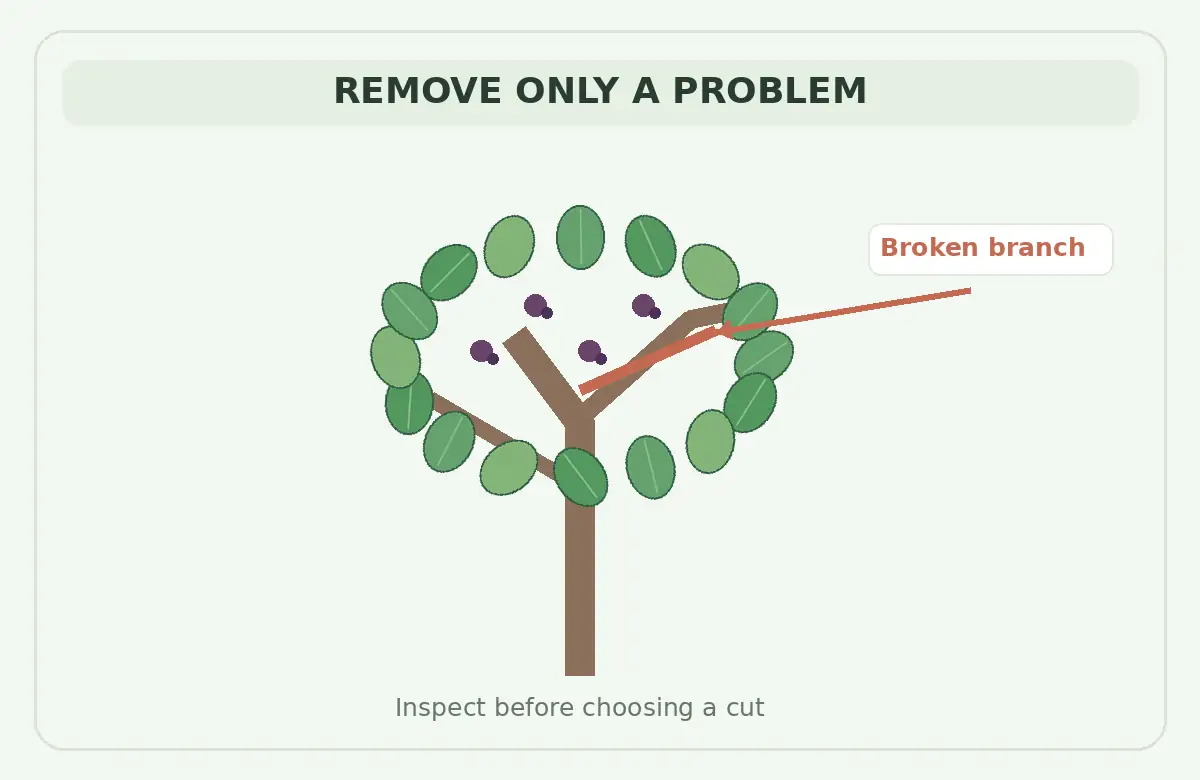
A hanging broken branch or limb over a busy walkway deserves prompt attention, but large tree work is not a do-it-yourself ladder task. Assess the site for overhead power lines, decay, and inaccessible limbs. Have a qualified arborist evaluate substantial hazards or major structural pruning. For safe low branches, a clean small removal cut may be reasonable with the right tool. Do not cut large limbs to make the tree suddenly smaller; topping provokes weak regrowth and creates unnecessary wounds.
Young trees may benefit from early structural decisions, while a healthy mature mulberry may need almost none. A plan to keep a naturally large tree in a tiny space through repeated heavy cutting is usually a design mismatch. Where local regulations address certain Morus species, consider identification and local guidance before replacing or planting a tree. If you are starting from scratch, read When to Prune Ornamental Crabapple Trees and Where to Cut.
Understand why pruning dates can differ
Mulberries may release conspicuous sap from cuts as growth begins. RHS mulberry advice favors pruning from leaf fall into midwinter rather than the period when active sap flow increases. Colorado State Extension’s broader discussion of sap-bleeding trees allows that, depending on local conditions and objectives, pruning after spring growth has hardened can also avoid the most noticeable bleeding. Those recommendations are not a universal contradiction: they come from different climates, tree conditions, and pruning objectives. Neither makes a large unnecessary cut harmless. If you are starting from scratch, read When to Prune Ninebark Without Losing Next Spring’s Flowers.
For a substantial pruning plan, ask a local Extension or qualified arborist about the safest window for the species and region. Avoid periods of severe weather, drought stress, and sensitive local pest activity. A fixed nationwide date is less trustworthy than a small, well-justified job timed thoughtfully.
Use small removal cuts that preserve collars
Locate the junction between a branch and the trunk or parent limb. The slightly raised branch collar is living tissue involved in sealing wounds; do not slice it off with a flush cut. Do not leave an excessively long stub either. Cut just outside the collar, with the tool aligned so it removes the unwanted branch cleanly. Use hand pruners on thin growth, appropriate loppers on manageable stems, and a saw only where you can work safely. Heavy branches require a staged cutting technique to prevent bark from tearing down the trunk.
Sanitize tools as appropriate when disease is suspected, and stop if wood appears decayed or hollow in a way that changes the risk. Paint and sealants are not a substitute for proper cuts. The ideal number of pruning cuts is the smallest number that accomplishes the real objective.

Protect fruiting canopy and natural shape
A mulberry with a healthy canopy needs leaves to make sugars and grow fruit. Large-scale thinning may expose remaining branches and remove much of the fruit-bearing structure. Instead of clearing the middle indiscriminately, look for one branch genuinely crowding another and ask whether removing it creates meaningful space. If two shoots are competing at a young branch junction, select the sounder direction without chopping large permanent limbs. Photograph the canopy before you start so you do not lose track of its original balance.
Keep the area under the tree safe and practical during fruit drop. A tree that stains paving is not automatically made tidy by topping; site choice, a groundcover suited to cleaning, or a different planting may be more durable solutions.
Identify species and site risks before making changes
Not every tree called mulberry is the same. In some US regions, white mulberry (Morus alba) is invasive or a conservation concern because it can hybridize with native red mulberry (Morus rubra). Confirm species identity and regional rules before planting or moving seedlings. For a mature tree already present, pruning for size does not resolve any invasive-status issue, and removing it may be a separate local management decision. Fruit color alone is not a reliable species identifier. If you are starting from scratch, read When to Prune a Plum Tree.
Watch for structural defects, unusually rapid dieback, and root-zone disturbance such as trenching or soil compaction. These problems need diagnosis before a canopy adjustment. Keeping mulch away from the trunk and avoiding chronic root disturbance may matter more than a cosmetic trim.

Plan follow-up care after the cut
After a justified small pruning job, leave the tree time to respond. Monitor branch tips for normal leaf emergence, check that there are no torn bark flaps, and observe whether new shoots become crowded or weak. Do not immediately add high fertilizer doses to drive vigorous regrowth. Established mulberries generally perform best with stable rooting conditions and care adapted to local weather, not a feeding program invented after every cut.
If sap appears on a recent wound, do not assume the tree is dying. Sap bleeding from some spring cuts can be conspicuous without indicating catastrophic loss, although a major injury or unusual symptoms require assessment. Avoid creating more wounds in a panic. Photograph and seek regional advice where the health or safety of a large tree is uncertain.
| What you see | Priority | Appropriate response |
|---|---|---|
| Healthy broad canopy | Low | Leave most growth intact |
| Small rubbing branch | Moderate | Consider a clean removal cut |
| Hanging broken large limb | High safety concern | Seek professional assessment |
| Tree too large for permanent space | Long-term site issue | Plan with qualified arborist, not topping |
Keep pruning records instead of chasing a shape
Make a simple note of the tree’s estimated size, the branches removed, and why. Revisit the decision after one full season, not after every new flush of growth. A documented safety concern is easier to act on than a shifting desire for perfect symmetry. If the tree truly cannot coexist with buildings, utilities, or neighboring property, discuss long-term options with a qualified tree professional rather than repeating heavy heading cuts. If you are starting from scratch, read When to Prune a Magnolia.
The most useful result is often discovering that almost nothing needed removing. Mulberries have natural irregularity, and an attractive tree does not need to look like a neatly rounded ornamental topiary to be healthy and productive.
How We Research These Plant Care Decisions
This guide was researched and cross-checked on October 23, 2026 using university Cooperative Extension materials and/or the Royal Horticultural Society. We compared the growth habit, seasonal risks, and planting or pruning technique before writing the recommendations. The specific information below is educational, not a substitute for diagnosing an individual tree, plant, or site.
Sources reviewed: RHS source 1; university Extension source 2; university Extension source 3. Each linked source supports the particular facts recorded in the editorial source list. Local climate, plant species, and cultivar characteristics can change the best action.
Editorial and affiliate disclosure: This is independent informational garden guidance. No paid product endorsement or affiliate relationship is claimed in this article. See our affiliate disclosure for site-wide details.
Often not. Established freestanding trees can remain productive with minimal selective maintenance.
Timing varies with climate and source guidance. RHS favors a dormant window; local Extension may recommend an alternative after spring growth.
Avoid topping. It creates large wounds and potentially weak regrowth; ask a qualified arborist about a large structural problem.
Not necessarily. Some trees bleed conspicuously during seasonal sap flow; assess the whole tree and seek advice for severe injury.
Species affect size, conservation concerns, and whether the plant may be invasive in your location.