
Buckwheat is useful because it races across bare garden soil while many weeds are still getting started. That same speed creates its main management problem: the crop soon carries airy white flowers and then dark, angular seeds that can sprout where you wanted a vegetable bed. Knowing when to cut is more important than counting an arbitrary number of days. Watch the flower clusters, not just plant height, and have a plan for the resulting stems and leaves.
Identify common buckwheat in the bed
Common buckwheat, Fagopyrum esculentum, is not wheat and does not grow cereal-grass blades. It is a broadleaf annual with branching green to reddish stems, simple heart- to arrow-shaped leaves, and many small pale flowers collected in airy clusters. The flowering heads branch from real stems above the leaves. Its seeds later mature into distinct small, angular, dark fruits. Identifying these parts prevents you from waiting for a grass-like seed head that will never appear.
Choose seed sold as a cover crop rather than assuming a bag of processed buckwheat groats will germinate. Keep a packet label or planting record, especially if you use multiple covers. Flowering white umbels from nearby weeds are not proof that your buckwheat has begun bloom. Study one branch at close range: several tiny five-part blossoms should be gathered along branching tips; below them, broad green leaves connect to the stem.

Choose the best window for quick summer cover
Buckwheat is mainly a warm-season, frost-sensitive cover choice. University of Minnesota Extension gives region-specific planting windows, but the calendar differs in other states. Pick a gap when there is enough suitable warmth to establish a dense canopy and enough time before the next crop to remove that cover. If cold weather is likely to arrive soon, a locally recommended cool-season species may be more reliable.
A cover crop competes with weeds only when it establishes promptly. Prepare a reasonably even seedbed with minimal existing weeds, use seed intended for sowing, and follow locally validated seeding instructions. Do not automatically scale an agricultural pounds-per-acre recommendation into an overflowing raised-bed dose. Poor seed-to-soil contact, very dry topsoil or excessive shade can leave patchy cover no matter how correct the date looked on paper.
Read flowers as the cutting deadline
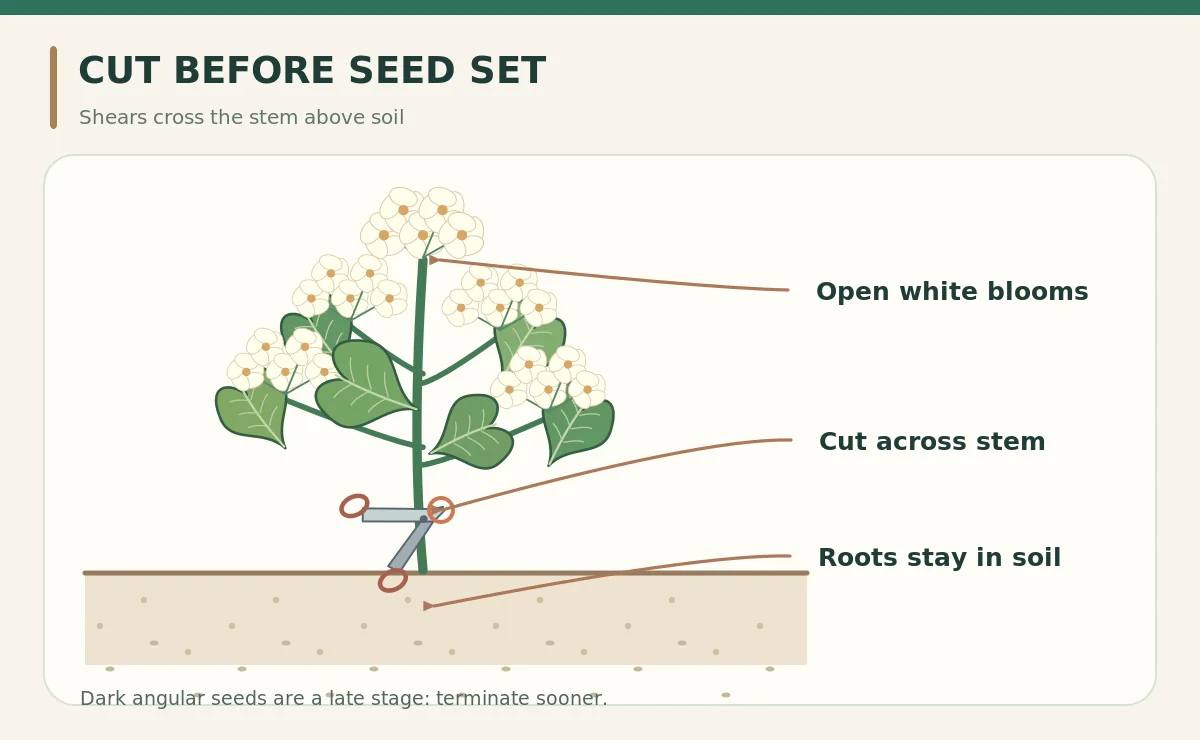
University of Minnesota Extension specifically warns that buckwheat sets seed quickly and recommends termination at flowering to prevent volunteer plants. A useful small-garden signal is the appearance of numerous open white blooms across the stand, before clusters of brown, hard seeds develop. A few first flowers give you a chance to schedule the job; do not wait for every flower on every plant to finish and dry.
White blooms can still support pollinating insects for a brief period, but keeping a cover in bloom indefinitely has a cost. You are exchanging seed suppression for floral resource time. If your next vegetable crop is already scheduled or volunteer buckwheat would be troublesome, make the cut sooner. If you intentionally leave flowering strips for insects, monitor them closely and terminate those strips before ripe seed drops.
Make a clean cut across stems above soil
In a small bed, use sharp shears or a sickle to cut the standing buckwheat close enough to manage the stems without digging through the soil. For larger patches, a mower may be practical. The cutting action belongs across branching stems above the soil line, not through a fictional underground grain head. Keep hands and tools away from rocks, string, irrigation tubing, and the next crop’s seedlings.
Inspect the remaining stubble after cutting. Some plants can regrow depending on how early and how high they were cut, so do not assume every severed stalk is dead. Check for recovery and remove any new flowers before seeds mature. If a dense living mat is still holding the ground, it may need a second termination pass. A single mow is a management action, not proof of permanent elimination.
Use the chopped foliage as surface residue
Cut stems and leaves can be left on the bed surface as a thin organic cover if they are free of mature seed and troublesome disease. Spread them so they do not smother vegetables you want to keep. University of Oregon guidance describes pulling buckwheat before seed set and laying the material on the surface to act as mulch. In a dry region, residue can help protect the soil surface while decomposing; it is not a substitute for checking soil moisture.
You can also incorporate the material in a bed that will remain empty, but disturbed soil and decomposition change the timing for the next planting. Do not plant delicate seeds straight into thick fresh chopped foliage and expect consistent emergence. Decide whether to leave residue as mulch or incorporate it based on the following crop, available time and the bed’s moisture. In either case, check for surviving stems and volunteer seedlings.
Time the next crop after termination
One of the most useful questions is not merely when the buckwheat flowers, but when the next vegetable needs the space. University Extension cover-crop guides discuss allowing a break for incorporated residues to decompose, with recommendations varying by crop and conditions. Make your planting calendar backward from the next crop’s planned date and leave time to terminate, evaluate regrowth, and prepare a fine seedbed.
If the following crop is direct-seeded, remove or part dense residue at the row so seeds contact mineral soil and receive moisture. If transplants follow, keep their stems and crowns clear of thick rotting vegetation. Do not promise that one patch of buckwheat will supply all nitrogen for a hungry vegetable crop: unlike legumes, buckwheat does not fix atmospheric nitrogen. Its rapid cover, weed competition and manageable residues are its main value.
Separate pollinator flowers from mature seeds
Buckwheat’s small white flowers are often busy with insects, a genuine benefit that must be balanced against reseeding. Look at flower heads over several days: creamy fresh blossoms can coexist with older darkening fruits on the same branched head. A photograph showing only flowers does not guarantee that no seed has formed elsewhere in the patch. Inspect more than the most attractive stem before deciding that you have another week.
A practical comparison sketch shows three stages: green branching foliage, clusters of open white blooms, and mature angular dark seeds. The safe routine for most soil-cover goals is to cut at the flowering stage, before dark seeds begin dropping. If seed already matured, collect or remove suspect heads separately instead of scattering them while moving the residue. Monitor the bed for volunteers and hoe out small seedlings early.

Keep simple notes on cover performance
Record sowing date, germination density, date of first bloom, date of cutting and whether any plants resprouted. Note how many weeds grew through the canopy and how well the next vegetable crop established. That information beats an unsupported promise that every buckwheat planting flowers on exactly the same day. Soil moisture, day length, temperature, seed lot and management differ across gardens.
At the end, ask whether the cover did its assigned job: was the soil shaded, was a bare interval filled, and did you avoid a flush of self-sown buckwheat? If not, adjust the window or choose a different cover. Flowering is a visual deadline, not a guarantee of improved fertility. Manage it like a short crop whose harvest is mulch, exposed soil protected from weeds, and a clean start for the next planting.
Related Guides
- Cover Crops for Vegetable Beds: Choose, Sow, and Terminate
- When to Plant Hairy Vetch Cover Crop Before Fall Frost and Spring Growth
- When to Plant Crimson Clover as a Fall Cover Crop and Prevent Reseeding
- How to Plant Winter Cereal Rye as a Cover Crop, Not Annual Ryegrass
- How to Grow Red Clover as a Cover Crop and Manage Its Roots
How We Research and Verify Garden Advice
We consulted the following university Extension and research-based IPM sources on 2026-10-29: extension.umn.edu; extension.umn.edu; extension.oregonstate.edu. Our decision points focus on the actual plant anatomy, seasonal conditions and observations those resources support. We compared this intent with the full supplied VegWin WordPress title list, adjacent draft-batch topics and live search results to avoid duplicating an existing article. Garden schedules and cultivar traits depend on local conditions; these illustrations explain practices but are not diagnostic laboratory results.
This educational article contains no sponsored products or paid recommendations; no affiliate partnership is claimed. See the VegWin affiliate disclosure for current site policy. Before using any pesticide, rely on current local product labels and your Cooperative Extension guidance, not on a diagram or a general online list.
You can, but Extension guidance often uses flowering as the termination stage; the priority is cutting before mature seed drops.
No. Common buckwheat is a broadleaf annual with heart-shaped leaves and branched clusters of small white flowers.
Not necessarily. Inspect the stubble for regrowth and cut again if fresh shoots begin producing flowers.
Yes, seed-free cut foliage can serve as surface mulch, provided it does not smother crop seedlings or crowns.
No. It is not a nitrogen-fixing legume; it is valued for quick soil cover, weed competition and decomposable biomass.